We are developing the social individualist meta-context for the future. From the very serious to the extremely frivolous... lets see what is on the mind of the Samizdata people.
Samizdata, derived from Samizdat /n. - a system of clandestine publication of banned literature in the USSR [Russ.,= self-publishing house]
|
Tonight many of the Samizdata.net, White Rose and the Big Blog Company bloggers will be attending a seminar about blogging being hosted at the Houses of Parliament in London.
It will be interesting to meet fellow members of the Blogerati in such a different context.
In case some of the people attending did not get the message, the time has been changed to slightly later (now 7:00 pm to 9:00 pm), and the venue is now the Grand Committee Room in order accommodate the larger than expected demand for seats. Entry as before will be via St Stephens Entrance, Houses of Parliament.
A few days ago I wrote an article pointing to information indicating that the French government had not only agreed to not arrest General Ratko Mladic, the man who supervised the murder of 7,000 men and young boys in Srebrenica under the orders from Chetnik leader Radovan Karadzic, but were also giving the former Bosnian Serb leadership a safe haven from arrest to this day in sector of Bosnia under their military control.
So when a French serial commenter who leaves his remarks on Samizdata.net left a comments under that post saying:
VIVE LA FRANCE !
VIVE LA REPUBLIQUE !
VIVE L’EUROPE !
VIVE LA PLANETE !
VIVE LA LIBERTE !
I whish you all the merriest July 14 ever.
My first reaction was pure fury. This guy might as well have just pissed on the graves of these people, murdered just eight short years ago. In fact to remind us all of his horror which happened under the nose of humane and oh so moral ‘Europe’, and with the complicity of government officials who are still in office today in Paris, London and the UN in New York, just last Friday it was reported that more bodies had been found in Srebrenica, bringing the total up to about 8,000 murdered in cold blood.
I was on the verge of banning this guy and leaving an extremely hostile remark of my own. But then I thought about those remarks a bit longer and calmed down. In fact it started to dawn on me that those comments were a perfect adjunct to the article.
The storming of the Bastille on July 14, 1789 was an event more important in the mythology of the French Revolution than in the actually history of it (far from freeing imprisioned patriots, the inmates were four forgers, two lunatics, and the Marquis de Sade), but it was indeed a portent of the blood soaked egalitarian horror that was to follow.
So yes, that was the perfect comment to remind us that not only is France, like most countries, rooted in slaughter and horror in the distant historical past… but that recent outrages (giving aid and comfort to mass murderers) will just be forgotten in France and millions of French people will sing the national anthem and feel good about the people who lead them. The same people who gave Ratko Mladic and Radovan Karadzic a free pass for slaughtering thousands in Srebrenica and tens of thousands elsewhere in Bosnia-Herzegovina. Vive la France.
And yet this same commenter, like so many French people, decries the overthrow of Ba’athist Socialism in Iraq. Vive La Liberte? Not for the people of Iraq it would seem and certainly not for the slaughtered people of Srebrenica.
There are hypocrites and then there are French hypocrites. Do not let anyone ever tell you that there is nothing at which the French are truly world class.
It has been claimed that French President Jacques Chirac negotiated de facto immunity from prosecution for the second greatest post-WWII war criminal in Europe west of the former Soviet border, Bosnian Serb General Ratko Mladic, in return for the Bosnian Serb military releasing two captured French pilots.
The claim, dismissed as “hearsay” by Paris, was contained in the transcripts of a telephone conversation between the former Yugoslav president, Zoran Lilic, and the head of the Yugoslav armed forces in Belgrade.
They described Mr Lilic explaining in December 1995 that Gen Mladic would be safe from extradition after the Dayton Accords that ended the Bosnian conflict, even though he had already been indicted for war crimes.
“He will not be delivered to anyone from the tribunal. He has got the guarantee by Chirac and Slobodan [Milosevic],” said the transcript. “Accordingly, he has to deliver these men to us, if he wants to, or he should come with us and place the men at the place of his choice.”
If this is true, then Chirac is nothing less than an accessory after the fact to mass murder. The fact that both General Mladic and the former Bosnian Serb leader Radovan Karadzic have both remained at large does rather suggest this report is true. Oh… and where are these two indicted mass murderers at large? In the French controlled sector of Bosnia, of course.
Britain has its own amoral creatures like Douglas Hurd who disgracefully equated murder victims with their murderers in the Balkans, so it would be fair to say that this particular shit sandwich is large enough for much of the political class on both sides of the English Channel to take a bite… but next time your hear a member of the French establishment lecture anyone about anything on ‘moral grounds’, tell them to drop dead, preferably in Srebrenica.
Make no mistake, the moves afoot to ban hunting in Britain have very little to do with animal welfare but everything to do with class warfare. It is nothing less than a clash between those who believe civil society must be tolerant to those who share different minority views and who wish to freely associate in the pursuit of a beloved activity… and those who believe that state and violence backed political interaction, rather than society and voluntary social interaction, is the core around which all activity must revolve.
The class warriors of the Labour and LibDem Parties, and a few statist Tory confreres, wish to regulate notions of free associating civil society out of existence and replace it with a regulatory democratic state in which no aspect of rights or affinity are beyond the reach of regulatory politics… nothing less than an intolerant dictatorship of the political plurality.
Well a bunch of people met in front of Parliament today who said that regardless of what the bigoted class warriors of Westminster say, they are not going to cooperate.

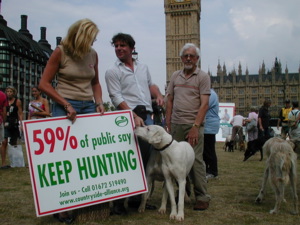
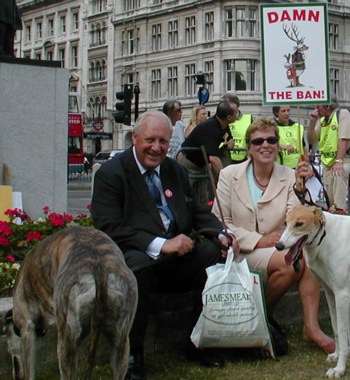
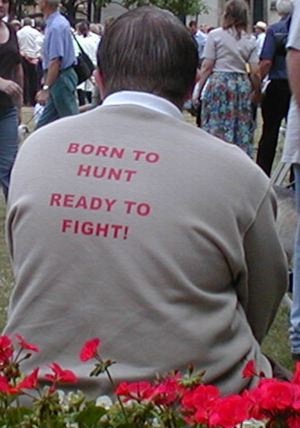
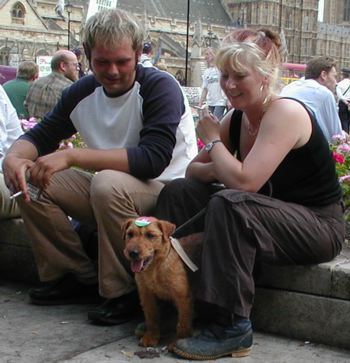
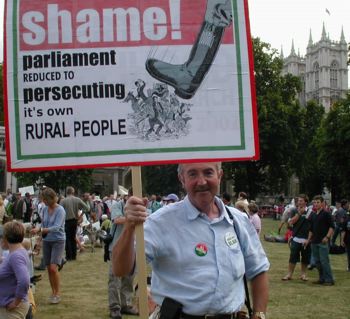
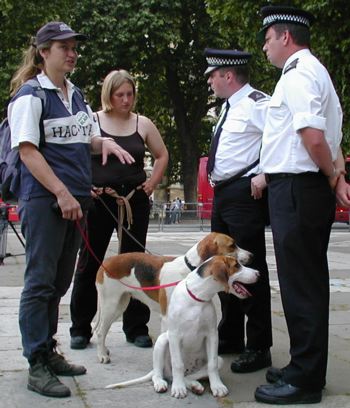
The class warriors are not ‘progressive’ at all… they are in fact the heirs to a view of the role of the politics which in days gone by used law to oppress other despised minorities, such as homosexuals or Roman Catholics. They are just hate filled sanctimonious collectivist bigots.
(the photos taken today courtesy of The Dissident Frogman because my camera is knackered)
F is for Frogman… Dissident Frogman… he is here… in London!
We know who he is… and you don’t.
Samizdata.net’s many spies have told us that these are being stockpiled in Iran for use during the coming ‘transitional times’.
My chum Julian, who is a prince amongst men, contrived to acquire me a copy of Lara Croft’s latest outing for the PC… Tomb Raider: Angel of Darkness. I have been very keen to see what could be done with this franchise now that all aspects of games technology have advanced so far.
Alas, although I am only about a third of the way through it so far, I am mightily unimpressed. The graphics are downright primitive: there is simply no excuse for representing tree branches and foliage with 2-D sprites these days. Character models are boringly drawn, lack detail and either do not lip-synch at all or do so very badly. Two female character in the part I have just finished use exactly the same face model, hands look like baseball gloves … if graphically speaking U2003 powered ‘Splinter Cell’ is the current state of the art, then Tomb Raider: Angel of Darkness is at least two years behind the curve. It is little more than a re-hash of the last Tomb Raider, which was looking tired even back then. The some of the graphics purporting to show the game on the Internet are misleading to put it mildly. If there is a way to get it to look that way I have yet to discover it. And yes, I am using a fairly high-end PC with a good graphics card and half a gig of RAM.
Additionally, the voice acting is flat, the controls are a f**king nightmare when attempting precise manoeuvres, camera control is dreadful and sometimes simply does not work at all, the story line is just a re-hash of all that went before it… in short, the whole bloody thing is un-engaging and frustrating.
To make matters worse, the program is buggy as hell, with entire documented features apparently unimplemented (I have yet to get ‘sprint’ to work no matter what key I map it to and unarmed combat does not seem to do much either). One character (a bartender) chats to Lara whilst appearing to be turned inside-out and all manner of graphic anomalies are scattered throughout the game, strongly suggesting extremely sloppy beta testing by the makers. I honestly cannot think of a single positive thing to say about this game.
I will probably complete the game regardless but if they had managed as much humour and snappy dialogue as someone did with the promotional stuff for the game, I might not be playing with gritted teeth.
Given that the ‘Lara Croft’ franchise is such a valuable property, if I was a shareholder with money invested in this I would be looking for boardroom-heads-on-spikes about now. I am very glad I got this game as a present but I would not recommend it to anyone. Save your pounds/bucks/euros etc. and wait for Half Life 2 and Deus Ex: Invisible War.
As usual, it starts with a scrum of bloggers descending on the beer and chili…
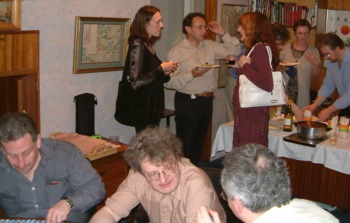
Glug, glug, munch, munch
Shockingly, many of the bloggers discussed… BLOGGING!
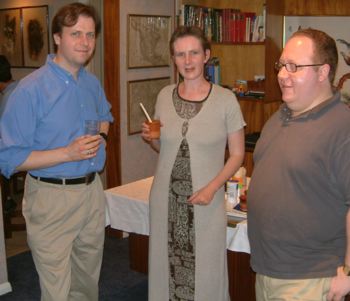
Patrick Crozier, Natalie Solent, Stephen Pollard
Eventually numbers and the need to smoke causes the proceedings to explode out into the garden. Many curses were uttered at the people responsible for the absence of Andrew Dodge and Sasha…
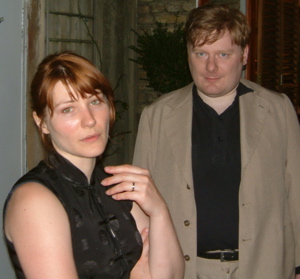
My… what big eyes you have!
Much beer was consumed…

I was only resting!
It is now 02:30 in the morning and strangely, people are starting to demand more chili!
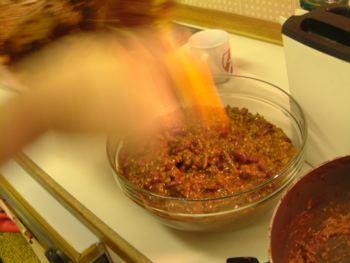
Why aren’t you people tired yet? Will it never end???
Update: Over a dozen of the hard core are still here…
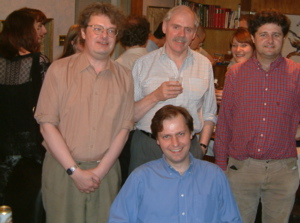
The Transportblog Team: would you buy a train ticket from this lot?
Nearly 04:00 in the morning and at least one intrepid blogger has passed out in The Comfie Chair…
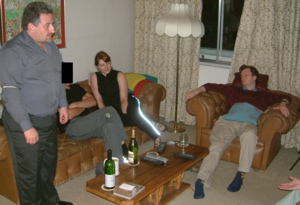
Don’t you people have blogs to write for?
DissidentFrogman’s face is censored to protect the guilty
Final update: The grizzled hardcore diehards finally staggered off into London’s cold morning air at the first warning glow of daylight, a few minutes past 05:00 this morning…

Another highly successful British Blogger Bash!
verb. To use one’s blog to beg for assistance (usually for information, occasionally for money). One who does so is a ‘blegger’. Usually intended as humorous.
noun. RDF is a web content syndication format. Acronym which stands for Resource Description Framework
Used as noun or verb. The willful omission of one or more words so the meaning of the statement is no longer understood but that the statement suits the needs of the writer in launching an ad hominem attack whether or not the construction is truthful or grammatically complete.
Named after Maureen Dowd, based on her manufacture of a quote attributed to President Bush in her May 14, 2003 column (as first reported by Robert Cox on TheNationalDebate.com).
The term and the practice are often found in the Blogosphere.
(Coined by James Taranto)
|
Who Are We? The Samizdata people are a bunch of sinister and heavily armed globalist illuminati who seek to infect the entire world with the values of personal liberty and several property. Amongst our many crimes is a sense of humour and the intermittent use of British spelling.
We are also a varied group made up of social individualists, classical liberals, whigs, libertarians, extropians, futurists, ‘Porcupines’, Karl Popper fetishists, recovering neo-conservatives, crazed Ayn Rand worshipers, over-caffeinated Virginia Postrel devotees, witty Frédéric Bastiat wannabes, cypherpunks, minarchists, kritarchists and wild-eyed anarcho-capitalists from Britain, North America, Australia and Europe.
|






