We are developing the social individualist meta-context for the future. From the very serious to the extremely frivolous... lets see what is on the mind of the Samizdata people.
Samizdata, derived from Samizdat /n. - a system of clandestine publication of banned literature in the USSR [Russ.,= self-publishing house]
|
I can only hope that the Americans keep their nerve and use the wide scale of the uprising to not just decapitate the more florid Islamist leadership but also place clear ‘markers’ as to what the response will be to armed uprisings during the de facto ‘protectorate’ phase of Iraq’s post-Ba’athist reconstruction.
As things are developing day by day, it is pointless for me to just reiterate the reports filling the news media as to the current state of the cut and thrust on the ground, but there may indeed be an analogue with the Vietnam war here… and it ain’t a ‘quagmire’… the Tet offensive may have been a political disaster for the USA but it was a military triumph and more or less wiped out the Vietcong as a significant military and political force. If the US can do the same to not just Muqtada al Sadr’s Islamo-fascist militia but also to any the militias of any who make the mistake of supporting him, it will have profoundly useful effects long after the fighting fades into history and the US and UK forces have gone home.
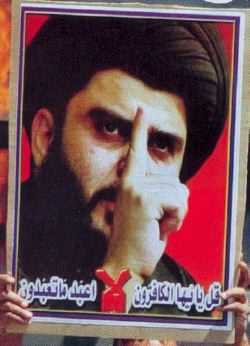 Translation: Follow my finger and shoot… here Translation: Follow my finger and shoot… hereAlthough Ali Sistani is, in the overall scheme of things, someone that the occupying powers can probably do business with (though that remains to be seen), it can only be helpful to his education if Muqtada al Sadr, that heir to the ‘Mad Mahdi’, can be seen to come to a fairly public and messy end surrounded by as many of his supporters as possible. Notions of putting this man on trial are to say the least ‘unhelpful’.
If a successful confederated Iraqi republic is going to come out of this without falling into a democratically sanctified ‘popular Islamic’ tyranny like that which so many in Iran are trying hard to throw off with their own efforts right now, it is going to take some serious stick, and not just carrot, to make things come out more or less the right way. That is, alas, the way the real world works and hopefully the US and UK have the fortitude to see it through to its conclusion without cutting and running prematurely. So far the signs are reasonably good as only the usual suspects are bleating for political defeat to be plucked from the jaws of eventual military victory.
Unpersons alerted us to the news that from today British police may legally and against the will of any law-abiding subject, take DNA samples and fingerprints from any arrested person without that person having even been charged with committing a criminal act.
We can but echo the good Unpersons concerns:
The law now leaves British police officers free to help Blunkett establish one of the most ambitious and truly disturbing elements of the British police state that he has slowly but surely been working to create over the last few years. In a country where the state can take over half of your income, charge you expenses when it wrongly imprisons you – yet fail to defend you after it has crushed the right to self-defence, send parents to jail for not sending their children to state day-care centres schools, steal your property because ‘you couldn’t possibly have earned that much money without selling illegal drugs’ whilst slowly handing over control to a foreign power, attempt to dictate what you eat ‘for your own good’ and generally treat its citizens as its troublesome children one has to wonder to what extent we already live in a police state.
This has not been a good week.
What seems to be developing into an open revolt in Iraq by Shi’a Islamists could be a Godsend to the coalition and secular elements of Iraqi society in the long run… in openly taking up arms against the coalition and its Iraqi supporters, radical leader Muqtadar al-Sadr has changed the equation: what could have been a long term intractable political problem has been turned onto a military problem with a fairly obvious and direct solution.
Blair is a liar. But of course the notion any politician does not utter more than the occasional porkie pie is a very uncontroversial one. But as I said in the wellspring of lies yesterday, one can but marvel at the bare faced effrontery of it when our political masters stand up and state something is true when any person not wilfully blind (or David Blunkett) can see it is patently untrue just by reading a few newspapers or one of several thousand blogs and websites.
Mr Blair said political objections had been removed and the only obstacle now was technical. He made clear he wanted the project to “move forward” as soon as it was feasible.
He risked antagonising civil rights campaigners by claiming they no longer objected to the idea, which would see each citizen required to buy a computer-readable card that would record personal details.
Risks antagonising? Civil rights campaigners no longer object to the idea? Excuse the French, but, what the fuck? Blair is a bare faced liar. The only other alternative to that is that he is so ignorant of goings on outside the cloistered world of 10 Downing Street as to be completely deluded.
I will try my damnedest to refuse to get an ID card and I will openly declare that I do not have one when the sun rises on that evil day. I urge as many people as possible to not just resist but to do so openly when the time comes. They will try to make it very difficult to live without one so we must make the system unworkable by using whatever civil disobedience and intelligent resistance is needed. Do not cooperate with your own repression. Time to get creative, people. Time to get angry.
Cross-posted from Samizdata.net
Blair is a liar. But of course the notion any politician does not utter more than the occasional porkie pie is a very uncontroversial one. But as I said in the wellspring of lies yesterday, one can but marvel at the bare faced effrontery of it when our political masters stand up and state something is true when any person not wilfully blind (or David Blunkett) can see it is patently untrue just by reading a few newspapers or one of several thousand blogs and websites.
Mr Blair said political objections had been removed and the only obstacle now was technical. He made clear he wanted the project to “move forward” as soon as it was feasible.
He risked antagonising civil rights campaigners by claiming they no longer objected to the idea, which would see each citizen required to buy a computer-readable card that would record personal details.
Risks antagonising? Civil rights campaigners no longer object to the idea? Excuse the French, but, what the fuck? Blair is a bare faced liar. The only other alternative to that is that he is so ignorant of goings on outside the cloistered world of 10 Downing Street as to be completely deluded.
I will try my damnedest to refuse to get an ID card and I will openly declare that I do not have one when the sun rises on that evil day. I urge as many people as possible to not just resist but to do so openly when the time comes. They will try to make it very difficult to live without one so we must make the system unworkable by using whatever civil disobedience and intelligent resistance is needed. Do not cooperate with your own repression. Time to get creative, people. Time to get angry.
Cross-posted to:

Nothing any political body says can be taken at face value. On that point I doubt many would demur. In days gone by when the state had a large measure of control over information flows, this was only to be expected and was easier to do. In modern times, this is a bit harder to pull off and requires ‘spin’ and other psycho-media exercises in obfuscation to muddy waters, confuse issues, bamboozle and generally misdirect people from politically inconvenient facts. Nevertheless, in this information rich interconnected world in which we now live, one can but marvel that some political creatures seem to act as if they operate in a universe in which the official pronouncements carry the same weight they did in, say, the 1920’s.
A remarkable and even bizarre example of this is the summary which has been attached to the factual European Monitoring Centre on Racism and Xenophobia‘s report on anti-semitism in Europe. This EU publication comes out against the screamingly obvious backdrop of Islamic youths running rampant in some communities in many countries. And the summary of this report states what exactly?
The largest group of the perpetrators of anti-Semitic activities appears to be young, disaffected white Europeans
Huh? I mean, did they expect that no one would actually read the actual main text? The report clearly says that by far the major source of ‘anti-semitic’ (meaning anti-Jewish) violence is other semites… Muslim ones. → Continue reading: The wellspring of lies
But then I suppose you already knew that. After all, state’s often think it is justified to outlaw consensual sex-for-sale (unless it is part of a package involving marriage, of course). Now however, it seems even what you do with your private bits in a non-sexual way is the business of a bunch of priggish regulators.
You think not? Well that is what Georgia’s political masters reckon (that is Georgia in the USA not the one in the former USSR). It is now illegal for an adult woman to get a genital piercing. Now I realise that the USA already claims de facto ownership of its subjects (a much more realistic term than ‘citizens’) even when they wander off to foreign lands, but I though that these notions of owning folks only applied to the fruits of their labour, not their actual bodies (yes, I realise this may be wandering into a touchy area given the USA’s interesting history of intrapersonal economic relations, particularly in places like Georgia).
Now if some woman is subjected to non-consensual genital mutilations, I have no problem regarding that as criminal, but will someone tell me how a bunch of legislators can think they have the right to tell a woman what she can do to her own labia and clitoris for her own private aesthetic reasons? To me the law itself is an affront, but far more shocking is that every single one of the members of the Georgia legislature feel they have the right to tell a woman what she may do with her own body for her own private ends.
(via Jessica Lyons: Naturalis)
Recently a commenter here on Samizdata.net used a term that I think sums up modern regulatory statism in the Western World rather well.
Populist Authoritarianism
Whilst Google shows that the term is not exactly new, it does seem both little used and particularly apt. The banning of smoking on private commercial property seems a classic example of this in action. Let’s start calling a spade a spade and stop letting the statists of all stripes hide behind euphemisms.
Spread the word.
A new nationwide police agency, the Serious and Organised Crime Agency (SOCA) has been created in Britain.
The creation of a new “British FBI” to combat organised crime, with informants being offered reduced sentences to snitch on their gangland bosses, was given unanimous support in the Commons today – despite a controversial raft of new powers.
The home secretary, David Blunkett, told MPs he was in favour of allowing intercept material – bugged phone calls and emails – to be used as evidence, pending a review which would report back in June.
And he would also, for the first time, force professionals such as lawyers and solicitors to cooperate with police enquiries into organised crime, even if it meant betraying client confidentiality.
And thus people will simply stop asking for legal opinions just in case their shyster runs off to the police in order to cover their rear ends and thereby ensuring a steadily increasing climate of fear, distrust and uncertainty. The Blair-Blunkett government are nothing less that populist authoritarians.
Barbara Amiel is someone I frequently find disagreements with but when she is right, boy, is she right. Whilst I am usually rather prone to point the finger of blame at the state as the font of all evils when things go wrong, Amiel makes the reasonable point that even with the best intelligence in the world, the prevailing zeitgeist in the United State (and elsewhere) on and before September 10th 2001 meant that there was very little support for anything which could really have stopped Al Qaeda’s infamous arrival onto the world’s front pages.
The question is not whether Reagan-Bush-Clinton-Bush actually knew about the murderous intentions of radical Islam or whether they took what they knew seriously, but what the public mood would have let them do about it before 9/11.
Not much, I wager. What administration could, before 9/11, have sent in American boys to fight a regime in Afghanistan because it was implementing the ideas of an old man with a long white beard, sitting crossed-legged in the mountains talking about Satan America? Had I been in Congress before 9/11, knowing everything that was knowable about the Islamists, I still doubt if I would have voted to send troops to the Hindu Kush to topple the Taliban. Eardrums would have exploded all over Capital Hill from outcries of racism and imperialism if there had been serious efforts, pre-9/11, to round up suspected Muslim militants in the United States and tighten security on Muslims entering the country. As it is, the post-9/11 sensitivity to racial profiling makes travel hazardous for white grannies who dislike body-searches.
All too true. Read the whole article.
Gerhard Schröder is calling companies who outsource ‘unpatriotic‘, after Ludwig Georg Braun, the president of the federation of chambers of industry and commerce, advised German businesses to seek opportunities elsewhere.
So, Gerhard Schröder, the man who has presided over yet another interventionist government whose policies have made Germany progressively more and more uncompetitive over the years, brazenly refuses to accept his personal responsibility for imposing the very policies which are driving businesses to seek to invest elsewhere.
But then I suppose as the prerequisite for any professional politician is to be able to look an entire nation in the eye and tell them black is white and up is down, and then ask to be applauded for saying that… and what is more, more often than not, that is exactly what happens.
Whatever. Reality always has its way with vainglorious politicians in the long run because people, and their capital, will eventually go where their interests are best served.
And that place will not be Gerhard Schröder’s Germany.
One of the reasons for slightly less output on this august blog is that two of the editors and the inimitable Gabriel Syme were off meeting other sinister Illuminati in Prague for a fine Czech beer or six.

No prize for guessing where the Illuminati meet in Prague Prague, like Bratislava, is known for its splendours…

Hot… steamed in fact One of the upsides of the dire weather was that many of the usually crowded tourist attractions were almost deserted.
We meet one of the leading central European bloggers, Tomas Kohl (on the right)…
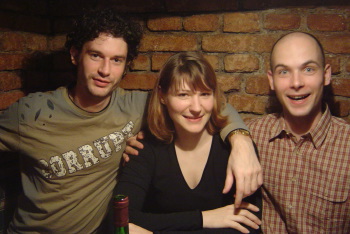
Tomas sinks some fine Czech Pilsner with Adriana and Gabriel Syme → Continue reading: Samizdata.net on the river Vltava
|
Who Are We? The Samizdata people are a bunch of sinister and heavily armed globalist illuminati who seek to infect the entire world with the values of personal liberty and several property. Amongst our many crimes is a sense of humour and the intermittent use of British spelling.
We are also a varied group made up of social individualists, classical liberals, whigs, libertarians, extropians, futurists, ‘Porcupines’, Karl Popper fetishists, recovering neo-conservatives, crazed Ayn Rand worshipers, over-caffeinated Virginia Postrel devotees, witty Frédéric Bastiat wannabes, cypherpunks, minarchists, kritarchists and wild-eyed anarcho-capitalists from Britain, North America, Australia and Europe.
|