This is today’s cartoon by Ben Jennings in the Guardian:
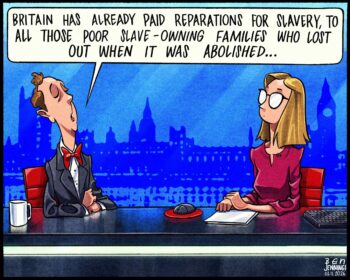
If you can’t see the cartoon, it shows a man and a woman in what looks like a TV studio set up for a Sunday morning political interview. The man, a toffee-nosed member of the upper classes, is saying, “Britain has already paid reparations for slavery to all those poor slave-owning families who lost out when it was abolished…”. The woman – presumably the interviewer – looks nonplussed.
The cartoon is clearly meant to suggest that the British government of the 1830s paying the slaveowners the then vast sum of twenty million pounds to free their slaves after the passage of the Slavery Abolition Act was a bad thing.
It was indeed regrettable that those who had done evil were rewarded rather than punished. But paying off the masters worked. After half a century of effort, and with a thousand caveats and complications, it freed the slaves.
I ask Mr Jennings, as I ask everyone who sneers at the fact that the British government paid off the slaveowners, what strategy they think the government should have followed to free the slaves instead?
Just telling the owners to get on and do it because Parliament said so ran the risk that, without any incentive to obey a law that would impoverish them, they would simply refuse. Then what – war? The slaves were held in the colonies, not in Britain itself. Sending multiple fleets across thousands of miles to subdue each rebellious island and territory would have been beyond the capacities of any government in the world at that time. Civil wars, as this would have been, are particularly terrible. The war the United States fought to end slavery in that country killed a higher proportion of the people involved than almost any other war in history.
Another thing: the outcome of war can never be certain. The slaveowners might very well have fought off the overstretched government forces, establishing independent slaveowning states in which slavery might have lasted for generations more than it did in real life.
All in all, if you were a slave circa 1833 and you somehow heard about this proposal to bring freedom to you and your family at the cost of unjustly rewarding your oppressor, would you want it to go ahead?





Slavery was legal. Slaves were seen as property. There was reluctance to see government taking it away without compensation. The promise of compensation dealt with that, and cleared the way for further honourable work in banning slavery and freeing slaves. Highly principled. Extremely admirable.
Why is it that the original source nations that captured and sold slaves are never expected pony up reparations?
Glad to read this post. As a Yank, I was not familiar with the term “toffee-nosed.” Always nice to learn something new.
From AI:
Modern Slavery Estimates (2018-2026 Data):
India: Estimated 8 to 11 million people in modern slavery.
China: Estimated 3.86 to 5.77 million people.
North Korea: Estimated 2.64 to 2.7 million people, with a prevalence rate of 10.5%.
Pakistan: Estimated 2.3 to 3.19 million people.
Russia: Estimated 794,000 to 1.9 million people.
Any sign of the modern descendants of Caribbean slaves giving a damn?