We are developing the social individualist meta-context for the future. From the very serious to the extremely frivolous... lets see what is on the mind of the Samizdata people.
Samizdata, derived from Samizdat /n. - a system of clandestine publication of banned literature in the USSR [Russ.,= self-publishing house]
|
I have noted before that an inordinate number of doctors seem to be totalitarian inclined folks, dead keen on using the force of law to impose their view of what is best on other people.
This, however, takes the biscuit not just for the totalitarian meta-context within which it is framed, but also for sheer idiocy:
The prevention of attacks involving kicking or blunt objects is just as important as preventing knife violence, new research from Cardiff University shows. A team from the University’s Violence Research Group found that injuries inflicted with feet were more likely to result in severe injury than any other method of assault
[…]
The research, published in the international academic journal Injury Prevention, is the first ever to compare injuries by method of attack. Professor Jonathan Shepherd, who led the research, said the surprisingly severe injuries from kicking and blunt objects should make them just as high priorities as knives in violence reduction strategies. Professor Shepherd said: “This might be achieved through public awareness campaigns and tackling alcohol misuse to reduce the chances of people falling over, since victims of violence are usually kicked after they have fallen. “We also need to take action to reduce the availability of blunt objects coming to hand in licensed premises and city centre streets.” [emphasis added]
So… Professor Jonathan Shepherd (a Professor of Oral and Maxillofacial Surgery from Cardiff and Director of the Violence Research Group) wants to find a way to make it less likely that people will fall over in a fight (he must mean that as people tend not to get kicked when they fall over unless they are in a fight) and he wants to reduce the availability of blunt objects coming to hand in licensed premises and city centre streets. Blunt objects? As in, well, anything you can pick up? Bottles? Chairs? Bins? Umbrella stands? Ashtrays (oh, silly me, those are due to be made illegal in effect anyway)? So how exactly would you do that? Needless to say ‘bovver boots’ are going to be frowned on.
Presumably the Good Professor wants a panoptic state in which we all wear state approved (and mandated) padded clothing, state approved soft shoes and require everything (and and I do mean everything) be screwed to the floor. Amazing. This is not a man I would like to see in a position of power over me or anyone else.
In the latest body blow to the British Army, Scottish soldiers have been denied their heritage as the latest supply shortages hit the infantry.
The British army’s decision to end its 150-year relationship with a kilt maker has left Scottish regiments with a shortage of dress kilt uniforms.
The 5,000 soldiers in the Royal Regiment of Scotland only have enough kilts for one out of every 15 men, The Daily Record of Glasgow reports.
Jeff Duncan, campaign manager for Reinstate Our Army Regiments, blamed Prime Minister Tony Blair.
“Mr. Blair promised they would get whatever was needed — what they need is a change of government,” he said.
This is a government that cannot provide basic equipment for its soldiers. Private Widdle would be shivering in the Khyber Pass but he would probably be dead, due to a lack of body armour.


Personally I desire himalaya wonderful style. Which means it must be the place for me.
This is just too easy. I am in the Nonhyeon area of Seoul, which is a nice part of town with lots of interesting shops, and some reasonably decent architecture. And a variety of other interesting sights.

Yes, that is a Daewoo Matiz with spoilers. Really.
Update:


As a Londoner, all I can say is that their profound insight into and authentic reproduction of London’s street fraternity culture is uncanny. Particularly the bit with the skateboard.
“Money frees you from doing things you dislike. Since I dislike doing nearly everything, money is handy”.
Groucho Marx (the Marx who actually had intelligent things to say about money).
Reason magazine’s Brian Doherty (he of Burning Man fame) has written a nice piece looking at the controversial role the late Milton Friedman played in advising economic reforms to the government of the late, and not-very-lamented, Augusto Pinochet of Chile.
The New York Times columnist Anthony Lewis declared in 1975 that “The Chilean junta’s economic policy is based on the ideas of Milton Friedman…and his Chicago School…if the pure Chicago economic theory can be carried out in Chile only at the price of repression, should its authors feel some responsibility?” Such attitudes haunted Friedman to his death and beyond.
The reaction of some of the usual conservative suspects to Pinochet’s death didn’t help debunk this unfortunate association. Since he was a pro-American autocrat, who ultimately honoured a plebiscite and stepped down, portions of the American right have always had an unhealthy affection for the general. National Review ran both a symposium and a stand alone piece by former editor John O’Sullivan marking Pinochet’s passing, neither of which were much outraged about his crimes. O’Sullivan explicitly said , in the sort of bizarre moral prisoner exchange that partisan squabbling generates, that sure, Pinochet should suffer for his villainy – but only if Castro and Allende’s associates do as well.
I agree with pretty much every word of Doherty’s analysis, and his punchline is good:
Undoubtedly, Friedman’s decision to interact with officials of repressive governments creates uncomfortable tensions for his libertarian admirers; I could, and often do, wish he hadn’t done it. But given what it probably meant for economic wealth and liberty in the long term for the people of Chile, that’s a selfish reaction. Pinochet’s economic policies do not ameliorate his crimes, despite what his right-wing admirers say. But Friedman, as an economic advisor to all who’d listen, neither committed his crimes, nor admired the criminal.
Those leftists who nitpick at the late economist for his role in advising the Chilean regime have only the tiniest of legitimate reasons for bashing Friedman, I think. Considering that he was a man who made the case for abolishing the draft, decriminalising drugs, promoting school choice and so forth, his credentials as a pro-liberty guy were pretty much impeccable.
Is the UKIP really a single issue party any more? I have been asking that question for a few months now and I keep being pleasantly surprised by the answer. Sure, I am all for getting out of the EU but that does not change the fact that the biggest threat to the liberty of British people is very much home grown. Just ditching the EU is not enough, not by a long shot.
However more and more the UKIP seems to be sounding more than just a single drum beat… their latest satirical offering on the web is not just about the €uro-nanny superstate but rather just about the nanny state in all its forms and its message is overtly anti-Big Government… and not just Big Government from Brussels, the tag-line “Big Government needs little Hitlers”. Outstanding.
It would appear their slogan of It’s time we governed ourselves! means not just independence from the corrupt political machine in Brussels but time we as individuals had more ability to govern our own private affairs without domestic nanny-states and nanny-super-states alike regulating every aspect of life.
I may not agree with all their platform but more and more frequently they are putting out messages I can get behind without any problem at all.
“Progressive taxes do not redistribute income. They redistribute taxpayers.”
George Gilder, one of the early evangelists for “supply-side” economics, which is a fancy way of saying that he thinks people respond to incentives, considered a wild-eyed idea by some people.
Apologies for not flagging up sooner that I recently had a recorded conversation about Samizdata with Perry de Havilland. It took me over a week to edit the thing, by which I mean over a week to get around to stitching the two chunks it happened in together (I find everything involving computers to be hard until I know how to do it). And after posting about it on my blog, it has taken me another two days to mention it here. I had a busy weekend. But the mills of Samizdata grind small, and slowly. A week and a half’s delay will make no huge difference to the big picture, or to the meta-context as Perry likes to call it.
Anyway, click here to have a listen. It lasts about forty minutes.
Our conversation reminded me of something I first heard myself say to Madsen Pirie a long time ago, in the old Alternative Bookshop. What will this achieve? – said Madsen, waving some pamphlet I had just done in my face. I replied: “In the short run, nothing. In the long run, everything.” Samizdata is like that.
Jackie D liked it too.
Today, assuming the plan goes according to plan, I will be doing another of these things, with Alex Singleton, about… Gilbert and Sullivan. There is more to life than what governments do.
It is presently 2.42 am in Seoul. I am suffering from jetlag (Making an eastern journey with a nine hour time difference is especially brutal). I went to bed at about 6pm yesterday evening, and I have therefore just woken up, and I have a few hours to while away, . Buying an international power adaptor in the largest electronics market in Asia did not turn out to be particularly difficult, so thankfully I do not have to ration electrons this morning and I have my laptop and the internet. This makes lying awake in a foreign city with jetlag somewhat more bearable than it has been at some times in the past, and it makes the hour I spent making sure that the versions of my music and photo libraries, my e-mail archive, and various other things that are stored on my laptop were fully up to date were well worth it.
In a way, though, this is kind of relaxing. I have no other obligations for the next few hours. The last few months have been extraordinarily hectic for me. My team at work has been seriously understaffed (we have had great difficulty hiring good people), it has been bonus season, and the total workload has risen. I have been working ridiculous hours, and things like blogging have been lost in the rush. Suddenly, though, I am on holiday, and due to the absence of any GSM mobile phone networks in Korea my mobile phone and Blackberry suddenly don’t work, so my colleagues do not know how to contact me even if they wanted to. I am out of touch and have no immediate obligations to anybody, particularly when jetlagged early on a Sunday morning.
However, I do have an obligation to the people of Samizdata. I am yet to explain why I was in Denmark on November 11.
The reason is actually fairly simple. I went to see Emma Maersk, the largest container ship in the world, at the end of its first trip from Europe to Asia and back. After being built in the shipyards of the Danish city of Odense and being christened on August 12, the ship had sailed from its home port of Aarhus to Gothenburg, Bremerhaven, Rotterdam, Algeciras, the Suez Canal, Singapore, Yantian (Shenzhen), Kobe, Nagoya, Yokohama, Yantian, Hong Kong, Tanjung Pelepas, the Suez Canal, Felixstowe, Rotterdam, Bremerhaven and Gothenburg, and was scheduled to arrive back in Aarhus at 1pm on November 11. Upon reading about the ship in various places, I thought it would be nice to go and actually look at her. I could have gone to see her in Felixstowe in Suffolk on November 4, but that was a weekday. In any event, low cost air travel in Europe has reached the point where it is no harder or more expensive to go to Aarhus than it is to go to Felixstowe, so I thought “what the heck” and spent about $60 on a return plane ticket.
After getting to Aarhus, and a semi-leisurely half hour in a coffee house, I headed down to the port. The AP Moller terminal was on the far side of the port, and I knew I would have a lovely view of the ship across the harbour if she were in the berth closest to the harbour entrance. If she was to dock at a berth further up the port, there would be other terminals in the way. But in any event, I would have a nice view as she sailed into the harbour. I might have to wait in the cold for an hour or so, but I would at least see her come in, which was why I was in port.
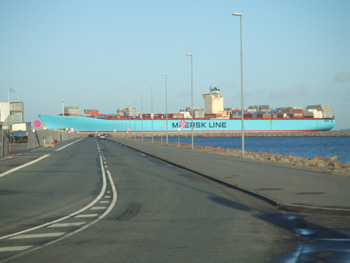
However, I was thoroughly confused when I walked to the harbour and saw this.
Yes, it was a big container ship in Maersk livery that looked exactly like the pictures of the Emma Maersk I had seen in photographs, but it was there prior to the scheduled arrival time, and it was not carrying a large load of containers, as one would expect if it had just sailed in from China. I knew that Maersk were building more ships in the same class, but I had not realised that any were completed. So I spent the next couple of hours wondering whether Emma Maersk had arrived early and had been rapidly unloaded (but container ships like this are never completely unloaded), whether I was confusing a smaller ship in a different class with Emma Maersk, or whether a new ship had arrived in port prior to its maiden voyage. Only one of these explanations made consistent sense, but I did not want to miss seeing what I had come for, regardless of explanations and sense.
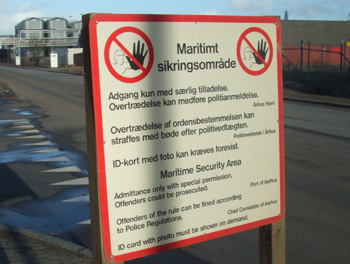
In any event, the view was not very good. I needed to walk around the harbour to get a better view, at least to the extent that I was permitted to. (People tend to sometimes get nervous these days when you wander around and take photographs of critical infrastructure). And I wasn’t sure where the roads went, and stuff like that. However, I gradually made my way around the port, towards the outer breakwater and the AP Moller terminal.
I do like the observation that I could be prosecuted. Presumably, after they figured out I was a banker/blogger/ship spotter/Danish cheese fan/beer drinker, I would not have been prosecuted, but it was in truth a good thing that I turned around and left the Secure Maritime Area, because I would not have otherwise reached the outer breakwater in time
When I got there, I now had a much better view of the AP Moller terminal, the ship already in port, and the open sea. And look what was sailing towards port?
Clearly, this was Emma Maersk. → Continue reading: Watching big ships
The only way to view the present, imploding Labour government as it fights over the cash-for-peerages issue, is like a bunch of street rats at each others’ throats. This story in the Sunday Telegraph states that Tony Blair is willing to let one of his top cronies and fund-raisers, Lord Levy, take the hit for the scandal.
In many ways, what strikes me as so distinctive about this government and its ministers is that the big bust-ups, the big fights, were not on issues of principle. At least the Tories, for all their manifest faults, fell out over things like the euro and the Maastricht Treaty, which were serious, major issues. But then the Tories were once a grown-up party, with grown-up people in it like Margaret Thatcher, Geoffrey Howe and Nigel Lawson. Say what you like about these personages, but their rows were over issues of major substance.
It seems an awfully long time ago.
Hosting company ‘Watching America’ are currently under a sustained (two days and counting) denial-of-service attack and as a result various blogs may be hard or impossible to access as a result. Consider this a public service announcement. Methinks some lynchings are in order.
I had the pleasure of meeting U.S. blogger Stephen Green, of the excellently entitled Vodkapundit, a few months ago at a party in London. Stephen has been ill, lost a lot of weight, and I must say I got quite concerned when he stopped posting. He now explains what has been going on. It looks as if the fella is going to be all right, which is terrific news for him and his wife and child. Feel free to nip over to his site and give him your best wishes.
I am looking forward to the Colorado Scribe posting up more of those cocktail recipes again. Mine’s a gin and tonic.
|
Who Are We? The Samizdata people are a bunch of sinister and heavily armed globalist illuminati who seek to infect the entire world with the values of personal liberty and several property. Amongst our many crimes is a sense of humour and the intermittent use of British spelling.
We are also a varied group made up of social individualists, classical liberals, whigs, libertarians, extropians, futurists, ‘Porcupines’, Karl Popper fetishists, recovering neo-conservatives, crazed Ayn Rand worshipers, over-caffeinated Virginia Postrel devotees, witty Frédéric Bastiat wannabes, cypherpunks, minarchists, kritarchists and wild-eyed anarcho-capitalists from Britain, North America, Australia and Europe.
|










Recent Comments