The ‘private sector’ of the economy is, in fact, the voluntary sector; and the ‘public sector’ is, in fact, the coercive sector
– Henry Hazlitt, author of books including the superb Economics in One Lesson.
|
|||||
|
The ‘private sector’ of the economy is, in fact, the voluntary sector; and the ‘public sector’ is, in fact, the coercive sector – Henry Hazlitt, author of books including the superb Economics in One Lesson. January 24th, 2007 | 9 comments - (Comments are closed)
 Moving past discussions of endlessly increasing government responsibility over our daily existence and on to the really weighty matters of the day! Gentlemen. Do not be fooled by recent television commercials depicting comely young hetero chaps guzzling that horrendous, barely alcoholic, sweet, creamy, Celtic muck known as Baileys (girl’s drink). See this for what it is – a shameless attempt to broaden the demographic that consumes Baileys (girl’s drink). It will not work. I do not care how many advertisements are broadcast showing Baileys (girl’s drink)-clutching studly guys and their mates in bars catching the eyes of implausibly hot women. Baileys (girl’s drink) is a girl’s drink, and no amount of telemarketing sophistry can alter that fact. January 24th, 2007 | 48 comments - (Comments are closed)
January 24th, 2007 | 16 comments - (Comments are closed)
Whilst having lunch the other day, I saw an attractive young woman wearing a tee-shirt with a slogan that made me laugh:
No doubt she was reacting to this campaign. And when she and her gentleman friend were finished, she put on her fur trimmed coat and they left. It reminded me of this. Bless. January 24th, 2007 | 16 comments - (Comments are closed)
It is easier to grumble than to get off one’s backside and do something if a disaster hits and the supposed emergency systems of the state prove to be a joke, as was the case when Hurricane Katrina hit the U.S. Gulf Coast over a year ago. In catching up on some reading, I came across this terrific and highly encouraging story of how assorted groups of volunteers, many of whom had a refreshingly dim view of officialdom, swung into action to help the people of New Orleans and others in the surrounding area. The article also reinforced my view of how the internet is helping fuel voluntarism in a way that feeds into the “Army of Davids” perspective of Glenn Reynolds recently. The article contains this line:
I agree. I think the energy and neighbourliness of ordinary Americans as shown in this article are a welcome corrective to the cynicism many people may have felt when reading stories about looting or disorder in the aftermath of the disaster. (Some of these stories were questioned). I recall reading about the blackouts in New York a year or so ago and about how people banded together to ensure that folk got home safely. American civil society, precisely because of the still-strong ethos of voluntarism that so struck Alexis de Tocqueville 160 years ago, is in many ways in much better shape than here. I was particularly struck when I read the latest reports tonight of how looters scrambled to grab what they could from the cargo washed up on the English coast from the grounded container ship. I wonder how many ordinary people ever bothered to wonder how they could help protect the beach from pollution or ensure that no-one got hurt? Yes, I know that looting goes on after disasters around the world, but there seemed to be no countervailing examples over the past few days of people volunteering to help recover items for their rightful owners, for example. The idea of volunteers helping owners to sort out their property from the wreckage is just too bizarre for we Britons to contemplate. Generalisations are always risky, but I get the feeling that if I was in a natural disaster, I would rather be in America than in Britain. It is a sad thing for a proud Briton like me to say, but I think that in this respect at least, the sort of neighbourliness and willingness to lend a hand has more or less died, although I may be a bit too gloomy here. To describe what might have killed that spirit would take me longer than a blog posting, so I will leave it to the commenters. January 23rd, 2007 | 12 comments - (Comments are closed)
It appears that Britain’s finance minister, Gordon Brown, has timed his run to be our next Prime Minister just in the nick of time as the economic data starts to look a bit sickly. Even with all the usual health warnings about data that seeks to try to capture the complexities of an economy in numbers, the figures on inflation and productivity do not look good. (In the case of productivity, they are not disastrous, mind). It is probably not grounds for great worry – yet. When an economy expands and more people join the workforce, this can have the perverse effect of reducing “productivity”, while if an economy stagnates but millions lose their jobs, then output per person can go up. Productivity growth is not the be-all or end-all of economics. But the ability of an economy to grow rapidly without triggering inflation is helped if the productive capacity of an economy grows. There is no doubt that after nearly 10 years of this hyper-active Chancellor, with his taxes, lust for regulation and control, that the arteries of the British economy have hardened. Brown inherited a British economy in 1997 that was, by the standards of the 70s and early 80s, in remarkably fine fettle. The state took less than 40 percent of GDP; inflation was low, productivity was rising, the ranks of the rich and the decently-well off were rising fast. Yes, problems of crime and the weakening of civil society were serious and yet how optimstic so many people were at that time that some of the remaining social evils could be addressed. How long ago that now seems. For years, I have heard it said that Labour’s ace card was its handling of the economy at the macro-economic level. I tended to go along with that in the main, and I think the decision to put the Bank of England in day-to-day charge of interest rates was sound. Brown’s move of the inflation measure to the less exacting euro zone measure of consumer prices – which does not capture housing costs like mortgages – and his sometimes dubious picks of BOE personnel to set interest rates, threaten to tarnish even that achievement. January 23rd, 2007 | 16 comments - (Comments are closed)
There’s a definite urge – don’t you have it? – to say, “The Muslim community will have to suffer until it gets its house in order.” What sort of suffering? Not letting them travel. Deportation – further down the road. Curtailing of freedoms. Strip-searching people who look like they’re from the Middle East or from Pakistan. … Discriminatory stuff, until it hurts the whole community and they start getting tough with their children. … They hate us for letting our children have sex and take drugs – well, they’ve got to stop their children killing people. – Martin Amis, quoted by Christopher Hitchens in his City Journal review of America Alone January 23rd, 2007 | 28 comments - (Comments are closed)
I am back and have been lurking for a bit. I did not intend to post for another week or two. In my initial post I said that occasionally something would cause me to “blow a gasket”: Habeas corpus is that something. Since King John at Runnymede was compelled to accept the Magna Carta, the right of an individual to demand access to judicial process has been the foundation stone of constitutional government.
While I have been away, I have apparently missed some fun jesting about ‘meta-context’. This is a serious example of it. In its simplest and most fundamental way, this is about tribalism. This is about who ‘we’ are. Who we see our selves as. Are we defined by our geographical boundaries? Is ‘American’ a tribal bond? Or are we the citizens of our constitution? Have we charged our government with protecting its own sovereignty and security by exchanging it for that of its citizens? Or have we charged it with protecting all citizens from violation of their personal sovereignty by all powers. Are we, the citizens, not the fundamental reason for our government? If it will not abide by its contract with us, is it truly still our government? At what point does it become an occupying power? It is babies and bathwater. More than that, it is meta-context. Underpinning assumptions about collectivism vs individualism. Did you happen to notice that Attorney General Gonzales singled out individuals and citizens:
→ Continue reading: A bolt between the eyes of constitutional government January 23rd, 2007 | 25 comments - (Comments are closed)
Most of my old mates from Country Durham probably know how to download porn off the web (that’s what its really for after all) but I’d be willing to bet that to a man they think MySpace is where you part your car. – Commenter ‘Albion’ January 22nd, 2007 | One comment - (Comments are closed)
I missed this the other day… The French government, the same people who gave aid and comfort the the instigators of the Rwanda genocide, and have done everything they could to thwart the arrests of mass murderous Serbian war criminals in Bosnia, have decided to ‘honour’ one of their own. They have awarded the Legion D’Honneur, France’s highest award, to Harold Pinter, that well know playwright, man of letters, literary colossus and apologists for mass murdering national socialist Slobodan Milosevic and mass murdering national socialist Saddam Hussain. Vermin, one and all. January 22nd, 2007 | 20 comments - (Comments are closed)
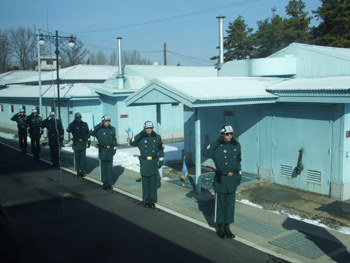 As I have recounted, on my way home to see family in Australia in December I stopped in South Korea for a few days. The trip was principally a city break: I had a look around Seoul. Seoul was in many ways very impressive, but it was also a city striking in its normality. It is a modern, technologically advanced city. The subway system works extremely well. There are McDonald’s and Starbucks outlets everywhere (this is a rare market where a local McDonald’s clone has apparently outdone the original. On the other hand, all Korea’s coffee shops belong to Starbucks). Buildings are modern. People love their mobile phones. Certain Korean brands are perhaps more prominent than they would be in a more balanced economy and they seem to realise this though. Samsung and LG, for instance, seem to market many of their products under local brand names, leading to iconic and very familiar Korean products being present in Korea only under unfamiliar brand names. The city feels extremely safe, it is very clean, and it is about as low stress a place to visit as can be imagined. The only hint that complete insanity begins less than 50km to the north is only a small one: the fact that uniformed soldiers are to be seen regularly on the streets. There is nothing threatening or remarkable about this. These are just ordinary 19 year old guys in the middle of their compulsory military service. You see them catching the subway, or having lunch in fast food restaurants. These are just young guys going about their lives, who happen to be wearing fatigues. There are many other cities where you will see the same thing. However, now that most developed countries have abandoned compulsory military service, these cities are fewer than they used to be, particularly in countries as advanced as South Korea. 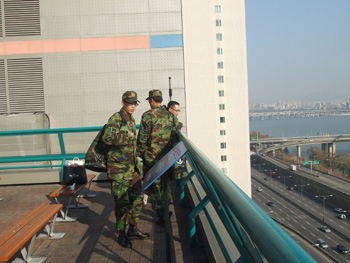 But Korea has retained compulsory military service, and this is because the most heavily defended border in the world lies less than 50km north of Seoul. Of course, I had to go to see it. One can only go into the Demilitarized Zone by going on an organised tour. These are run by both the local USO and by local Korean tour companies. The guidebook recommended the USO tour as “the best tour” but the days on which it ran were not convenient with my schedule, so I booked myself on one of the locally run tours. This turned out to be just fine. However, perhaps because most English speakers go on the USO tour, English speakers were in a minority on this tour. Most of the people on the bus were Japanese. Only six of us were English speakers (myself, three Singaporeans, and an American engineer based in Seoul who was on the tour with his adult daughter who was visiting him for Christmas). There was also a Korean couple. This is apparently rare. Korean civilians are not normally allowed in the DMZ, and those that wish to go on the tour have to apply six months in advance, in which time a thorough background check is undertaken on them, apparently to make sure they are not the sorts of people who are likely to wish to defect to North Korea or otherwise allow the enemy to gain propaganda points (this seems like a deeply peculiar thing to do, but apparently once in a while someone is nutty enough to want to try it). In any event, their presence on the tour was apparently quite unusual, as the English speaking guide remarked upon their presence. And of course, there was no ‘Korean speaking guide’ (although the guides were both Korean and thus clearly spoke the language). The tour was conducted in Japanese and English, and the English and Japanese speaking guides took turns to speak. When you drive north from Seoul, you realise what a huge metropolitan area the city is at the centre of. (It depends how you measure it, but there is a case for Seoul as the second largest city in the world, which is doubly impressive given that the population was reduced to a few hundred thousand during the Korean War). Urban areas and manufacturing centres are beside the road almost all the way to the border (the LG/Phillips LCD display factory is no more than 10km from the DMZ, so our flat screen television supply is one of the first things we shall lose upon the start of World War 3). As we drove north the guides gave us various useful pieces of information, such as that we should not run off into the bushes “as there are many minefields”, and that it was very important that we not taunt or gesture at any North Koreans, as if we did they would take our photographs and use them for propaganda purposes against the free world (also, our tour would likely be terminated immediately). Then we crossed the river Imjin,and normality ceased. → Continue reading: A trip to the DMZ January 21st, 2007 | 26 comments - (Comments are closed)
Longish article in the Telegraph today about the increasing domestic economic woes in Iran, which puts pressure on current leadership of that country. If such a country is this state when the price of crude oil has been so high, albeit off its peaks – Iran is a major oil exporter – then imagine how things may pan out if the price of the black stuff goes down even more. January 21st, 2007 | 11 comments - (Comments are closed)
|
   |
||||

All content on this website (including text, photographs, audio files, and any other original works), unless otherwise noted, is licensed under a Creative Commons License. |
|||||
Recent Comments