We are developing the social individualist meta-context for the future. From the very serious to the extremely frivolous... lets see what is on the mind of the Samizdata people.
Samizdata, derived from Samizdat /n. - a system of clandestine publication of banned literature in the USSR [Russ.,= self-publishing house]
|
Orwell imagined a political order that would try to change people by expunging certain terms from the vocabulary in order to make the very concepts those words represent un-knowable.
Of course Orwell had not heard of the European Union. To quote EU Justice and Security Commissioner Franco Frattini:
I do intend to carry out a clear exploring exercise with the private sector… on how it is possible to use technology to prevent people from using or searching dangerous words like bomb, kill, genocide or terrorism
And of course this will also block anyone researching the history of Nazi German and all manner of other governmental action throughout history . It might be interesting to speculate on what the motivation of someone like the EU’s “Justice and Security” Commissioner really are.
(via Ben Laurie)
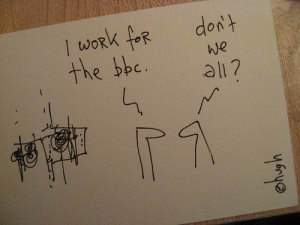
Cartoonist and commentator Hugh MacLeod says it all about the organization with “an assured income of £3.5 billion a year” of forced funding:
The other day I encountered this argument, which I failed properly to swat away and as a result, got rather rude to my interlocutor and he went off in a huff (sorry about that mate). What he said that made me go red was this:
“You libertarians keep banging on about the terrors of regulation. Yet you also slag off massive lawsuits and things like that. But if you want to get rid of huge payouts for things like people suing for damages, you need regulations. So why are you so hostile to them?”
As I pointed out, this is what is called a straw man argument.. Such “arguments” hold up a false, or in some cases deliberately false and weak, version of a point of view that a person wants to knock down easily (hence the “straw” bit). So let us fisk it.
First, I do not know any liberals or libertarians who argue that regulations are and always are a bad thing. Private sector bodies and voluntary associations of all kinds have them. A privately owned hospital, for instance, would regulate the behaviours of people who entered the premises. Why? Because that hospital would not want its reputation and bank account to be wrecked by outbreaks of disease, which lead to nasty insurance payouts. So it is in the self interest of said institutions to operate regulations, and more important perhaps, to be seen to do so. Another case is the London Stock Exchange. Long before modern financial regulators like the Financial Services Authority came along, the LSE was founded (back in the 18th Century, I think) and it had rules, albeit not always formal ones, but rules nonetheless (“my word is my bond”, etc). Trust is the key. And if you do not have trust, and have ways of enforcing said, then networks of commercial or other transactions do not work so well. So let us dispose of the canard that classical liberals are agin regulations. They are not. What we are against is one-size-fits-all regulations imposed heedlessly by the state. This is the crucial thing. Regulations, to be useful, need to be tried and tested, and if need be, discarded. State regulations tend not to be like that, but rather resemble clumps of ivy climbing up the side of a tree. They are much harder to reverse.
Okay, so now we come to the idea that libertarians hate expensive lawsuits. I suppose it is true that we hate frivolous, massively costly lawsuits, by definition (and who does not, except lawyers?). But sometimes you need to have lawsuits because you will not always have perfect knowledge of the kind of problems that can arise. Take the example of the hospital again – its managers may not know about new diseases that can be transported into the building in unexpected ways. A lawsuit following a disaster may be the trigger for a new rule. In this sense, lawsuits, although unpleasant for those on the receiving end of them, act as a sort of discovery process about what sort of problems exist. Lawyers have their uses.
In other words, this is quite a complicated argument. I just will not make the same mistake of trying to explain it after two beers and a 13-hour day at the office.
There is an interesting article in The Times about Ehsan Jami, a former Muslim who rejected his religion in the aftermath of 9/11. He is organising a movement to fight for the rights of people who leave the Muslim faith and as a consequence face the threat of death, as mandated by the Koran.
This is not an issue on which there can be any compromise whatsoever. However it is also an issue which needs to be highlighted not just for the sake of former Muslims but as a means to rubbish the advocates of multicultural relativism. This is an issue that must be forced down the throat of anyone who wishes to practice Islam in any civilised country.
The administration has sent you here today to convince the members of these two committees and the Congress that victory is at hand. With all due respect, I don’t buy it.
– Tom Lantos, chairman of the House Foreign Affairs committee, accusing General David Petraeus political motivations when delivering his report on military progress in Iraq. And of course a seeker-of-truth like Tom Landos’ utterances on the military situation could not possibly be motived by political considerations, right?
… too busy with politically incorrect activities…
He could have taken his article to this conclusion but perhaps he thought the baggage that would come with it would distract from his intended points. In order for my ‘friendly amendment’ to make sense, it is important to understand what “multiculturalism” really means. Multiculturalism is not a recent ideology. Only the name is new. Most of you are far more familiar with it as “separate but equal”. Wikipedia says:
Multiculturalism is an ideology advocating that society should consist of, or at least allow and include, distinct cultural and religious groups, with equal status.
Separate but equal … segregationism. Multiculturalism as an ideology is diametrically opposed to integration and assimilation. Some have noted a difference in the formation of terrorists in America as compared with Europe but without necessarily attributing it to America’s still comparatively high cultural emphasis and expectation of newcomers to assimilate.
The absence of significant terrorist attacks or even advanced terrorist plots in the United States since Sept. 11 is good news that cannot entirely be explained by increased intelligence or heightened security. It suggests America’s Muslim population may be less susceptible than Europe’s Muslim population, if not entirely immune, to jihadist ideology. In fact, countervailing voices may exist within the American Muslim community.
So what does this have to do with Richard Miniter? → Continue reading: Richard Miniter stops short
On ‘Any Questions’ (BBC Radio 4) this week, whenever David Cameron’s name or policies were mentioned there were hoots of contempt from the audience. This was not a Labour or Liberal Democrat audience as the show was being broadcast from Stamford, one of the most conservative towns in England.
Also the panel treated Mr Cameron with contempt – not just the socialist and the Liberal Democrat (Greg Dyke ex-Director General of the BBC) but the two conservatives – the conservative (not Conservative party) ex-editor of the Sun newspaper and R. Johnson (sister of Boris Johnson).
At least it seems no one is fooled by ‘Dave’ any more.
By the way it was also funny to hear the “culture clash” between the socialist (Tariq Ali the student radical from the 1960’s) and the good people of Stamford.
He wanted to talk about revolution and the Iraq war – and they asked questions about people putting their shoes on train seats and about what was the members of the panel favourite song to sing in the bath.
Mr Ali clearly hates the English – especially when they are being Hobbit-like (perhaps he suspects they are just playing). As a serious future dictator he refused to reply to the silly questions of the Hobbits and got upset and snobbish. I was so upset for Tariq that I laughed and laughed.
I wonder if Mr Ali suspects that at least some of the people in the audience were not unfamiliar with serious things, indeed violent things. After all there are a lot of ex military people in Stamford – and not wildly far from the town are the Fens.
For a little while I actually felt optimistic.
It is interesting that the French government is now apparently seriously trying to stop people eating Ortolan, a delicacy I once tried some years ago (that said I ripped it apart rather than the traditional method of eating it whole). A small matter to be sure but It really does seem to me that the control obsessives like to pick on the people who have tastes or habits some despise, as a way to gradually control more and more aspects of civil society.
Smoking is another interesting example: wait until social attitudes mean smokers are not in the majority and only then use the force of law to repress the hard core. This dynamic is why I have often thought that people who are statists and also homosexuals, i.e. who are members of a group that is always going to be disliked by a significant portion of the population, are really quite stupid. There will come a time when they reap what they sow.
I suspect all of us do something that a lot of other people will dislike and there is an entire class of people out there who use that fact to convince ‘us’ to support the use of the state to “do something about that”.
I am glad to see that the current moral panic about Britons sliding into a Hogarthian nightmare of drunken idiocy has not put off these guys from selling sparkling wine – or champagne, maybe – for £5 a bottle. I am not sure whether it is going to taste as good as Krug, mind. And of course, with many so-called luxury goods, the business model gets ruined if the prices are cut so massively that the exclusivity is lost, and hence the cachet of buying X or Y in the first place. Would Ferraris, for example, be quite the same if they were as cheap as Fords?
Even so, fair play to the businesses that bring us cheap goods. Globalisation – terrible, isn’t it?
There could be an interesting storm brewing when you see things like this…
Gold has raced to a 16-month high of $700 an ounce as investors seek to shelter their cash after stock markets ended the week sharply lower. The yellow metal has clawed back around $30 this week, raising hopes it could revisit last year’s highs of around $730 an ounce. Although gold is traditionally strong at this time of year, the rout in credit markets is fuelling further appetite for the safest investments.
and this…
A sharp drop in foreign holdings of US Treasury bonds over the last five weeks has raised concerns that China is quietly withdrawing its funds from the United States, leaving the dollar increasingly vulnerable.
I am trying to join the dots but instead of a bull or a bear, the outline looks a bit like a hippopotamus. Not sure what to make of that.
|
Who Are We? The Samizdata people are a bunch of sinister and heavily armed globalist illuminati who seek to infect the entire world with the values of personal liberty and several property. Amongst our many crimes is a sense of humour and the intermittent use of British spelling.
We are also a varied group made up of social individualists, classical liberals, whigs, libertarians, extropians, futurists, ‘Porcupines’, Karl Popper fetishists, recovering neo-conservatives, crazed Ayn Rand worshipers, over-caffeinated Virginia Postrel devotees, witty Frédéric Bastiat wannabes, cypherpunks, minarchists, kritarchists and wild-eyed anarcho-capitalists from Britain, North America, Australia and Europe.
|









Recent Comments