We are developing the social individualist meta-context for the future. From the very serious to the extremely frivolous... lets see what is on the mind of the Samizdata people.
Samizdata, derived from Samizdat /n. - a system of clandestine publication of banned literature in the USSR [Russ.,= self-publishing house]
|
I occasionally take a look the Observer newspaper to see if that sister publication to the Guardian has improved; sometimes it has good things in it – I like its sports coverage – but its write-ups on business issues never change from a sort of anti-globalista, Keynesian mish-mash. An article in this Sunday’s paper about the supposed crisis of shortages of drinking water is no exception:
The midday sun beats down on a phalanx of riot police facing thousands of jeering demonstrators, angry at proposals to put up their water bills by more than a third. Moments later a uniformed officer astride a horse shouts an order and the police charge down the street to embark on a club-wielding melee that leaves dozens of bloodied protesters with broken limbs.
A film clip from the latest offering from Hollywood? Unfortunately not. It’s a description of a real-life event in Cochabamba, Bolivia’s third largest city, where a subsidiary of Bechtel, the US engineering giant, took over the municipal water utility and increased bills to a level that the poorest could not afford.
Yup, those evil foreigners, and worse, Americans!
Welcome to a new world, where war and civil strife loom in the wake of chronic water shortages caused by rising population, drought (exacerbated by global warming) and increased demand from the newly affluent middle classes in the emerging economies of Asia and Latin America.
If water is so scarce (it is not, two-thirds of the globe is covered with the wet stuff) then those evil capitalists would surely be investing like hell to create more of it, by irrigation, building reservoirs, desalination plants, etc. If demand from all those “affluent middle classes is rising” for the good things of life, that seems like a great market to tap (‘scuse the pun). Greater revenues for the water companies, particularly if they are allowed to compete for business rather than protected as monopolies, will surely drive increased investment in water, no? But as far as the author of this article is concerned, the very idea of allowing foreign, private companies to operate such utilities is beyond the pale.
The question for countries as far apart as China and Argentina is whether to unleash market forces by allowing access to private European and American multinationals that have the technological know-how to help bring water to the masses – but at a price that many may be unable, or unwilling, to pay.
If the problem is that people cannot afford to pay supposedly higher water bills, then the problem is lack of income; protecting state-run utilities and resisting the investments of mulitnationals is daft; surely, if the underlying problem is poverty, then the solution is more trade, more capital flows, more investment, right?
As Cochabamba illustrates, water is an explosive issue in developing countries, where people have traditionally received supplies for free from local wells and rivers. But in the past 15 years rapid industrialisation, especially in places such as China, has led to widespread pollution and degradation of the local environment.
“For free”. Well, someone had to dig that well. Someone had to lift the water out of it, transport it, purify it, etc. When people say that water should be “free”, they pay no heed to the expenditure of effort in getting water and conveying it to where people want it the most. Multinationals are rather good at figuring out how to do this.
Max Lawson, senior policy adviser for Oxfam, says: ‘We are sceptical that private-sector involvement is the solution for very poor countries. In fact, there is an argument that much greater public sector involvement and cash is needed to channel supplies to where they are most needed.’
Another pretty good reason for not giving a penny to Oxfam, in my opinion.
Some earlier reflections on water.
With technology, ubiquity is a virtue. People use Microsoft Word because everyone else does. The CD-Rom became a more popular backup device than the Zip, Jazz or SyQuest disk because there were lots of manufacturers involved. And, of course, floppies took far too long to die simply because they were everywhere, despite being evil unreliable and having a tiny capacity. Sony Betamax failed in part because far more movies were available for VHS. JVC was also proactive in licensing the VHS technology to lots of manufacturers. Consumers did not want to buy two different video players, so in the end most chose VHS simply because of its ubiquity.
Today, in the current format war between Blu-Ray Disc and HD-DVD, it seems that (unlike two decades ago) the Sony-backed format is going to win. This is despite the fact that Blu-Ray discs cost more to manufacture (although, arguably, Blu-Ray is the better format).
Why will Blu-Ray win? Because, firstly, Sony equipped every PlayStation 3 with Blu-Ray capability. Conversely, Microsoft (a major backer of HD-DVD) decided to only make it available as £100 add-on for its Xbox 360. Secondly, according to Wikipedia, as of late November there were 415 titles available in the US for Blu-Ray, compared with only 344 for HD-DVD. A search on WHSmith.co.uk brings up 259 results for “blu-ray”, but only 167 for “hd-dvd”.
Yet over the coming years, some of the companies that have benefited from the economics of ubiquity may find it turns round and bites them. With OpenOffice only ever a free download away, will people keep going to PC World and paying for Microsoft Office? Schools are already questioning whether it is a good to teach on expensive proprietary software in the classroom, when if they were to use open source applications, all the pupils would be able to practice with the same software at home.
This YouTube video on the Volokh Conspiracy shows a truly outrageous incident where a policeman in the USA tasers a man who was at no point threatening anyone and who was actually calmly walking away from the policeman. The longer CNN coverage gives more context and makes it more clear to me that this was a completely unjustified use of force.
Yet more proof no state should have a monopoly on the means of violence. The incident is astonishing and at least it does show the value to the public (and without doubt to honest decent policemen) of having all traffic stop incidents videoed.
“The loss of a leg may generally be regarded as a more real calamity than the loss of a mistress.”
– Adam Smith.
I think I agree, although I guess it depends on the mistress.
A Muslim lawyer in Canada is trying to use the profoundly illiberal notion that ‘contempt and hatred’ should be criminal offences (which are by definition ‘thoughtcrimes‘), to silence Mark Steyn for his critical remarks about Islam. Bizarrely, the move to sanction Steyn is being billed as a ‘human rights’ action. That said, I suppose it is indeed a ‘human rights’ action in the perverse sence that the intention is to abridge Steyn’s human right to express his opinions in favour of allowing Islamists to have a veto over anyone printing anything they dislike.
Well, that sort of fascistic behaviour makes me both hold the likes of Faisal Joseph and the Canadian Islamic Congress in utter contempt and to hate them. I suppose I better give my lawyer a heads up then. Or then again, as it is their behaviour which makes me hold them in contempt and hatred, can I sue them for making that happen? Would that actually be any more unreasonable than what they are doing?
Just askin’.
Of course do not kid yourself that thoughtcrimes do not get prosecuted in Britain, or that it is only something Islamofascist lawyers do to us non-believers, because sadly nothing could be further from the truth.
I want one.
The website is great fun for over-grown teenagers like me.
Most of us grew up expecting the flying car would eventually come to pass. One of the more successful attempts occurred in the 1950’s but although some were produced, it never made it into the mass market. Although I cannot substantiate it, I understand the FAA of the time was rather horrified at the thought of such large numbers of people flying. Whether true or not, there are very real problems associated with aircraft which one does not face with a car: you cannot pull an airplane over to the side of a cloud when something goes BONK in the night.
Another issue is flying requires a pilot. Even with the new US FAA sport flying category, getting your ticket is no mean feat. Being a flyer does not just mean you know how to point the thing. It implies you are conversant with the rules of a three-dimensional sea, one whose buoys are marked with radio waves and whose small craft must stay out of the way of large aircraft not just for their own safety but for the safety of the heavy iron as well.
This is not to mention knowledge of meteorology, the jargon required to talk to towers and other pilots in order to communicate critical information quickly through sometimes noisy radio systems and all the rules and regulations which encode the hard won wisdom of a century of flight and the loss of thousands of lives. I could go on for a very long time but I will just say that being a pilot right now requires a skipload of skills and knowledge.
However, as we move deeper into the 21st century, some of these problems are abating. With smart systems and eventually self-repairing systems we will get flying machines which either won’t take off when there is a problem or get you down before it gets serious. With autonomous AI systems development moving along the way it is (think UCAV’s!) the knowledge base of the pilot will more and more be embedded in the avionics and the ‘driver’ will simply point the thing.
For all this to happen there has to be a Transition that opens up the market. And that machine may finally be here:
An aeronautical startup called Terrafugia has developed a small airplane called the Transition that it says can take to the sky as easily as the road. It is about the size of a large SUV and features innovative folding wings that collapse with the press of a button. Terrafugia calls it a “personal air vehicle.”
The team behind the Transition still has to design a drivetrain to propel the craft and a mechanism to transfer power from the propeller to the wheels, but it expects to begin flight tests late next year.
Production could begin as early as 2009, and Terrafugia says it’s already received more than 30 orders.
You will still need to be a real pilot, but at least you can save on the hangar or tie down fees.
Bryan Appleyard has some interesting things to say about science fiction (hat-tip, Glenn). As a commenter said in the Times’ letters section though, Bryan focuses a little too much on the dystopian side of SF, on science-out-of-control. There are some nice touches though: he is right to examine how SF has affected the course of science, as well as the other way round.
The problem with a newspaper article like this, unfortunately, is that you can only really skim the surface of the subject. SF is pretty vast – hey, like the universe itself! There are bound to be vast tracts of land that get overlooked. Appleyard does not mention the more positive, life-affirming side of hard science fiction in the works of people like John Varley or Vernor Vinge, for instance (two of the best writers of the lot, in my opinion). And he barely mentions Arthur C. Clarke, Neal Stephenson, Ken MacLeod and R.A. Heinlein. Mention of the latter, of course, brings us onto the fact that SF has often been quite daringly political; it has used imagined futures to play around with cultural, social and ideal political scenarios (regular readers of this blog will know what I mean, such as The Moon is a Harsh Mistress, or Stephenson’s Snow Crash, etc).
But, to be fair to Appleyard, he takes SF seriously. As he points out, there seems to be more interest in fantasy instead: the enormous popularity of Lord of the Rings, Terry Pratchett, being just two examples. Maybe I am missing something, but I have never been interested in that side of the genre. My wife keeps badgering me to read Pratchett. Another sub-genre is what one might call “techno-military” SF; Heinlein wrote some of this in things like Starship Troopers; a good current example are the writings of John Scalzi.
Here’s a pretty good dictionary of science fiction.
It seems to me that we’ve reached the point at which a facility that bans firearms, making its patrons unable to defend themselves, should be subject to lawsuit for its failure to protect them. The pattern of mass shootings in “gun free” zones is well-established at this point, and I don’t see why places that take the affirmative step of forcing their law-abiding patrons to go unarmed should get off scot-free.
– Instapundit
Many of the Samizdatistas attended the Stockholm Network‘s Golden Umbrella Awards last night, an event that was described to me as the ‘Free Market Oscars’. The intention is to encourage the people working in the varied pro-market think-tanks and advocacy groups around the world by acknowledging their contributions to the cause of liberty.
In truth I attended with moderate expectations as I have struggled to say awake through all too many award ceremonies, but was surprised at how well the event was managed and produced and although it may damage my credentials as a cynic, I thoroughly enjoyed myself.
Helen Disney, the Stockholm Network’s CEO, is one of the most focused and appealing people on the free market scene and her team, such as Tim Evans (who as many of you know, also wears a Libertarian Alliance hat), should be congratulated on managing such a great event. The Master (Mistress, surely?) of Ceremonies was Dr. Karen Horn of the Cologne Institute for Economic Research and former economics editor for Frankfurter Allgemeine Zeitung. She was an outstanding choice, attractive, witty and very engaging, thus setting a wonderful tone for the evening.
The after-dinner speech was delivered by C. Boyden Gray, the imposing US Ambassador to the EU. He is a terrific speaker and I found his less than flattering remarks about the US legal profession most endearing. There was very little to disagree with in his advocacy of reducing limits to free trade and he was frank about how this needs to happen on both sides of the Atlantic.
Another notably good speaker was Ján Čarnogurský, the former Prime Minister of the Slovak Republic. In fact the only speaker who hit the wrong note was Iain Duncan Smith MP, who launched into a defence of his own think-tank, the Centre for Social Justice, although by the time he had finished speaking I still had no idea who he was defending it from or what the hell it actually does.
For details of who won what, see here, but the big winner of the evening was the Bulgarian think tank, the Institute for Market Economics, who walked away with two well deserved prizes. I was also delighted to see the very worthy UK based Taxpayers Alliance come away with an award. The TPA are like a fact-checking ‘urban guerilla’ organisation of thorn-in-the-side activists who have achieved results out of all proportion to the resources at their disposal.
I was quite struck by how young most of the think-tank and activist people in attendance were and that is surely a good thing.

The US Ambassador is an excellent speaker…
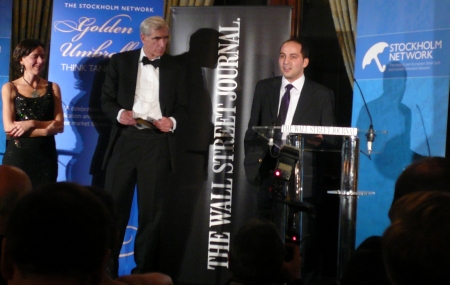
…and he towered over everyone! Seen here with Tural Veliyev of the Free Minds Association of Azerbaijan
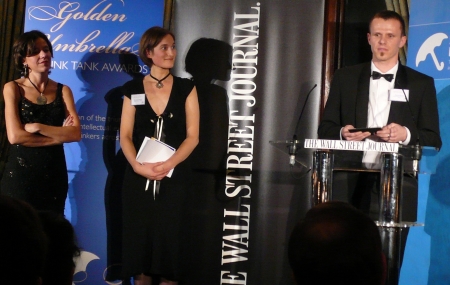
Karen Horn and Cécile Phillipe, presenting an award to Richard Durana of the Institute of Economic and Social Studies in Slovakia
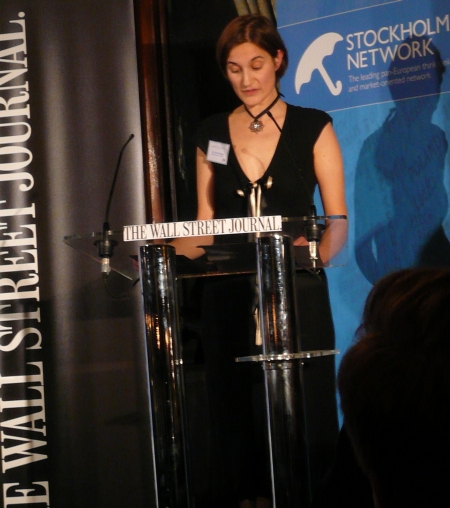
The delightful Cécile Phillipe, Director of the Molinari Economic Institute
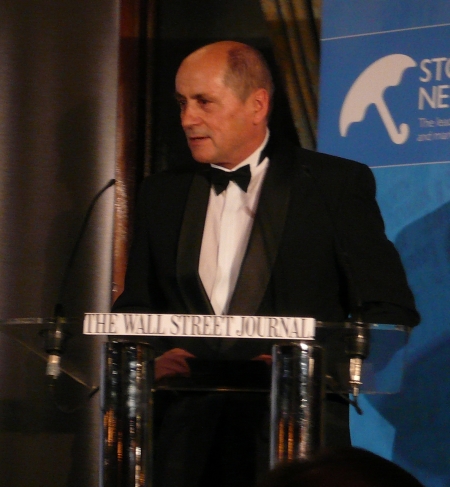
Ján Čarnogurský is also an excellent speaker
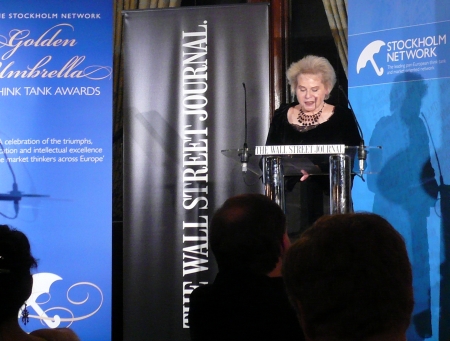
Janet Daly is not someone I often agree with but I found little to disagree with last night
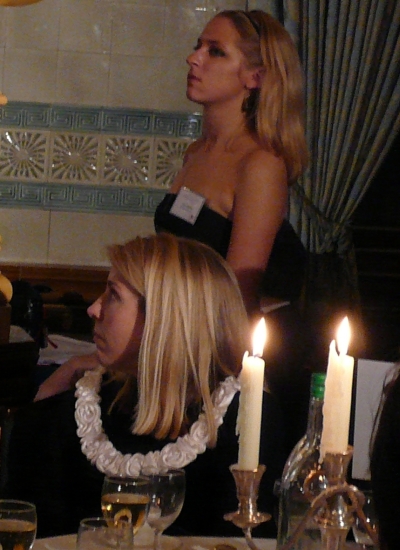
No, I am not going to put up any pictures of Iain Duncan Smith speaking
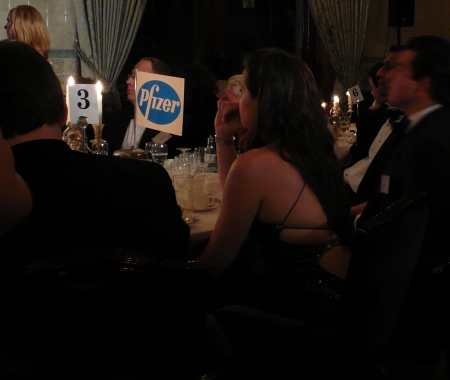
Big Pharma! Eye Catching Dresses!
Downsize DC has just reported on the introduction of an act to repeal the “Legal Tender” law. This is the law which requires Americans to accept the US dollar for “all debts public and private” regardless of whether they have contracted payment otherwise. According to Downsize DC:
Choice is good because it allows competition. Monopoly is bad because
it leads to price fixing. Monopoly control over what people use for
money provides the greatest price-fixing power of all, because it
impacts ALL of your economic transactions. The Fed can manipulate the
price of absolutely everything, by increasing the number of
circulating dollars (inflation), or by decreasing them (deflation).
This act opens wide the door to competing free market currencies, yet has little immediate or drastic impact. If people are happy with US dollars, they will simply continue to use them. Those that are unhappy with manipulations by the Fed or who simply prefer inflation hedged means of payment will be able to contractually specify their preferences.
Go here to ask your elected representatives to cosponsor HR 2756 and allow freedom of choice in money.
There is so much good news out there right now it is hard to know where to begin.
First off, Carla Howell and Michael Cloud have done it again. They have filed over 78,000 signatures for a ballot initiative to repeal the Massachusetts income tax, some 12,000 more than the requirement.
This is their second go. The first time the major media outlets in the state all but ignored them, other than an occasional hatchet job. Despite the virtual blackout, the measure got some 45% of the vote. This time around they are getting massive coverage right off the bat:
The Worcester Telegram and Gazette is owned by the Boston Globe –
which is owned by the New York Times.
The Worcester T & G is the third or fourth largest newspaper in Massachusetts.
After they ran the article on our END the Income Tax Ballot Initiative On December 3rd, they polled their readers on whether we should END the Massachusetts Income Tax.
A whopping 66% of their readers voted “Yes” – while only 34% voted “No.”
You can find out more here.
|
Who Are We? The Samizdata people are a bunch of sinister and heavily armed globalist illuminati who seek to infect the entire world with the values of personal liberty and several property. Amongst our many crimes is a sense of humour and the intermittent use of British spelling.
We are also a varied group made up of social individualists, classical liberals, whigs, libertarians, extropians, futurists, ‘Porcupines’, Karl Popper fetishists, recovering neo-conservatives, crazed Ayn Rand worshipers, over-caffeinated Virginia Postrel devotees, witty Frédéric Bastiat wannabes, cypherpunks, minarchists, kritarchists and wild-eyed anarcho-capitalists from Britain, North America, Australia and Europe.
|






Recent Comments