We are developing the social individualist meta-context for the future. From the very serious to the extremely frivolous... lets see what is on the mind of the Samizdata people.
Samizdata, derived from Samizdat /n. - a system of clandestine publication of banned literature in the USSR [Russ.,= self-publishing house]
|
After the speeches finished I headed up to the stage to take a photo or two. We were supposed to wait for the speakers and the press to go outside first so I intended to put my wait to good use. To my surprise, I was nearly run down by the group of very very important persons and had to squish back against the edge of the stage as Arnold hurried past inches away. Once they were all outside I joined the rest of the merely VIP filing out onto the tarmac at the side door .
It was cold outside, at least down into the twenties. That would not have been so bad except for the rather brisk wind coming down the runway into our faces.
There were a lot of media folk freezing their tuckus off in the Press Stand.
Photo: copyright Dale Amon, All Rights Reserved
There was music and a deep percussive bang as each of the huge images on the left of the runway flashed to on, starting from the direction in which we could hear the sound of distant engines. Then a white line became visible in the distance, the wing of WhiteKnightTwo. It lengthened as the singing jets grew louder… and then I could see it: the underslung SpaceShipTwo.
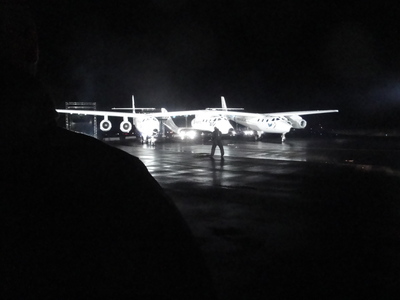
It came from out of the dark of a Western night… the first commercial Space Ship. Am I really here? Is it really here?
Photo: copyright Dale Amon, All Rights Reserved

Is it just love in the eyes of the beholder or is she just plain gorgeous?
Photo: copyright Dale Amon, All Rights Reserved

Ship and mothership came to a stop in front of us.
Photo: copyright Dale Amon, All Rights Reserved
A group of four persons went up to the ship for the Christening and the Governors simultaneously smashed bottles of champagne. I had expected the woman with Richard, his daughter, to do this as it seems more in line with centuries of British and American naval tradition.
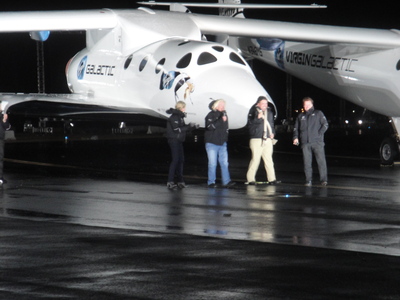
Left to Right: Holly Branson; Sir Richard Branson on the mike; Governor Richardson; Governor Schwartznegger.
Photo: copyright Dale Amon, All Rights Reserved
To my great surprise, we were allowed to move forward right up to the dual vessel. I might say I was almost shocked that in this day of lawyer-induced destruction of our quality of life something as cool and wonderful as this would be allowed. Of course, now that it has been done I am sure they will realize people got to directly experience something amazing and you can not have things like that, now can you?

You would almost imagine this was still a free country: we were allowed to walk right up to her.
Photo: copyright Dale Amon, All Rights Reserved

A crowd formed around the nose of SpaceShipTwo.
Photo: copyright Dale Amon, All Rights Reserved
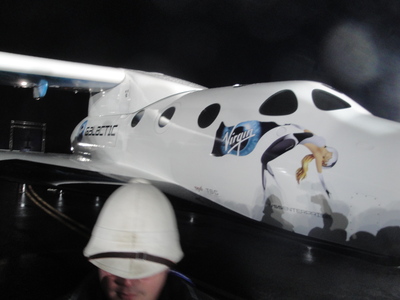
It even had sexy nose art like American warbirds of WWII.
Photo: copyright Dale Amon, All Rights Reserved
There were too many people at the starboard side of the nose so I started working my way counterclockwise around WhiteKnightTwo. My fingers were numb well before this and when I was taking these photos I could quite literally not feel my finger depressing the shutter button. I could only tell it had happened by watching for the still image to show on the preview screen.
It seems that not very many folk did what I did, so there are not a lot of other photos floating around showing the business end of SpaceShipTwo.

Portside of SS2 nose.
Photo: copyright Dale Amon, All Rights Reserved

Like any old spacehand, I went around the other side to look at the most important part of any spaceship.
Photo: copyright Dale Amon, All Rights Reserved

Two ships and four vertical stabilizers.
Photo: copyright Dale Amon, All Rights Reserved
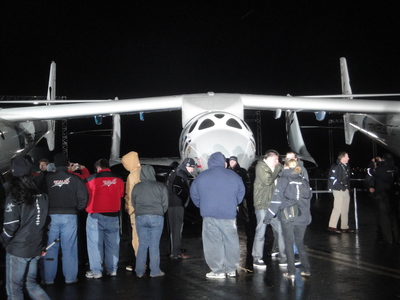
As I had hoped, the crowd had mostly headed for the relative warmth of the tents and Absolut vodka by the time I got back to the nose.
Photo: copyright Dale Amon, All Rights Reserved

I framed one last shot of the huge ship as I left the tarmac.
Photo: copyright Dale Amon, All Rights Reserved
In part six our crowd of future space travelers party on until dire storm warnings force an emergency evacuation.
The previous section of this tale may be found here
When you read this passionate denunciation of the sheer intellectual cowardice of the Conservative Party over the issues of tax, public spending and the banking sector, ask yourself again: who gives a brass farthing as to whether David Cameron and friends win power next year? Who?
… people are beginning to be afraid of the state – but they are also afraid to be without the state
– Chris Mounsey
But I think, in fact, it is worse than that. There are many people – and you can often tell them by their fierce, defiant pronouncements that they have nothing to hide, they have done nothing wrong – who are in a dependant, abusive relationship with the state. They feel the bullying and their fear itself as evidence they are wanted and have a place in the world. Being pecked is reassurance that you are somewhere in the pecking-order. Seeing people who are outside the hierarchy of subjection as evil, a threat, and pleading one’s own inoffensiveness at every turn is a way of legitimising one’s own pigeonhole.
It is a nasty tendency. The feeble people who are trying to hide in the mainstream make up the lynchmob. And it is entirely equivalent to the morality of the prison-house, where violent gangsters are at the top and sex offenders are brutalised at the bottom, of an alternative chain of being. “You may think I’m scum, but at least I’m not one of them.”
(Hat-tip: Iain Dale, even if he was only advertising his magazine)
“There is no reason to doubt that Mr Brown’s statement that he went into politics because of his horror at the effects of unemployment. Unfortunately, he forgot one of the few laws of political economy: that the road to unemployment is paved with work creation schemes. He is likely, therefore, to go down as something like the patron saint of unemployment.”
– Theodore Dalrymple, from “Not With A Bang But A Whimper”, essays on current affairs, page 79. The whole chapter from which this paragraph is taken is a brilliant summary of everthing that is wrong about the current prime minister.
When an argument is being won and lost, the retreating team does not issue statements saying: By gad, you were right and we were wrong, sorry and all that, we’ll try not to let it happen again. No, the way you spot a victory and a defeat is when you see bits of bullshit (linked to rather admiringly, on account of the piece not being complete bullshit throughout, from here) like this from the Los Angeles Times:
The real scandal illustrated by the e-mails is not that scientists tried to undermine peer review, fudge and conceal data, and torpedo competitors, but that scientists and advocates on both sides of the climate debate continue to claim political authority derived from a false ideal of pure science. This charade is a disservice to both science and democracy. To science, because the reality cannot live up to the myth; to democracy, because the difficult political choices created by the genuine but also uncertain threat of climate change are concealed by the scientific debate.
Actually that is pretty much exactly what the real scandal was, except that they missed out the bit about sabotaging the entire world economy.
But allow me to draw your particular attention, just in case you missed it, to this bit:
… scientists and advocates on both sides …
Position one: Our guys are right and your guys are wrong. Position two: Yes, it’s true that our guys are wrong, but … but … so are your guys! “If we have the decency to admit that our bad guys are bad, now that your good guys are proving it, can’t you at least be a sport and say that your good guys are bad also?”
No.
How, exactly, do the AGW sceptics “continue to claim political authority derived from a false ideal of pure science”? How has their conduct earned them the insult of being part of a “charade”? How have the sceptics been undermining science? Or democracy? There has been a charade. But the sceptics are busily unmasking it, and replacing it with truth.
This is a classic retreat from fraudulent moral superiority to fraudulent moral equivalence.
Once again, as so often in this ruckus, I’m thinking: Cold War. “Yes indeed, Communism is not working very well and many of the communists are very bad people, but capitalism and those who support it are no better …” No, communism was indeed a catastrophe, but capitalism was and is colossally, world-transformingly better. I despised the fraudulent army of anti-anti-communists then, and I despise the fraudulent and soon-to-be-huge army of anti-AGW-sceptics now.
Richard Castle of the Burton Mail wrote the following story about a recent act of vandalism: Vandals deface the town war memorial :
A ROYAL British Legion boss says vandals have “dishonoured those who have given their lives for our country” by defacing Burtonʼs war memorial.
Roy Whenman, vice-chairman of the town’s Legion branch, received calls from members saying an extremist message had been written on the statue. Having been informed at 9.20am, borough council chiefs had cleaned the graffiti from the relic, situated outside Burton College, in Lichfield Street, by 9.40am.
Mr Whenman, of Birches Close, Stretton, has described whoever committed the offence as “diabolical”.
He said: “There’s nothing worse, in my eyes, than discrediting a war memorial. It dishonours those who have given their lives for our country.
“I don’t know how long it was there for, but I was pleasantly surprised by the council’s quick action and I commend them for it.
“What I would say to them is there are other ways of expressing your anger about certain issues.”
Dennis Fletcher, chairman of East Staffordshire Racial Equality Council, said he suspected someone from the far right was responsible.
He said: “My reaction is one of horror. Just two nights ago at our general committee meeting we were talking about the harmony between communities in the borough.
“I suspect members of the far right have done this to stir things up and there are generally very good inter-cultural relations in East Staffordshire.
“Graffiti of any type is terrible but when it includes racist material it has to be considered utterly unacceptable.”
An East Staffordshire Borough Council spokesman said: “We would say that this vandalism is deplorable and we do our best to clean such graffiti as soon as we possibly can.”
â– The Mail has manipulated the mainpicture to remove some of the content of the message.
The Burton Mail would like you to think that what was removed in the manipulation was swear words or something like that.
Actually, no. A picture of the graffiti has been posted by “OldWarDog” of the “4 Freedoms Worldwide” blog. It shows that the censored words were…
…Before I tell you, see if you can guess. Not the exact words, but the general idea. You can make a guess based on this gnomic comment from the vice-chairman of the Burton branch of the British Legion: “What I would say to them is there are other ways of expressing your anger about certain issues.” (What issues? Why are you talking in this strange, indirect way?) You can make a guess from the otherwise inexplicable involvement of the chairman of East Staffordshire Racial Equality Council, and his guess – unsupported by any evidence – that “someone from the far right was responsible”, when the British Far Right are usually all too anxious to muscle in on displays of support for the armed services. You can make a guess from his further comment, which only starts to make sense when you realise that something is being hidden, that “Just two nights ago … we were talking about the harmony between communities in the borough.”
Did you get it? Here is the picture.
And in case that link goes dead, let me just tell you. The graffiti says “Islam will dominate the world. Osama…” The next few words are difficult to read in the picture. Never mind, you guessed the general thrust of them anyway.
Now read Kathy Shaidle’s post :When media bias becomes media malpractice.
What is the Burton Mail playing at? I was about to write, “you can’t get away with that sort of thing now we have the internet” until half a second’s more thought told me that you couldn’t get away with that sort of thing in the days before the internet either. Hundreds of people in Burton must have seen the graffiti, even if it was removed quickly by the council. When even one or two of these hundreds saw that report in the Burton Mail they will have instantly realised they were being lied to, and will have become far more likely to spread the news about what they really saw. The graffiti on its own will do harm to race relations. The graffiti plus the cover up will do far worse.
(Via House of Dumb)
James Delingpole delivers the goods on the latest blow against AGW alarmism. It has come from Russia. The story is not quite so “John Le Carre” as the theory put up recently by Sean Gabb, however.
Happy Christmas!
Following on from Brian’s post immediately below this one, is what can only be described as an encouraging story by Bloomberg, stating that the chances of a deal being agreed by world leaders in Copenhagen are remote. Excellent if true.
I’ve just been watching this video, of Lord Monkton laying into the Climategate gang. What makes it so potent is that he is quite bluntly calling them crooks, and calling anyone who still follows their fraudulent prophecies dupes and fools. He names names, and crimes. Yes, crimes. And yes, criminals. Criminals with names. Monkton does all this in his posh British public school voice. Nevertheless, you can almost see him doing that thing that fist fighters do, but with their beckoning hands rather than with their mouths, and pointing at their own chins. Come and get me! Give me your best shot! I say you are a pack of scoundrels. Prove me wrong! I say that the logical thing to do about “climate change” is: nothing. Nothing. Why on earth do you still have the damned nerve to think anything else? Such pugilistic vulgarities are not to be found in the text of the talk. Monkton is too canny, too cool, to get that excited. But that is the subtext.
Here is some other evidence that those with the job of chasing crooks are now getting interested in this.
I agree with Johnathan Pearce in the previous posting that the old-school media are definitely, albeit belatedly and with much embarrassment and confusion, starting to notice all this. You can feel that most crucial of propaganda processes happening with Climategate: the reversing of the burden of proof. Unfair to all the fraud detectives (Watts, McIntyre, and the rest of them, including Monkton himself) though it undoubtedly was, those noble toilers, until the Climategate revelations erupted, had to prove everything, in defiance of the default position. Their every tiny blemish was jumped upon. Their major claims were ignored. Now the default position is slowly mutating into: It’s all made-up nonsense. And the burden of proof is shifting onto the shoulders of all those who want to go on believing in such ever more discredited alarmism. In short, our side is winning this argument, big time.
And it turns out that the rich countries do indeed wish to remain rich, as I merely hoped was the case a week ago. The underlying point being: nobody is actually as scared about climate change as they were a few months back. Doubters who feared that there might have been “something in it”, “no smoke without fire”, etc., now doubt far more completely. All but the craziest warmists are now going rather quieter. The people who matter no longer feel deep in their guts, those of them who ever did, that there has to be a deal, or the earth will fry. All potential parties to it are now more willing than they were to walk away from Copenhagen with no deal, because the fear of being blamed for not reaching a deal is now (in the nick of time) being replaced by the fear of being accused of having reached a bad deal.
In other good news: Gordon Brown is backing the Copenhagen Conference to be a success.
And yes, I know, a huge amount of institutional infrastructure remains in place, created partly by means of these climatic lies, before people had to justify believing in them and when critics of that apparent scientific consensus (Monkton has interesting things to say about that) had to justify believing in anything else. The Copenhagen Conference, for all that it now looks like being a huge disappointment to the more incurable of the AGW alarmists, will still do quite a lot of harm. The war isn’t over, to put it mildly.
But winning arguments is no small thing. During the 1980s I vividly recall being told, by people whose pessimism about the Cold War was so profound that they might as well have been Soviet agents of influence for all the use they were to the side they claimed to be on, that merely proving that despotic state centralism was an economic disaster would make no difference. Those wicked Soviet Communists – who were, they claimed, so very much cleverer than any of us – would still eat us all alive, and all the more horribly on account of having run out of stuff to eat in Russia and surrounding parts. Well, it turned out that winning that argument counted for quite a lot. And winning this one will count for a lot too.
Al Gore has been caught out basing scary scenarios on what turn out to be highly questionable figures. What I am starting to notice – despite the efforts of some, not all, parts of the MSM – is that AGW scepticism is getting more of a hearing in the media. The effects of the leaked emails from the University of East Anglia are not fading; if anything, the momentum behind this story is building.
Near where I live in central London, there is a big construction site and one of the most impressive things about the work going on has been to watch the crane-driver deftly move the huge arms of the crane around to lift and place different materials. I don’t suffer from vertigo but I certainly would not have the guts to sit up in the cab at the top, or be able to easily face the long climb up and down. The crane-drivers are one of those group of construction workers that make much of the modern urban skyline possible. So here’s to them. And here is a nice article about this feature of the modern urban landscape.
Yet another intellectual gem from a senior member of the Church of England:
The Rt Rev Stephen Venner called for a more sympathetic approach to the Islamic fundamentalists. The Church of England’s Bishop to the Forces said it would be harder to reach a peaceful solution to the war if the insurgents were portrayed too negatively. […] “We’ve been too simplistic in our attitude towards the Taliban,” said Bishop Venner, who was recently commissioned in his new role by Dr Rowan Williams, the Archbishop of Canterbury.
“There’s a large number of things that the Taliban say and stand for which none of us in the West could approve, but simply to say therefore that everything they do is bad is not helping the situation. The Taliban can perhaps be admired for their conviction to their faith and their sense of loyalty to each other.”
Could not the same have been said about the formidable soldiers of the Waffen SS? But how is ‘conviction’ and ‘loyalty’ in the service of evil somehow admirable? And how is noting this quality in an enemy going to “help the situation”? And what if the nature of the enemy simply precludes any possibility of a “peaceful solution”? This is the Taliban we are talking about.
Well in a way he is right I suppose… we should note that they are loyal to their faith and to each other, and understanding this, it should be understood that no accommodation can possibly be reached with fundamentalists, be they Nazi ones or Islamofascist ones. They need to be confronted, culturally, politically and when needed, militarily when they wander “off the reservation”… precisely because of their “conviction to their faith and their sense of loyalty to each other”.
Getting that set in people’s minds would indeed “help the situation”.
|
Who Are We? The Samizdata people are a bunch of sinister and heavily armed globalist illuminati who seek to infect the entire world with the values of personal liberty and several property. Amongst our many crimes is a sense of humour and the intermittent use of British spelling.
We are also a varied group made up of social individualists, classical liberals, whigs, libertarians, extropians, futurists, ‘Porcupines’, Karl Popper fetishists, recovering neo-conservatives, crazed Ayn Rand worshipers, over-caffeinated Virginia Postrel devotees, witty Frédéric Bastiat wannabes, cypherpunks, minarchists, kritarchists and wild-eyed anarcho-capitalists from Britain, North America, Australia and Europe.
|





Recent Comments