We are developing the social individualist meta-context for the future. From the very serious to the extremely frivolous... lets see what is on the mind of the Samizdata people.
Samizdata, derived from Samizdat /n. - a system of clandestine publication of banned literature in the USSR [Russ.,= self-publishing house]
|
I have started reading the book, Crashproof 2.0 by Peter Schiff, and I thought I would register some early impressions.
He is a guy who was once mocked for daring to suggest, only a few years ago, that the buildup of debt in the US and parts of the West, and its reliance on what amounts to “vendor financing” from Asia, was bound to end in tears. It did. “Vendor financing”, by the way, relates to the practice of a firm that offers temporary loans to the consumers of its own products. This, more or less, says Mr Schiff, is what happened in the past decade or so: Western consumers bought cheap products from China; Western manufacturers went bust or offshored production to Asia; China used the foreign earnings from its exports to buy up Western debt, enabling even more Western consumer spending, fuelling even more Chinese exports……until the whole process when up in smoke. (This process was aided by an artificially weak Chinese exchange rate, not to mention the recklessly loose monetary policy of the Fed.) So far, so good: Schiff makes a lot of sense in debunking all of this.
But then there is a rather rum argument. Schiff says that somehow, this process was bad because as a result of the low-cost production from China and other parts of the world, US manufacturing jobs were replaced by allegedly lower-paying, crappier service sector jobs. (It is simply assumed that non-manufacturing jobs are worse than manufacturing ones). This sounds a bit like the sort of attack on globalisation I have heard made by such economic illiterates such as Lou Dobbs of CNN. I was a bit surprised that an Austrian-leaning writer such as Schiff should be making it. If the service sector can generate wealth for those who work in it, what is the problem? If, in a proper free market without the distortions of fiat money etc, certain manufacturing jobs were to be done by low-cost nations and other jobs by us, how is this a cause for Apocalyptic treatises?
Another query I have is this: if the Chinese/whoever are earning real income by selling us stuff, and then use that real income to lend us money that is used to fund investment in things that will create wealth in the future, again, how is this a problem? Sure, if that Chinese money is simply fuelling consumer spending and encouraging feckless spending and low savings – which is what did actually happen, I can see the issue. But lending money for productive purposes is hardly an evil. In the 19th Century, for example, the UK, with its wealth generated in the Industrial Revolution, was a net investor into countries such as the US, Canada and Argentina. I guess the trick is to make sure that the money lent for productive purposes is money derived from genuine savings, not funny money.
Maybe Mr Schiff will answer these points later in the book.
Like James Delingpole, I’m finding it hard to keep up with Climategate, the latest posting by this Climategating journo-blogger, after another tumultuous weekend of Climategatery, being a piece he put up on Saturday about the Beano. Read EU Referendum, read the Bishop, Climate Audit, WUWT, and the rest of them. In particular, the sheer quantity of good stuff that EU Referendum puts up every day amazes me.
In one of his more recent postings, EU Referendum’s Richard North says this:
… there is a long way to go before the institutional inertia supporting the global warming industry can be overturned, and the lack of political engagement by the Conservatives is a major handicap. Until and unless this issue goes political, there is little to sustain it in the long run. Without that political traction, skeptics will find it hard to keep up the momentum, feeding fresh stories to the media. The campaign could falter.
I don’t believe the campaign will falter for a moment, any more than that old habit we used to have of complaining about the uselessness of Communism ever stopped, just because the newspapers had been ignoring that fact for a week or two. But, I get the point. Yes, the “campaign”, in the sense of daily old and new media Warmist catastrophes and surrenders and humiliations and measured retreats that turn into routs, might soon slacken off bit. And a few words of doubt about Warmism from David Cameron would indeed keep the media pot boiling that little bit longer. But how to contrive this? → Continue reading: The global warming hoax is a capitalist plot!
“Had McQueen’s life been recorded in a measured and appropriate way, it would have retained some dignity. As it is, we’ve had to consider the silhouette of trousers as though it ranks with the irrigation of Sudan or a cure for cancer. And that just makes him look a complete prat.”
George Pitcher, writing about the fashion industry in the light of the death of 40-year-old designer Alexander McQueen. Much of what Mr Pitcher writes in this piece also applies, in my view, to parts of the architecture and “modern” art establishment. However, at least the fashion industry operates mostly in a free(ish) market. If we don’t like its products, then we don’t have to buy them. When a tax-funded body pays for some freakish statue, for example, it is not quite the same thing.
It is only a matter of time before ballistic missiles are rendered impotent and obsolete.
Well, for yours truly, along with fellow rugby fans such as Antoine Clarke and Brian Micklethwait of this parish, some of our weekend plans have had to be slotted around watching, or trying to watch, the rugby matches in the Six Nations tournament. For the uninitiated, the teams are Ireland, England, Scotland, Wales, Italy and France. I watched the games on Saturday – I did not see today’s England-Italy match as I was driving around the Kent coast – but on the strength of yesterday’s matches alone, I am risking the prediction that this tournament could be one of the finest of recent times, or at least one of the most engrossing.
As a person with a bit of Scottish inheritance, I was rooting for the Scots on Saturday, and I thought they had pretty much clinched it until, in the last 10 or so minutes of the game, the Welsh, aided by some Scottish injuries, errors and possibly some lapses of concentration, staged an incredible comeback to win the match. As for the French, they comprehensively beat the Irish in Paris by a margin that makes one wonder how the Irish managed to win the previous tournament, although I imagine that the Irish will play, or try to play, with a bit more composure in the next match. But the French look a class apart from the rest – their pack was awesome.
One small detail pleased me yesterday, in that the Scottish team seems to have reverted to wearing a dark-blue strip that bears some relationship to the colours of the country. As I noticed several years ago, the Scottish recently had a strip that looked very similar to that of the New Zealand one, and very confusing that was.
Anyway, bring on next weekend!
I am very happy to see key Republicans Newt Gingrich and Robert Walker have publicly backed the new NASA budget.
Glenn just emailed me a question: “When will we see a Tea Party campaign in Britain?” to which I have no answer. If I must hazard a guess, I would say it will be after the Tories take power again… and people realize Cameron is nothing but NuLabour in Tory clothing.
In any case, you may want to read Glenn’s WSJ report on the Tea Party Convention.
An old friend of mine who is now second in command at NASA gave an FAA AST Keynote speech on Friday which should warm the cockles of any free marketers heart. The new budget is a drastic directional change for NASA from the old Socialist Bureaucracy model to one using entrepreneurship and free market capitalism.
I am sure this is not enough for some of you, but it is a massive change towards the right direction which we should applaud and support.
All I can say is, “Go Lori!!!!”
PS: I will endeavour to write up my take on the new direction as soon as I can. As you can see from the previous article, I have been a bit occupied. If you take from the above that I am a tad… positive… about the new policy, you would be British in your level of understatement.
“The fluffy stuff you put in your roof for rats to urinate on.”
– Matthew Paris quotes Australian Shadow Finance Minister Barnaby Joyce‘s description of loft insulation. Paris says that politics throughout the West is moving towards the uncouth right. Mr Turnbull’s fate has made him, he says, “shudder”.
Now that the East Coast has mostly dug itself out of a snowbank and I am not busy on the job attempting to keep (or restore as the case was for several days) minimal capability at a customer site, the pictorial tale of the Blizzard of ’10 can be told.
I have been working for one of my usual customers in the DC area who has a large house that doubles as office and ISP. In normal circumstances this is a comfortable arrangement. Last week, however, was not so comfortable. We lost power by 22:00 on Friday; the emergency generator had a carburetor problem and we could not get it to run very long. When it did run, we got the ‘Doom lighting effect” as power to the lights and the UPS’s faded in and out. It was still snowing the next morning.
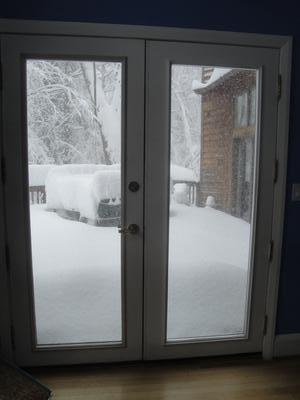
This shows the depth of the snow on the rear deck before the first blizzard was even finished. We got another ten inches or more in the second storm.
Photo: copyright Dale Amon, All Rights Reserved
An entire line of trees came down due to the heavy snow load. One could almost hear these poor enbarked-southerners crying out “But we’re not evolved for this!”
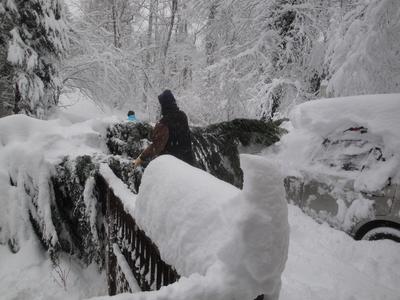
The railing and snow softened the blow so the car was luckily undamaged.
Photo: copyright Dale Amon, All Rights Reserved
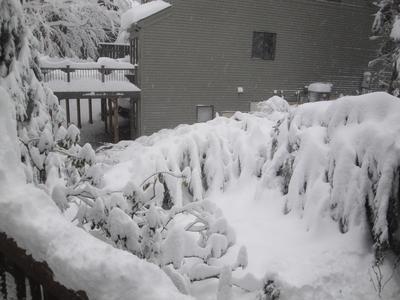
The entire row but one beside the next house.came down.
Photo: copyright Dale Amon, All Rights Reserved
After a lot of shoveling, I went walking through the snowdrifts down by the canal with the owner’s wife. This turned out to be a bit more of an adventure than either of us had expected and I heartily concur with those who tell you to stay with your car if you are caught in a blizzard outside of town. Our one mile hike felt like ten.

It really was beautiful though!
Photo: copyright Dale Amon, All Rights Reserved
I heard a crackling sound behind us and got my camera up just fast enough to catch the cloud of ice particles, snow and water as a tree fell into the canal.

This tree fall had someone to hear it and it definitely made a sound!
Photo: copyright Dale Amon, All Rights Reserved
The sun came out the next day and with blue sky it was a magical sight, despite the fact we were still without heat and still had the problem of the failed emergency generator to deal with.

The woods around the house were almost magical looking.
Photo: copyright Dale Amon, All Rights Reserved
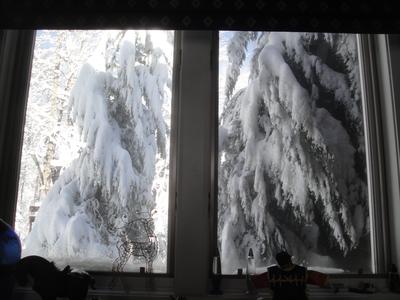
No, we were not attacked by Ent’s, but it was a damn near thing when the row of trees fell the other night!
Photo: copyright Dale Amon, All Rights Reserved
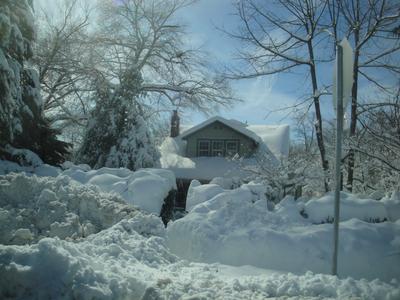
This is just a random house we passed while looking for a new generator.
Photo: copyright Dale Amon, All Rights Reserved
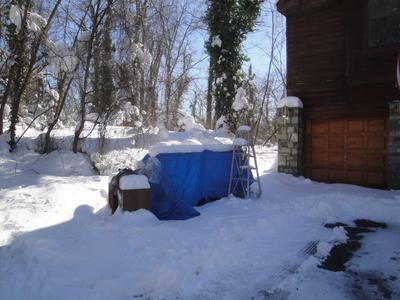
This is the ‘tent’ we built to protect the new emergency generator.
Photo: copyright Dale Amon, All Rights Reserved
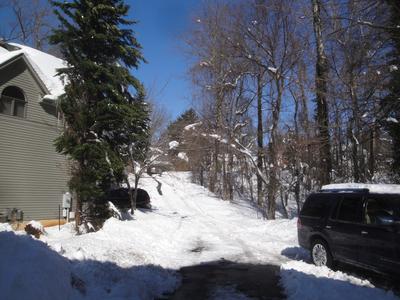
This is the 200 foot driveway two of us shoveled after the second storm. The snowblower made it through the first one and then croaked.
Photo: copyright Dale Amon, All Rights Reserved
I had a bit of fun with camera angles and the 7-8 foot high mounds of snow in a shopping centre parking lot. Perhaps it shows the area’s future. The glaciers will come again after all…
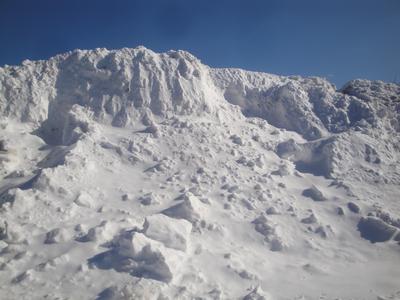
Is this the future of the DC area in a world of Global Cooling? Is it George Bush’s fault?
Photo: copyright Dale Amon, All Rights Reserved
“The Pope? How many divisions has he got?” Joseph Stalin is reported to have said dismissively. And we all know how that turned out.
Ron Paul, the “Dr No” of US politics for his habit of being the only member of the House of Representatives to vote against some measure to increase federal government spending, debt or power, could witness the repeat of such a peaceful realignment.
Tim Evans, writing on the Cobden Centre’s blog, has found that a Google search for “Ron Paul” will find over 28.8 million entries, whereas one for “Karl Marx” will generate a mere 6.26 million. As he concludes: “it is true that these things take a long time to play through, but as a sociologist I am excited by the long-term cultural, political and economic impact of these sorts of numbers” for the cause of a free world.
Presumably, a rise in online interest about Ron Paul, relative to Karl Marx, should translate into tangible results at some point. The election of Scott Brown the Republican challenger in the recent Massachusetts special election to replace Senator Edward Kennedy, was also preceded by a similar gap between the Google ratings of the various political parties’ candidates.
The battle over Google and Bing search engines
Google – Scott Brown has been mentioned 53,200,000 times on Google, while Martha Coakley has been mentioned 50,600 times on Google, the appointed Senator Paul Kirk has more mentions than the current Democrat candidate for that seat!
Bing – Scott Brown has been mentioned 52,800,000 times on Bing, while Martha Coakley has been mentioned 219,000 times on Bing…
It seems that Congressman Paul could put together more divisions than the cause of Marxism. Seems like a cheerful note to end the week.
Football: is the bubble about to fade and die?, asks Jim Thomas. No Jim Thomas, it is not. It may be about to burst. But bubbles don’t fade. Further figures of speech surge forward. “Damp squib”, “Macbeth levels of scheming”, “weathering the storm”, “walking towards the precipice”, “belt tightening”. Mix and mismatch at will.
Aside from this linguistic oddity, this short piece is quite interesting, listing some of the financial grief now afflicting various English soccer clubs. Thomas singles out Arsenal and Aston Villa for praise. Apparently, they have not been spending loads of money recently, hence their ability to weather the storm, avoid the precipice, etc.
|
Who Are We? The Samizdata people are a bunch of sinister and heavily armed globalist illuminati who seek to infect the entire world with the values of personal liberty and several property. Amongst our many crimes is a sense of humour and the intermittent use of British spelling.
We are also a varied group made up of social individualists, classical liberals, whigs, libertarians, extropians, futurists, ‘Porcupines’, Karl Popper fetishists, recovering neo-conservatives, crazed Ayn Rand worshipers, over-caffeinated Virginia Postrel devotees, witty Frédéric Bastiat wannabes, cypherpunks, minarchists, kritarchists and wild-eyed anarcho-capitalists from Britain, North America, Australia and Europe.
|





Recent Comments