We are developing the social individualist meta-context for the future. From the very serious to the extremely frivolous... lets see what is on the mind of the Samizdata people.
Samizdata, derived from Samizdat /n. - a system of clandestine publication of banned literature in the USSR [Russ.,= self-publishing house]
|
I am not going to talk about religious beliefs but about matters so obvious that it has gone out of style to mention them. I believe in my neighbours. I know their faults, and I know that their virtues far outweigh their faults. “Take Father Michael down our road a piece. I’m not of his creed, but I know that goodness and charity and loving kindness shine in his daily actions. I believe in Father Mike. If I’m in trouble, I’ll go to him. My next-door neighbour is a veterinary doctor. Doc will get out of bed after a hard day to help a stray cat. No fee – no prospect of a fee – I believe in Doc. I believe in my townspeople. You can know on any door in our town saying, ‘I’m hungry,’ and you will be fed. Our town is no exception. I’ve found the same ready charity everywhere. But for the one who says, ‘To heck with you – I got mine,’ there are a hundred, a thousand who will say, “Sure, pal, sit down.” I know that despite all warnings against hitch-hikers I can step up to the highway, thumb for a ride and in a few minutes a car or a truck will stop and someone will say, ‘Climb in Mac – how far you going?’
I believe in my fellow citizens. Our headlines are splashed with crime yet for every criminal there are 10,000 honest, decent, kindly men. If it were not so, no child would live to grow up. Business could not go on from day to day. Decency is not news. It is buried in the obituaries, but is a force stronger than crime. I believe in the patient gallantry of nurses and the tedious sacrifices of teachers. I believe in the unseen and unending fight against desperate odds that goes on quietly in almost every home in the land. I believe in the honest craft of workmen. Take a look around you. There never were enough bosses to check up on all that work. From Independence Hall to the Grand Coulee Dam, these things were built level and square by craftsmen who were honest in their bones. I believe that almost all politicians are honest. . .there are hundreds of politicians, low paid or not paid at all, doing their level best without thanks or glory to make our system work.
If this were not true we would never have gotten past the 13 colonies. I believe in Rodger Young. You and I are free today because of endless unnamed heroes from Valley Forge to the Yalu River. I believe in – I am proud to belong to – the United States. Despite shortcomings from lynchings to bad faith in high places, our nation has had the most decent and kindly internal practices and foreign policies to be found anywhere in history.
And finally, I believe in my whole race. Yellow, white, black, red, brown. In the honesty, courage, intelligence, durability, and goodness of the overwhelming majority of my brothers and sisters everywhere on this planet. I am proud to be a human being. I believe that we have come this far by the skin of our teeth. That we always make it just by the skin of our teeth, but that we will always make it. Survive. Endure. I believe that this hairless embryo with the aching, oversize brain case and the opposable thumb, this animal barely up from the apes will endure. Will endure longer than his home planet – will spread out to the stars and beyond, carrying with him his honesty and his insatiable curiosity, his unlimited courage and his noble essential decency. This I believe with all my heart.
– R. A. Heinlein.
An unfolding saga in the game of cricket in recent years has been the question of whether technology should be used to aid umpires in the case of close or potentially controversial decisions. Like many things in life, the question of whether to do this has turned out to be more complex than it may at first have appeared to be. There have been situations in which the on field umpire has asked for a replay, and the replay has been unclear but has none the less been used to overrule an on field umpire who probably saw more. There have been situations in which the players have appealed to a video replay that didn’t show anything, when they likely knew themselves what had happened and the situation would previously have been resolved with a gentlemanly code of conduct. There have been situations when the television company did not manage to produce the appropriate replay in time, and the umpire then made a decision that was revealed to be incorrect five minutes later. Many decisions depend on whether the batsman hit the ball, and a mixture of sound and picture is used to make these decisions, and determining which items of the bat, ball, ground, clothing, safety equipment etc came in contact with each other is often no clearer using the technology than not.
Fans of other sports are no doubt nodding at this point, as similar issues have come up in most sports that have attempted similar things. Cricket has one further issue, not unique to it but relatively central to it, which is the question of how technology should be used in the interpretation of the leg before wicket rule (LBW).
One of the principal ways of getting a batsman out is for the bowler to bowl at the batsman, for the batsman to miss the ball, and for the ball to then strike the wooden stumps behind him. It would be possible for a batsman to avoid getting out this way by his simply standing in front of the stumps at all times. In order to avoid this, the rules of cricket allow for a batsman to be out if he is standing directly in front of the stumps, the ball hits his leg, and the ball would have gone on to hit the stumps. (The rule is actually more complex than this, but the complexities are not relevant to the point I am making). The umpire stands in a good position from which to judge whether the ball will hit the stumps, and traditionally the umpire’s judgment has been used to decide whether the ball would have hit the stumps.
Umpires inevitably make mistakes, and there have been many accusations of umpire bias over the years. For a long time people have been watching replays in slow motion on television in order to second guess umpires, but these have never been conclusive. Occasionally an umpire will make an obviously wrong decision, but most of the time there is as much of an element of doubt watching at home as there is for the umpire. Or perhaps more: the umpire is in a better viewing position than the TV cameras.
In recent years, however, things have changed. The “Hawk-eye” system was initially used by television companies, and there was then pressure for it to be used in assisting umpires as well. Basically, this system looks at a number of video replays, and from them constructs a three dimensional model of the ball, the pitch, the bat, etc. From the this model, the path of the ball is extrapolated going forward. Television viewers see a computer graphic image of the ball hitting (or not) a computer graphic image of the stumps, and are told whether the ball would have hit the stumps and whether the batsman was or was not out.
Every since this system has been in place as part of television coverage, there has been pressure for it to be used in umpiring decisions. When people have asked me about this, I have stated my position with unexpected vehemence, particularly given that I am generally in favour of using video replays as part of the adjudication process. For I am, at present, unequivocally opposed to the use of Hawk-Eye and similar decisions in umpiring decisions.
My reason for this is as follows. → Continue reading: Of cricket and climate
That James Lovelock is a strange case, as discussed by Natalie here on Monday. After hearing him on the Today programme the other day, I had to interrupt my bath and rush off to make notes, yelling to my wife as I went that he’s an old charlatan. The immediate provocation was the claim that’s bothered me in the past and had me quarrelling with fellow members of a science journalists’ mailing-list – the claim that global warming could cut the world’s population to a billion. I don’t know where he got this from, but it’s fixed in his head now – he keeps saying it. He talks of the scientific sin against the Holy Ghost being to fudge the data, but there’s another mortal sin too – lending the weight of your authority to pronouncements made in a field in which you’re not actually expert. Calculating the demographic effects of such a geophysical change, if it’s possible at all, would be the province of a team of – what? – geoscientists, economists, geographers, sociologists (sociologists – right, yeah, duh, like they’re really going to be any use – as the young people say). It’s not something that can just be dreamed up in the noggin of an old greybeard who did some useful geophysics decades ago and then got deified for the barmy green non-hypothesis of Gaia.
When I read the notes of his Guardian interview published by Leo Hickman on the paper’s environment blog, I found the charlatanism mixed with all sort of stuff that sounds superficially congenial to libertarians. But it’s clear that he’s got no clear ideological compass to make sense of it all. He seems to think that climate science is in a mess because all these terrible oiks were churned out by state-funded education instead of the right sort of chap, like himself, that we had in the good old days. And the journalists are to blame too, presumably for demanding sensationalist answers from those naturally bashful creatures, the climatologists.
Whereas the journalists, when they do their job right, are part of the solution – part of the scrutiny that all specialists need.
While Nature had turned the paper down because so many others had already shown the existence of the problem, this referee recommended rejection because no evidence for the problem existed.
– Ross McKitrick, discussing the difficulties of getting sceptical papers on climate change published in climatology journals. Read the whole thing.
Three quick asides:
Firstly, McKitrick is Professor of Economics at the University of Guelph in Ontario, and the partner of Stephen McIntyre in many of the papers that have questioned Michael Mann’s hockey stick. Basically, McIntyre is someone of considerable quantitative expertise whose actual career is (shudder) in the private sector (in the mining industry) and who has done the heavy lifting, whereas McKitrick has provided oversight and experience of academia and the academic publishing process. At least, such is my impression. If I have undersold his contribution, my apologies. That said, this doesn’t seem to have helped greatly in getting papers published in climatology journals.
Secondly, this kind of thing seems to have happened a lot with respect to people attempting to take a sceptical line on climate change. Papers have been submitted to journals, relatively neutral referees have come out in favour of publication, but the papers have ultimately been rejected on the basis that they are unsuitable in some way with respect to the journal’s editorial policies. Really, this reveals weaknesses of the peer review process. Ultimately it is the editor of a journal who decides if a paper will be published. If an editor thinks yes, then he will find a way for peer review to support this belief, either by choosing tame additional referees or by overruling negative referees on technical points. If he thinks no, the tactic of changing the referees and/or the terms of reference under which the paper should be accepted is an old one, and one that has been used a lot in this field. McIntyre and McKitrick’s 2004 submission to Nature, which attempted to question the methodology of the Hockey Stick is a classic example. Initially both referees argued that the paper should be accepted, but somehow it was ultimately rejected.
Thirdly, the fact that neither McIntyre or McKitrick are climatologists is highly relevant. I suspect, though, that the argument is about how it is highly relevant. The Global Warming alarmist camp would say that it is relevant because they lack expertise on climatology and/or they are funded by the oil industry, I suspect. The sceptical camp would say that it is relevant because they are not part of a captive clique. The libertarian camp would probably say that it is relevant because they (or at least McIntyre) are not directly funded by the state, and are not being therefore funded to advance a pre-decided agenda. I will leave decisions about the appropriate level of cynicism to the reader.
Link via Bishop Hill
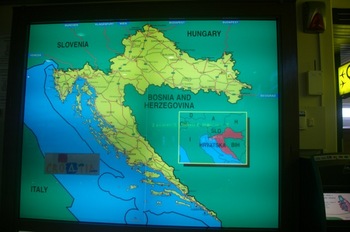
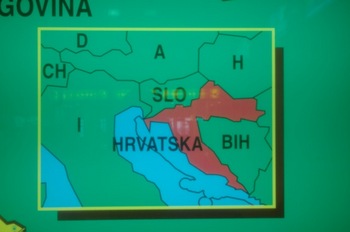
Yesterday, upon arriving at Pula airport in Croatia, I found a helpful map on one of the walls, showing the highlights of the country, and with a useful inset showing where Croatia fits in with other nearby countries.
I suppose they could have sent explorers to discover what actually exists in that uncharted wilderness to the east of Zagreb and Bosnia, but I suspect it was not worth it.
One of the tedious features of that TV phenomenon, the celeb chef, is how so many of them go on and on about the wonderfulness of buying local ingredients, implying that those evil, globalised behemoths – supermarkets – grind the faces of farmers, sell insipid products to the masses, etc. Like the US blogger Timothy Sandefur, I tend to take a dim view of those who turn up their noses as the many benefits of trade and the division of labour. And Mr S. has spotted this rather grimly satisfying story.
As I have said before, people who refer to such things as “food security” or the supposed joys of self sufficiency can sometimes overlook the fact that Man’s best insurance policy against shortages is a global division of labour when it comes to producing food.
“I have a feeling that climate change may be an issue as severe as a war. It may be necessary to put democracy on hold for a while.”
So says James Lovelock, originator of the Gaia theory.
Other than the fascism, Mrs Lincoln, he talks some quite good sense. For instance he says that “You need sceptics, especially when the science gets very big and monolithic.” I presume he envisages a situation where sceptics are still allowed to talk but not to vote.
On the BBC’s morning news show, was a short spot about unruly school pupils. One of the issues that was raised by the presenter was the fact that in a lot of schools, headteachers do not really have a very strong idea of what goes on in the classroom. A bit later in the show, a female headteacher was asked about this and she said something to the effect of “Well, I am on the road a lot and out of the school attending conferences and so on, but I have children of my own”.
Nice.
I confess I have done no more than skim this paper by Maxim Pinkovskiy of the Massachusetts Institute of Technology and Xavier Sala”i”Martin of Columbia University and NBER. I will have a go at reading it properly later. I got the link from Tim Worstall, who gets distracted from “ragging on Ritchie” into a rather moving defence of his belief that capitalism is the system that actually works when it comes to lifting hundreds of millions of people out of poverty.
I liked the title. I liked it so much I think I will type it out again.
African Poverty is Falling… Much Faster than You Think!
Waitrose sells Horse and Hound magazine.
Huh?
Didn’t they ban hunting, like, years ago? Yes. Yet Horse and Hound is still there on the hotly contested shelves of the Waitrose magazine rack, and in the posh aspirational section right next to Country Homes & Interiors to boot. I suppose some of the reason for H&H’s survival must be down to upping the quotient of writing about Princess Zara and her horse Toytown and downing the quotient about hunting. Even so, it must be galling for the anti-hunting activist community. Not what they imagined back in the heady days of 2004 when they were offering to help the government and police enforce a hunting ban.
At this point I could either launch into a detailed, link-filled account of whatever it is hunts actually do these days or I could just vaguely mutter some half-remembered stuff about how there is some get-out clause that allows them to chase the foxes with as long as they don’t actually kill them, or if they do it’s collateral damage or done for research or something. I shall do the latter and make a virtue of it, because vague half-remembered perceptions and their political consequences are what this post is actually about.
It didn’t stick. Thirty years plus of campaigning, thousands of letters to the editor, millions of Ban Hunting Now badges, at least three private members’ bills, Royal Commissions galore, keeping the faith in the dark days of Thatcher, then the dawning hope that this Bill might be the real deal, First Reading, Second Reading, Committee, Third Reading… then that last minute farrago with the Parliament Act when the Lords cut up rough, then finally Royal Asssent (through gritted Royal teeth, yeah)… all that and it still didn’t bloody stick. The hunts are still there, shooting foxes by firing squad or whatever they do, and the sabs are still there cutting off peoples’ heads with gyrocopter blades or whatever they do, and when the Tories get in, as they almost certainly will in three months time, they will repeal the ban.
I will rejoice. I have never seen the appeal of hunting, still less hunt-following, but hundreds of thousands of my fellow-citizens seem to like these pastimes, as their ancestors did, and a large proportion of the human race still do. The anti-hunt argument that does have some power to move me is the one about preventing suffering of a creature who can suffer. I myself prefer not to think too deeply about Mr Fox getting killed by dogs – but I do not see that it differs much from what Mr Fox does to rabbits. It’s a predator thing. As for the argument about humans, get lost. On those grounds the new puritans had about the same moral right to stop their fellow humans hunting foxes as they would have to stop their fellow mammals, the foxes, hunting rabbits. Another thing, it bugged me to hear people who, if they were to learn that Amazonian tribesmen, having been forced to give up their ancient traditions of the hunt, had taken to soccer and Playstations instead, would be heard from here to the Amazon squealing about Western cultural oppression – it bugged me to hear these same people cheering on the Western cultural oppression of their own tribesmen.
As well as rejoicing to see these puritans discomfited, I will rejoice because the repeal of the ban is a retrograde step. When one has gone in a wrong direction a backwards step is a good thing. Every generation or so the progressives have the presumption buried in their name for themselves knocked out of them and the whooshing noise is pleasing. Yet for most of the my lifetime their presumption has been justified. The progressive ratchet slips a little but mostly it moves on. What a liberation it would be to see the clock turn back, just to show it could! What strange new vistas it might open if one bad law were repealed. We could repeal some more. The smoking ban… the European Communities Act 1972… it might even have an effect overseas; at present most people seem to assume that President Obama’s historic achievement in passing the US healthcare bill is just that, historic. A historic change is a change that stays changed. But history turns round sometimes, as the original puritans found out to their cost in 1660.
So the repeal of the hunting ban will be a fine thing, and on that morning even I shall hear something of the
..long-drawn chorus
Of a running pack before us
From the find to the kill.
But the end of a bad law and the good example its end sets will not be the only reasons to rejoice. Sure, repeal will annoy the progressives but – as the fox understands the huntsmen – a law going against them for once in a while leaves their worldview intact. What I really will value in the repeal is that it will be symbolic completion of a process that has already happened. The Royal Assent on this one may be good fun for her Maj, and me, but the really subversive thing is that people will say, “Oh, they’ve got rid of that law… didn’t know it was still on the books, actually. I’m sure I saw Horse and Hound on sale on Waitrose.”
Just read an article by Afua Hirsch in the Guardian called “How can lawyers help Haiti?”
“By going away” was the general opinion expressed in the comments. A little harsh, I thought, given that establishing a more solid rule of law might indeed help reconstruction there. But I am not really interested in that coz my gob just got smacked. In passing, Ms Hirsch mentioned this little fact:
…what is happening to millions of extra dollars pouring into a country that already had a staggering 10,000 NGOs before the earthquake. For an island with a population of fewer than 10 million, there is at least one NGO per 1,000 people.
Blimey. Ten thousand. Not ten thousand people, ten thousand organisations. Of the sort called “non-governmental” although that is a lie. And that was before the earthquake. Ah well, ’tis an ill wind that blows nobody any good. Just think, had not the earthquake come along all these helpers might have solved all Haiti’s problems and left themselves with nothing to do.
“So you live beyond your means and rack up a bunch of bills you can’t cover. So you go to your rich uncle. He’s tapped out, alas. And tired of supporting you. So he goes to his rich uncle who’s even richer and known for his desire to keep the family name unsullied. But what if he’s tapped out? Those are my thoughts when I read this story that Sarkozy is supporting Merkel in getting the IMF to bail out the Greeks. The IMF is the richer uncle. Eventually the other guy runs out of money. We’re going to have to start borrowing from Mars or Venus soon.”
– Russ Roberts, at the Cafe Hayek blog.
|
Who Are We? The Samizdata people are a bunch of sinister and heavily armed globalist illuminati who seek to infect the entire world with the values of personal liberty and several property. Amongst our many crimes is a sense of humour and the intermittent use of British spelling.
We are also a varied group made up of social individualists, classical liberals, whigs, libertarians, extropians, futurists, ‘Porcupines’, Karl Popper fetishists, recovering neo-conservatives, crazed Ayn Rand worshipers, over-caffeinated Virginia Postrel devotees, witty Frédéric Bastiat wannabes, cypherpunks, minarchists, kritarchists and wild-eyed anarcho-capitalists from Britain, North America, Australia and Europe.
|





Recent Comments