We are developing the social individualist meta-context for the future. From the very serious to the extremely frivolous... lets see what is on the mind of the Samizdata people.
Samizdata, derived from Samizdat /n. - a system of clandestine publication of banned literature in the USSR [Russ.,= self-publishing house]
|
Joe Kaplinsky, who is a biophysicist just completing his PhD at Imperial College, gave a talk on the state of the climate issue at Christian Michel’s salon the other evening. His main point was that there has been a shift in the debate between the 1990s, when the environmentalists were down on the supposed uncertainties of science, and today, when their refrain is “the science is settled”.
Correspondingly it is the sceptics/deniers/denialists/contrarians who now harp on the theme of the uncertainties of science. Joe wants to damn both their houses, but I was not very clear why from his talk, and I think the same went for most of his listeners. I got a better idea of what he thinks when I found a review of his book, which I mention below.
Joe quoted from a wide range of writers. There was one amusing episode that I had not known about. Frank Luntz, an adviser to Bush, was reported as saying that:
“the scientific debate is closing against us.” His advice, however, is to emphasize that the evidence is not complete. “Should the public come to believe that the scientific issues are settled,” he writes, “their views about global warming will change accordingly. Therefore, you need to continue to make the lack of scientific certainty a primary issue.”
Bruno Latour, distinguished Gallic “theorist of science”, was disconcerted. He had been arguing all this time that the notion of science as an objective and impartial process of discovery is bogus, and now that self-same thesis was being used by a hated Bushist to draw entirely the ‘wrong’ conclusions. “Was I wrong?” he asked himself. I have dug up his self-flagellation – in an article called “Why has critique run out of steam?” This is rather a long quote, but it is too good to miss:
Do you see why I am worried? I myself have spent sometimes in the past trying to show the “lack of scientific certainty” inherent in the construction of facts. I too made it a “primary issue.” But I did not exactly aim at fooling the public by obscuring the certainty of a closed argument–or did I? After all, I have been accused of just that sin. Still, I’d like to believe that, on the contrary, I intended to emancipate the public from a prematurely naturalized objectified fact. Was I foolishly mistaken? Have things changed so fast?
… entire Ph.D programs are still running to make sure that good American kids are learning the hard way that facts are made up, that there is no such thing as natural, unmediated, unbiased access to truth, that we are always the prisoner of language, that we always speak from one standpoint, and so on, while dangerous extremists are using the very same argument of social construction to destroy hard-won evidence that could save our lives. Was I wrong to participate in the invention of this field known as science studies? Is it enough to say that we did not really mean what we meant? Why does it burn my tongue to say that global warming is a fact whether you like it or not?
… Maybe I am taking conspiracy theories too seriously, but I am worried to detect, in those mad mixtures of knee-jerk disbelief, punctilious demands for proofs, and free use of powerful explanation from the social neverland, many of the weapons of social critique. Of course conspiracy theories are an absurd deformation of our own arguments, but, like weapons smuggled through a fuzzy border to the wrong party, these are our weapons nonetheless. In spite of all the deformations, it is easy to recognize, still burnt in the steel, our trade mark: MADE IN CRITICALLAND.
Hilarious. → Continue reading: Made in Critical Land
To all intents and purposes, the banking industry inside the EU has ceased to have any serious claim to be a part of the free market. The EU has voted to cap bonuses for bankers, introducing remuneration controls that look pretty draconian.
Of course, defenders of such controls might say that we are where we are: the modern banking industry, with all its privileges, “too big to fail” ability to claim taxpayer support, controls on capital ratios, and the rest, means that banking has not been a proper model of free market behaviour for decades. That is true. But capping bonuses is about the least relevant reform that policymakers could make, though no doubt this panders to the sort of anti-banker sentiment that also recently encouraged Germany’s government to impose, without warning, controls on the investment techniques of hedge funds. The radical overhaul of our banking system advocated here, for example, is not really considered.
We are in the best of hands, as Glenn Reynolds likes to say.
Germane to Michael Jennings’ post below pertaining to Prince’s declaration that the “Internet is completely over”, I had a brief conversation with a decidedly winsome 20-something young lady, elegant yet edgy (she was a cut glass accented thoroughbred Sloane Ranger wearing ‘All Saints’). She was sitting in a sandwich shop in a well-heeled part of town… expensive Apple laptop open as she availed herself of the free WiFi whilst having luncheon…
The following really happened, serious, not joking.
Samizdata Illuminatus “Did you read that Prince thinks the ‘Internet is completely over”? He refuses to release any of his music on it at all”
20-Something-Young-Lady “Really? Umm… I did not even know he was a musician.”
SI “Well, yes…he is. He is one of the great guitarists of our time.”
20-S-Y-L “Hah, that’s funny! I cannot picture that old foggy playing a guitar! I thought he just spent his time playing polo, messing with architects and hugging trees…”
SI “No, no, no, not Prince Charles… ”
20-S-Y-L “Prince William? No, I am sure you must mean Harry! Oooo! Yummy Harry with a guitar!”
SI “No, the American musician called ‘Prince’.”
20-S-Y-L “Oh, I see. And this chap calls himself ‘Prince’? That’s hilarious!”
SI “He used to call himself ‘Squiggle’.”
20-S-Y-L “I’m sure I’ve never heard of him.”
SI “I suddenly feel very… old’.”
20-S-Y-L “I’ll download something of his off Bit Torrent and see if he’s any good.”
I do not believe she immediately grasped the sheer transcendent irony of the moment.
The internet’s completely over. I don’t see why I should give my new music to iTunes or anyone else. They won’t pay me an advance for it and then they get angry when they can’t get it. The internet’s like MTV. At one time MTV was hip and suddenly it became outdated. Anyway, all these computers and digital gadgets are no good. They just fill your head with numbers and that can’t be good for you.
– The artist formerly known as The Artist Formerly Known as Prince, explaining why he isn’t getting down with the tubes.
It will be found an unjust and unwise jealousy to deprive a man of his natural liberty upon the supposition he may abuse it.
– George Washington
Now I am usually harsh in my criticism of the National Health Service and indeed I wish to see it abolished entirely… but credit where credit is due. This was a very, er, uplifting example of ‘Enterprise Thinking’ by the NHS.
Carry on, Doctor!
Apologies to Samzidata readers if you have already seen this, but I had not, and boy, this is just gooooooood.
Great was the lamentation among the staff of the General Teaching Council when Michael Gove, Her Majesty’s Secretary of State for Education, decided to abolish it. Less great was the lamentation from pretty much anyone else. Teachers did not seem bothered.
In case you were wondering the GTC is…
Don’t go away! Sex! Nazis! Nazi sex! Oh, all right, no Nazi sex. But there are evil Australians, so keep reading.
… the GTC is an official body that regulates teachers. When talking to teachers it described itself as in some sense belonging to them; the equivalent of the British Medial Association or the Law Society. (Alas for teachers’ bank balances, it was not nearly as good at conspiring against the public as these two bodies are.) When talking to government it downplayed that aspect and up-played its aspect as a government-appointed regulator.
Anyway Mr Gove has said he will abolish it. A bloke called Martin Dean, co-chair of the Public and Commercial Services Union at the GTC, defended it in this Guardian article.
I was particularly struck by one of the arguments he used to bolster his claim that the GTC was a worthwhile body. He writes,
Gove should have been aware that the GTC has identified over 10,000 people who were teaching but not qualified, and has taken action to facilitate their removal from classrooms. We are still called upon by employers to clarify overseas-trained teachers’ professional qualifications, and we contact headteachers to inform them if one of their staff is not suitably qualified.
In other words the GTC tracked down ten thousand teachers against whom no complaint had been made and forced their schools to sack them, caring nothing for the disruption that caused to the education of the children they were teaching. Ten thousand people who were peacefully doing their jobs had their jobs taken away from them because they did not have the right pieces of paper. In most cases it was not even that these were unqualified teachers (not that I would care, but some people do); in fact most of them were qualified teachers, just not qualified in Britain. What the GTC has heroically put a stop to is the tradition, beneficial to school and teacher alike, of young teachers from Australia and New Zealand doing a few years in Britain before going home.
Consider again that these words were put forward by a member of the GTC in an effort to make people like it more.
Well done, Mr Gove. Now if you could just drop your own magical thinking and credentialism (he has proposed to “increase the status of teachers” by forbidding the profession to those with only a Third class degree*), you might turn out to be quite a useful education minister, in so far as such a thing can exist.
*CORRECTION: Commenter rosscoe says “I don’t think he’s said that people with a third can’t be teachers just that the tax payer won’t pay for their training.”
“Those who desire to give up freedom in order to gain security will not have, nor do they deserve, either one.”
– Benjamin Franklin.
Happy 4th of July to my American friends and relations. This is a good day for all Anglospherists to remember.
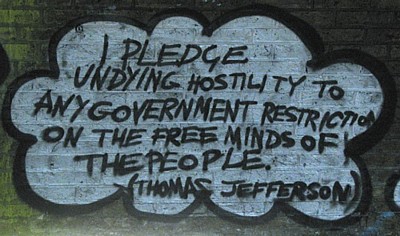
The words are mainstream anarcho-lefty stuff, but the name being quoted is a bit of a departure for the place where I spotted this. I took this photo in March, in Leake Street, which is a tunnel under Waterloo Station where graffiti artists do their best and their worst, with results that constantly change. Thank my Photoshop clone for how clear those words are. I went through the Leake Street tunnel again today and wondered if this sign had survived, but of course there was no sign of it. Here is how Leake Street mostly looks.
Frequent samizdata commenter ‘Jaded Libertarian’ wants to ask a question:
After a number of years dwelling on the matter I think I have just about got what I personally believe straight. The guide I have used to get there is what I believe to be both moral and just. I am not particularly well read in this area, but have thought myself to a fairly classical liberalism – nothing that has not been said before. No man has the right to transgress another’s liberty unless he is causing physical harm to another’s person or property – that kind of thing. I now know what I believe and that is great. I never tread on another person’s autonomy if I can help it. So how do I get the rest of society to extend me the same courtesy?
Here’s where I have run up against a wall.
To effect political change that would enshrine the rights of the individual would require imposing this system on a great many people who do not want increased personal autonomy – and what is more they do not want me to have it either. It scares them. Much as I disagree with them, it is not for me to seek to impose upon them a life they do not want, even if they do not extend me the same courtesy. To do so would be most illiberal.
The only way in which some good could come of such thinking would be if someone was willing to degenerate the rights of naysayers in order to enshrine the rights of everyone else. This seems to have been what (partially) happened in the USA, and many still reap the benefits. But it would be unwise to try and repeat the process. First of all it seems morally dubious at best. Secondly, history has shown us that political revolutions almost always result in dictatorships and tyranny. America was an aberration never to be repeated.
My own thinking thus far is that knowing what I believe and how I will act is, for now, enough. Society is after all made up of individuals. If by some bizarre chance every single person resolved to respect one another’s liberty, we would find ourselves in utopia overnight. Of course that is not going to happen, but then everyone else’s motivations are none of my business and it is not for me to criticise.
I try to live by the words of Burns:
Then let your schemes alone, Adore the rising sun, And leave a man undone. To his fate
Sadly although it eases my own heart, it does not get me away from the fundamental flaw in libertarianism. I am compelled to live under collectivist tyranny, something which I would never wish upon another.
How can libertarianism ever be anything more than a nice intellectual exercise to put yourself through if it cannot be acted upon by its very nature?
Contrary to what most people had assumed, banking in the United States had been highly stable in the decades before deposit insurance. Of course, depositors were concerned about their safety, but this made them cautious in whom they banked with. They demanded reassurance from their banks, and the banks gave it to them. Pressure from depositors forced the banks to be conservative, to lend carefully, to keep their leverage ratios low, and to disclose their broad positions. The bankers themselves were conservative even in their dress, but this was itself reassuring, and the solid architecture of the banks’ offices reinforced the notion that they were pillars of the community with solid roots in it. The key to banking was maintaining the confidence of depositors and not taking that confidence for granted.
Before deposit insurance, a bank that took too many risks would eventually undo itself. It would do well for a while, increasing market share and generating better shareholder returns than the fuddy-duddy banks, which would feel the pressure. However, come the inevitable downturn, the cowboy bank would experience heavy losses on its questionable lending, liquidity would tighten, and a point would come where the frightened depositors would run for their money: the cowboy would be literally run out of business. These occasional crises were unpleasant, but good for the long-term health and even stability of the system: the runs would expel the cowboys from the system and give a salutary reminder to those who survived. The system itself was rarely seriously at threat, because the depositors would redeposit their funds with the safe banks. There would typically be a flight to quality, a transferring of funds within the system, rather than a run on or threat to the system as a whole. Thus, it was the threat of a run that kept the bankers in line.
Once you introduce deposit insurance the situation changes profoundly. Deposit insurance allows the bankers to take their depositors’ confidence for granted. This takes the pressure off the bankers, who can now safely increase both their lending risks and their leverage ratios, thereby increasing returns to their shareholders (or, in modem Wall Street, to themselves). For their part, the depositors are no longer concerned with the risks their banks are taking, but only with the rates they get on their deposits. Consequently, deposit insurance subsidizes risk-taking, so leading to excess risk-taking with the deposit insurance agency and, ultimately, the taxpayer, picking up the tab.
Nor does the damage end there. With deposit insurance, there is no longer any run to fear and even the most insolvent banks following the most unsound “shoot to the moon” investments can now remain in business indefinitely, attracting more funds and staying in business by merely raising deposit interest rates. The process of competition then becomes utterly subverted: instead of allowing the conservative banks to drive out the cowboys, even if it takes a little time, the process of competition now rewards the cowboys and penalizes the good banks. It therefore pays to become a cowboy and, eventually, all banks do.
– From Alchemists of Loss by Kevin Dowd and Martin Hutchinson (pp. 271-2). Pictures of the two authors here, taken at the launch of the book last Wednesday evening at the Institute of Economic Affairs.
|
Who Are We? The Samizdata people are a bunch of sinister and heavily armed globalist illuminati who seek to infect the entire world with the values of personal liberty and several property. Amongst our many crimes is a sense of humour and the intermittent use of British spelling.
We are also a varied group made up of social individualists, classical liberals, whigs, libertarians, extropians, futurists, ‘Porcupines’, Karl Popper fetishists, recovering neo-conservatives, crazed Ayn Rand worshipers, over-caffeinated Virginia Postrel devotees, witty Frédéric Bastiat wannabes, cypherpunks, minarchists, kritarchists and wild-eyed anarcho-capitalists from Britain, North America, Australia and Europe.
|






Recent Comments