We are developing the social individualist meta-context for the future. From the very serious to the extremely frivolous... lets see what is on the mind of the Samizdata people.
Samizdata, derived from Samizdat /n. - a system of clandestine publication of banned literature in the USSR [Russ.,= self-publishing house]
|
Over at Instapundit (and at various other places), Glenn Reynolds has recently spent a lot of time discussing the question of whether Higher Education (and particularly Higher Education in the US) is essentially yet another debt fueled bubble in the process of popping. His reader Peter Galamga recently said the following, implicitely condemning quite a few fields of study and the academic departments associated with them
I think the days of spending the equivalent of a mortgage on one of the many two-word degrees (the second word is usually “Studies”) are coming to a close.
Although the second word might often be “Studies”, I think “usually” is too strong. In particular, one should also be extremely suspicious of courses and fields where the second word is “Science”. These are very seldom worthwhile, and are even less often actually science. “Biology” is good. “Plant Science” is bad. “Statistics” is good. “Political Science”, less so. “Meteorology” and possibly even “Climatology” is likely good. “Climate Science”, I will leave to you.
That said, I think things are much more likely to be okay of the second word is “sciences”. In particular, I can think of one or two truly formidable “Natural Sciences” programs. Does anyone else have any thoughts on this?
Some people may remember Natalie Solent writing a post on Samizdata about statist developments in Kenya (a post inspired by a BBC report – of all things).
Predictably a from-central-casting leftist commenter turned up – accusing Natalie Solent (and even nice, gentle, fluffy me) of lies, ignorance…
Well Glenn Beck has actually read the new Kenyan Constitution, passed last week (even I could think of better things to do than read the small print of the new Kenyan Constitution – for example pluck out some of my nose hairs, so if Glenn wants to use his failing eyes to read the thing for the rest us…) and he read out sections of it on Monday, live on his show.
There is a list of “positive” rights (i.e. nice things the government must do for you) – wild promises of health, education, and so on. The idea that these can be afforded even in a developed economy (in the long term) is problematic – as for in an economy like Kenya, the idea is absurd.
Also (as even the Economist magazine admitted – although, of course, it supported the new Constitution) large areas of what are presently privately owned land can now be taken by the government.
Lastly – we have an interesting definition of “freedom of speech” (the very thing that Natalie was pointing to) . “Hate speech” is excluded from “free speech” protection – and hate speech is defined as an attack on a group, or an individual (which just about covers everything one might use a right to free speech to do). I am sure that Frank Lloyd (President Barack Obama’s “Diversity” Commissar at the Federal Communications Commission) would love to introduce such a Constitution in the United States (no naughty Fox News, or talk radio or internet to upset him any more), Kenya may even replace the Venezuela of President Chevez as his favourite country.
Although there are no explicit use of words like “Marxism”, the style in which the Kenyan Constitution is written (and a lot of the content – see above) is very much like the old Soviet Constitution – not a nasty, negative, set of limitations on government power like the United States Constitution.
Almost needless to say Comrade Barack Obama spent a lot of money making sure the new Kenyan Constitution was passed – although Glenn Beck did not mention that point. Although Glenn did mention that this sort of Constitution was the “Dream” of Barack Obama’s Marxist pro Soviet father (not to be confused with his Marxist mother or socialist maternal grandparents, or his Marxist childhood mentor Frank Marshall Davis, or his fellow Marxists in New York whilst a post grad, or the Marxists he worked with for his whole adult life in Chicago, or his Marxist Liberation Theology Minister for twenty years Rev. J. Wright or…), as made clear (if one reads carefully) in Barack Obama’s own first book “Dreams…”
A friend of mine has looked into the Kenyan constitution – I hope I do not have to read it (i.e. I am forced to when some moron, or paid hack, comes along and say it is a wonderful example of truly limited government), from the sound of even this bit it seems like the Constitutional document equivalent of a snuff film.
His initial comments were:
I’ll stick to other countries’ coffee now, the rights enumerated are amazing, even goods and services. Why didn’t Marx think of simply enumerating legal rights to plenty? Were the massacres encouraged as a reason for the new Constitution? Clause 10 is bad enough; 34 (4); 43; 66, 73 etc.
How do I enforce my rights (were I Kenyan) under 43 (1) (c): By not paying in a restaurant? Everyone is obliged to uphold the Constitution 3 (1). OK, start saving up for the Famine relief now…
No wonder the Economist magazine supported it (no I am not saying they are Marxists – they are just whores who always try and get into bed with the powerful) and Comrade Barack spent American tax money to make sure it passed.
The vile ContactPoint database, which held details about every child in England and was accessible to hundreds of thousands of professionals has been switched off.
I have to say that in pulling the plug the government has confounded my gloomy predictions that no matter who won the election civil liberty and privacy would be equally poorly served.
Good comment to a BBC article on the subject here:
I work with large data sets professionally (I am a data architect working with large companies). ContactPoint was always going to fail, either disastrously through its own failings, or through an eventually inevitable political decision. The experience of data management within public and private organisations is that almost any data set like this will eventually end up on a laptop or a memory stick which then gets lost, and that users need to be carefully trained and monitored to ensure appropriate use. That was never going to happen here, with 300,000 users in a number of organisations, roles and lines of business, spread across the country.
Dr Robert Daniels-Dwyer, Oxford
However Simon from Doncaster feels differently:
David Cameron, in my view, will be directly responsible for any child who is abused in whatever form as a result of scrapping this system. How long before another Victoria Climbie? Well, with the cut backs to child social care, expect more and more and no doubt it will be local authorities who take the blame. This government is a disgrace.
Where did you say you worked again, Simon?
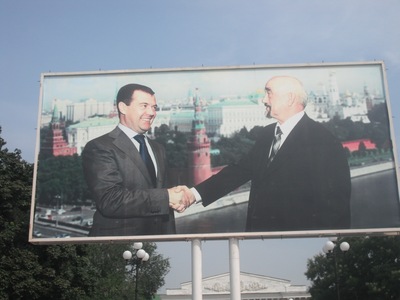
 Tiraspol, Transnistria. August 2010.
Amusingly, these two billboards are in front of adjacent buildings. Both, alas, are some distance from the brandy distillery that appears on the Transnistrian five rouble banknote.
The British government want to sign up to the Schengen Agreement… but they want the police state parts of it without the free movement of people parts of it
– Guy Herbert
One Catherine Bennet has yet another article in the Guardian about that jam experiment. Hers is called Since when was giving people a choice a good idea?
It is not merely the chorus from anguished parents (and patients), that they cannot exercise choice where there is no spare capacity, that might give a rational education secretary pause, but a growing body of research indicating that too much choice is overwhelming. Gove will know of the much cited experiment with jam, by the US academic Sheena Iyengar, which found consumers were more than six times more likely to buy a pot if they had to choose from six varieties, rather than 24. If uncertainty about preserves is a problem one can probably live with, or possibly enjoy, a similar helplessness in the face of big, irreversible decisions is, to judge by a new study, State of Confusion by Professor Harriet Bradley of Bristol University, something that should worry a government that advertises choice as an unmitigated good.
Mr Eugenides says,
So, just to recap: a woman who used to live with a lord in a 365-room mansion, now in a household with a combined income of some quarter of a million pounds a year, has read a PR puff commissioned and paid for to advertise a price comparison website, and uses this as evidence that we should all just take what we’re given by the state and shut up.
Ironically, price comparison websites are themselves a market mechanism for making choice easier.
I say, to Catherine Bennett and the next fifteen journalists to go into an ecstasy of servility when pondering this little demonstration that some people find shopping boring, shut up about the jam already. It’s jam. The process of choosing it has no deeper meaning. Unless one is a connoisseur of jam, in which case one probably finds choosing between 24 varieties a pleasing experience, as people usually do when shopping for something that interests them.
Look at it this way, Ms Bennett. You have twice to my knowledge chosen a man as mate and helpmeet. Was making that choice from all the prospective partners you could have had ever stressful? There is some literature – like about half of it – to suggest that some people find it so. Some people regret their choice. The evidence suggests that you have at least once. Can we assume that if by any sad chance you find yourself seeking a man again you are willing to let a civil servant choose for you?
The danger is not that a particular class is unfit to govern: every class is unfit to govern.
– John Dalberg-Acton
I have expected this to come along as it seemed an obvious market step for SpaceX. They have announced their plans to enter the Heavy Lift arena.
If you are familiar with the politics in DC right now, this really puts the cat amongst the pigeons.
 Constanta, Romania. August 2010
Rand Simberg attended the Boeing press conference and has supplied some notes on their CST-100 plans.
I am glad to see there will be competition in the LEO cargo and business passenger field. As much as I like Elon and what he has accomplished, there is nothing like real competition to grow the market.
No libertarian purist is going to love London’s new public bike hire scheme but it is nearer to harmless than many other state schemes. Apparently it looks to be quite popular. The same cannot be said for Melbourne’s scheme, launched two months ago with high hopes and high rhetoric about the benefits of cycling for people’s health and the environment. The reason for these “ranks of unused blue bikes” is that another bunch of health-promoting statists had queered the pitch.
Andrew Bolt in the Australian Herald Sun writes:
Most cities around the world with such a scheme – a network of docking stations of hire bikes – have found it works a treat. Take Montreal, a city Melbourne’s size, which in its first five months logged a million rides.
But Melbourne? Two months after parking 600 bikes in 50 docking stations in the city, the Government has sold just 70 rides a day.
The reason is as simple as it was predictable, and Melbourne Bike Share’s own surveys picked it up as the most cited disincentive: it’s having to wear a helmet.
The blogger, David Thompson, who seems to have the knack of unearthing all matter of weird and wonderful stuff for his Friday postings, also has a posting about a far less amusing subject: the cringeing of certain Western, post-modernist types when confronted with a direct, brutal example of violence by the Taliban.
This is what I meant in my previous post about the fact while radical Islam poses a threat that should not be underestimated, there is nothing inevitable about that threat succeeding. What is necessary is for the heirs of our great institutions to start growing a pair, so to speak.
|
Who Are We? The Samizdata people are a bunch of sinister and heavily armed globalist illuminati who seek to infect the entire world with the values of personal liberty and several property. Amongst our many crimes is a sense of humour and the intermittent use of British spelling.
We are also a varied group made up of social individualists, classical liberals, whigs, libertarians, extropians, futurists, ‘Porcupines’, Karl Popper fetishists, recovering neo-conservatives, crazed Ayn Rand worshipers, over-caffeinated Virginia Postrel devotees, witty Frédéric Bastiat wannabes, cypherpunks, minarchists, kritarchists and wild-eyed anarcho-capitalists from Britain, North America, Australia and Europe.
|





Recent Comments