We are developing the social individualist meta-context for the future. From the very serious to the extremely frivolous... lets see what is on the mind of the Samizdata people.
Samizdata, derived from Samizdat /n. - a system of clandestine publication of banned literature in the USSR [Russ.,= self-publishing house]
|
Hello, what is this? BBC comedians (Armstrong and Miller, no less) making fun out of the failure of Global Warming to be … warm?
Spotted by the ever-alert Delingpole, who has the video up at his blog. It’s under a minute long and is a must-see, if you’ve not already seen it.
I wonder if it was that earlier viral video, the one in the classroom with the exploding kids, that alerted these guys to the comedic possibilities of this debate? The reaction to this latest piece of (I trust) internet virality will be interesting.
Reflecting on the Wikileaks issue – see Perry’s post on Samizdata on Saturday – it occurs to me that one group of folk who must be a bit miffed by the leaks are parts of the anti-war side, especially those of a conspiracy theory cast of mind. For example, where is the leaked memo that “proves” there was some evil Jewish/neo-con/international banker/armsdealer/insert villain of choice conspiracy to blow up the WTC and then blame it on bin Laden? And I note that one of the leaked cables suggests that the Saudis are very alarmed by the geo-political ambitions of Iran, and want the West to contain it. Well, that surely fits with what a lot of those supposedly bloodthirsty neocons around George W Bush had been saying. And so on.
The leaks have done damage, no doubt about it, and unlike Perry, I am not so sangine about the overall impact of Wikileaks as far as rolling back the state is concerned. This is one of those things I find hard to be able to prove conclusively one way or the other; generally speaking, the more openness, the better, and the fewer hiding places for governments, the better. I also think, however, that leaks of secrets that may harm self defence efforts of genuinely liberal states against terrorist groups, if they occur, are enough to send such leakers to jail on the grounds of being reckless in offering, however unintentionally, aid to such groups.
But it is, nonetheless interesting that none of the dottier conspiracies swirling around 9/11 have yet to appear. The reason is that such conspiracy theories are bunk.
Philip Johnston write that “Vested interests are protecting administrators and forcing cuts to vital services” in an article about PFI contracts (Public Finance Initiative).
But for the most part “privatisation” is a meaningless distraction. The only realistic way to reduce state expenditure is to actually shed state functions as the root cause is not which mechanism the state uses: direct employees funded with taxes or outside hired hands funded with taxes.
Either way, the people who carry out state functions are creatures of a system funded by taxes rather than subject to the rigours of actual market pressures… until everyone in the chain can go broke as a consequence of their actions, it is still a state structure regardless of who is making the wheels go around.
Indeed every time the state bales out a bank regardless of the moral hazard, they spread the decision skewing and insulated-from-consequence disease associated with being supported by taxes.
To reduce state expenditure, you need to get the state out of all but its “core business”. You need to remove whole function of what the state does, not just hire different people to do it. The real problem is a century of ‘mission creep’. Until you can countenance that you are not serious about reducing the bloated state.
But I don’t get the impression that Cameron and his Coalition are any more interested in personal liberty or rolling back the frontiers of state than their predecessors. The “Big Society”, indeed, is a watered-down version of the sort of bogus, grand, unifying scheme employed in the Fascist Italy of the Thirties.
–James Delingpole
My id always said that an article by a Freudian therapist would be a sloppy half-cooked pizza of generalities and buzzwords, and this one in the Guardian by Darian Leader is much as expected:
Therapy occupies a unique space in the modern world. In a culture obsessed with surface and statistics, it allows the detail and narrative of a human life to be explored. Where society tells us what to be, therapy allows us to reflect critically on the imperatives that shape us. Challenging received notions of wellbeing and happiness, we can try to find out what is really important to us, often with life-changing consequences. It offers a system of values freed from the moral judgments of social authorities.
Then he whinges away about how his woo is going to be regulated, and throws in a couple of digs at the “market-led vision of human life” for good measure. While complaining about being regulated. Boo Woo Hoo.
There is only one thing stopping me having a really good laugh. His complaint is just. His concern is justified.
(And, unusually, Tim Worstall, whose blog is linked to by the word “woo” above, is wrong.)
If people, for reasons that seem good to them, want to pay to spend time with a therapist, what right does the Health Professions Council have to force the interaction into a tidy format of input and output? Who asked them to the party?
There seems to be a growing belief among our dear protectors that whenever money changes hands then their guiding presence is necessary. They generously allow us to speak more or less as we choose to our friends, lovers, and random blokes on the Clapham omnibus, but as soon as a cheque is written, they say, away flew an invisible invitation to make a threesome: me, you, and the government.
I see no logical justification for this. Some people might end up paying for therapy and then feeling they had wasted their money. That is sad. It is also sad that in my time I have wasted good money on dresses that looked bad on me, plays that I left during the interval, and exercise machines.
Come to think of it, money you can get back. Time is irrecoverable. I am still traumatized by the fact that in 1978 I watched 17 episodes of the original Battlestar Galactica thinking something interesting might happen. Some people who have experienced therapy say it was a waste of time; others say it saved their sanity. My only opinion on the matter is that the Health Professions Council has no right to an opinion on the matter. Certain clear categories of abuse or fraud by therapists have long been forbidden in law. If someone’s beef with their therapist is big enough for them to sue, then the State might just have a role. Other than that, the bureaucrat should not intrude.
It is easier to resist at the beginning than at the end.
– Leonardo da Vinci
This started off as a reply to a comment on Samizdata but by the time I reached the fifth paragraph, I realised it might as well be a full blown blog post. Below is the remark to which I was replying but this article is now really about explaining why I have moved from tentative opposition to inescapable support for Wikileaks.
When the Saudi diplomat expressed concern about Iran – something that he would not have done without the presumption of secrecy – that information was intended for the American government and no one else.
This is actually the very core of the ‘systemic attack’ that Assange has made on nation-states. It is precisely by attacking their ability to informally and easily exchange casual and often banal information that has such remarkable implications on the ability of states to act the way states act.
It does not need to be “the date of D-Day” kind of revelations (the kind I too want to remain secret) that can significantly interfere with a state’s ability to act as a ‘conspiracy’ (and not in the “Grassy Knoll” or “Bilderburg” or similar gonzo conspiracy theory sense)… indeed I wish Assange had never used the word ‘conspiracy’… I have long described the Green movement ‘Warmists’ as a ‘confluence of interests’ rather than a ‘conspiracy’… but I actually mean the exact same thing when discussing the Greens as Assange means when he describes Government as a ‘conspiracy’…
But if you are someone of the view that the modern regulatory welfare state has vastly too much power over its subjects, and that these states are unreformable from within the ‘democratic’ systems… the very systems that have been in place during the growth of this overweening state power, then a valid way to oppose that power is to carry out systemic attacks on the very networks that allow that ‘confluence of interests’ to express what those interests are and to thereby find ways to achieve that confluence. → Continue reading: Why I support Wikileaks
If Assange can be convicted of a crime for publishing information, that he did not steal, what does this say about the future of the First Amendment and the independence of the internet?
– Ron Paul
Jim White at the Daily Telegraph has a good piece about the recent unjust – in my view – sacking of Newcastle Utd manager Chris Hughton. Apparently, Hughton’s “mistake” was that he was a “nice” person: straight-talking, honourable, considerate towards his players and unwilling to suck up to the owners of the club. White points out that it is silly to suggest that “nice guys” cannot do well in sports management or sports more generally, and cites examples such as Andrew Strauss, the England cricket captain, whom I have met and thought was a very likeable person; tennis gods Rafal Nadal and Roger Federer, two gents who are brilliant players, and for that matter, the late Sir Bobby Robson, football management great and all-round fine man. I hear stories that Sir Alex Ferguson, the gruff-appearing Scotsman who manages Manchester United, takes a fatherly concern for his players, especially the younger ones. Another example of a nice guy doing well in sports management is Harry Redknapp, currently doing great things at Spurs and presiding over a very entertaining team.
I think the same point about decent people able to achieve greatness because, not despite, their niceness applies in the realms of business, too. Generally speaking, some of the best business people in my experience are certainly hardworking and committed, even aggressive, but they are not nasty pieces of work. That is how anti-businesspeople imagine business people should be. Alan Sugar, the front man for The Apprentice TV show, hams it up by coming across as a total monster, which is presumably what the TV producers want. In reality, any businessman who behaved like that would lose a lot of talented staff. Being a tosser is not a great business strategy, as far as I can see, but there obviously exceptions.
In politics and sport, I can, of course, see why aggression, even nastiness, can be a winning strategy given that politics and sports are, in some ways, zero-sum. If politician A achieves office, he or she does so by pushing B out of the way. And that sort of eye-gouging gets worse the greater the stakes are, such as in totalitarian systems. Hence FA Hayek’s point, in the Road To Serfdom, about why “the worst get on top”.
Anyway, I hope Hughton gets another job in football management from a club that values his qualities. No wonder Newcastle Utd fans are steamed.
Tim Worstall has a new book out, Chasing Rainbows, which sets out what he regards as the economic fallacies of much of the Green movement. Such fallacies, he argues, actually get in the way of solving or at least trying to handle the genuine problems that may exist.
What is good about Tim’s book is that he is not some sort of cliched “denier”; he does not base his argument on the idea that AGW is some sort of evil collectivist con-trick or piece of doomsterish nonsense (although I am sure some commenters will want to raise that point). Rather, he says if there are problems caused by a buildup of CO2 in the atmosphere, and there are costs of such problems, then let’s use the tools of economics. For instance, he talks about carbon taxes. I am not a fan of taxes, but I can see a certain logic. They are far better than carbon credits and carbon trading, in my view.
Like Nigel Lawson, I see the idea of a market in carbon credits not as a solution to AGW but as something with great potential for fraud. The question I have about carbon tax, however, is what happens to the revenues. If they are levied by nation states, then clearly there will be demands for such taxes to be “harmonised” and levied by some sort of single organisation. And then the question arises as to what happens to such revenues?
Much of the book bears many of the trademarks of Tim Worstall’s own excellent blog: lots of data flecked with his caustic wit, often at the expense of such buffoons like George Monbiot and Jonathan Porritt, and on tax, the appalling Richard Murphy, who gets a solid going over at least once a day. There is a touch of PJ O’Rourke in how Tim likes to use a quip to make a serious point. I particularly like the way he gets hold of important concepts, such as the Law of Comparative Advantage, or the idea of opportunity costs, using examples of how forcing households to recycle waste imposes unpaid labour costs, which if added up, can be shown to represent a large cost. Being a good student of the great French classical liberal Frederick Bastiat, Tim understands the point about “what is seen and what is unseen” – understanding that the visible costs of environmental degradation need to be balanced against the unseen costs of trying to deal with it. Bastiat is one of those writers who ought, in a sane world, to be on the compulsory reading list of every school pupil.
The central message of this book is that there are problems, but there are also rational approaches to them, and that the Green movement, or at least its most collectivist parts, are blocking rational reforms. It is a similar point to that made by Matt Ridley in his book, the Rational Optimist, to which I have referred before. By their one-eyed focus on AGW alarmism, and by adopting a reactionary, command and control approach to the issue, they are blocking sensible alternatives, and also crowding out other issues, such as alleviation of poverty, which can be made worse by such foolish ventures as subsidies to biofuels, for example.
Chasing Rainbows makes for a good stocking filler this Christmas. Go on, do it for the children and for Tim’s bank balance.
New media has empowered citizens around the world to report on their circumstances, express opinions on world events, and exchange information in environments sometimes hostile to such exercises of individuals’ right to freedom of expression.
At the same time, we are concerned about the determination of some governments to censor and silence individuals, and to restrict the free flow of information.
– State Department spokesman Philip Crowley, announcing at UNESCO that the US intends to commemorate World Press Freedom Day next May. The theme will be “21st Century Media: New Frontiers, New Barriers.”
We are in to the last half hour of the countdown for flight two. This time there is a real Dragon capsule, a vehicle which will be tested in orbit and then put through a re-entry, the first to be done by a private venture. This is a difficult sequence and even partial success is a major step forward. It is the second flight of a designed from the ground up launch vehicle; the first flight of a pressurized capsule that will someday be manned; and the first re-entry and recovery for the capsule.
It is a lot to accomplish and I will be reporting on what I see.
0854: The are proceeding to terminal count with no holds. Terminal count is when all of the interesting things happen. Preumably they have polled all of the key people for launch go. Terminal count will start in 1 minutes at t-10 min.
0856. Terminal automatic sequence is running…
0859. T-7. Chill down progressing. All going well.
0900. Chill down complete.
0903. The rocket is in terminal account. They have gone to a terminal count abort. They are safing it now.
0904. This is not unusual. The engineers will check out the reason for the abort and possibly correct it within this launch window or delay until later today. They have several possible windows today. They will probably recycle to at least t -10 if things can be cleared. Second launch window will be the next option.
0915. The time has recycled to t-13. No word yet as to the reason for the abort. Could be just a minor item that is out of bounds or a too tight constraint. This happens nearly every time. They detect things on their rocket that I doubt anyone else does and have an automation level that is far beyond the competition.
0920. The next open slot is 10:36 to 10:45 Eastern time. That is 15:36 to 15:45 UTC (GMT). No word from the engineers yet.
0934. Back channel info is that it was a problem with the range telemetry and they are fairly sure they know the source of the problem. They had a similar issue on Flight 1, although I do not have enough information to say whether it is exactly the same issue or not. Everyone is currently showing a retry in the next slot, although nothing official has come out yet.
0936: It is official. Retry in about an hour. Sounds like it was a problem in the link to the ordinance on board. Whether that was destruct or other is not clear to me yet.
0948. Okay, they’ve given detail publicly now. It was a false abort on the telemetry monitoring the self destruct explosives. A correction has been made to their database and they will proceed with the countdown at the next TDRSS (Tracking and Data Relay Satellite System) window in a bit under one hour.
1022. They are polling the net prior to restarting the count. at t-13.
1033. Polling for restart of terminal count… everything looking good so far. Prechill in progress.
1038, Chill down complete, Now they go to internal power in preparation for lowering the umbilical tower…
1052. Dragon is in orbit!
1054. My post mortem. The launch was nearly flawless. They have definitely got their control equations down pat this time as the roll attitude was rock steady from lift off through orbital insertion. Staging was perfect. No sign of any impingement of the separating 1st stage with the 2nd stage engine. The have again demonstrated capabilities that I do not believe anyone else has, with their automated sequencing, their ability to detect and abort on problems and then to analyze and retry without weeping and wailing and burning of midnight oil. The one day delay from Tuesday to today was due to a factor that would have scrubbed other vehicles for days if not longer. That delay was due to cracks in the expander extension. They simply removed it for this flight. When a rocket goes upwards the external pressure falls to zero and changes the way the jet expands. For vacuum operations you need a longer expansion nozzle to extract the most energy out of the hot gases. For this flight they did not need that wee bit extra so they did without it.
The Dragon capsule is now due to orbit the Earth 2-3 times before they do the re-entry. I will keep my ears open for the results. I am also going to be listening to find out of the first stage comes down in a recoverable condition this time. It is Elon’s long term goal to be able to recycle stages to bring costs down even further but so far there has been little success there. They will get to it… it is far less important than the goals they have reached.
All in all, this has been a very good day for commercial space.
1216. A little bit more post mortem. One glitch that has been noted, not a particularly big one and one that happens on other rockets as well, was a bit of a fireball from the umbilical during liftoff. This was caused by drainage of fuel left in the hoses. Some thought it was a pretty good size fireball. It would not be notable except that this is only the second flight so everyone was a bit nervous about anomalies. The Dragon capsule is in orbit and is exercising its Draco thrusters and being put through its paces. Re-entry will be in 2-3 hours, somewhere off the coast of Mexico I believe. There have been no reports yet on the splash down of the first stage. Telemetry on it lasted fairly long this time so it may have remained intact through its re-entry this time. I’ll pass on anything else I pick up over the next few hours. Personally, I think I’m going to go out and celebrate with a large coffee.
1402. I’m just back from a coffee and doing a bit of obligatory work… while I was away the capsule re-entered and parachuted into the Pacific. All flight parameters were nominal for human space flight. The only item still to be ticked off is the recovery of the first stage from the Atlantic. I have seen nothing yet as to whether it survived its return. I will let you know when I find out. The new age has dawned. Private manned orbital activity is now possible although a couple years away. SpaceX is running an aggressive but prudent test program and will not fly people until the F9 is a few more flights up the learning curve. They may also (for NASA use) be required to use an rocket escape tower on the capsule.
1443. What with all the excitement due to the main event, I completely forgot to mention that they *also* released several small payloads, ‘CubeSats’ for paying customers. So this was not only an Engineering test, it was also a commercial (although high risk) flight.
1507. I am still catching up with things. Just to let you know: the capsule was on floats within 35 minutes of the drogue chute deployment. That tells you the re-entry was right on target. Great work SpaceX!
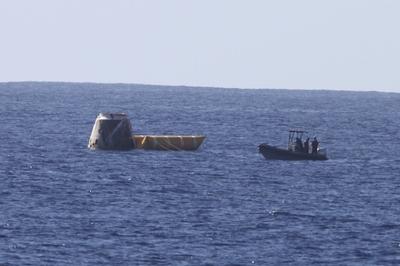
Dragon Capsule after splashdown in the Pacific.
Photo: rcvd by Gwyne Shotwell’s mobile phone from the Pacific, with thanks to SpaceX
1545. Elon Musk just announced another surprise. After separation from the capsule, they relit the 2nd stage engine and sent it into an orbit with an 11,000 km apogee. Now is that cool or what?!! Elon has also said that in the future the Dragon capsule will land propulsively and be ready for turn around and re-use. The heat shield was barely touched… it was designed to handle lunar and martian return re-entries. They have confirmed that it would take the worst case… as an alternative to the Orion. Unconfirmed: Gwynne Shotwell says the landing was within 800m of the target point.
1600. Elon has said that NASA said if all went well, the next flight might be allowed to do prox-ops at the space station. Everything went smashingly on this flight, so there is a high probability the next Dragon will go to ISS. First stage re-entry gave them a lot of data, but was not successful. Elons says it will come eventually… this is a long term goal that they are approaching incrementally. No one has ever done it before with a liquid first stage. It might take 2-3 years to beat this one down.
1608. If you are on line right now, you can watch the press conference here
1658. The Press conference is over and I am about to call it a day on this live blog and attempt to do some work. There is one other item that Elon stated which has to be repeated. The Dragon capsule has nearly the same volume as the Orion capsule. Dragon has a heat shield which can survive a Mars return re-entry, which Orion cannot. It is probably a more capable spacecraft than Orion. It costs far less and has sucked up a fraction of the cost of the Orion thus far. And now, to top it off, Dragon has flown and landed. Orion is still on the ground. Enough said?
Viva la capitalism!
With that, I bid you all a good night… and that’s the way it was… Wednesday the Eighth of December, two thousand and ten.
|
Who Are We? The Samizdata people are a bunch of sinister and heavily armed globalist illuminati who seek to infect the entire world with the values of personal liberty and several property. Amongst our many crimes is a sense of humour and the intermittent use of British spelling.
We are also a varied group made up of social individualists, classical liberals, whigs, libertarians, extropians, futurists, ‘Porcupines’, Karl Popper fetishists, recovering neo-conservatives, crazed Ayn Rand worshipers, over-caffeinated Virginia Postrel devotees, witty Frédéric Bastiat wannabes, cypherpunks, minarchists, kritarchists and wild-eyed anarcho-capitalists from Britain, North America, Australia and Europe.
|





Recent Comments