We are developing the social individualist meta-context for the future. From the very serious to the extremely frivolous... lets see what is on the mind of the Samizdata people.
Samizdata, derived from Samizdat /n. - a system of clandestine publication of banned literature in the USSR [Russ.,= self-publishing house]
|
In the post below, Jonathan quotes Theodore Dalrymple saying the following rather mind-boggling statement.
“[Journalists are taxed at lower rates than normal people] … this is a considerable privilege, definitely worth preserving. It creates an identity of interest between the elite and the journalists, who are inhibited from revealing too much about anyone with powerful protectors.”
He thinks this is a good thing? Seriously? Journalists have an incentive to cover up the wrongdoings of the powerful, and this is good?
Leaving aside the obvious corollary of this, that France effectively licenses journalists, I personally do not think that politicians and bureaucrats should have any right to privacy whatsoever. They choose to go into politics, and they are trusted with our money and are given considerable power over us. In return, everything they do up to and including going to the toilet should be subject to scrutiny. They should have some protection against being libelled (but even then a relatively weak right – the burden of proof should be on the politician and it should be necessary to prove both untruth and malice). In truth I am not that keen on extending much of a right to privacy to anyone else either. As long as you are telling the truth, you should generally be able to say it out loud, in any forum. This is one case where the Americans have it right with the First Amendment.
As for the vulgarisation of culture, London is the most culturally vibrant city in Europe. Culturally speaking, Paris today is about as interesting as English food circa 1955. At least, Paris inside the peripherique is. There are some interesting things going on in rap music, language and art in some of Paris’ suburbs, but I doubt that Dalrymple is much of a fan. The price of cultural interestingness may be some vulgarity, but who gets to decide what is vulgar and what is art? Old men decrying the tastes of yoof today, I guess. The Nazis were very keen on doing this, too. As are the Chinese communists.
China is a deeply authoritarian place. As a consequence of that, the country is culturally pretty dead. The Chinese watch imported movies, and encourage their children to learn to play western classical music. What is produced domestically and gets wide distribution is frighteningly bland, which is what happens under authoritarian regimes. Interesting things can be going on underneath, which can sometimes lead to cultural explosions when the authoritarian regimes are gone (see Spanish and South Korean post-dictatorship cinema, for instance), but China is a way from that.
Who do you compare China with, though? There is one obvious rival.
In late April, a couple of days after some unspeakable barbarians had exploded a bomb in a restaurant in Marrakesh, I was sitting in a cafe in Fez, in a more northern part of Morocco. As in many cafes worldwide, there was a television in the room. This was showing a soap opera of some kind on a pan-Arabic TV channel. (There are many, many, many pan-Arabic TV channels. They are run out of Qatar and Dubai. Moroccan roofs have more satellite dishes on them than I have seen anywhere else on earth). This particular pan-Arab channel was showing a soap opera or a popular movie of some kind.
In any event, the program in question contained some Islamic symbols. There were mosques in the background of a few scenes. The TV was showing subtitles in Arabic. I am not sure if that was because the program was originally in some other language or if these were just closed captions in the same language as the original material, turned on because there was a lot of background noise. (It may have been that the program was in fact Pakistani, and the original language was Urdu, but I am not sure). In any event, though, the program contained musical dance numbers of a form that were familiar to me. And there were slightly more bare female midriffs than one expects on TV in an Arab country. I expect there were more than one sees on domestic Moroccan TV, too, which partially explains the satellite dishes. Morocco is authoritarian enough to censor its own TV, but not authoritarian enough to attempt to ban the dishes.
The program was not made in India, but the grammar of the program was entirely that of Bollywood. In North-West Africa, in the Arab world, one of the leading cultural influences is clearly India. This is hardly surprising. Go to Dubai or Abu Dhabi or Qatar and who does the actual work? People from South Asia; Indians and Pakistanis and Sri Lankans. Even when they are making programs for Arab markets, they use their own cultural reference points. Even when making programs for their own market, Pakistanis use Indian cultural reference points. However it happens, and however second or third hand it comes, the cultural influence of Bombay on the Middle East and North Africa is clearly immense
And is Bollywood vulgar? Oh Lord yes. More conservative Indians elsewhere in the country denounce its amoral wickedness as much as anyone in America has ever denounced Hollywood. The entertainment industries of India are run by gangsters at least as depraved as any who have ever run Hollywood or Las Vegas. It isn’t any great coincidence that the most savage terrorist attack carried out by Islamic extremists in recent years was on the city of Bombay. This is the heart of wickedness and vulgarity, and they know where the enemy is. Indian culture is vibrant and vulgar. On the surface and in the mass market at least, Chinese culture is dead. And Indian culture is the country’s greatest weapon against its enemies.
I used to read Theodore Dalrymple (aka, Antony Daniels) quite a bit, and some of his collections of essays, such as “Life At The Bottom”, are searing and very honest depictions of problems in the modern world, even though I find them to be short on remedies.
But while I can share some of his horror at certain trends – such as welfare dependency – there is an increasingly marked level of sustained, Daily Mail authortarianism and the sky-is-falling-in hysteria in his work, a sort of constant refrain that everything in the world is getting more “vulgar”. (A certain amount of vulgarity is, if you think about it, a sign of health, or life generally). A particularly good example of this sort of humourlessness can be found in an article about the attractive sister of one of the new UK royals.. In that article, he made a generally good point but as is increasingly the case, overdid it to such an extent that he seemed to be doing what a lot of British grand journalists do: wallow in disgust at his fellow countrymen and women while at the same time keeping the object of his supposed disgust in continued view.
His current obsession is the “vulgarity” of modern culture, and, presumably, a desire that something less vulgar takes its place. Some idea of how Dalrymple thinks that might be achieved can be seen in this not terribly convincing defence of France’s draconian privacy laws, which muzzle the media in its coverage of the shenanigans of public figures, such as the disgraced former head of the International Monetary Fund. He writes of how Mr Strauss-Kahn’s personal life was kept private by the French media:
“Had the French press and media failed in their duty, or had they maintained the correct distinction between private and public life? The French often pride themselves that they are more respectful of the private life of public figures, more mature about sexual matters, and generally less prurient, than les anglo-saxons, who are at one and the same time libertine and puritanical, in short grossly hypocritical.”
“It is obvious that the two opposed policies – to tell all or say nothing – have different disadvantages. The first leads, when carried to excess, to a general vulgarisation of the culture, well-illustrated by Britain, the most vulgar country in the world (at least that is known to me). The second, when carried to excess, leads to the impunity of the powerful in a sphere well beyond the private. Since most policies are carried to excess at some time or another, the question amounts to this: do you prefer the vulgarisation of culture to the impunity of the powerful? Within limits – and clearly there are limits in France – I prefer the latter.”
He then writes about a tax issue as it affects journalists in France. I was not aware of this tax issue, but if true, this proves that French civil society is even more buggered than I had imagined:
“One of the reasons, not generally adverted to in the foreign press, for the journalistic silence about the behaviour of the elite is the special tax regime that journalists enjoy in France. In a country with very high tax rates, where a visit from the fisc is viewed with about as much pleasure as a visit from the Gestapo, this is a considerable privilege, definitely worth preserving. It creates an identity of interest between the elite and the journalists, who are inhibited from revealing too much about anyone with powerful protectors.”
Here’s another paragraph. I love the silkiness of how TD talks about the “tolerance” of French society:
“Should the French press have told all before the events in New York – with the implication that the events might then have been averted? It seems that Strauss-Kahn’s behaviour went considerably beyond the normal even for a tolerant country.”
No kidding.
“It might be argued that his private behaviour in France made him unsuitable for his post in the IMF, not because he was incompetent, but because he was incapable of conforming to the mores of the country in which the IMF had its seat.”
Ah, ze great seducer cannot be allowed to live in eeevil, puritan Amerika. Seriously, is the author of this piece arguing that a man who uses his power and influence to not just seduce, but allegedly attack, women, would be suitable in any part of the world, be it New York, Paris or Tokyo?
“As in so many matters, the relevance of a man’s private life to his suitability for a position of public trust is a question of judgment, rather than of hard and fast rule. Public figures are not, and will never be, plaster saints; and wisdom before the event is always considerably more difficult than wisdom after it. Boring as happy mediums no doubt are, I should wish for just such a happy medium between corrupt French indulgence towards the elite, and vulgar, hypocritical, prurient British interest in the elite’s private affairs. If, for some reason, a happy medium were not possible, I should prefer the French way.”
In other words, a largely ineffective press. For all its many faults, I prefer the British way. After all, in the end – after a lot of attempts – the UK media were able to bring down a number of bent members of parliament over the expenses issue. As I write, there remains coverage of the venality of officials at FIFA, the global football organisation; the UK media has also in the past been willing to cover the corruptions, major or minor, in places such as the EU. And in the US, the First Amendment means that the shortcomings of politicians are covered. Yes, such a “muck-raking” press can be hypocritical, but for example, does anyone imagine that a journalist such as Bob Tyrrell could have hammered Bill Clinton under a French system of law?
This was one of the more splendid comments that we have had on Samizdata in quite some time: David Gillies, regarding this manifest steaming pile: the deceptively named “World Health Organisation” claiming mobile phones increase the risk of brain cancer.. even though there has been no observed spike in brain cancer despite the explosive growth in the use of such phones world wide….
This has been headline news in every newspaper I have seen, including the leading daily here in Costa Rica, and none of ’em have been fit to wrap fish in (I’d wager there’s a far higher carcinogenic propensity in the ink used to print this shit.) Non-ionising radiation? Check. Sub-milliwatt power levels? Check. No causative mechanism that survives the laugh test? Check. Decades of use and no detectable increment in tumours at the lax 2.0 relative risk for publication in a halfway-reputable journal? Check. Defeats the null hypothesis at the 95% confidence interval? Ha ha ha, oh my sides. Soundbite-ready quacks straining in their traces to leap into the running on CNN and Fox and Sky and the Beeb to peddle doom-mongering (but possibly book-selling) crap? Mais bien sur, a regiment of them. The disgusting WHO ready to dip its grubby fingers into the whole stew of idiocy and rent-seeking? Ho, yus, my chilluns, and when were they ever not? Pathetic.
If you cannot, within say 30 seconds, get a ballpark figure for the photon energy in microelectronvolts of an 1800 Mhz photon (and why that matters), or describe qualitatively what a femtowatt is (not quantitatively, oh no, that won’t do at all) or give a fairly robust description of what ‘3 dB/octave’ means when it comes to microwave absorption coefficients then shut your face, crawl back under your silly epidemiological stone, and die of something real and not imagined. Maybe the publication-hungry pseudoscientists that infest this field might be able to do all of the above as some sort of parlour trick, but the notion that your average journalist could is as laughable as spaniels doing differential equations. And this isn’t the argumentum ad verecundiam, like it is with the global warming zealots. There’s practically no-one in the hard sciences who thinks that microwave radiation is a causative agent in cancers. It’s lies, sophistry and nonsense. The really big question to ask (like with the AGW scam) when you see a scientific fraud being perpetrated on this scale is, as ever, cui bono?
– David Gillies
Meanwhile, over at the global superpower, the public is slowly waking up to the fact that this government, too, is going bust, thanks to out-of-control entitlement programs, expensive bailouts, and the suicidal policy of everlasting peace through everlasting war. For the past six months, all of the United States government’s issuance of new debt has been bought by its compliant central bank and paid for by the printing press. As the politicians of this empire in decline are fiddling on the aptly named Capitol about a few billion in savings here and a few billion there, trillions are getting burned by the unstoppable state machinery. And over in Albion, the hotly debated “savage” cuts in public spending still seem the figment of tabloid imagination as they have so far not prevented the country from accumulating another £145 billion in debt over the past 12 months.
– Detlev Schlichter
Though a World Health Organization study concluded cell phones may cause cancer, some are wondering why, if their truly is a link, there not been a significant worldwide increase in brain cancers.
Go figure. But of course providing excuses for more regulations, and more funding for further studies, is the reason bodies such as the World Health Organisation exist.
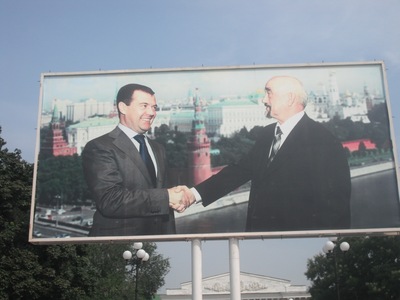
Dmitri Medvedev and Igor Smirnov
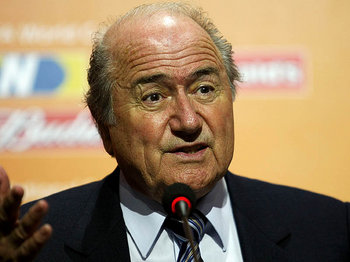
Sepp Blatter The British tabloids are this week shocked (shocked) by revelations that FIFA, the international governing body of Association Football, appears to be deeply corrupt. The bizarre decision to give the hosting rights to the 2022 World Cup to Qatar (which has a tiny population of well under 2 million people, no football culture or traditions, no suitable stadiums, and a great deal of political uncertainty) has received particular criticism. Alternative bidders for that 2022 event included the United States, who have facilities in place such that one thinks they could hold the event next week if they wanted to, plus Japan, Korea, and Australia, all of which would require slightly more preparation but who could none the less hold the event without much fuss if they wanted to.
The fine Scottish journalist Andrew Jennings (no relation) has spent much of the last two decades attempting to publicise the corruption and deeply unsavoury connections of FIFA, UEFA, the International Olympic Committee, the motorsport body the FIA, and various other sporting organisations. He has found this to be a deeply thankless task. The trouble with sporting administrators everywhere is that they are allowed to play by different rules to everyone else. Typically, they are arrogant, venal, and often deeply stupid, but the glamour of their product is such that politicians, journalists, and various other people who should know better will flatter them, and will suck up to them in return for their favours. The articles and books and television programs of the aforementioned Jennings have contained very few things that have not ultimately turned out to be true, but in return for this he has been shunned by both the sporting world and much of the world of so called “respectable” sports journalism. Sports journalism is a strange thing. It is pretty much required to be biased, the journalists themselves are always very close to the people they cover, and the narrative that they write is not required to greatly resemble the truth, as long as the narrative is good.
I confess that the only thing I find interesting about the decision to give the 2022 World Cup to Qatar is the level of hubris involved. After holding the 2010 World Cup successfully (although in some ways expensively to FIFA’s coffers) in South Africa, FIFA now seems to believe that they can hold the event anywhere. A host nation’s lack of preparedness is possibly even an advantage. When preparations go wrong, FIFA can take over the running of the event, and provide expensive “consultants” that it pays for with its own money. If a lot of construction is required, this is good. Construction industries are often corrupt. The opportunities for graft and corruption are greater. The less prepared the host nation, the more of this can happen.
So Qatar appears to make perfect sense to me. Once you figure out that FIFA officials like to be heavily bribed while being treated like medieval feudal monarchs, and you then ask the question as to which potential host country is best at treating them this way, and you accept that the decision as to who would host the 2022 World Cup was made solely on this criteria, things become entirely uninteresting.
What is actually more troubling is the decision to give the 2018 World Cup to Russia. This decision has received less disdain in the English press in the last week (despite the fact that one of the countries that lost out to Russia was England) possibly due to the decision being not quite so obviously absurd as Qatar 2022. Russia is after all a large country. Russia does have a little of a football tradition – their national side is a second ranking European side that sometimes qualifies for big events and sometimes doesn’t, and their clubs are good enough to be competitive in the UEFA Cup/Europa League (ie the second division of intra-European competition) without being quite good enough to be competitive in the Champions League (the genuine first division). And Russia is a big, somewhat belligerent country that is perceived to be powerful. Russian money already influences football further west – from Russian ownership of English club Chelsea, to a surprising number of shirts with “Gazprom” written on them in Germany and other clubs further East.
Once again though, from the point of view of what might have actually been the best bid, the decision to give the World Cup to Russia was absurd. Of the other bidders, both England and Spain/Portugal were in the category of bidders who could have probably hosted the tournament this time next week. Given the tournament to either of these bidders would have seen the tournament hosted by the most famous and storied stadiums in the footballing world, run by organisers who are used to hosting capacity crowds approximately once a week. The combined bid of Belgium/Netherlands was not quite as good, but was still much better. Russia on the other hand requires a lot of new stadiums in what is (despite the brash glamour of Moscow) a country with baroque bureaucracy and crumbling, second rate infrastructure. Moscow may appear flash, but visitors to some of the secondary venues may find them less so
At this point, I am going to digress to somewhere that may initially seem tangential and irrelevant. I hope my readers will forgive this for a moment. There is method in my madness.
Last August, I visited the Republic of Transnistria, which is a breakaway region of the Republic of Moldova. Moldova is principally Romanian speaking, but is an ethnically complicated place. (Romania is also an ethnically complicated place, but in not quite the same way). Approximately, during the second World War, the Soviet Union (disgustingly and immorally) annexed the easternmost portion of Romania, which it combined with a sliver of territory it already held east of the Dniester river to form the Moldavian Soviet Socialist Republic. As with most places in the USSR populated by non-Russians and particularly by non-Slavs, the Soviets attempted to settle Moldova with ethnic Russians. They had been at it in that eastern region over the Dniester for longer, so that portion of the Republic of Moldova was by the late 1980s pretty much exclusively Russian (not even Ukrainian). Moldova proper appears today to be ruled by a political elite of Romanian speakers mixed with a business elite of Russian speaking mafioso types.
In any event, upon the dissolution of the USSR at the end of 1991, and after a short but bloody war the Russian speaking region east of the Dniester river seceded from Moldova with the aid of the Russian army to become the Republic of Transnistria. The Russian Army is present in Transnistria to this day. The Russians like having an outpost this far West. Transnistria borders the pro-Russian region of the Ukraine near Odessa. Transnistria became the personal fiefdom of a dictator with a gloriously Bond-villain sounding name: Igor Smirnov. Transnistria is a rather grim and depressing place, at least partly because it retains the symbols of the former Soviet Union: hammers and sickles, ostentatious military parades and monuments, other dubious stuff. Transnistria’s independence is recognised by no generally recognised states – not even Russia. (It is recognised by other breakaway regions of former Soviet republics: South Ossetia, Abkhazia, and to some extent Nagorno-Karabakh).
When you go to Transnistria and in particular its capital city of Tiraspol, it is not all that clear what is there, beyond weird remnants of communism. The Kvint distillery makes some of the finest spirits in central Europe, but the fact that a country feels the need to put a brandy distillery on its five rouble banknote does tend to suggest that there is a certain sparcity of other legitimate economic activity. There are terrible rumours of arms dealing, drug and human trafficking, the peddling of bodily organs of dubious provenance, and various other activities frowned upon in respectable places.
But, of course, there is the Sheriff factor. There is a logo of a single company on all kinds of businesses: supermarkets, petrol stations (can one say subsidised Russian oil money, by the way?), a mobile phone network (using the CDMA/IS-95 technical standard that unlike GSM family standards does not require registration with the certificate authorities of the ITU, of which Transnistria is not of course a member), a television channel, a construction company, even the aforementioned Kvint brandy distillery. Basically, a single conglomerate controls pretty much the entire Transnistrian economy. It has two main managers and shareholders, former KGB agents Viktor Gushan and Ilya Kazmaly, and it has all kinds of special privileges in Transnistria that no other companies are allowed. (Most notably, Sheriff is the only company in Transnistria that is allowed to trade in foreign currencies directly). These privileges were granted by Igor Smirnov’s son Vladimir Smirnov, the head of the Transnistrian customs service Despite occasional public spats with Gushan and Kazmaly, it is fairly widely acknowledged that Sheriff is a front through which Igor Smirnov controls, profits from, or at least plunders the Transnistrian econony.
Dedicated football fans might just be starting to understand the purpose of this digression, as a team named Sheriff Tiraspol have been seen in European football recently, in the previously mentioned Europa league. Although Transnistria claims to be a separate country from Moldova, its football teams compete in the Moldovan league. The Moldovans presumably originally tolerated this because this was originally a de-facto acknowledgement that Transnistria was in fact part of Moldova, and expelling Transnistrian teams from the league would have suggested this was not so. Or possibly they were pressured by Russia, and by Russia’s friend’s in FIFA and UEFA, or by the Russian mafiosa who rule Moldova in concert with the Romain speaking politicians. Or something.
In any event, approximately 15 years ago, the omniscient Transnistrian Sheriff corporation founded a football team, named FC Sheriff Tiraspol. With money that came from somewhere or other, that corporation recruited players from Africa and Latin America, and it rapidly became the dominant team in Moldova. And when I say dominant, I mean dominant. Sheriff have won every Moldovan league since 2000. In European competition, they are good enough to at times qualify for the group stage of the UEFA Cup/Europa League. This tends to imply they are about as good as a middling first division Dutch club, perhaps.
Moldova is perhaps the poorest country in Europe. Transnistria appears bleak next to Moldova. However, the one non-bleak place in Tiraspol is Sheriff Stadium, which is a beautiful 15,000 seat football stadium built to the highest standards. (There is a Mercedes Benz dealership in the same building as the stadium, incidentally. This franchise also belongs to Sheriff corporation, incidentally. Throughout the Russian sphere of influence, one finds German companies doing business in places where the English or the French fear to tread). This appears to have cost around $200 million to build. This is of the same magnitude as Transnistria’s annual GDP. Lord only knows where the money came from. (That is a lot of black market organ transplants of illicit AK-47s). I make no connection, but the phrase “Russian oil money” has appeared earlier in this post).
One of the interesting things about FIFA and UEFA is the interpretation of regulations. Theoretically, for a certain level of international match, a certain standard of stadium is required. The only stadium in Moldova that satisfies the standards necessary for international matches is Sheriff stadium in Tiraspol. Thus, the Moldovan national team has been required to play its home matches in Tiraspol in Transnistria. This has not gone down well with actual Romanian speaking Moldovans, who have stayed away from the matches in droves. On the other hand, Sheriff Tiraspol have been playing in Europe, and have made the rest of the Moldovan league irrelevant, and have become the host of Moldovan national matches. FIFA president Sepp Blatter has attended at least one match at Sheriff Stadium, and said the facilities were “wonderful”.
The Transnistrians lack of international recognition would prevent them from joining UEFA and FIFA in their own right, and yet they have somehow managed a reverse takeover of Moldova’s membership of these organisations. The feeling in Transnistria is that this grants them certain legitimacy that they would not have otherwise. UEFA and FIFA have gone along with this, and have supported this. Once can only speculate as to why, and who exactly is friends with who, and who exactly else is involved. And where exactly the money goes.
One might compare the situation with another State of limited recognition, the Republic of Kosovo in the former Yugoslavia. The Kosovars love their football as much as anyone. (This is not entirely a positive – football teams and nationalist movements are mixed up in the Balkans in ways that are not always savory). However, their teams have long been excluded from Serbian leagues and the world. The option of playing in the league of a neighboring country (whether or not they then take it over) is not open to them. FIFA and UEFA’s rules apply here in a different way. One sort of thinks this might have something to do with their having the wrong friends.
Correction: Unfortunately, a couple of paragraphs describing the doings of Sheriff corporation in Transnistria were omitted due to a badly placed tag when this piece was originallly posted. This has now been fixed.
“The serf first obtained chattels and then land in property; on them he won his first power, and that meant his first liberty – meaning thereby his personal liberty. His title to these things, that is, his right to appropriate them to his own exclusive use and enjoyment, and to be sustained by the power of the state in so doing, was his first step in civil liberty. It was by this movement that he ceased to be a serf. This movement has produced the great middle class of modern times; and the elements in it have been property, science and liberty. The first and chief of these, however, is property; there is no liberty without property, because there is nothing else without property on this earth.”
– The Essential Essays of William Graham Sumner, “On Liberty, Society and Politics”, (Edited by Robert C. Bannister), page 247.
While some minorities become popular political causes, other minorities are on the receiving end of negative political populism. Politically correct campaigners will loudly support the “good minorities” such as GLBT or immigrant groups, but they are equally loud in their condemnation of the “wrong minorities”. This seems to indicate that we are not becoming more tolerant… we are simply switching our bigotry on to other areas.
– John Humphreys
Read the whole thing.
The danger is not that a particular class is unfit to govern: every class is unfit to govern.
– Lord Acton
There are few headlines I have enjoyed more, ever. Sadly, owing to BBC Online’s disreputable habit of invisibly editing stories, this one has lost its original title, which was:
Deadly cucumbers claim more lives
What’s glorious in this story is not just that incongruity, not amusing if you or people you know suffer organ-failure owing to an infected salad vegetable; it is the way the world stubbornly refuses to adopt superstitious man-made categories of what’s safe and wholesome. The cucumbers were deadly because they were organic.
Today is Memorial Day, which although it is an American holiday, is relevant to anyone anywhere who has had friends or relatives serve their country and perhaps make the ultimate sacrifice.
The father of a woman friend personalizes it for me: he served with the Marines and went ashore on Iwo Jima. He was there when the flag went up. Some days later he was wounded and evacuated. He fortunately lived through the war despite serving in such terrible battles for otherwise someone very close to me would not have been born.
It is difficult to honor such people enough. They were the ordinary men who did extraordinary things when called upon to do so.
A moderate Muslim has not understood Islam.
– Sam Solomon, twenty five minutes into a remarkable video interview of him by Ezra Levant.
Solomon, who was raised a Muslim but is now a Christian, explains, in particular, just what is so explosive about the threat to Islam of Christianity. Built into Islam, says Solomon, is a huge bundle of falsehood about what Christianity actually says. Simply learning about Christianity by reading the Bible, whether you accept in or not, will automatically undermine your Muslim faith.
|
Who Are We? The Samizdata people are a bunch of sinister and heavily armed globalist illuminati who seek to infect the entire world with the values of personal liberty and several property. Amongst our many crimes is a sense of humour and the intermittent use of British spelling.
We are also a varied group made up of social individualists, classical liberals, whigs, libertarians, extropians, futurists, ‘Porcupines’, Karl Popper fetishists, recovering neo-conservatives, crazed Ayn Rand worshipers, over-caffeinated Virginia Postrel devotees, witty Frédéric Bastiat wannabes, cypherpunks, minarchists, kritarchists and wild-eyed anarcho-capitalists from Britain, North America, Australia and Europe.
|





Recent Comments