We are developing the social individualist meta-context for the future. From the very serious to the extremely frivolous... lets see what is on the mind of the Samizdata people.
Samizdata, derived from Samizdat /n. - a system of clandestine publication of banned literature in the USSR [Russ.,= self-publishing house]
|
Jack Straw, sometime Justice Secretary, is on a campaign against referral fees in accident insurance claims. Claims management companies (CMCs) busily ferret out details of accidents that people have suffered, and sell on the details to solicitors who will encourage the victims to sue, on a no-win-no-fee basis. Mr Straw and many like him claim this pushes up legal costs that will eventually have to be paid by insured people generally. Furthermore, it encourages that wicked thing, the ‘compensation culture’, the habit of demanding that someone be to blame for every misfortune we suffer and should pay up accordingly. Mr Straw says referral fees are:
a lucrative and self-serving merry-go-round in which the personal information of anyone involved in any collision with another vehicle, no matter how trivial its effects, is traded like a commodity, typically for £600 to £800 a shot, with the aim of pursuing a claim – any claim – provided that it brings rich rewards to all those involved in this industry.
He reckons that whiplash injuries claimed by car occupants after being shunted from behind are largely fictitious – it seems they’re difficult to diagnose, so such claims are hard to refute.
In fact, one Dr Simon Margolis, CEO of something called the Premex Group, while trying to counter Straw, ends up by making him seem more credible:
There is no blood test or imaging modality currently in existence that can prove or disprove an injury was sustained or whether symptoms are being experienced. That is why a combination of the taking of a history and the laying on of hands during clinical examination by a medical expert remains the appropriate approach. Much can be learned from the general demeanour of the claimant and the way the history is delivered.
“The laying on of hands”! I love that. Much can be learned from the general demeanour of industry apologists.
Straw’s beef seems to be another instance of the ancient complaint against middlemen in general: people can’t see what service they provide and think they just push up prices. I compare the referral-fee example with the old complaint against advertising: when I buy a can of beans I have to pay the costs of the advertising that persuaded me to buy it. Outrageous!
The same answer applies to both cases, I suppose: in claims management, the middlemen actually reduce costs and push up the effectiveness of the whole system by matching up buyers and sellers, and encouraging buyers (accident victims) to buy (sue). If CMCs are squashed, lawyers will have to do the job themselves, or use other means to attract custom.
Jack Straw’s proposals are bound to make the whole process of getting justice less efficient – if that’s imaginable. But his private member’s bill has been read in the Commons without opposition, regrettably.
To bring legal costs down we need the process of linking up providers and consumers to be untrammelled. We also need police, judges and lawyers who do their jobs efficiently. Fat chance of that in the oldest of nationalized industries.
Maybe whiplash injury claims are largely a scam. I’d rather leave it to the people with a direct financial interest in showing this – namely, the insurers – to sort that out, rather than to the medical expertise of Jack Straw.
A lot of people are sceptical about whether no-win-no-fee improves the quality of justice. It may not be the whole answer, but it’s certainly part of the answer. If I ever found myself inside an ambulance I would want to see an ambulance-chasing lawyer hard on its heels. And I’d want some clever type in a sharp suit to introduce us.
The Tea Party, perhaps more than any other contemporary movement, brings out the ‘Yeah, but what they’re really saying…’ tendency. The ‘tea’ stands for ‘Taxed Enough Already’ but, if you relied on the BBC and the Guardian for your information, you might not know it. Many Lefties pretend – or perhaps have genuinely convinced themselves – that the Tea Party is clandestinely protesting against immigration or abortion or the fact of having a mixed race president; anything, in fact, other than what it actually says it’s against, viz big government. The existence of a popular and spontaneous anti-tax movement has unsettled the Establishment. They’d much rather deal with a stupid and authoritarian Right than with a libertarian one. Hence the almost desperate insistence that the Tea Partiers have some secret agenda.
– Daniel Hannan, writing about the extraordinary abuse heaped on the Tea Party crowd. Well, they want to cut taxes and push back the State. I guess they must be psychotic or something.
I am presently in Pogradec, on the southern (Albanian) coast of the very beautiful Lake Ohrid in the southern Balkans. (The weather is awful, alas). Albania is an Islamic country of course, which might explain the modesty of the advertising billboards.
Also, I am presently using a WiFi hotspot in a bar in a betting shop. And the koran I had for dinner last night was delicious.
Corporatism in finance has brought ruin onto the world. Letting banks fail is messy, disruptive and ugly (though not as much as people think). But bailing them out creates moral hazard – it gives a blank cheque to reckless banks. Unless bad banks are allowed to fail, good ones cannot take their place. Preventing failure is good for established banks, but bad for everybody else.
Cheap credit created by central banks inflated the housing bubble that burst in 2008. The combination of artificially cheap credit and banks expecting a bailout led to the crisis. Money should emerge from markets, not be imposed by governments. Without radical changes to money and banking policy, we will sleepwalk into the next crisis, and it may be even bigger.
Somebody needs to speak up for the freedoms of the many against the protections of the few. Corporatism – not capitalism – was at the root of the last crisis and it will be at the root of the next one. Britain needs to reject protections for businesses. It needs a free market revolution.
– Sam Bowman

And the Lord saith unto Achmed from on high, “Seventy virgin Windows. Windows you idiot, not Women!”
Photo: copyright Dale Amon, All Rights Reserved

Bongo expresses joy at his NASA aided escape from Earth and the evil Petans.
Photo: copyright Dale Amon, All Rights Reserved
Backstory: The dinner speech by NASA Administrator General Bolden at our NSS conference in Chicago in May 2010 was briefly (about 10 seconds) interrupted by some little twit from PETA who was carried bodily to the ballroom door. We did not press charges. Her complaint? NASA was going to put some monkeys through the same things that people will be going through on a trip to Mars.
So, I am striking a blow to open the stars for all Primate-kind! Arise Primates of Earth! You have nothing to lose but 1G and your Petan chains!
You could live decades in Manhattan and still be surprised by what its vibrant capitalism throws up at you. Last weekend I got an invite to go along to a party that was raising money for some charity cause, although I was not one of the ones there to be a high roller. Let us just say I got in via the journalists back door since one of the celebrity guests was a Fox News personality who was also a friend of my usual Manhattan drinking buddy. It should come as no surprise to long time readers that when in New York I chill with journalists, spacers and the odd Irish musician.
I knew it was going to be interesting before I met up with Taylor Dinerman at the usual media waterhole, but on the some thirty block walk we were lost in discussions about typical fighter pilot behavior with the fair sex, space policy and which foot Paul Krugman is currently inserting. I was expecting something exceptional but when I finally walked over to the railing of the rooftop party I was not quite prepared for a night time view of New York like this. It is really different when you can see the city laid out in front of you in every direction and yet you are close enough to be struck by the full three dimensions. I can hardly imagine what waking up to this every day must be like, but I am glad to know there are people out there who do.

A Northerly view of the Chrysler building and surrounds.
Photo: copyright Dale Amon, All Rights Reserved
The party had the standard accoutrements. If you simply looked at the bar man serving drinks from a table by the core wall, or at the disk jockey in the corner, it would look like the standard parties we have all attended. The DJ laid down a modern sound track to insure all would eat, drink, be merry and network till they dropped. I was of course doing just that. I handed out Immortal Data Corporation business cards to all and sundry while keeping up my energy from the passing trays of hors d’oeuvres. I do not think I had a repeat taste all evening.

The disk jockey kept the place rocking, or whatever you call it with dance music.
Photo: copyright Dale Amon, All Rights Reserved
Being the spacer that I am, my actual first photograph of the night was the stunning image of a fall moon rising over the East River from a southeasterly direction. A mere photograph cannot come close to what the eye took in. Believe me, this poor small subset of photons does not come close to doing it justice.

The view of the moon was even more amazing in person.
Photo: copyright Dale Amon, All Rights Reserved
Later on, after several drinks and much mixing I decided to temporarily break from the crowd, and that was when I discovered the flat was even more spectacular than I had thought. This is where Tony Stark would live if he owned a flat in Manhattan. No doubt about it.

This is not one of Tony Stark’s residences. But it should be.
Photo: copyright Dale Amon, All Rights Reserved
Taylor and I mostly talked with media folk, although there were lots of financial types there as well, with some of which we also spoke. I knew Taylor was fluent in French and Hebrew. Tonight I found him talking at length in German to a businessman and doing the occasional phrase in Mandarin. We were also joined by James Taranto of the Wall Street journal after he returned from a quiet far corner where he did a radio show call in to express his opinion of the latest Krugman piece at the New York Times.
One of the more fun people I spoke to was a woman who started her career as an NPR reporter assigned to Belfast. She was there in the seventies, well before my time, but we still had much common knowledge to share as she was a lover of Irish Traditional music and I think it fair to say that a few of my close friends in Ireland can play or sing a note or two of that genre.

I was there with journalist and occasional Samidatista contributor Taylor Dinerman.
Photo: copyright Dale Amon, All Rights Reserved
It was a very international crowd, although it is sometimes hard to tell in New York. Someone who you think looks foreign may come out with a strong New York accent when they say hello… or they may speak with a strong accent from some odd corner of the world. You simply cannot tell.
Late in the evening Taylor and I were sipping our drinks and talking Chinese politics with a VP of Tang Dynasty TV, Mike Chen. He is very much the all American himself but is able to travel and mix in China and the three of us were off in a Samizdata like discussion of China’s economy, ethnic strife problems, what happens when the North Korean penny drops, why China is building forces, what sort of aircraft India is buying and why…
I think it rather suitable that drinks in hand, we were looking down upon the United Nations Building from our high capitalist perch.

I have always looked down on the UN as an institution. But from here I really did look down on it.
Photo: copyright Dale Amon, All Rights Reserved
Oh, and we had a chance to talk with Rita Cosby, an old friend of Taylor’s from Fox News, before he and I and James went off for our rather late dinner at McFadden’s Bar.
Despite the Corona’s, the wine, the rum and cokes, and the Johnny Walker I had already downed, or perhaps because of them, I decided after my dinner pint of Guinness that I could not let that poor pint feel lonely. So when they headed home, I headed further down Second Avenue to an old hangout of mine. The rest of the night (and pints) is another story and I was off duty as your Samizdata On The Scene reporter.
Slante!
I have been in Manhattan for the last few weeks and will remain several more. Although very busy with work for my startup company and earning enough to cover my daily Subway sandwich, I have found time for photos and a bit of fun as well.
I was in Manhattan during the 9/11 remembrance, but I only went to Times Square as getting around in the city was a bit painful at times. On the Friday before the anniversary, a full 1 train I took for an afternoon meeting went out of service for no apparent reason. The engineer told us to get off and then left us standing on a platform up in the hundreds of the Upper West. I skipped the next train as there was no one with a large enough shoe horn and vegetable oil to squeeze me on board.
On Saturday, Manhattan had more roadblocks than Belfast City Centre 1989… although there was a considerably more relaxed constabulary and no automatic weapons in sight.
I did not actually see the new building until this Thursday. I decided to get off the subway early and walk down 7th Avenue through Greenwich and the East Village since I was not in a rush for a fixed time meeting. I did not notice it at first… the new building was directly in front of me but it did not register for quite some time because it is not yet the sort of overawing magnitude of the old Twin Towers. Once I did realize though, I could see that although already a large building, it has a long way to go and is going to be a very large upraised middle finger to the Jihadi’s.
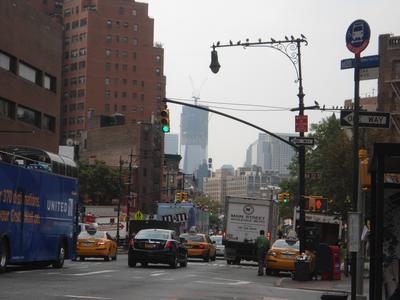
It has a long way to go but with an eventual height of 1776 feet it is a message to the world writ large in concrete and steel.
Photo: copyright Dale Amon, All Rights Reserved
It is just our simple, quaint, un-nuanced American way of saying ‘Up yours Osama”; our way of telling the Jihadi’s they have failed and that they will always fail. We will track them down no matter where they hide and no matter how long it takes. And we will kill them.
Meanwhile, we will rebuild and go back to our proper business of making money.
There is not a lot for me to add. Just go watch it.
Time was when Ford was the model for corporatism and seen as a template for the State.
But that was before we got to a situation where Communist China’s state media castigates the US federal government for wasting money on welfare programs and over-borrowing.
I like the fact that Ford let Chris choose his own words to explain why he wouldn’t buy a government bail-out car. Very Post-Fordist.
Correction: I mistakenly wrote in an earlier version of this that Hari was being sent on a course at the expense of his employer, but that is not so. He is paying for it himself. I am still not quite sure how this helps: do you need to learn how to be honest? Maybe he should read some books on ethics instead. Anyway, the error was mine.
Reading this comment about the revolting Johann Hari, a journalist who fabricated interviews and, well, basically made stuff up, I am still stunned that he has not been fired by his current employer. Instead, the creep writes a sort of mea culpa and is attending a course to learn about journalism. He should have been fired, in my opinion. There are thousands of talented people trying to make a career in the media; why should this shit be allowed to stay in the business?
Of course, in a free market, he should be able to do what he likes so long as he does so not at my expense, so I would, for example, object if he ever got a job working for the BBC, which is funded by a tax. But this sorry saga does rather suggest that if you are a leftie, self-styled preacher of idealism like Hari, that you can get away with a lot.
Here is a blog, with the beguiling title of Splintered Sunrise, by a man who obviously swings to that side of the political spectrum who is rightly appalled by Hari and his antics.
Sometimes it pays to call a spade a spade. Johann Hari is a conman. End of subject.
Christina Odone, who was on the receiving end of Hari’s behaviour, is unimpressed.
If this lowlife ever resurfaces in journalism, he should be referred to as “Johann Hari, the plagiarist”, in much the same way as Paul Krugman is sometimes dubbed “the former Enron advisor”.
This is interesting:
“As the EU debt drama continues unspooling like a perversely watchable soap opera (the FT’s Neil Hume describes it as ‘eurozone crisis porn’), an intriguing sub-plot has emerged: Britain is suing the European Central Bank. The Treasury is unhappy with an ECB move to limit the kind of euro-denominated products that can pass through UK clearing houses, suspecting it’s a bid to shift financial activity from London to Paris/Berlin. So it’s taking legal action, the first of its kind by an EU member state.)”
Via the Spectator’s “Coffee House” blog.
I enjoyed this paragraph:
“On a wider level, there’s some irony in the fact that the UK and the EU are squabbling over euro-denominated transactions. Who even knows which countries will still be using the euro by the time the year is out? Exactly what kind of euro will be cleared in clearing houses come Christmas?”
Someone explain to me why we are in the EU. I am sure there is a reason, but bugger me if I can remember now. Old age creeping in.
|
Who Are We? The Samizdata people are a bunch of sinister and heavily armed globalist illuminati who seek to infect the entire world with the values of personal liberty and several property. Amongst our many crimes is a sense of humour and the intermittent use of British spelling.
We are also a varied group made up of social individualists, classical liberals, whigs, libertarians, extropians, futurists, ‘Porcupines’, Karl Popper fetishists, recovering neo-conservatives, crazed Ayn Rand worshipers, over-caffeinated Virginia Postrel devotees, witty Frédéric Bastiat wannabes, cypherpunks, minarchists, kritarchists and wild-eyed anarcho-capitalists from Britain, North America, Australia and Europe.
|






Recent Comments