We are developing the social individualist meta-context for the future. From the very serious to the extremely frivolous... lets see what is on the mind of the Samizdata people.
Samizdata, derived from Samizdat /n. - a system of clandestine publication of banned literature in the USSR [Russ.,= self-publishing house]
|
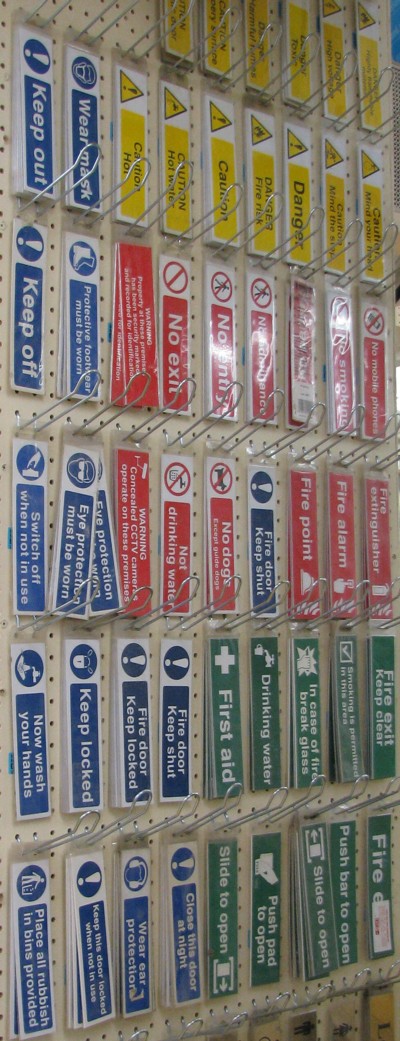
Nag, nag, nag:
If you click on that, you will see that this snap was snapped in a hardware store. A randomly selected one, as it happens, near to where I live.
I’ve said it before, and I’ll say it again, health and safety is, among other things, a business, and therefore an interest. If it diminished, money would be lost, money which knows it would be lost and which would therefore speak up against it being stopped.
But of course the big complaints, if they now tried to moderate this crap, would come from all the big businesses which have now got used to all this excessive nagging and know how to handle it, unlike smaller potential competitors who, poor innocents, know only about making good products.
Hey, “tyranny” was his word, not mine. Sid Ryan writes in the Guardian:
There have been some serious incidents at the camp in the last few months including: thefts, tents being slashed and minor assaults. These problems are not of Occupy’s making, but they’re happening on its watch. When anyone is challenged about people’s behaviour they’re quick to cry “persecution” and appeal to the founding principles of inclusion. If Occupy can’t solve the problem of behaviour on-site, a hostile media and the police will end the movement before it gets going.
Even people who aren’t aggressive or violent can derail the movement. The very nature of the general assembly (GA), whereby everyone can wield a veto, makes it inevitable. A block should be used only if the blocker feels so strongly that they would rather leave the movement than see it carried through, but it is rarely used as such and rarely with a full understanding of the issues at stake. Occupy proudly states that the GA is “real democracy”, in fact it is a tyranny that makes it possible to drown out a hundred rational voices with a single irrational one.
Schadenfreude aside, Mr Ryan’s article provides an interesting case study of an attempt at non-coercive organisation, a subject that interests many libertarians. Perhaps what stops it working for them is Original Sin. I refer to the sinful desire, shared by both the reformist and the revolutionary wings of Occupy, to coerce others.
Added later: Guardian commenter Forlornehope mentions the Seige of Münster. One hopes events will not come to such a pass that St Paul’s ends up being adorned in the manner of St Lambert’s Church:
Vigorous preparations were made, not only to hold what had been gained, but to proceed from Münster toward the conquest of the world. The city was being besieged by Franz von Waldeck, its expelled bishop. In April 1534 on Easter Sunday, Matthys, who had prophesied God’s judgment to come on the wicked on that day, made a sally with only thirty followers, believing that he was a second Gideon, and was cut off with his entire band. He was killed, his head severed and placed on a pole for all in the city to see, and his genitals nailed to the city gate. Bockelson, better known in history as John of Leiden, was subsequently installed as “king”.
Claiming to be the successor of David, he claimed royal honours and absolute power in the new “Zion”. He justified his actions by the authority of visions from heaven, as others have done in similar circumstances. He legalized polygamy, and himself took sixteen wives. (John is said to have beheaded one wife himself in the marketplace; this act might have been falsely attributed to him after his death.) Community of goods was also established. After obstinate resistance, the city was taken by the besiegers on June 24, 1535, and in January 1536 Bockelson and some of his more prominent followers, after being tortured, were executed in the marketplace. Their dead bodies were exhibited in cages, which hung from the steeple of St. Lambert’s Church; the cages still hang there, though the bones were removed later.
Austrian economic theory describes how purposive action by fallible human beings unintentionally generates a grand, complex, and orderly market process. An additional ethical step is required to pronounce the market process good. Economic theory per se cannot recommend but only explain markets. This is what Ludwig von Mises meant when he insisted that Austrian economics is value-free. Anyone of any persuasion ought to be able to acknowledge that economic logic indicates that imposing a price ceiling on milk will, other things equal, create a shortage of milk. But that in itself is not an argument against the policy. Mises assumed the policymaker would have thought that result bad, but the economist qua economist cannot declare it such. As Israel Kirzner likes to say, the economist’s job in the policy realm is merely to point out that you cannot catch a northbound train from the southbound platform.
– Sheldon Richman writes about How Liberals Distort Austrian Economics
Exposed: Taxman’s ‘illegal’ war against Britain’s small businesses. That is the title of a most interesting report in the Independent. Not so much a war, I would have said, as a shakedown.
The Government is unlawfully using late-payment penalty fines against tens of thousands of small firms who do not file their tax returns on time as a “cash-generating scheme” for the Exchequer.
In a damning judgement, the Tax Tribunal has ruled that Her Majesty’s Revenue and Customs is operating a policy of “deliberately” waiting months before alerting businesses that have not filed their tax returns so that late- payment fines stack up.
…
“It is no function of the state to use the penalty system as a cash-generating scheme,” said the judge, Geraint Jones, QC. “We have no doubt that any right-thinking member of society would consider that to be unfair and falling very far below the standard of fair dealing expected of an organ of the state.”
While applauding his judgement in this case, I question his expectations of standards of fair dealing by an organ of the state. It’s not as if they didn’t try much the same with speed cameras.
I gather HMRC are to appeal*. Confusion to their knavish schemes.
(Via Englishman’s Castle)
*This sentence originally read “I gather HMRC are appealing.” Edited for accuracy.
Jeremy Warner, a columnist at the Daily Telegraph, has a short, thumb-sucker about what happens if Scotland becomes independent, as many Scots (and many English voters and taxpayers) want. Given that the Euro is a partial disaster, no sane Scottish politician would want to campaign to join it, at least not yet. The idea of Scotland staying in the sterling zone is also bit, well, problematic if Scotland breaks free of any fiscal union with the English, or if the English decide to give the Scots the elbow. Could Scotland go back to an old, Scottish currency of its own and would that be viable?
Of course, the land of Adam Smith and David Hume could adopt a gold-backed currency and set a magnificent new trend, but given the socialistic nature of most Scottish politicians seeking independence, that does not seem very likely, but you never know. I always felt that if the SNP wanted to really pull a trick, they should seek to turn Scotland into a sort of northern Switzerland.
Here is an old essay by Lawrence White about Scottish banking.
The ultimate pre-flight procedure, courtesy of Southwest Airlines.
Some commenters on this blog got more than a little sniffy when I had a few critical things to see about Ron Paul the other day. I stand by my remarks, which actually were hardly the sort of fire-eating stuff that some people come up with, but I’ll happily repeat my respect for his genuine good points, as I see them.
David French, over at National Review, has an interesting item reflecting on why, of all GOP candidates, and of Obama himself, Ron Paul gets more respect in financial terms from the serving military. Here is the final paragraph:
“I know there are many other reasons why troops support Ron Paul (quite a few embrace libertarian economic principles), but this post is an attempt to explain his support within a national-security framework — how some of the most hardened warriors I know enthusiastically embrace a man whom others say is soft on national security. They don’t see him as soft. They see him as realistic. I disagree (strongly), but it’s an argument that won’t be defeated by ridicule, and it’s an argument grounded in a cultural reality that few Americans have experienced.”
Incoming from Detlev Schlichter:
Just a heads-up in case you are interested, I will be one of four guests on Andrew Marr’s show Start the Week on BBC Radio Four on Monday, 16th January. The program starts at 9 am but there are various ‘listen again’ facilities, and it will also be published as a podcast. The topic is the financial crisis, and the other guests are The Economist’s Philip Coggan (author recently of Paper Promises), Angela Knight, chief executive of the British Bankers’ Association, and the Labour life peer Maurice Glasman.
I am interested.
One of the more dispiriting processes I regularly notice in confrontations between Good and Evil is when Evil concedes that it has done something evil, and Good promptly turns round, in the spirit of fair play, and concedes something else evil. It’s like Good is a football team, and when it goes one-nil up, it feels that the fair thing to do is to give the other fellows a goal. To make a game of it. Or something.
So, for instance, if Evil concedes that, I don’t know, “socialism hasn’t turned out very well in practice”, Good, in a burst of bonhomie and generosity and brotherhood-of-manliness, concedes that socialism was a nice idea “in theory”.
No it wasn’t. An idea that turns out badly in practice is a bad idea. Especially if the badness was a predictable and predicted consequence of that bad idea.
Often, in circumstances like these, Evil even asks for an equalising goal.
Evil offers a pairing of ideas – good twinned with evil, like socks emerging from the laundrette – as a package: “I’ll concede that socialism has turned out badly in practice if you concede that socialism is a nice theory.”
The proper way to behave, if you are Good, and go one-nil up in an argument, is to press for a two-nil lead.
The proper response to going one-nil up in the above argument about the practice and theory of socialism is to say: “Socialism has indeed turned out badly in practice. Now, about this evil notion of yours that socialism is a nice theory. Let’s talk about that. And let’s you admit that you are wrong about that also. We told you you were wrong from the start, and we were right that you were wrong. We predicted that socialism would turn out badly in practice, on account of it being a bad theory. You pressed on. You were wrong. In theory as well as in practice.”
Like I say, press for two-nil.
So, all hail to Mark Meckler. (And further hail to Instapundit for linking to the story, today, and earlier.)
Meckler, arriving in New York and learning that he must not carry a gun, handed his gun over to the New York goons. (That much, he was willing to concede.) The goons promptly arrested him, for carrying the gun up to the point where he stopped carrying it, or something.
Faced with a determined Meckler, and a huge outcry of rage and contempt from the forces of Good, the New York goons have dropped their evil charges. One-nil to Meckler. But Meckler is now being subjected to another evil injustice. The goons still have his gun, and are refusing to return it.
Instead of thanking the goons for being so nice about not arresting him any more, Meckler now wants his gun back. Quite right. New York goons, give the man his gun back! (This is now an international campaign. I am international and I now say this.)
Saying “now give me back my gun” is not only the good thing for Good Mr Meckler to do; it is also excellent tactics. He is now one-nil up. He faces the chance to score another goal, and go two-nil up against the forces of Evil. He is now pressing to do just that.
Quite right. When you have argumentative momentum, against a team that is saying (or in this case also doing) not just one bad thing but many bad things, use it. Thereby keep it, and build it.
When the New York goons do hand back Meckler’s gun, if they ever do (and actually, even if they don’t), the proper next response, from all of us who have now rallied around Meckler, is: “Now, about all these other gun-carrying people, against whom you have not dropped the charges, and whose guns you have not returned …” Three-nil. Four-nil. Five-nil …
If the New York goons don’t hand back Meckler’s gun, perhaps because they sense that if they do, Meckler’s team will then get more momentum, then the New York goons will be digging their heels in in an argument that they will hate but which the Meckler team will relish.
Also good. Shame about the stolen gun, but also good.
If we immerse ourselves wholly in day-to-day affairs, we cease making fundamental distinctions, or asking the really basic questions. Soon, basic issues are forgotten, and aimless drift is substituted for firm adherence to principle. Often we need to gain perspective, to stand aside from our everyday affairs in order to understand them more fully. This is particularly true in our economy, where interrelations are so intricate that we must isolate a few important factors, analyze them, and then trace their operations in the complex world.
– from the Introduction of What Has Government Done To Our Money? by Murray Rothbard. To read the whole thing, go here.
Whilst I am working a private contractor cyber-defence job for a large financial conference, it seems apropos to summarise some recent intel from Janes.
The DOD is selling two THAAD missile interceptor batteries to the United Arab Emirates, This is the first international sale. I wonder who they are defending against..
US chooses Super Tucano for Afghan Air Force
Sierra Nevada and Embraer have been selected to deliver A-29 Super Tucano’s the Afghan Air Force (AAF) and 15 more for the USAF. This is also interesting because Sierra Nevada is developing the DreamChaser orbital space plane.
The Saudi’s are buying 84 new F-15SA Eagle’s with Raytheon’s APG-63(V)3 active electronically scanned array (AESA) radar, a digital electronic warfare system (DEWS) and a Joint Helmet Mounted Cueing System (JHMCS). I wonder who they are defending against…
General Atomics has the contract for Electromagnetic Aircraft Launch System (EMALS) and Advanced Arresting Gear (AAG) configurations for the UK’s Queen Elizabeth-class aircraft carrier programme. Mass Drivers as we call them in the space business, are a key technology for lunar industry.
The US Missile Defense Agency has selected Boeing to oversee the Ground-based Midcourse Defense system in a multibillion dollar sustainment effort. This system will defend the US against a rogue state attacks. At the same time a bunch of orders were placed at the end of 2011 as noted here and above. Raytheon’s SM-3 was also in the mix. On the downside, the Boeing 747-400F carrying the YAL-1 Airborne Laser Testbed (ALTB) is being mothballed as the development has been terminated.
The Indian Navy has gone nuclear with the Akula-class (Project 971) nuclear-powered attack submarine (SSN) now in its hands on a 10 year lease from the Russians. The 9,246 tonne (dived) INS Chakra (ex- Nerpa ) recently finished sea trials three years behind schedule.
If you are depressed about the economic state of the world, one way to cheer yourself up is to google things like “fracking” or “natural gas”. Another is to try “3D printing”. That was how I found my way to this piece, about a company which has started selling 3D printers to … people. From what I can make out, each printer now costs something like two thousand dollars, more or less, depending on whether you want it ready to roll or are willing to assemble it yourself.
I can think of three things, right away, that are bound to be true about such “printers”. They will get cleverer. They will get cheaper. They will get smaller.
Currently, these gizmos seem to resemble those very early personal computers, circa 1975 (as I remember it). There are no very obvious things you can do with them, but despite that, they just reek of the future. Learn about them, and the next four decades of world technological history will be yours to surf at will, in ways that are impossible to know the details of but which are bound to be huge.
In due course, 3D printers may become no rarer than the 2D printers like the one I have on my desk are now. The first laser printer I blagged may way to using cost (someone else) around two thousand quid. My current one cost (me) about eighty quid, and is much better, not least because it is so much smaller. Presumably similar progress will occur with 3D printers.
I wonder what such machines will do to the world?
|
Who Are We? The Samizdata people are a bunch of sinister and heavily armed globalist illuminati who seek to infect the entire world with the values of personal liberty and several property. Amongst our many crimes is a sense of humour and the intermittent use of British spelling.
We are also a varied group made up of social individualists, classical liberals, whigs, libertarians, extropians, futurists, ‘Porcupines’, Karl Popper fetishists, recovering neo-conservatives, crazed Ayn Rand worshipers, over-caffeinated Virginia Postrel devotees, witty Frédéric Bastiat wannabes, cypherpunks, minarchists, kritarchists and wild-eyed anarcho-capitalists from Britain, North America, Australia and Europe.
|





Recent Comments