We are developing the social individualist meta-context for the future. From the very serious to the extremely frivolous... lets see what is on the mind of the Samizdata people.
Samizdata, derived from Samizdat /n. - a system of clandestine publication of banned literature in the USSR [Russ.,= self-publishing house]
|
This article over at the Foreign Policy website, by Helen Mees, dusts off an argument that I have mentioned here on Samizdata before, (in relation to a comment by the US investor and commentator Peter Schiff) namely, that China, by using its vast foreign exchange reserves to buy Western government debt, thereby pushed down long-term interest rates and encouraged the kind of reckless lending that ended up going ker-boom! in 2007-2008. And if only the Chinese had not flogged us all those artificially cheap computer parts and children’s toys (made cheap by that naughty fixed exchange rate regime for the yuan), they would not have made so much money to then lend to us Westerners to blow on housing we cannot really afford. (Here is another old post of mine on the same subject of debt/savings imbalances between the West and China.)
The problem with this line of reasoning is that if, say, a country has earned genuine income by selling something valuable and useful (like toys, cars, electronic components or whatnot), and invested the proceeds abroad in things that can generate new wealth in the future, what is the problem? The problem is not that China invested huge savings and other surpluses into the West – after all, in the 19th Century, the UK invested large capital surpluses in places such as the US, Canada and Argentina (now there’s an irony, Ed). And there was nothing “imbalanced” about that. If real savings – not central bank funny money created out of thin air – gets lent to people to invest, that’s hardly bad. The problem is if the money is lent to people buying homes as part of a broader speculative bubble in real estate, say. And there is no doubt that domestic policy in the West, most definitely in the US, encouraged unwise lending and borrowing for property, consumer goods and so on, rather than investment in new technologies and industries.
The comment thread on the FP item are interesting, where it is contested that subprime borrowing made up only a tiny fraction of the US mortgage market. It did not, since one of the issues with the sub-prime market and the huge losses sustained by banks was how sub-prime debt was mixed up with better quality stuff and then sold to investors as if it is was all investment-grade, when it was wasn’t. For example, here is a comment from a person called “RRAFAY”:
“Actually, 5% of Subprime is enough to cause a crash. Especially, when no mention is made of how these mortgages were leveraged. Secondly, Alt-A is not mentioned either. When both are taken together, they represent roughly 15% of the US mortgage market. Secondly, the idea that Chinese surplus capital led to an excess supply of money is so weak, that it is mind boggling that someone would even suggest this. China only holds 7% of total US debt. Each country mentioned had a housing crisis, Ireland, Spain, and the US.”
In my view, it is certainly true that in a world of free capital movements, if a country A can export a vast amount of its capital into country B, and people in the latter country are not constrained by proper market disciplines and there is already a full-blown encouragement of high borrowing and lax lending, then the added money will pour fuel on the fire. But in the main, I think it is a pretty silly line of argument to say that it is the fault of the Chinese for having earned so much money and then reinvested it. There’s something just not quite right about that argument on so many levels.
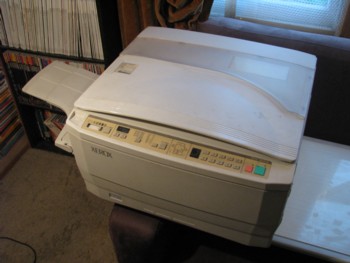
Yes. This …
… has finally moved out of my home, and out of my life. Last week, Men collected it and took it … I don’t know where. A dump, presumably.
I recently wrote here about the continuing life of physical books and about the limitations of the idea of the paperless office or paperless home. Office-working commenters piled in to describe the persistence of paper in their offices, often in the teeth of earlier diktats from on high to the contrary.
But as far as my own libertarian activities are concerned, I really have pretty much completely abandoned communicating on paper, with my own writing, and most definitely with anyone else’s. Which means that this machine, with which I once processed all the paper that I once processed, really had to go, if only to help me to accommodate my ever increasing hoard of books. Only inertia had caused the photocopier to linger on, in my kitchen. That, and the affection I still feel for something which once made such a difference to my life.
A simple way of describing what this machine did for me, and for a small gang of mostly London-based libertarians, from the 1980s until the early 2000s, is that it enabled us to do something like blogging, before there was blogging. → Continue reading: My photocopier – 1981-2012
Comment just attached, by “Malcolm”, to my posting here a while back entitled Austrianism as Number Two:
Newsnight has just introduced its story on Ed Milliband’s decision today to back the government’s pay freeze by playing the Keynes v Hayek video from Econstories.tv
The narrator even described it as a “fabulous” video that is “easily the most entertaining explanation of the issues” – as closely as I can remember the wording, anyway.
I realise I’m commenting on a posting that’s six months old, but I’m hoping Brian, as the original author, gets automatically notified of comments. That the video is being used to give context to a now-current news item is certainly consonant with Brian’s original theory about Austrianism as the new #2 (with apologies to The Prisoner).
I did get automatically notified of this comment. Many thanks for the kind thought. However, I also clocked this Newsnight snippet myself, and added an off topic bit in a comment I also added to the earlier posting today about SOPA, which Newsnight is also reporting on, thanks to the Wikipedia black-out that Rob Fisher noted.
The more I ponder those Keynes v Hayek videos, the more of a stroke of total genius I believe them to be. They play especially well with the BBC, because the BBC is never happier than when explaining an issue in terms of competing arguments. Yes, the BBC is often “biased”, in the sense that you get a definite idea of which team they may prefer (which may not be yours), and which team they choose to give the last word to. But the “other” team often gets a more than fair crack of the whip.
As I made clear in that earlier posting of mine, the real sufferers from this kind of bias are the “other other” teams, so to speak, the ones who don’t even get a look in, the ones who are shown as being not even wrong, on account of not even existing.
To quote Rob Fisher in the posting immediately below, about Detlev Schlichter’s performance on the BBC’s “Start The Week” show yesterday morning:
All in all not a bad day for the spreading of Austrian ideas.
Which adds up to two consecutive not bad days for the spreading of Austrian ideas.
As Brian Micklethwait informed us ahead of time, Detlev Schlichter appeared on the BBC Radio 4 programme Start The Week on Monday. A podcast of the programme can be downloaded. Remember that all of this is being talked about on the BBC, on Radio 4, which I imagine is listened to by lots of Guardian and Independent readers. Austrian economics is now Being Talked About, as Brian might point out.
The programme opens with Economist columnist Philip Coggan talking about the supposed conflict between money as a store of value and money as a medium of exchange. Creditors will always want a fixed supply of money and debtors will want an expanding supply of money, and this seems true enough, up to a point. Coggan goes on to point out that the biggest debtor is government and governments have always been very keen on expanding the money supply. He also explains how banks’ interests are aligned with the governments because the expanding money supply props up asset prices. There is no way out except by defaulting or inflation.
Angela Knight of the British Bankers Association is worried about more immediate matters like tomorrow and the Eurozone crisis.
Detlev Schlichter is up next. He says that paper money systems have been tried throughout history and have always failed; have always been implemented to fund the state. The failure mode is either a return to commodity money or hyperinflation. He clarifies Coggan’s point about conflict between debtors and creditors by pointing out that in a voluntary contract both expect to benefit. They would both like a means to honour that contract with money that they can trust. This makes sense because if debtors routinely get the expanding money supply they want, this ultimately will get factored into the price of the loan.
Coggan says that the trouble with the gold standard is that it imposes more austerity on governments than the voters will stand. I think Schlichter agrees, which is why he is predicting hyperinflation.
Maurice Glasman says that capitalism requires ‘exploitation’ of humans and their environment and short term returns. Detlev is ignoring the imbalance of power between the debtor and creditor. After that I couldn’t follow what he was on about.
Schlichter responds to Marr’s questions by saying that expanding money supply is right now being done to stimulate the economy rather than just to fund governments. Furthermore he is not suggesting that we walk around with little sacks of gold; payment technologies do not depend on state fiat currency. The BBC listeners are reminded that money is not backed by gold and that it’s just an invention of the state. Schlichter advocates removing the state entirely from money. Consumers should control what is produced in the economy by sending price signals, but this does not work because of the expanding money supply. If we went back to gold, as has been done before in Britain, markets would correct. Andrew Marr is incredulous: interest rates shooting up!? In this day and age? Yes, says Schlichter, calmly, it is essential that savings and investments are coordinated by interest rates.
Philip Coggan says going back to gold is possible but very unlikely, but could arise from complete collapse of the system, Zimbabwe-style, but this is not imminent in the next two or three years. Schlichter agrees that politicians are unlikely to take that decision. Over the last 40 years, since the whole world has been on paper money, we have had unprecedented money expansion and, surprise surprise, the whole world is in a mess. If we suddenly went back to hard money now it would cause a sharp correction and a recession. So Politicians will avoid this and in so doing cause a worse outcome.
Angela Knight is asked whether bankers are failing savers by getting into league with the government and she avoids the question, but agrees that banks should not be protected and should be allowed to fail. But there are a lot of Buts that I didn’t follow.
Philip Coggan says bankers have become so important because of the credit money expansion of the last 40 years. For some reason he brings international trade into the conversation. Knight starts waffling about ATM machines and the disruption to people’s lives that a move to gold would entail. Schlichter says that gold works fine in an international economy (after all, gold is gold wherever you are). When he talks about disruption he is talking about the correction of the accumulated imbalances in the economy. It’s clear he doesn’t know what Knight is on about, either.
Maurice Glasman makes a distinction between… oh I give up. The man is completely incomprehensible.
Coggan and Knight dignify him far too much by conversing on his terms, which wastes most of the last 15 minutes of the programme. Schlichter disagrees with him completely and gets in a point about how Germany’s success after WWII is a result of its relatively hard currency which encourages savings and avoids asset bubbles.
So there we have it. Coggan and Schlichter have their differences but would have appeared very close to each other to the BBC listeners. Knight didn’t really say anything, and Glasman was the token lefty who only other committed lefties would have been cheering along with. All in all not a bad day for the spreading of Austrian ideas.
Wikipedia will be going offline tomorrow to protest against the Stop Online Piracy Act. So will Reddit. This kind of protest could have some effect because ordinary Wikipedia users from all points in the political hyperspace will be told just what a terrible idea SOPA is, and a lot of them will get it.
CNET has a useful FAQ about SOPA.
Ben Pile at Climate Resistance notes Steven Pinker’s latest book:
In this startling new book, the bestselling cognitive scientist Steven Pinker shows that the world of the past was much worse. With the help of more than a hundred graphs and maps, Pinker presents some astonishing numbers. Tribal warfare was nine times as deadly as war and genocide in the 20th century. The murder rate of Medieval Europe was more than thirty times what it is today. Slavery, sadistic punishments, and frivolous executions were unexceptionable features of life for millennia, then suddenly were targeted for abolition. Wars between developed countries have vanished, and even in the developing world, wars kill a fraction of the people they did a few decades ago. Rape, battering, hate crimes, deadly riots, child abuse, cruelty to animals—all substantially down.
Sounds good, and all very plausible. But how to explain it?
Thanks to the spread of government, literacy, trade, and cosmopolitanism, we increasingly control our impulses, empathize with others, bargain rather than plunder, debunk toxic ideologies, and deploy our powers of reason to reduce the temptations of violence.
I am not sure about that government bit. Perhaps “rule of law” might be more accurate. Perhaps the Amazon reviews can shed some light. Says one reviewer:
Pinker challenges the two prevailing views of human nature – Rousseau’s view that the noble savage has been corrupted by civilization, and Hobbes’s idea that human greed and violence can only be curbed by strong government. The first view is common on the left of the political spectrum, the second among conservatives. The reviewers who think poorly of the book may have been upset by the fact that Pinker rejects both positions. Instead he shows, with a mass of evidence and interpretation, that violence has declined through history. We seem likely to have started with the high levels of inter-group killing found in our chimpanzee cousins, eventually to be tamed by the slow development of effective government, peaceful trading and eventually Enlightenment thinking.
Says another:
Words like `democracy’, `government’ or `gentle commerce’ are not seriously analyzed. Consequentially, his view of history is a very mechanical one: we were extremely violent in the past and thanks to the Leviathan and `gentle commerce’ we have become better persons. We either accept the political and economical assets of our era or we risk going back to violence and chaos.
My sense is that Pinker’s evidence for decreasing violence over time will be very interesting to see, but his explanations for why this is so will be less interesting. I think the answer is that technology makes us less violent, by making our lives overall so much more comfortable that violence seems even more out of the ordinary, and so to be avoided, than it otherwise would.
The best debater was, without doubt, Newt Gingrich. He would tear Barack Obama apart in a debate.
A good way of understanding just how good a debater Gingrich is may be to compare him to Ron Paul – someone whose opinions I often agree with more than I do with the opinions of Newt Gingrich.
Ron Paul was asked about a radio interview where he appeared to say that Bin Laden should not have been killed by the Navy Seals (I, and a lot of other people, predicted that he would be asked such questions by Obama if Ron Paul was the nominee).
The only way out of such a position is to apologize for one’s confused speech and say “OF COURSE BIN LADEN SHOULD HAVE BEEN SHOT”.
Instead we got a long complicated reply, comparing (at one point) Islamist terrorists in Pakistan to Chinese dissenters in the United States, and saying that the reason that people attack the United States is “because we bomb their countries all the time”.
And on and on (Taliban allies against the Soviets – the Taliban hardly existed at the time, Taliban totally different from Bin Laden’s supporters NOT TRUE THEY HAVE THE SAME THEOLOGY, and…).
Ron I agree with you that the wars in Iraq and Afghanistan have proved to be a mistake – and I was still almost booing at the television screen as you spoke (a lot of people actually present at the debate could not stop themselves booing you – how you spoke was just so offensive). I agree with your policies (on just about everything), but they way you express yourself…….. You do not just sound silly (and make errors of fact) you actually sound hostile to the United States and the West in general. As if you were an enemy of the West – you are not, but you sound as if you were.
And Newt Gingrich – he told a brief story about Andrew Jackson and “killing the enemies of America” and had everyone cheering him. As he did on virtually everything else…
“But he is still wrong about the issues” – no more wrong than Mitt Romney, Rick Perry (less than one percent of the vote in New Hampshire) and Rick Santorum. And he can debate vastly better than they can.
Still it is all pointless now.
Neither Rick Santorum or (even) Rick Perry will get out of the race and endorse Gingrich – which means that Mitt Romney will win on Saturday.
And that means it is over.
The candidate with the least good economic plan (although light years better than Obama) and the person who, when asked if he would support the new Obama law that allows imprisonment (without time limit) of citizens suspected of supporting enemies of the United States – said “yes” (and meant it).
People are to “trust in the good character” of the President not to “abuse this power” – well that is fine, let us see the end of what is left of the rule of law at once. As long as the President is of “good character”.
Oh well at least Goldman Sachs and J.P. Morgan Chase will be pleased.
I hear they have switched some of their support from Barack to Mitt – what a good sign of high moral character. Almost as good as being against abortion (as the most senior Elder of the Morman Church in Massachusetts), then being “pro choice” when in politics in Massachusetts, then being against abortion again (when running for the Republican nomination for President). Oh well my “do not say nasty things about Mitt” New Year’s Resolution did not last long – but he is going to be nominee after Saturday, so it is a last negative statement before I (and everyone else interested in defending the West) have to rally behind this man’s banner.
One must draw a sharp distinction between the person of the King (as a human being) and “the Crown”. In the clash against the Marxists, Mitt Romney will be “King” after Saturday (the Coronation is not till the Convention, but a King is King before his coronation) – so his personal imperfections will have to be overlooked, the oaths that I (and so many others) have taken to defend the West against the totalitarians, will bind us to him in the contest (regardless of what terrible end this riding leads to). The choice of not following the banner will still exist – but not as an honourable choice. The statement “the King will lead us to our deaths” may be true – but it is also irrelevant. After all the enemy will still be in the field, seeking to flee (on the grounds that the commander of our own army is useless) is just a “cop out”. When the banner is formally raised one follows the banner – even if it leads into a narrow valley, with the enemy in front and on both flanks. One can advice against it – one can even call the King an idiot to his face. But fleeing is not really an option – neither in honour (leaving everyone else to die), or in practicality (for the enemy will follow after they have done their business – in reality there is no real place to hide). And defeat is not predetermined – if one attacks fast enough (and fortune turns in one’s favour), one may be able to cut one’s way through, before the enemy has time to react.
To turn to lighter matters…. or, at least, the same matters expressed in a lighter tone.
Max Keiser (and the rest of the dodgy people) will be overjoyed – they are already using their “two Dollar whore” lines (and so on) against Romney. The attacks on Bain Capital may be unfair – but “loading companies with debt so that they fail after you walk away with millions” was a line used against Romney by the Wall Street Journal questioner, the left will use it also (and much more). They will love it when he is the nominee.
Which he will be.
“And, make no mistake, Marxists did lose a big argument, one we now know as ‘the 20th century’.”
– Will Wilkinson
“Certainly there is a need for free-market economics to be rescued from those who distort and discredit it, but that is the argument that must be made: that this system has delivered mass prosperity (and the self-determination that comes with it) on a scale unprecedented in human history, and that it deserves to be saved from the spoilers.”
Janet Daley, writing with justified scorn about those people who have been bashing Mitt Romney for his career in venture capital at Bain. To be honest, his background in this area is one of the few things going for him. It would be quite refreshing to have a president of the United States who can actually read a balance sheet.
For those who have not come across the “creative destruction” line before and how it applies to sometimes wrenching change in business, check out the great Joseph Schumpeter.
As a caveat, I should add that some – but no means most – private equity buyouts of firms have been made possible by cheap credit, and therefore might not have occurred in the way they did had interest rates not been how they were in the past decade or so. On a related point, here is what I wrote in defence of private equity at Samizdata several years ago. Excerpt:
“In the main, what these firms do is target cash-rich firms that are run by often lazy executives who have presided over crappy business decisions. Take the meltdown of Marconi a few years ago, one of Britain’s most famous companies. That was a listed company. The destruction of value and jobs in that company remains, in my mind, one of the most disgraceful episodes in British corporate history and who knows, it might have been saved from making big errors had a private equity fund been in charge, rather than deluded executives. Private equity firms helped stymie Deutsche Börse’s foolish bid for the London Stock Exchange 2 years ago, and have turned around businesses. They typically buy and hold a firm for 5 years or more, take a hands-on approach to running firms before spinning them off to another buyer or floating them in an IPO. So Will Hutton should spare us sentimental guff about how limited liability firms floated on the stock exchange represent the perfect model of doing business or something that Adam Smith or Voltaire would exalt. They are merely one of the many ways in which economic activity manifests itself. As interest rates rise and the economic cycle turns, some of the excesses of leveraged buyouts will fade and private equity transactions will decline.”
Phyllis Dixey – 1914 to 1964 – Striptease Artiste – lived here in flat number 15.
– The wording proposed last November for a new British Heritage blue plaque, but it proved controversial. I only just came across this story. Since then, I don’t know what has happened. Is this plaque actually going to materialise? What it says at the bottom of this recent news item, about another proposed blue plaque in honour of movie actress Margaret Lockwood, suggests not. If not, shame.
Anyone looking for evidence that the current Conservative/Liberal Democrat government in the UK has the same tidy, but severely limited intelligence of its predecessor need do no more than read this story suggesting that thousands of jury trials held in the country could be axed to save what appears to be a relatively paltry sum, when measured against the dangers and cost to individuals of being wrongfully convicted.
I can understand why jury trials can be an easy target. In my distant past I had a spell covering court cases in the UK and watched several juries at work. It struck me – especially in the more complex fraud cases – that there are clear problems. And maybe – although no politician will dream of saying so – that the British are not as law abiding as they presumably were 50 years ago and therefore the average jury panel reflects this fact. But historians would point out that juries in, say, early 19th Century England could be an awkward bunch. But therein lies the strengths of trial by jury – it is one of the few elements in which ordinary members of the public can be brought into the affairs of civil society by sitting in judgement on the alleged guilt or innocence of their fellows. Juries remind the powerful and the legally sophisticated about the proper order of things.
As I remarked the other day about the dangerously misconceived move by the previous Labour government to scrap the double-jeopardy rule, the ongoing attempts by administrations of all political hues to gut the English Common Law, and the checks and balances of the system, remain one of the most foolish trends in our public life. And that such an idea is being contemplated makes a mockery of the idea that having the Lib Dems in the government coalition will increase, in any way, the supposed liberality of this administration.
He wastes no time in twisting the knife of truth in this thrillingly irreverent talk. No, he probably will not ever be invited back.
O’Leary’s conference bio should have foreshadowed to organizers that they would not be getting the traditional, polite, boring PowerPoint presentation.
|
Who Are We? The Samizdata people are a bunch of sinister and heavily armed globalist illuminati who seek to infect the entire world with the values of personal liberty and several property. Amongst our many crimes is a sense of humour and the intermittent use of British spelling.
We are also a varied group made up of social individualists, classical liberals, whigs, libertarians, extropians, futurists, ‘Porcupines’, Karl Popper fetishists, recovering neo-conservatives, crazed Ayn Rand worshipers, over-caffeinated Virginia Postrel devotees, witty Frédéric Bastiat wannabes, cypherpunks, minarchists, kritarchists and wild-eyed anarcho-capitalists from Britain, North America, Australia and Europe.
|





Recent Comments