We are developing the social individualist meta-context for the future. From the very serious to the extremely frivolous... lets see what is on the mind of the Samizdata people.
Samizdata, derived from Samizdat /n. - a system of clandestine publication of banned literature in the USSR [Russ.,= self-publishing house]
One example of a speculative bubble that gets mentioned sometimes is the Dutch Tulip Bubble of the 17th Century. I have occasionally come across the argument that says that this bubble, like some others, cannot be blamed on expansion of the money supply, ergo, those hairshirt Austrians banging on about the evils of elastic money are wrong, there are sometimes bad things that happen in capitalism and we need laws against it, etc, etc.
But according to this guy at the Mises Institute, even the mania for tulip bulbs in the Netherlands had a monetary cause. So that’s that issue settled then.
“On the basis of economic theory and historical experience, the life expectancy of a societal model with 50 percent or more government control over the economy does therefore not look promising. The taxing, resources-consuming state-parasite must constantly weaken and sooner or later kill the productive and wealth-creating market-host. When does this happen? Well, we are about to find out, as we are now all part of some gigantic real-life experiment, bravely conducted by the current policy establishment in Europe and elsewhere at our own expense and that of our children. Across the EU, the share of government spending in the economy is already around 50 percent, depending whose numbers you believe. If we could account for regulation and interventionist legislation, the state’s grip on economic decision-making is certainly larger. To call such an economy capitalist is a joke, albeit perhaps not as cruel a joke as the one the economy itself, with its persistently anaemic performance, is playing on the Keynesian economists and their ridiculous clamour for ever more government spending to boost ‘aggregate demand’.”
– Detlev Schlichter, making a point that needs hammering home. What we have in the West, right now, is a million miles from laissez faire capitalism.
Is this video the 21st century version of a photocopied 1980s Libertarian Alliance pamphlet? It contains Madsen Pirie explaining an economics concept in under three minutes. He tells me that he is going to do 20 videos, one a week.
Strangely, outside of lectures held by the ASI and IEA, there isn’t much video coming out of the UK libertarian scene. Over in the States, all sorts of organisations, especially Reason.tv, have done sterling work with online video. My instinct is that the returns on time for British libertarians doing video could be significant – and that Madsen’s videos will have quite an effect among young people exploring economics.
As I’ve recently been mentioning here, I have lately been doing lots of clearing out of junk from and organising of my home, which is a very satisfying activity. While doing this today, I had another of those haven’t-things-been-progressing-a-lot-lately? moments:
The point being that that’s 16 megabytes. Not gigabytes, megabytes. This thing came with one of my earlier digital cameras, from about eight or nine years ago, and in fairness 16mb was rather stingy even then. The card could only have accommodated four photos of the size of the photo I just took of it.
I seem to recall an earlier moment of this sort, also recorded here, and also involving an SD card. Yes. Despite all the financial woe we are now suffering, this kind of progress still seems to be hurtling along.
Just wait until I get stuck into all those back issues of Personal Computer World that I also find I still have.
The recent debates about the US Stop Online Piracy Act, or SOPA, has reignited interest in the subject of intellectual property. As regulars here know, people who defend free markets take very different views of IP, often clashing sharply about what the purpose of property rights as such is. So to help form my views about this, I recently ordered and received this book, Justifying Intellectual Property, by Robert P Merges. From a fast skim-read, it bases its arguments around the ideas of three thinkers: Kant, Locke and Rawls. A strange mix in some ways, I think. There is a huge bibliography, and the book notes – without rudeness or dismissal – those writers who dispute the case for IP, such as Stephan Kinsella and Tom G Palmer.
Definitely an interesting read, I think. Naturally, it is under copyright.
Update: this is an interesting observation from a man, D Halling, who is a fierce proponent of IP and yet regards the SOPA and related legislation as “power politics at its worst”. So if the IP crowd hate these bills, why bother?
Another update: here is a very rigorous explanation by Stan Liebowitz of the issues as to why IP exists, and does so very much from an economics point of view, rather than say, arguing that IP is about “free speech”.
“In retrospect, there are some obvious questions an Icelander living through the past five years might have asked himself. For example: Why should Iceland suddenly be so seemingly essential to global finance? Or: Why do giant countries that invented modern banking suddenly need Icelandic banks to stand between their depositors and their borrowers – to decide who gets capital and who does not? And if Icelanders have this incredible natural gift for finance, how did they keep it so well hidden for 1,100 years?”
Mr. Sachs here performs the equivalent of, say, accusing someone who advocates sobriety of thereby being indifferent to other values such parental responsibility, financial prudence, and neighborliness. But just as being sober in no way precludes – and likely promotes – other values such as parental responsibility, being a libertarian in no way precludes any of the values and causes that Mr. Sachs lists. Indeed, libertarians argue that these other values and causes are best promoted by individual liberty, and that too many people who insist that achieving these other values requires the suppression of liberty are cynically seeking convenient cover for their own self-aggrandizement.
Of course, libertarians might be mistaken about liberty’s merits. But that Mr. Sachs presumes that libertarians hold cheap such values as compassion, civic responsibility, and honesty proves that what Lord Acton wrote about Robert Kemp Philp’s description of history applies perfectly to Mr. Sachs’s description of libertarianism: “It were well if he knew his subject as well as he knows his own mind about it.”
– Two quotes there from Donald J. Boudreaux (responding to this). There is his own own eloquence, and there is the Acton quote at the end of what he himself says.
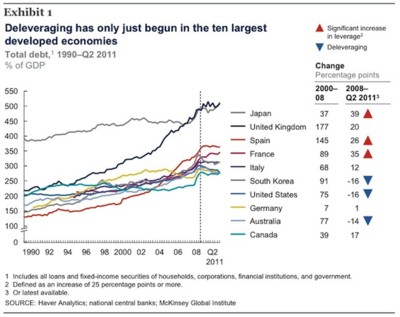
Tom Clougherty has an interesting graph up at the ASI blog, taken from this McKinsey report, of the movement in combined public and private debt for the ten biggest of the world’s developed national economies, from 1990 until now. Follow either of the above two links to get a bigger and more legible version of this graph:
Since 2007, of course, all have lurched upwards from wherever they were to quite a bit more.
To me the interesting bits are those between 1990 and 2007. The general trend was a general increase in debt, from somewhat troubling to somewhat more troubling. But three countries bucked this trend: Japan started very bad and merely stayed very bad; Canada started okay-ish and stayed okay-ish; Britain started okay-ish but became very bad. In terms of the direction things went in, Canada has the best graph of them all, and Britain has the worst. Between them, these three graphs, the grey one along the top (Japan), the green one in the pack towards the bottom (Canada), and the dark one moving most determinedly upwards (Britain), make a kind of big and elongated Z.
One other deviation from the norm worth noting is that just before 2007, Germany, unlike any other country, went (see the yellow graph) definitely downwards. It did what Keynes said, in other words, and paid down its debts when times were good, or at least when they seemed good. In Britain, the “Keynesians”, public and private, just carried on running up more debt.
I know that as a fan of Austrianism I am not supposed to get too excited about national economic aggregates. But this set of aggregates and aggregate movements looks to me quite telling. Make of it all what you will. For me, it confirms the sense that many now have that Tony Blair’s government was one of the worse ones that we’ve ever had.
They said it would never be agreed. Then they said it would never be launched. Then they said it would fail. When it was a success, the euro-haters still insisted that the single currency was a recipe for economic chaos and political instability. The phobes are proving to be wrong again. At a time when so much of Europe’s political leadership is in flux, the single currency is the steadying point in an uncertain and worrying world.
Imagine that the recent turbulence on the continent had occurred when Europe still traded in pre-euro currencies. What would have happened to the French franc when neo-fascist Jean-Marie Le Pen forced the Prime Minister to quit? The franc would have plunged. What would have happened to the Dutch guilder when an anti-immigration party with a dead leader impelled itself into government? The guilder would have plunged too. Before a German election too close to call, even the stolid old mark would be gyrating. And instability in currency markets would be fuelling even more political chaos: a vicious, downward cycle.
That this has not happened is thanks to the euro. The single currency has taken all this political upheaval in its calm stride.
– From an anonymous editorial in the Observer headed “A tolerant euro”.
In a good article at The Atlantic, Conor Friedersdorf (now that is a name to remember) has this zinger of a response to a recent desperate attempt by Andrew Sullivan to try and claim that Mr Obama has been pursuing a brilliant, long term strategy. He asks, how would any Obama voters feel had their man promised to do the following prior to his election:
“(1) Codify indefinite detention into law; (2) draw up a secret kill list of people, including American citizens, to assassinate without due process; (3) proceed with warrantless spying on American citizens; (4) prosecute Bush-era whistleblowers for violating state secrets; (5) reinterpret the War Powers Resolution such that entering a war of choice without a Congressional declaration is permissible; (6) enter and prosecute such a war; (7) institutionalize naked scanners and intrusive full body pat-downs in major American airports; (8) oversee a planned expansion of TSA so that its agents are already beginning to patrol American highways, train stations, and bus depots; (9) wage an undeclared drone war on numerous Muslim countries that delegates to the CIA the final call about some strikes that put civilians in jeopardy; (10) invoke the state-secrets privilege to dismiss lawsuits brought by civil-liberties organizations on dubious technicalities rather than litigating them on the merits; (11) preside over federal raids on medical marijuana dispensaries; (12) attempt to negotiate an extension of American troops in Iraq beyond 2011 (an effort that thankfully failed); (13) reauthorize the Patriot Act; (13) and select an economic team mostly made up of former and future financial executives from Wall Street firms that played major roles in the financial crisis.”
Now I don’t, as readers know, like everything about Ron Paul, who is opposed to every single thing mentioned in this paragraph. But the reason, surely, why even those who might have the odd doubt about him are giving this man respect is for the sort of facts as contained in this paragraph. It is, if you think about it for a few minutes, truly shocking, even though someone like me is not really all that easily shocked by politics and politicians any more.
And here are further signs that Sullivan’s infatuation with Mr Obama is a joke:
“Over the years, Sullivan has confronted, as few others have, American transgressions abroad, including torture, detainee abuse, and various imperial ambitions. He’s long drawn attention to civil-liberties violations at home too, as a solo blogger and as lead editor and writer of a blogazine. When I worked for Sullivan, he not only published but actively encouraged items I found that highlighted civil-liberties abuses by the Obama Administration, and since I parted ways with The Daily Dish, he and the Dish team have continued to air critiques of Obama on these questions.”
“But his Newsweek essay fits the pattern I’ve lamented of Obama apologists who tell a narrative of his administration that ignores some of these issues and minimizes the importance of others, as if they’re a relatively unimportant matter to be set aside in a sentence or three before proceeding to the more important business of whether the president is being critiqued fairly by obtuse partisans.”
And this:
“Beyond strenuously objecting to the focus of his piece and what it doesn’t mention, and agreeing with some of Sullivan’s points, I have important disagreements with others. “Where Bush talked tough and acted counter-productively, Obama has simply, quietly, relentlessly decimated our real enemies, while winning the broader propaganda war,” Sullivan writes. “Since he took office, al Qaeda’s popularity in the Muslim world has plummeted.” But it’s surely relevant that, according to surveys like this one from James Zogby in 2011, “After improving with the election of Barack Obama in 2008, U.S. favorable ratings across the Arab world have plummeted. In most countries they are lower than at the end of the Bush Administration, and lower than Iran’s favorable ratings (except in Saudi Arabia).” And in the areas where Obama’s drone strikes are killing innocent civilians, he is trading short-term terrorist deaths for the possibility that our policies will create more terrorists in the long run. It’s a tradeoff some people consider prudent; but that’s different from saying he is “winning the propaganda war.” In fact, the predictable effect of some of his policies is to increase hatred of the U.S.”
The Samizdata people are a bunch of sinister and heavily armed globalist illuminati who seek to infect the entire world with the values of personal liberty and several property. Amongst our many crimes is a sense of humour and the intermittent use of British spelling.
We are also a varied group made up of social individualists, classical liberals, whigs, libertarians, extropians, futurists, ‘Porcupines’, Karl Popper fetishists, recovering neo-conservatives, crazed Ayn Rand worshipers, over-caffeinated Virginia Postrel devotees, witty Frédéric Bastiat wannabes, cypherpunks, minarchists, kritarchists and wild-eyed anarcho-capitalists from Britain, North America, Australia and Europe.
All content on this website (including text, photographs, audio files, and any other original works), unless otherwise noted, is licensed under a Creative Commons License. Powered by WordPress & Atahualpa






Recent Comments