We are developing the social individualist meta-context for the future. From the very serious to the extremely frivolous... lets see what is on the mind of the Samizdata people.
Samizdata, derived from Samizdat /n. - a system of clandestine publication of banned literature in the USSR [Russ.,= self-publishing house]
|
I enjoyed this posting, at David Thompson’s blog, which includes a bit about a Guardian writer who (the horror!) has an inclination towards sending her daughter to a private school.
And I particularly enjoyed this comment attached to it, from “sackcloth and ashes”:
During the early 1980s, my mother taught at an inner city comprehensive which was going downhill fast, largely due to the efforts of the Inner London Educational Authority and the trots in the NUT.
Staff room discussions were usually dominated by the iniquities of private education, and how socially divisive it was, up to the point she let slip that she sent both her boys (self included) to a fee-paying school.
As a consequence, she often found herself being button-holed in the corridors by the most hard-left revolutionaries amongst her colleagues, all of whom wanted her advice on how to get one’s kids into an independent school, rather than a failing comp like the one they were working in.
In my opinion a pro-state-education lefty who sends his/her kid to a private school, because that’s the best school they can contrive, is doing the right thing. I disagree with them about the goodness of state education, not with them doing their best for their kid. What is really creepy is if you send your kid to a terrible school, which you know is terrible, purely in order to be ideologically consistent. Sending your kid to a good school, even though you officially don’t approve of such behaviour, is a tad hypocritical. Deliberately sending your kid to a terrible school, when you had the choice not to, is downright evil.
In 1980 the Olympics ceased to be what they had been for most of their modern history and even remained a little in Montreal in 1976, which was a great festival of amateur sport intimately linked to the grass roots of sport and became a curious combination of the Soviet and the commercial. Since then they have failed to fit either of the two justifiable models of modern games because they are neither amateur activity done for the love of it nor are they entertainment organised commercially. The overwhelming majority of Olympic sports have no spectator following of any substance and in the case of those which do (such as tennis, basketball and football) the event is peripheral and a nuisance to the normal calendar. Olympians are no longer the outsiders who make it in their own way – as Harold Abrahams was or Don Thompson who won a walking medal in 1960 training on his own, using his own methods. Nor are they genuinely commercial stars like Lewis Hamilton or Didier Drogba. They are Soviet-style, state-subsidised creatures, competing for the benefit of their political masters: “Team GB” with the PM as skipper.
– Lincoln Allison
Dr Frederick L. Hoffman, speaking at the International Eugenics Congress, as reported in the Times of 27 July 1912:
He said the statistics were taken from the [Rhode Island] State Census of 1905. They showed two things – first that half the population of this typical New England State were of foreign extraction, and, secondly, that fewer native-born women were married and had families as compared with foreign-born women. The statistics also showed that a far larger percentage of Roman Catholic married women were mothers. Therefore, this originally Protestant State was in a fair way of becoming Roman Catholic. He thought these figures showed an alarming tendency in American life.
Sound familiar? Of course it does. These are exactly the same fears we hear today and they are no more valid now than they were then. Well, I say that. I assume that Rhode Island is a functioning state albeit a social democratic one.
As this is a eugenics conference I can’t help being reminded of this choice quote from Niall Ferguson:
The crucial point to note is that a hundred years ago work like Galton’s was at the cutting edge of science. Racism was not some backward-looking reactionary ideology; the scientifically uneducated embraced it as enthusiastically as people today accept the theory of man-made global warming.
The conviction of Paul Chambers for making an obvious joke on Twitter about blowing an airport sky high has been quashed in the High Court.
So someone in the justice system has a brain cell to call his own. Pity the case had to get as far as the Lord Chief Justice, the aptly named Lord Judge in the job he was born for, before that person was found.
Tell you what is “clearly menacing”, though, if the future of liberty in this country means anything to you at all. The airport security manager who finked on Chambers to the police, the police who arrested him, the Crown Prosecution Service lawyers who prosecuted him, the magistrate who first convicted him, and Judge Jacqueline Davis who refused his initial appeal all still have their heads attached to their necks.
I jest.
Probably.
“Russ in Texas” (actual name: Russ Mitchell) commented most interestingly on this posting here about 3D printing, the point being that he had, or soon would have, personal experience of actually doing this stuff. I urged him to write about any such experience, and here (with apologies to him for the delay in doing this posting) is the email he recently sent:
Here’s my experience:
3d Printing is mature and ready to go NOW – if you need something in plastic, resin, or maybe ceramics. If you need functional metal parts, the revolution is not here yet.
Background: decent-enough 3d modeling skills with graphics/animation software like Blender/3dsMax.
Tools Used: TinkerCAD (godsend!), 3dsMax.
Formats needed by Pros: STL, DWG.
So, modeling arrowheads, etcetera, based on historical artifacts was not very hard. In some ways, this was preferable to scanning because of distortions called by corrosion (holes in artifact), rust bumps, bits missing, etcetera. TinkerCAD online proved to be REALLY fast for slapping together the rough models for figures based on intuitively jacking together various shapes (and then distorting them) – those who have difficulty visualizing in 3 dimensions might have trouble seeing how a pyramid, rotated, stretched, and then narrowed, gives you a scalene triangle, but it’s there and very doable.
The providers: Sculpteo and Shapeways. Their setup: entirely painless. Their materials? Affordable enough. Some of the arrowheads can be duplicated for a couple of bucks a pop in resin or plastic, up to 10-12 bucks…. COMPLETELY affordable.
Metal?
Write it off. 3d printing in metal is still OBSCENELY expensive (a 70-dollar arrowhead, made in 20-hrc stainless that can’t hold an edge??), and what I wound up having to do was take models to a guy I know with a laser/waterjet rig… who then recommended old-school forge dyes and stamping.
So that’s where we are now. It’s coming, and for the right material, it’s here now: stupid-easy modeling programs like tinkerCAD will get somebody 90% of the way to a useable model for simpler stuff, (almost) no skills required. But the material’s the clincher.
The more I hear about this stuff, the more revolutionary (in a good way) it strikes me as being. And we are now only at the beginning of the story.
“What I find fascinating is how many intelligent people are willing, even feel urged, to provide intellectual support for a system that is not the result of intellectual discourse but came about – rather non-intellectually – through sheer power politics, opportunism and hubris, and that is evidently failing. Our financial system (or non-system) offers a great example of Nietzsche’s dictum that investigating the true origin and the true motivation behind things most often leads to surprising results. The purpose and the clever design that most people later believe to be behind various institutions are often only projected onto them with hindsight.”
– Detlev Schlichter.
As regular commenter “Laird” said the other day, compared to the chicanery that is modern central banking, the row about the LIBOR business is small beer indeed.
Incoming from Michael J, drawing my attention to this video of the Mayor of London flagging up the Olympic Games in appropriately manic style, minus a great deal of piss that has been edited out of him, so to speak. The official grand opening is tomorrow.
Right at the end, in the one bit of Not Boris, someone shouts: “I hate Sebastian Coe!” This, if I am not mistaken, was Jeremy Paxman. I did not know he felt that way about Coe. (LATER: He doesn’t. Or not publicly. Not Paxman. See first comment.)
This sort of thing is the twenty first century’s version of pelting those who consider themselves Great and Good with vegetables.
Enjoy.
More on Boris Johnson here: here and here.
French intellectuals are, on the whole, a rather annoying group of people, notorious for confusing obscurity and verbosity with profundity, and for whom the regular use of words ending in “-isation” is a substitute for rather than an aid to clear thinking.
Nevertheless, when French intellectuals change their minds about something of significance, it signifies. Whether this is because they actually influence any persons other than other French people, and mostly only each other, or whether it is that they influence nobody but do have a highly developed sense of which way the intellectual winds of the world are blowing and when they are shifting in direction, and hence how to sale with them, I do not know. But, one way or another, these people do count for something.
So the fact that one of this tribe, Pascal Bruckner (a “celebrated French philosopher from the centre left”), has decided that environmentalism has now become a load of despotic hooey is, I believe, quite significant.
I remember when these people turned en masse against Soviet Communism, either because it had “betrayed” Communism (bad) or because it was Communism (bad), in the late nineteen seventies. That meant something then.
And this (“Scorning the propaganda of fear”) means something now.
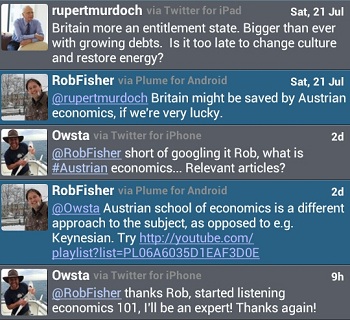
I recently had this conversation on Twitter:
Rupert Murdoch said something and I replied. Someone else overheard and I sent him a link to Madsen Pirie’s series of videos about economics. Well, how would you answer that question in 144 characters? Now one more person knows that there is such a thing as Austrian economics.
I am not surprised to encounter people who have never heard of it. “Economists” are presented as a homogeneous blob by the mainstream media. It is nice to be asked about it and to have the answer be appreciated.
From Foreign Affairs:
“The scandal has sparked calls from politicians, including Mervyn King, the governor of the Bank of England, for stronger regulation of the world’s most powerful banks. But such proposals miss a key point: Price fixing and manipulation are illegal. They have been for a long time. So it is unlikely that saddling financial markets with legal constraints that simply double down on what is already on the books will help. A better solution would go to the heart of the problem. Regulators and market participants should set such benchmark interest rates as Libor in a way that makes them reflect movements in the market, making manipulation impossible.”
“The fundamental principle underlying floating rates is to allow the market to determine borrowing costs. Customers who borrow on a floating-rate basis, if they are sensible, and institutions that loan money on a floating-rate basis, if they are ethical, therefore expect two things from a benchmark interest rate. First, the benchmark should reflect actual conditions in the financial markets. That means no random fluctuations — money costs what it is worth. Second, the benchmark rate should not be easy to manipulate. No rational, informed borrower would borrow money at a variable rate of interest and then empower the lender to determine when and how the interest rate changed in the future.”
This is one of the best and most incisive explanations of what is wrong with the current system of averaging out interbank rates – as done via the British Bankers’ Association – and what needs to be done to avoid a repeat. Refreshingly, the article, written in the sort of publication that policymakers read, does not call for more regulation, which is definitely not what is needed.
Yesterday, Michael Jennings fixed up for the two of us to take advantage of the relative cheapness of final day tickets for a test match in England. Accordingly, yesterday morning, we and the many others with the same idea made our way to the Oval, home of Surrey County Cricket Club (which I support) and just across the river from where I live, to watch the fifth and final day of the first test match, of a mere three this summer between England and South Africa.
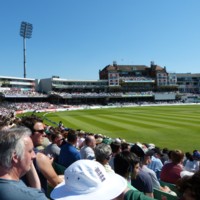
And the big news, from the point of view of any cricket atheists reading this, is that it really is now summer, finally. Look at all the clouds in these pictures. That’s right, there aren’t any. Click on them for bigger versions with more sky. Sill no clouds:
On the left there is the view of the old pavilion and associated buildings and stands. On the right is a TV cameraman high up above the new stand, to our right as we sat.
And we sat, in the sun, for the two two hour sessions that it took for the game to end. I had thought of everything else. Camera: tick, obviously. Food: tick. Drink: tick. Binoculars, which I didn’t use, but: tick. But, sunhat: not tick. “Sunblocker”: not tick. Today, the day after (similarly hot and cloudless) my face is very red and feels like it has been punched just below my left eye. My right hand has also had a good sandpapering.
But it was a fine day out nevertheless, given that I had my camera with me. I know I keep saying this in various blog postings, but I can hardly find words to communicate how much more I enjoy days out like this, now that I can take a digital camera with me and concoct a photo essay about it all later, and then, much later, look back through the photo archives, or maybe read again a blog posting like this one, and relive it all again. What’s a touch of the sun when set beside that? → Continue reading: A sunny day at the Oval
I have been playing on my Asus Padfone (review to follow) with an app called Zinio, which lets users buy electronic versions of print magazines. It came with a free sample of the November 2011 edition of India Today. As far as I can tell the magazine is run and written by Indians. According to Wikipedia it is published in Hindi, Tamil, Telugu and Malayalam as well as English. So I imagine it provides some kind of snapshot of the opinion and thinking that is going on inside India, rather than an outsider’s view. The cover story was about cotton farmers who are committing suicide because they can not pay their debts. A boxout by Dhiraj Nayyar entitled “Government the Culprit” reads:
Rahul Gandhi has a straightforward explanation for why farmers in Vidarbha commit suicide. Speaking on the perils of globalisation on October 18, he said, “The farmer in Vidarbha drinks pesticide as global prices tumble.” The economics behind the suicides of cotton farmers in Maharashtra is more complex.
Contrary to Rahul’s claim, it is the Government which has done more to depress the prices of cotton than the international market has. The Government has imposed numerous restrictions on the export of cotton since April 2010. This has led to a decline in the domestic price that farmers get.
…
The use of genetically modified Bt cotton has been at the centre of controversy, with activists blaming it for the plight of farmers. Evidence suggests that Bt cotton has been good for farmers. A position paper published by the Foundation for Biotechnology Awareness and Education, an NGO, quotes five independent academic studies conducted after the launch of Bt cotton in 2002, that say that Bt cotton has increased yields in India by 30.9 per cent to 63 per cent. The increase in profit to farmers, according to these studies, has ranged from 50 to 110 per cent over non-Bt cotton.
This seems like sound thinking so far. I wonder why the Indian government would restrict export of cotton.
While Bt cotton is resistant to pests, it is not resistant to droughts. So crops still fail.
In normal course, farmers are entitled to a concessional financial bailout from the local administration or public sector banks. They don’t always get it. “The administration will only help if the farmer was using a seed approved by the Government. A lot of farmers use unapproved seeds”, says [agricultural economist Yoginder] Alagh. By his estimate, there are 20 large firms and anywhere between 200-300 small firms which sell Bt seeds. Most small firms aren’t Government approved but sell seeds cheap. Banks are usually reluctant to lend to indebted farmers because they lack collateral. That sends farmers into the clutches of moneylenders who charge between 25 and 40 per cent interest instead of the 7-9 per cent charged by banks. It isn’t Bt cotton that has failed farmers. It is the failure of back-up systems that has.
I am not so sure about this appeal to government bailout schemes. The implication here is that the government is wrong to favour seeds from certain suppliers. There may be rational reasons for doing so, such as seed quality, or there may be political connections with certain suppliers. I imagine that a free market solution, such as insurance or futures trading, would be more likely to make only rational and proportional restrictions. Could the government scheme be crowding out such solutions?
In any case, I am encouraged to detect a somewhat pro-free-market stance in a mainstream magazine in India.
|
Who Are We? The Samizdata people are a bunch of sinister and heavily armed globalist illuminati who seek to infect the entire world with the values of personal liberty and several property. Amongst our many crimes is a sense of humour and the intermittent use of British spelling.
We are also a varied group made up of social individualists, classical liberals, whigs, libertarians, extropians, futurists, ‘Porcupines’, Karl Popper fetishists, recovering neo-conservatives, crazed Ayn Rand worshipers, over-caffeinated Virginia Postrel devotees, witty Frédéric Bastiat wannabes, cypherpunks, minarchists, kritarchists and wild-eyed anarcho-capitalists from Britain, North America, Australia and Europe.
|







Recent Comments