We are developing the social individualist meta-context for the future. From the very serious to the extremely frivolous... lets see what is on the mind of the Samizdata people.
Samizdata, derived from Samizdat /n. - a system of clandestine publication of banned literature in the USSR [Russ.,= self-publishing house]
|
Bernard Levin wrote this about a deceased leader much-lauded by progressives when certain domestic grievances became public after the icon’s death:
Tito’s widow has been claiming (unsuccessfully) her inheritance; he had got rid of her a few years before his death, no doubt to instal something more agreeable and up-to-date in her place, and they clearly parted very non-speaks indeed – so much so that she seems to have lived under conditions not far removed from house arrest ever since.
The marital relations of Tito do not concern me; what caused me to twitch an eyebrow when I read of the dispute over his property was the list of said property. It included cars, motorboats, horses, yachts, jewellery, paintings, a score of villas, orchards, a safari park and vineyards; and the value amounted to millions of pounds.
You see the point immediately, no doubt. What was this noble, selfless, upright, honourable, caring, moral, austere, heroic, truly socialist figure – the Stafford Cripps of the Balkans, the Keir Hardie of the non-aligned, the Nye Bevan of small nations – what was he doing with millions of pounds’ worth of luxury goods, disappointed widow or no disappointed widow?
[…]
Nor … is the corruption of power limited to one end of the political spectrum. It is true that supporters of left-wing regimes, and of left-wing insurgents against right-wing regimes, invariably claim that the defeated or beleaguered forces of the right are financially corrupt, and those making the claims proudly contrast their own side’s scrupulous purity in money matters, to such an extent that it sometimes seems as though Marxism is not an ideology but an antibiotic, with the miraculous property of cleansing the patient’s blood of avarice, dishonesty and a taste for grands crus and caviar.
But apart from the fact that it almost always turns out, even if only after some years, that the Marxist power-brokers were not in the least averse to sleeping off feather beds, dining off gold plate and exercising every variety of droit de seigneur, there is no evidence at all that a belief in communism, even if it is genuine rather than cynically professed, is in any way a guarantee of financial probity and moral uprightness.
[…]
As it happens, I knew that Tito was a crook as long ago as 1977, when on a state visit to France, he stopped at Michel Guérard’s place at Eugénie-les-Bains (to judge by that waistline, I bet he didn’t go for the cuisine minceur) and skedaddled without paying the bill.
[…]
I remember thinking at the time that Tito had been so accustomed to bilking restaurateurs and shopkeepers in his his own country without being challenged (because none, back home, would dare to challenge him) that he had altogether forgotten that elsewhere a bit of give is expected to accompany the take.
– Bernard Levin, from an article originally published in the Times on January 24th, 1986, and reprinted in his collection In These Times.
I have never heard that the late Commandante Hugo Chávez went so far as to put his troublesome ex under house arrest, but he has certainly had wife trouble. Marisabel Rodriguez, his second wife, claims that he made use of his official position to bully her. Not just wife trouble, woman trouble generally. Like Tito, Chávez was something of a Don Juan. His longest lasting paramour, Herma Marksman, told the Sunday Times in 2006 (subscription required to see full article) that he was a romantic lover but was “imposing a fascist dictatorship”. The similarities between Tito and the now presumably re-reincarnated reincarnation of Bolivar do not end there. Chavez seems to have done well for himself. I would prefer to have more than one source before endorsing the oft-quoted estimate of his personal fortune at a billion dollars made by Criminal Justice International Associates (CJIA), but An Argentinian journalist, Olga Wornat, can be heard here being interviewed by ABC News in 2007 and she does provide sources to suggest he liked the high life. Wornat wrote a book about several Latin American leaders called “Accursed Chronicles”, for which she interviewed Chávez himself and many of those close to him including cabinet members, his two ex-wives, his long time lover Herma Marksman mentioned above, his tailor and his psychiatrist. She says that he had collections of luxury watches and Italian suits, spent $65 million on a private Airbus (with a $500,000 bill to repaint the flag on the jet so it would look the way it did when he used to draw it in school) and that his family, despite the turbulent relations between him and them, were the “richest in Venezuela” and were the “royal family” of their home state. His daughter Rosines flashing wads of dollars on Instagram caused widespread irritation among less well-connected Venezuelans, who face severe restrictions when trying to obtain dollars.
Comnandante Chavez had the waistline to match Marshall Tito’s. Did he feel obliged to pay his restaurant bills? I did not find any specific claim that he did not, but it would be a brave restaurant owner who presented El Presidente with a bill when said Presidente had displayed such a penchant for expropriations, often done openly on his personal whim and in revenge for trivial thwarting of his desires; who, for example, seized the Hilton resort on Margarita Island in with the words,
“To hold the conference we had to ask for permission… and the owners tried to impose conditions on the revolutionary government. No way,” AFP quotes Chávez as saying. “So I said, ‘Let’s expropriate it.’ And now it’s been expropriated.”
Chávez is one up on Tito; Josip stole the meal, Hugo stole the whole building. In response, let it be noted, to the rightful owners having had the gall to expect that their permission was required before the revolutionary government could use their building.
So, when’s the reading of the will?
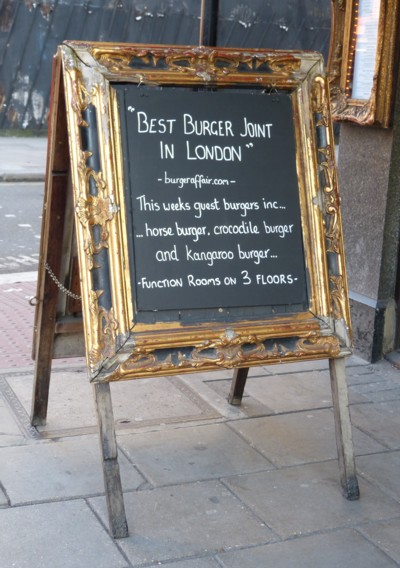
Yesterday, I took this photograph in Holborn, London, advertising the (Australian influenced?) cuisine of this pub:

Click to enlarge, and then note the horse burger. It’s starting to look as if the main long-term effect of the Great Horse Meat Scandal upon Britain is that the British diet will be expanded. The politicians huff and puff. We get to discover how good horse can taste (that being a piece that was linked to by Instapundit yesterday).
Healthy life expectancy is shorter in the UK than abroad
People in the UK enjoy fewer years of good health before they die than the citizens of most comparable European countries as well as Australia and Canada, a major report shows.
The health secretary, Jeremy Hunt, said Britain’s performance was “shocking” compared with that of other countries, and called for action to turn it around by local health commissioners, who are about to take up their new responsibilities.
The UK ranked 12th out of 19 countries of similar affluence in 2010 in terms of healthy life expectancy at birth, according to a detailed analysis from the Global Burden of Disease data collected by the Institute for Health Metrics and Evaluation (IHME) in Seattle.
Despite big increases in funding for the NHS in recent years and many reform initiatives, the UK was in exactly the same place as in the league table for 1990, according to the IHME report, published in the Lancet medical journal.
Emphasis added. The report’s authors, and the Guardian article from which I quote, are at pains to say that
the problem is only in part to do with hospital care – much of it is about the way we live. Our diet, our drinking and continuing smoking habits all play a part
In other words, Britain’s relatively poor average life expectancy partly is to do with NHS hospital care, but they would rather not say so. As for the remainder of the problem that is not caused directly by the failings of the NHS, I wonder if the report’s authors have considered the possibility that the “despite” might be a “because”? Why do the British do worse than other nationalities of similar wealth when it comes to living an unhealthy lifestyle? It is no answer to just say “culture”; why is our culture as it is? Have we always been thus? We have a long tradition of getting drunk, I grant you, but my impression is that the British were not considered any fatter or any more drug-addled than comparable nations a few decades ago… before 1947, let us say for the purposes of discussion.
It is often said that one of the great blessings of the NHS is that it has lessened the fear of illness. The fact that they do not have additional worries about costs or insurance does come to those already worried about illness as a huge relief, and NHS-sceptics like me have to engage with that, sometimes in our own lives. So let us do so. I submit the hypothesis that a certain amount of fear of getting ill is salutary – both in the general sense of producing a beneficial effect and in the more specific, and original, sense of promoting health.
Naturally, I speak here of averages over a large population. Many illnesses cannot be avoided by human action; that is what insurance is for. When considering any one individual, I doubt that when making the many small bad decisions that have the cumulative effect of making him or her unhealthy, “hey, I don’t have to worry about paying for healthcare” often comes consciously to mind. But, like the proverbial mills of God, the mills of incentives grind slow but they grind exceeding small. In some countries those many small decisions take place under the shadow of “I might end up with a bill for this”. In Britain they do not. My hypothesis might go some way to explaining Britain’s anomalously poor average health. Something must explain it.
By the way, I shall take it as read that every human being has a perfect right to eat, drink, smoke and inject as he or she pleases. I shall also take it as read that the authors of the report and 95% of its readers wish to deny others that right. If the hypothesis above is correct, Britain has set up a system that, besides the inherent wrong of being based on coercion, removes one of the incentives for people to take care of their own health. How to solve that? More coercion, of course.
Venezuelan tyrant Hugo Chavez kicks the bucket. At times like this I almost wish I believed in an afterlife and the whole eternal damnation shtick.
I do certainly hope that Guido Fawkes is correct that Lord Leveson’s atrocious proposal for statutory regulation of the press gets no-where, particularly now that it seems some of the supporters of Leveson now realise what dangerous folly it is. Of course, I am not getting my hopes up too much, but it would be a relatively rare good piece of news from UK politics to see this idea shot down, hopefully for a long time.
Here are related thoughts of mine about the Leveson process.
Buried in among the comments on this SQOTD is a disagreement between Jaded Voluntaryist and Rob Fisher.
Jaded Voluntaryist:
There are certain positions that it is unwise to try and debate rationally – specifically because they are not rationally held positions. … nothing you say is really likely to change the minds of such people.
Rob Fisher:
But have the debate anyway. Those who overhear it might then be prevented from joining the wrong cause.
I agree with Rob Fisher entirely. Jaded Voluntaryist says, and then repeats, that the people (“such people”) you argue with are beyond argument, which may be so. (Alternatively, they may just not want to argue with someone who keeps telling them they are being irrational.) But JV seems to me to ignore the point about those onlookers. Onlookers, particularly the silent ones, are what propaganda is all about.
Closely related to the point about arguing with those whom it is impossible to argue with, so to speak, is the virtue of repetition. Keep on having the arguments.
Repetition is actually humility. Repetition is recognising that what you say won’t reach the whole world, the very first time you say it. If others won’t repeat it for you (which is actually what reaching the world consists of), then if you think it deserves to reach at least a bit more of the world than it did first time around, you will have to repeat it yourself.
In the comments on this excellent posting at Counting Cats (a posting which restates some ancient truths about incentives but puts them in an academic rather than an “economic” context – highly recommended), you will observe commenters, many of their names being familiar from here, repeating to one another (as is entirely appropriate) many of the above truths about the need to keep on arguing. Are they talking only to themselves, echoing in their own echo chamber? No. One hitherto silent reader joins in, to say:
Keep it up guys, well done. … Every little anecdote helps.
Indeed.
I and many others have said all this many times before, which is because it deserves to be said again and again.
Michael Huemer, a professor of philosophy at the University of Colorado at Boulder, recently released a book called “The Problem of Political Authority: An Examination of the Right to Coerce and the Duty to Obey” that has made quite a splash in some libertarian circles.
As just one example, Bryan Caplan recently implied in a blog posting that he believes it to be the best book of libertarian political philosophy ever written.
I have not quite completed reading it, but I have already come to the conclusion that Bryan is absolutely correct. The book is a gem, destined to become a classic, and any serious libertarian should have it on their shelf near their copies of the works of Hayek, Rand, the Friedmans, and the rest of the pantheon. They should even, dare I say, read it.
(And with that understated endorsement, on to my review.)
One of the divides within the libertarian community is the debate between minarchists and anarchists — that is, between those that believe a night watchman state is a good idea, and those who are skeptical of the notion of any state at all. Outside of libertarian circles, of course, the question gets scarcely any attention at all, and it is generally assumed that the state is both a practical necessity and morally justified.
The topic that Humer’s astonishing tour de force concerns itself with is the moral and ethical underpinnings of state power, an area known in political philosophy as the problem of political authority.
In considering the justification for the state, a nagging question naturally arises. Most people would claim it is morally impermissible for your neighbor to force you to give money to a charity of his choice at gunpoint. However, in stark contrast, most people would claim it is permissible for the state to do essentially the same thing, that is, to extort taxes from you using the threat of force in order to spend those funds on projects other than your own.
Most people appear to claim there is an important difference between these cases — otherwise, they would not believe in the legitimacy of the state.
The eponymous problem of political authority is the question of what the distinction between these cases might be — on what basis, if any, might we justify this difference in treatment between the behavior we consider ethically justified from individual actors versus the power we accord to the state.
Huemer systematically addresses the justifications that have been articulated for political authority over the centuries, from hypothetical social contract theory to consequentialism and everything in between. I will give away the punchline by noting that his arguments would appear to fatally damage all of them.
Political philosophers generally start by attempting to construct a complete moral framework within which they justify their positions. Huemer takes an entirely different approach. He does not assume that we all agree on a single universal moral framework. He only assumes that most of us generally share similar moral intuitions about certain sorts of situations in the average case. (The strongest sort of assumption he demands is that his reader agree that beating people up without provocation is usually bad.)
Because he demands that the reader agree with him on so few things and so weakly, Huemer’s argument gains enormous strength, since there is no need to accept an all-encompassing ethical theory to believe the rest of his arguments.
On the basis of very pedestrian ethical assumptions, Huemer manages to build a case against any moral justification for political authority whatsoever. He engages, attacks and destroys arguments of all sorts with panache. Even John Rawls famous “A Theory of Justice” (perhaps the most cited work written in philosophy in the last century) is mercilessly examined under bright lights and staked through the heart.
One of the book’s greatest strengths is the simplicity and lucidity of his prose. Unlike many of his academic peers, Huemer’s writing is crystal clear and (nearly) jargon free. A bright ten year old would have no difficulty with the language. He does not seek to conceal weakness beneath an avalanche of polysyllabic words and mile long sentences. Instead, he makes his arguments so straightforward to understand that there is little or no room to disagree with him.
I am uncertain as to whether Huemer will persuade many people. As Swift once observed, “it is useless to attempt to reason a man out of a thing he was never reasoned into.” Most people hold their political positions not as a result of rational contemplation but because they were exposed to a set of ideas at an early age and have an emotional attachment to them that is not easily altered. The fact that Huemer is arguing for unfamiliar idea that goes against most conventional wisdom is probably more important to the average reader than the razor sharp edge to which he has honed his arguments.
Never the less, in a hypothetical world in which all chose their views on the basis of rational consideration, Huemer would be changing hearts and minds by the trainload.
When I saw this today:
After a decade in the making, cost over-runs to the tune of billions of euros, and delays of more than three years, the next generation of European military transport aircraft is finally poised for entry into service.
I was reminded of this from back in 2010:
New RAF transport plane is ‘Euro-wanking makework project’
Quite.
Professor Sunstein is undoubtedly correct that “people make a lot of mistakes.” Most of us can look back over our own lives and see many mistakes, including some that were very damaging. What Cass Sunstein does not tell us is what sort of creatures, other than people, are going to override our mistaken decisions for us. That is the key flaw in the theory and agenda of the left. Implicit in the wide range of efforts on the left to get government to take over more of our decisions for us is the assumption that there is some superior class of people who are either wiser or nobler than the rest of us.
– Thomas Sowell, quoted earlier today by David Thompson
I like two recent postings by Mick Hartley, both in connection with art exhibitions in London, Lichtenstein at the Tate, and Duchamp (and others) at the Barbican.
Of Lichstenstein, Hartley says, among much else that is worth reading in full:
So yes, it’s easy to see him as glib, compared to the great names of New York Abstract Expressionism, like, say Mark Rothko, whose brown and purple splodges of colour were seemingly dragged agonisingly from deep within his soul; who couldn’t bear for his Seagram works to be displayed in a restaurant; who finally killed himself in his studio. Compared to Rothko, yes, Lichtenstein does seem a bit of a light-weight.
Also, there’s the fact that Lichtenstein’s easy to get. Just about anyone can see what it’s about. And critics hate that. What they want is to be given the opportunity to demonstrate why they’re art critics and you’re just some dumb schmuck who doesn’t know much about art but knows what he likes. If they started lecturing us about how Lichtenstein is commenting on mass reproduction and popular culture, we’d say, well of course he is.
That’s one mark against the man. Another may be that, despite all the attempts to portray his art as somehow critical of the popular culture of the times, and by extension of the rampant greedy capitalism of post-war America etc. etc. together with the sexual stereotypes of those ditsy romantic blondes and macho soldiers from the comic books, it’s fairly clear that Lichtenstein, far from mounting a biting critique of US imperialism, was in fact celebrating rather than condemning the sheer vibrancy and energy of the visual world he lived in – of New York in the Sixties. Of course he maintained an ironic distance, but he was no revolutionary, no radical subversive – except in the sense that he saw popular culture as a suitable subject for high art.
The Lichtenstein exhibition is a popular hit, but, Hartley reports, the Duchamp etc. show is provoking no such mass enthusiasm.
In 1917, Duchamp grabbed a urinal, signed it, and stuck it in an exhibition, to the delight of art critics ever since. Says Hartley, at the end of his Duchamp posting:
The logical conclusion to this line of thinking would be that if anything can be art if its maker wishes it to be art, then anything or everything can be art – and we don’t need artists any more. Curiously this is an argument that artists themselves seem reluctant to make.
So yes, the urinal was funny; yes, it was subversive; yes, it was probably the kind of kick-up-the-arse that the art establishment needed at the time. But can’t we move on? It’s not as if the art establishment now isn’t in need of a kick up the arse. But it’s not going to come from repeating the same old tricks of 100 years ago. The urinal lovers now are the art establishment.
Indeed.
“If you want to revisit the 1970s, you no longer need a history book or a time machine. All that’s required is a collection of today’s newspapers – Right- or Left-leaning, it matters little – together with a regular infusion of BBC agitprop. With a few notable exceptions, all seem to gravitate around a tediously predictable banker-bashing, anti-profit, bonus-hating, anti-big-business agenda which spins us 40 years back in time to one of the lowest points in British history. What goes around comes around, I suppose, so with inflation perking up again, it can surely only be a matter of time before the Government brings back a fully blown Prices Commission. I exaggerate, of course, but only to make the point.”
– Jeremy Warner
He is broadly right, of course. Some of the “banker bashing”, though, has even come from the free market side of the fence, such as from the likes of Professor Kevin Dowd – who is known around these parts – making the point that banks operating with the implicit guarantee from the state and cheap money have been able to let their normally healthy instincts run amok. Alas, most of the attacks have focused on their allegedly big bonuses, which while it does not miss the mark entirely, is not really central to why we got into our current mess.
And Warner is interesting on how an energy sector, which has its problems, will not be in good shape if we keep hitting bank finance. There is another issue, meanwhile. What we might be seeing is a mixture of “junk science” (the notions that are leading us to turn our backs on cheap or at least reliable energy) and “junk money” (Quantitative Easing, etc).
It is interesting that he argues that there is a 1970s feel about the UK at the moment. He is right, although the private sector does not have the union militancy of back then, and the Cold War is over, and globalisation, for all its ups and downs, has taken more hold to the immense benefit of countries such as India and China. I see little sign of a move back to the 1970s in Asia.
Here are her comments, via Big Government, on the issue of the “sequester” (or for those not following this story closely, the automatic spending cuts that will kick in if Congress/White House cannot get their acts together and actually produce a credible line on public spending and debt):
Palin said if Americans cannot “stomach modest cuts that would lower federal spending by a mere 0.3% per year out of a current federal budget of $3.6 trillion, then we might as well signal to the whole world that we have no serious intention of dealing with our debt problem.”
“If we are going to wet our proverbial pants over 0.3% in annual spending cuts when we’re running up trillion dollar annual deficits, then we’re done,” Palin wrote on Tuesday. “Put a fork in us. We’re finished.”
No, she is just a dumb hick from the Wild West who hasn’t studied her Keynes enough. As we know, great minds in academia suggest that what the world needs to do is print more money, rack up more debt, and in time, all will be well. Worrying about the debt is just so, well, suburban, darling.
|
Who Are We? The Samizdata people are a bunch of sinister and heavily armed globalist illuminati who seek to infect the entire world with the values of personal liberty and several property. Amongst our many crimes is a sense of humour and the intermittent use of British spelling.
We are also a varied group made up of social individualists, classical liberals, whigs, libertarians, extropians, futurists, ‘Porcupines’, Karl Popper fetishists, recovering neo-conservatives, crazed Ayn Rand worshipers, over-caffeinated Virginia Postrel devotees, witty Frédéric Bastiat wannabes, cypherpunks, minarchists, kritarchists and wild-eyed anarcho-capitalists from Britain, North America, Australia and Europe.
|





Recent Comments