We are developing the social individualist meta-context for the future. From the very serious to the extremely frivolous... lets see what is on the mind of the Samizdata people.
Samizdata, derived from Samizdat /n. - a system of clandestine publication of banned literature in the USSR [Russ.,= self-publishing house]
|
It is rather hard to believe that an entire decade has rolled on since the first private manned vehicle released the surly bonds of Earth and flew into space, a realm where heretofore only governments had trod. It was the beginning of a new age, and much has come to pass since then. As with all prognostications, my thoughts of the time were both more and less than the reality of 2014 in commercial space.
I would certainly have been surprised by two things, one of which I would have predicted and one of which I did not even imagine. I am sure at the time I would with certainty have said someone would be flying passengers by now. I would have been equally surprised had someone told me I would be a member of the XCOR Aerospace team working on the Lynx space plane with my own desk in the same location from which I filed my stories that day, in the same room which I had pitched my air bed the night before the big event. I would likewise have been happily surprised to find George Whitesides, our then new Executive Director at the National Space Society, who appears in some of my photos that day, would now be CEO of Virgin Galactic.
So what has happened in the ensuing ten years? For one, SpaceX is now making deliveries to the International Space Station on a regular basis with its Dragon Cargo ship, lifted via its Falcon 9 rocket. They are now sucking up the launch vehicle market, once a near American preserve, that Old Space and their political cronies proved incapable of holding. Noone, not even the Chinese or the French can compete with SpaceX’s prices. Why? No one ever before built a launch vehicle from the ground up to be viable without government cost plus contracts to foot the bill. SpaceX did take government contracts, but they worked through fixed price commercial style contracting. Their startup capital was private venture money that came from the pockets of Elon Musk and friends of his. He put every cent he had on the line and very nearly lost it. He made it through the early Falcon 1 test failures (which I live blogged here as well) on a wing and a prayer. Those failures were pretty much an inevitable part of learning to do something hard in a different way. Elon stuck his own tuckus way out over the edge… and he won.
Virgin Galactic, the company that will be flying SpaceShipTwo, the follow on to the vehicle launched that day ten years ago, has had its share of difficulties, but the company is well funded and they are plodding along towards the finish line for a suborbital tourist vehicle. XCOR is doing pretty much the same, although with a more ‘right stuff’ flight experience.
SpaceX unveiled its Dragon II capsule a couple weeks ago. They will carry out escape system testing this year and will likely be in manned test flight next year. By 2016-17 they will be a Spaceline that is delivering passengers to the International Space Station and the soon to be launched Bigelow Aerospace space station. Robert Bigelow has been ready for years now… but it did not make business sense to create a destination in space until someone could provide a regular taxi service. When the manned Dragon goes operational, I expect his extensively space tested module technology (two ‘small’ ones are currently in orbit) will go up very soon thereafter.
SpaceX has also been working towards a re-usable first stage. They have succeeded in a liftoff, flight to 1000 meters and a precise landing of a Falcon 9R first stage on the spot in Texas from which it lifted. They recently returned one of those stages from a for-hire launch and brought it to a hover over the North Atlantic waves. Later this year they will fly one from a pad at Spaceport America in New Mexico, perhaps as high as 100,000 feet, and then bring it to a landing. Next year they plan to bring one back from a commercial flight to a dry land site. It will then be checked out for re-usability and possibly reflown. They expect ten flights per stage but even if they only got two, it would halve the capital cost of a launch. If they get the full ten, we are looking at a total collapse of Old Space, a Reardon Steel moment. The only survivors will be those few protected by the Wesley Mouch’s of the world.
Later this year, SpaceX will be launching the first Falcon 9 Heavy. It will have the largest cargo capacity available on Earth and that has only ever been outdone by one vehicle, the US Saturn V Moon rocket. One might make a case to put the Space Shuttle and the short lived Buran in that exalted class, but their actual payload to orbit was mostly vehicle weight.
So much is happening in the New Space sector in June 2014 or is scheduled over the next one to two years that I would need to write a far longer article than this to come close to a proper treatment of the topic. I have not even mentioned most of the companies in our industry. Sadly there is also much I cannot talk about as I am drawing my wages in the field and that places limitations on me. If you want more details on XCOR… you can go read the company blog which can be found via the XCOR home page.
And now… a trip down memory lane. Rand Simberg just wrote his retrospective and since he and I were traveling together for that momentous day, here are the stories I filed as well, plus one other by Johnathan Pearce. The pictorial is at the end. There are a lot of fond memories there!
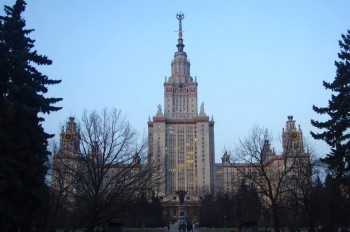
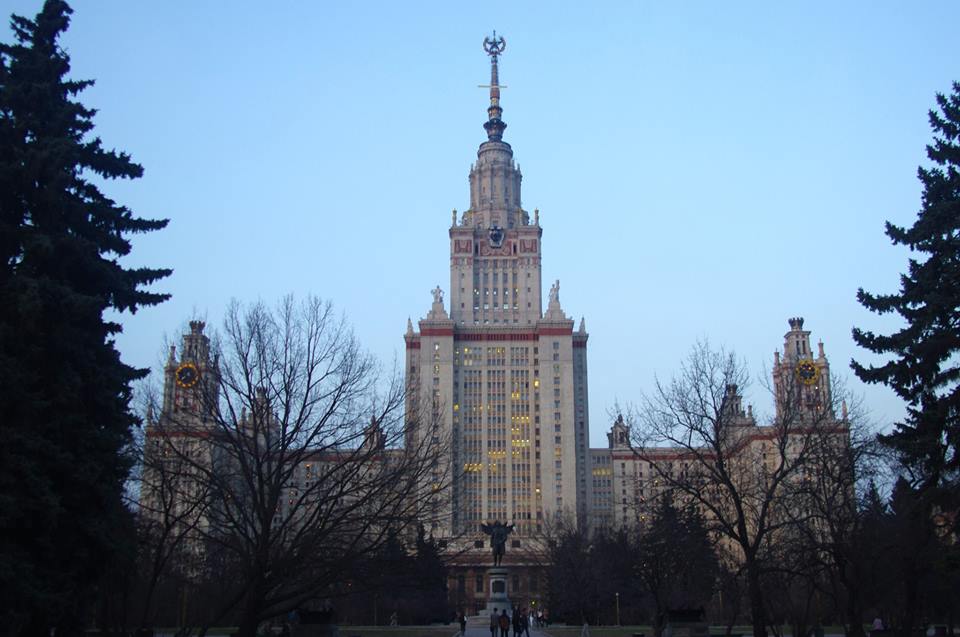
The above photograph is of the main building of Moscow State University in the Sparrow Hills district of Moscow. This is one of the so called Seven Sisters – the Stalinist buildings that are prominent in the Moscow skyline. When completed in 1953 this was the tallest building in the world outside New York City, and it remained the tallest building in Europe until 1990. The building was built partly with gulag labour. As it was nearing completion, the gulag workers were housed inside it in order to minimise the number of guards required, so the building functioned as something resembling a gulag itself during construction.
The Seven Sisters were built in the 1950s after the USSR obtained the technical knowledge to built large steel framed skyscrapers from the United States. There are a few more such buildings scattered throughout the former USSR and the former Warsaw Pact states. The most notable of them outside Moscow is the Palace of Science and Culture in Warsaw, which I have written about before.
The Polish attitude to that building is, at this point in time, mixed. It is a memento of having been occupied by the Soviets, an experience of which the Poles are not especially fond of the memory of. However, the familiar becomes familiar, and it is hard to imagine it not being there. The Palace of Science and Culture is full of many good cinemas, theatres, concert halls, and other venues for cultural activities, and many a good evening has been had there by many a Polish person. As the years go by, other tall buildings have been built in Warsaw, none of which have anything like the same style, and the Palace of Science and Culture has become just a historical artifact (and a reasonably interesting one) in a more modern, and more western city. Nobody would ever think of building another building anything like it, and it remains as an integral, but singlular, landmark of the city.
Moscow is different. There are seven large buildings in the same Stalinist gothic style, and a number of smaller ones. They are not physically together, but are scattered all over the city. They don’t dominate the Moscow skyline, exactly – if anything does it is the spires of the cathedrals of the Kremlin and Red Square – but they lend an essential part of the character of the city. Take photographs and there is always one lurking in the background somewhere. Their style is one of the defining styles that defines Moscow, and even defines Russia.
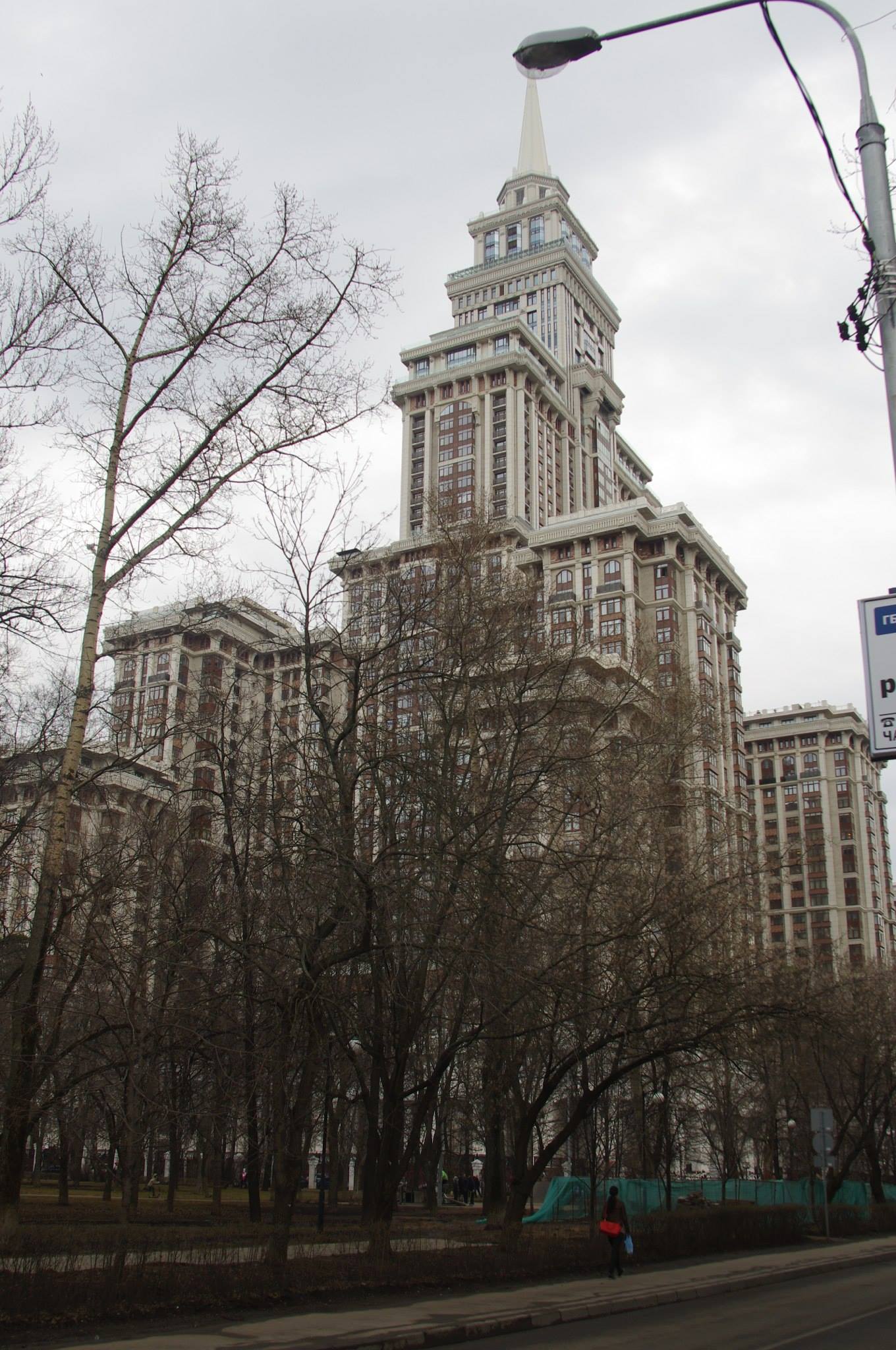
Consider this building, though, to be found elsewhere in Moscow.
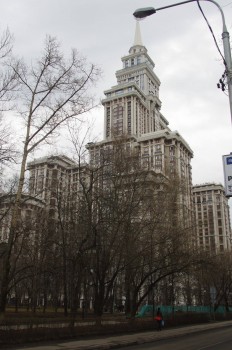
This is the Triumph Palance. This is a residential apartment building out along Leningradsky Prospect corridor in the direction of Sheremetyevo airport and the stadium belonging to the football team CSKA Moscow. It was completed in 2003. For a few years after that, it was the tallest building in Europe. There is also a hotel on the 53rd floors and above. A quick check on booking.com finds that the hotel offers rooms from £171 a night, which I think in Moscow puts it in the “very nice but not extremely luxurious” category. I bet the views are great. A walk up to the building finds security and people who come and going who look prosperous but not obscenely rich. I think we are talking oligarchs’ lawyers rather than oligarchs themselves.
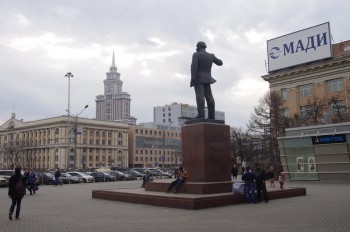
The building, though, is clearly influenced by the style of the Stalinist-Gothic architecture from the 1950s. It would seem that there therefore exists an architectural style that might be called “Stalinist revival”. Saying that this style is nostalgic for the communism of the Soviet 1950s is probably not right, but it is clear that that era has had a big influence on what makes Moscow Moscow just the same – to the extent that the city is still building upon it. This is unthinkable in Warsaw, but is what happens in Moscow. This almost makes me think about some of the strange iconography I have seen recently from Eastern Ukraine: “Russian Nationalists” holding up communist symbols and Russian Orthodox Christian iconography side by side. Communist iconography no longer means anything as communism, but has become part of the language of Russian nationalism.
I am told there are some Stalinist revival buildings in Kazakhstan, too. In fact, there is even another Triumph Palace in Astana. What I should read from this, I shall leave for another day.
I suppose some people who loathe rock festivals and want to pretend how much they enjoy playing the “working class hero” line might sympathise with Bruce Dickinson, who is the front-man for group Iron Maiden, in refusing to play at Glastonbury for it being “middle class”. (He was privately educated, which is ironic.) I normally really like Dickinson (if not his music, at all) due to his being a qualified pilot and having fairly pro-free market, no bullshit, views. And he cannot stand Coldplay and all that dreary stuff, so he must be a good egg overall. But something about all this makes me think, “Fcrissakes, can we just take class out of it and enjoy the music on its merits? Does it always have to have some frickin’ socio-economic agenda?”
Here is the item:
Bruce Dickinson, who attended the private Sharrow Vale boarding school in Sheffield, said the band had no interest in playing there. He said: “In the days when Glasto was an alternative festival it was quite interesting. “Now it’s the most bourgeois thing on the planet. Anywhere Gwyneth Paltrow [the actress] goes and you can live in an air-conditioned yurt is not for me.”
Dickinson, who is also a qualified commercial pilot, said he was glad he was instead playing at hard rock festival, Sonisphere, at Knebworth Park in Hertfordshire in July. “We’ll leave the middle classes to do Glastonbury and the rest of the great unwashed will decamp to Knebworth and drink lot of beer and have fun,” he said in an interview. Fellow heavy metal band Metallica are headliner’s at this year’s Glastonbury Festival, which starts next week and is attended by more 100,000 people. Tickets for the event, which sells out in minutes, are £210.
I can see his point about having a raving good time with cheap beer etc. Heck, I went to Le Mans last weekend to watch the 24-hour endurance motor race, which is the petrol-head equivalent of a rock festival with very, very fast cars blasting around a track in central France. There are lots of overweight middle-aged, lower-middle class guys (few women) who attend it, as well as the odd toff, group of rowdy youngsters and so on. I suspect even a few leftie-liberals go, in a guilty-pleasure sort of way. Think of Essex man and his European/North American versions all having a great time away from the other half and the kids. My wife stays at home with her friends and would not go there for love or money. And of course it is gloriously loud, vulgar, a hymn to non-PCness. But I don’t worry about the class backgrounds of those who go and would be a pretty sad individual if that sort of issue coloured my enjoyment. This weekend, I am in the Royal Enclosure at Ascot to watch the horses, and it doesn’t get more “upper class” in a cliched way than that.
Can we please, just for once, take the class obsession out of every such event? Please. Pass the champagne.
The purpose of the NHS is political, not medical. In the UK, in our Coronation of the State as our Bountiful Lord, it is the Crown, the dole is the Orb and State Education is the sceptic sceptre.
Those who question the State threaten to leave you without medical treatment, leading to a horrible death, or starve or be illiterate. Yet a Slaughterhouse like the Mid-Staffs can kill on a scale that an early 1940s German bureaucrat might admire, and nothing happens until hospital the pile of corpses becomes too obvious for excuses not to be shuffled out.
– Samizdata commenter Mr. Ed
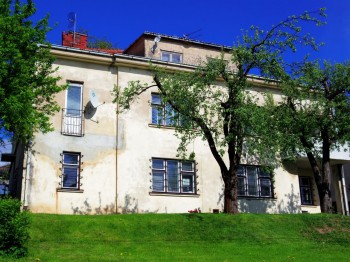
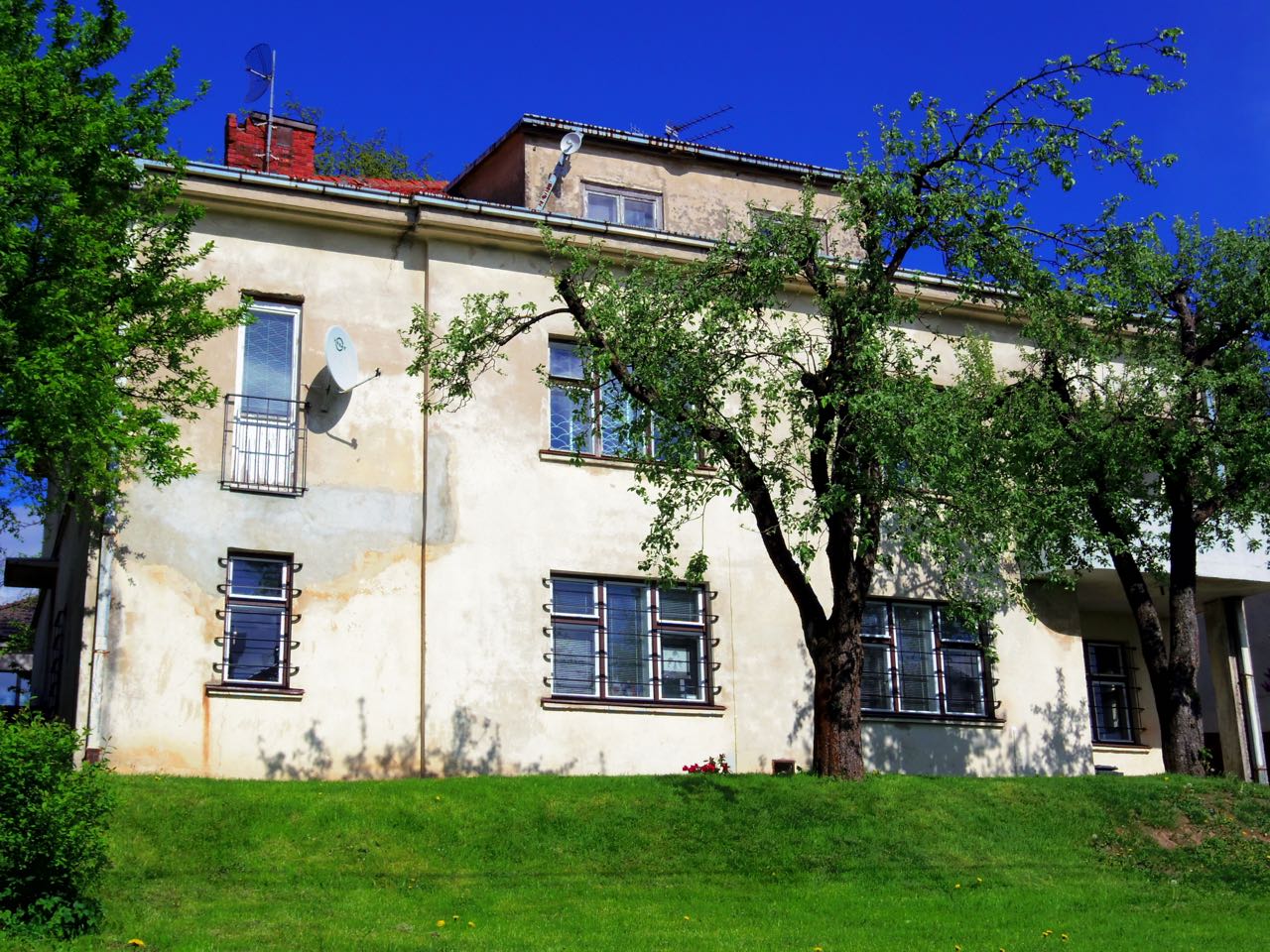
I visited the above house in Kaunas, Lithuania last month. In 1940, this house was the Japanese consulate. Kaunas functioned as the capital city of Lithuania prior to the Second World War. The Lithuanians considered Vilnius to be their rightful capital, but it was masquerading as the Polish city of Wilno at the time. Upon the German occupation of Western Poland and the Soviet occupation of Eastern Poland in late 1939, many (both Polish and Lithuanian) Jews were trapped in Lithuania and clearly in great danger, but were unable to gain exit visas to leave the Soviet Union (or travel across it by the Trans-Siberian railway) unless they had visas to go somewhere else. There were Japanese government rules stating that transit visas could be issued to Japan, but only if the applicant had plans to go somewhere else after Japan, and also that he had adequate financial resources.
Seeing the desperation of the situation, and against orders, Japanese consul Chiune Sugihara issued Japanese transit visas to anyone who asked. (In the book Bloodlands historian Timothy Snyder – who clearly finds Sugihara as fascinating a figure as I do – makes it clear that Sugihara was a Japanese spy as well as a Japanese consul, and his job was to keep track of Soviet troop movements for the Japanese government). During September 1940 he spent something like 20 hours a day writing out visas. When the consulate was closed and he had to leave, he was followed by a crowd to the railway station. As his train left, he was still throwing blank visas with his seal and signature on them to a crowd of desperate people. In total, he wrote something like 3000 visas, and as dependent family members could travel on the same visa as the principal person it was written for, those visas covered several times that number of people.
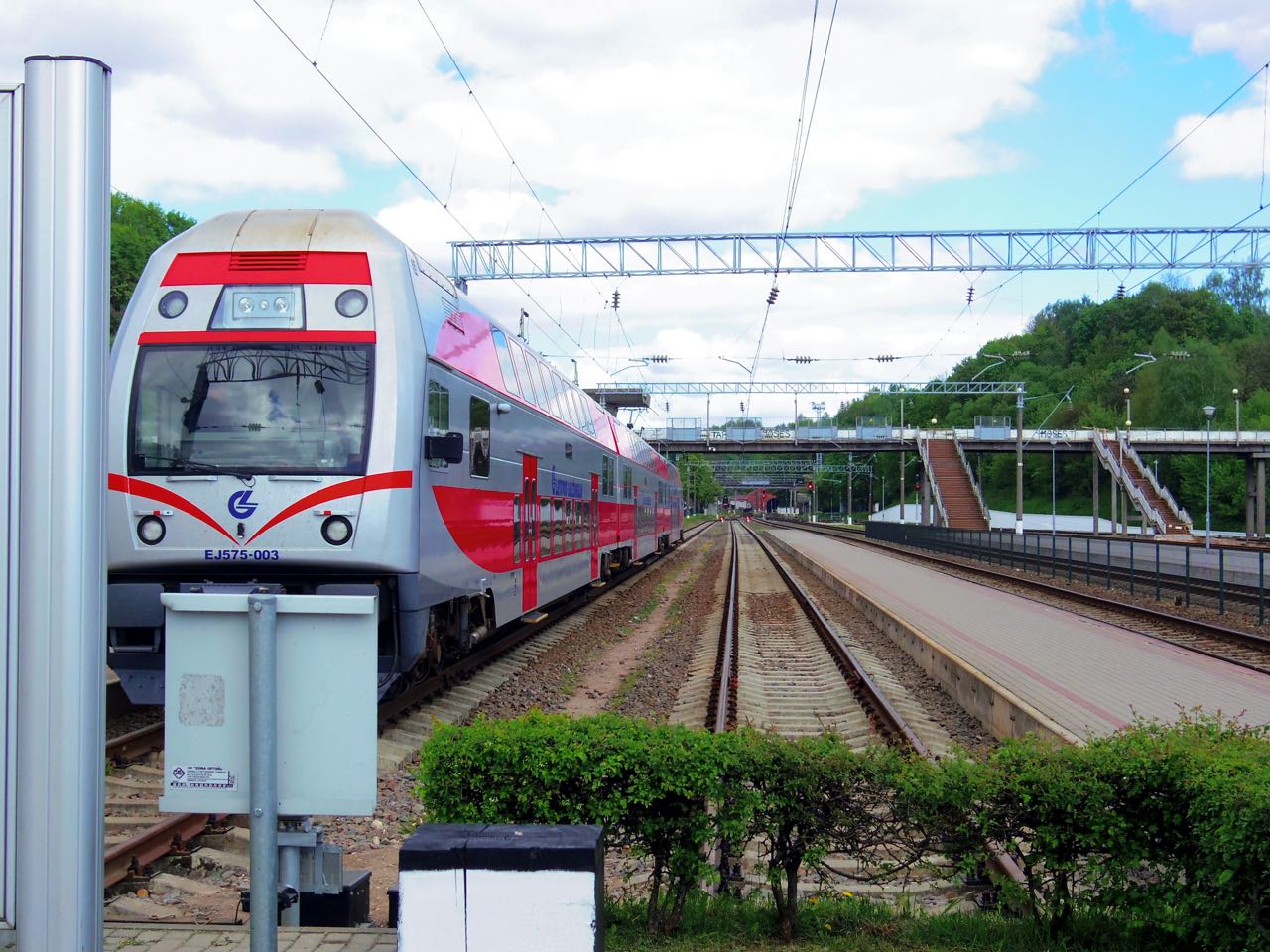
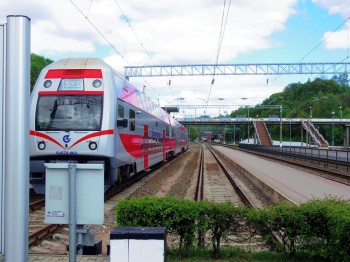 Kaunas railway station today. Kaunas railway station today.
Upon receiving these visas, Jews were able to travel on the Trans-Siberian railway to Vladivostok and then go by ship to Japan. They then dispersed to various places, but many were deported to Shanghai when the tripartite pact with Germany was signed shortly afterwards. Shanghai was also under Japanese occupation, and there these people spent time in the Shanghai ghetto – Restricted Sector for Stateless Refugees – where they stayed until Shanghai was liberated by the Americans in 1945. I visited the remnants of the Shanghai ghetto in 2006, and wrote about it at the time. Although this was crowded and at times squalid, it was a place of relative safety. The Japanese behaved monstrously towards certain other groups, but they had nothing against Jews, and did not turn the Jews in Shanghai over to the Germans despite German requests. Rather cleverly, Jewish leaders in Shanghai played upon Japanese mistrust of their German allies. Upon being asked by a Japanese governor why the Germans hated the Jews so much, rabbi Shimon Sholom Kalish replied “They hate us because we are short and dark haired”.
Most Jews who got to Shanghai survived, and then emigrated to Israel, Australia, the US and other places after 1945. Estimates of the number of lives saved by Sugihara go as high as 10,000, although estimates of about 6,000 seem more common.
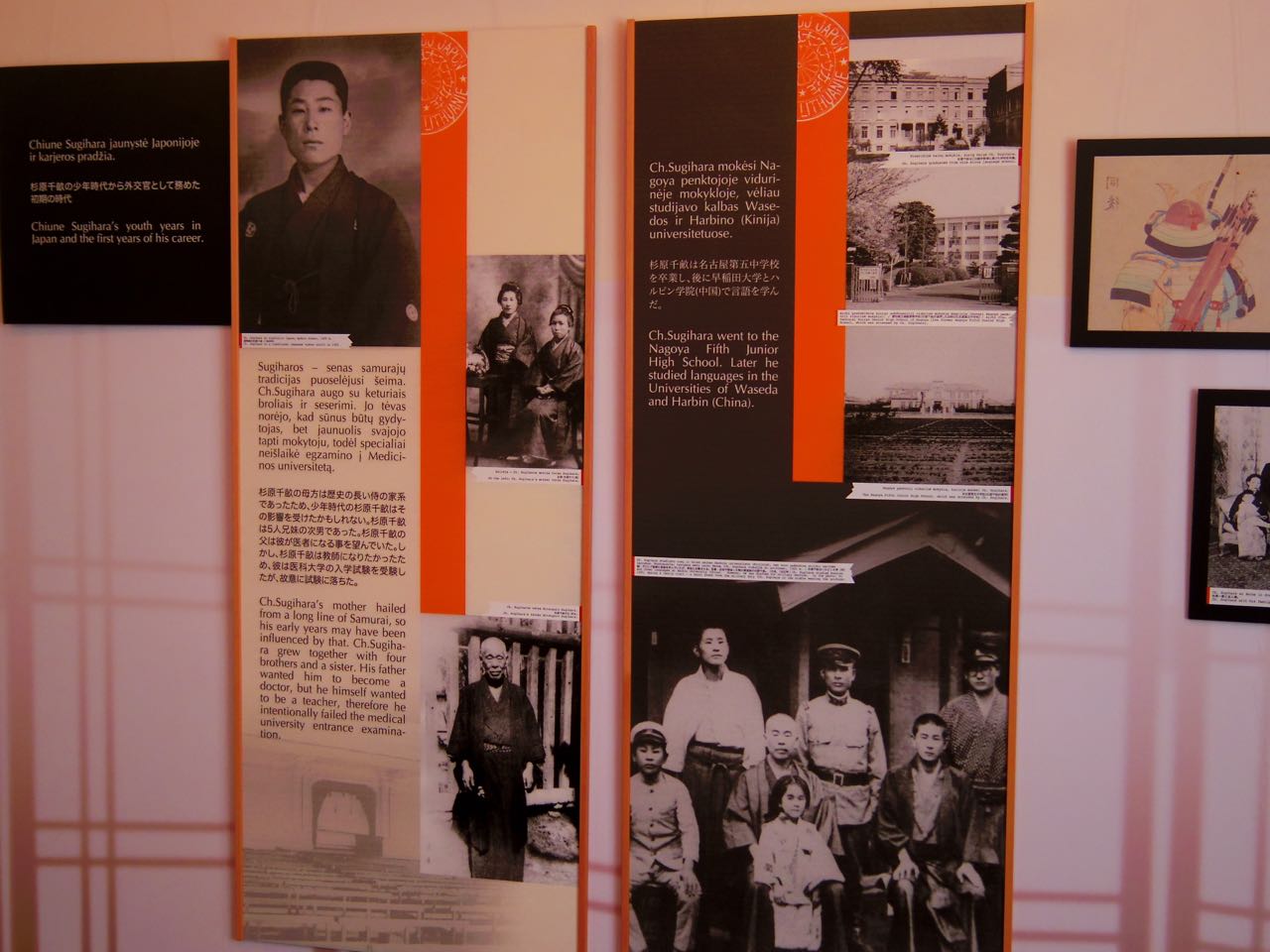
Half of the building in Kaunas is now a museum to Sugihara. I wanted to see this – it was why I went to Kaunas. The other people in the museum when I went there were a busload of Japanese tourists. Almost everyone who had signed the guest book had done so in Japanese, too. I didn’t see any Lithuanians or many other Europeans, which is a shame given this extraordinary story.

It’s an exceptionally good thing that the museum is there, but I did find the tone of the museum to be slightly curious. The museum did seem to be going out of its way to present the Japanese in general in the best possible light overall, rather than simply telling the story of Sugihara. That Sugihara was acting against orders was mentioned but not emphasised, and much was made of Jews who reached Japan being treated well, but not much was said about where they went after the Japanese alliance with Germany intensified and they were deported from Japan. The truth – the Shanghai ghetto mentioned above – doesn’t actually reflect too badly on the Japanese, but it is rather unfortunately connected to other things that do reflect badly on the Japanese. It is impossible to praise Sugihara himself too much – the man saved the lives of 6,000 or more people just out of basic human decency – but does this reflect well on Japan as a whole? That is harder to say. As is the case with other various people who did similar things, his story remained obscure for many years. His career with the Japanese foreign service ended after the war for reasons that may or may not have had to do with disobeying orders in Lithuania.

Eventually, Sugihara’s story became widely known, and he was later honoured by Yad Vashem, the state of Israel, the state of Japan and the state of Lithuania, but this took a long time. As it did with Paul Grüninger, Oskar Schindler, and others.
The only serious black mark against the NHS was its poor record on keeping people alive
– Denis Campbell and Nicholas Watt.
This was written in all seriousness in a Guardian article praising the NHS. Seriously. Not joking. You could not make this up.
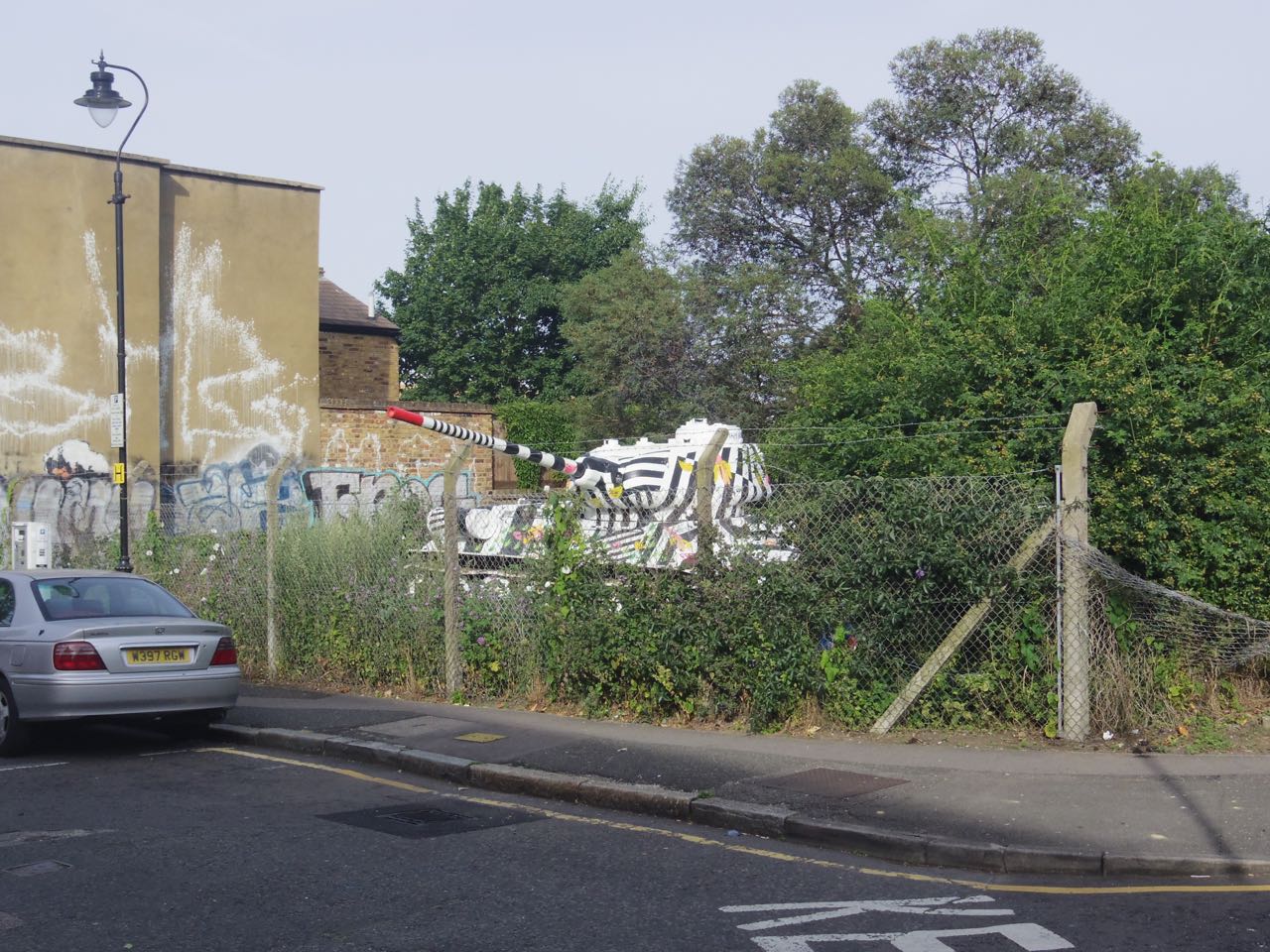
Often, when walking near Old Kent Road close to my home in Southwark, I have seen this peculiar sight.
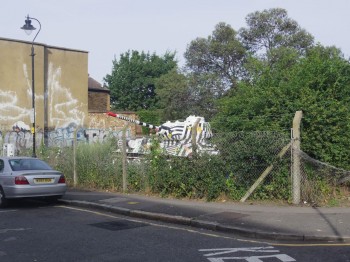
Yes, it appears to be a tank. London is London though. Our glorious city contains a lot of weird shit. Is it a war memorial? I doubt it. Is it a decoration in a public park? Again, I doubt it. The land is overgrown and is fenced off, although the fence has long ceased to be effective. Is it an art project? Possibly. Certainly the paint and graffiti on the tank changes from time to time, but as to whether this is planned or simply something done by the nearby and bored, once again who knows? As to what type of tank it is, my knowledge of military hardware is sadly lacking.
Half the Samizdata commentariat (and certainly this blog’s glorious leader) is no doubt jumping up and down and saying “It’s a T-34, you idiot”. As it happens, I discovered this when looking at Google Maps yesterday. The tank is in fact shown on the map, at the intersection of Mandela Way and Page’s Walk in London SE1. (Places in the UK that were ruled by Labour local governments in the 1980s are full of streets, council buildings, and lord knows what else named after Nelson Mandela, as this was considered a good way to annoy Margaret Thatcher).
Curiouser and curiouser. A T-34 is a Soviet tank. What the hell is it doing on an overgrown piece of land in Southwark? Thankfully we have the internet, which tells us one of those stories that is probably not entirely true but should be. Reputedly a man named Russell Gray, the owner of the now overgrown block of land, wanted to build a house on it. This seems perfectly reasonable to me. Although the block is fairly small and a peculiar shape, it is certainly big enough for a small house. As the location is no more than a 15 minute commute to the financial jobs in the City of London, any house there would be of considerable value. However, when Mr Gray applied to Southwark Council for planning permission, it was denied. In frustration he submitted another planning application requesting permission to put a tank on the site. This was granted. He then obtained a surplus Soviet T-34 and this has been on the site ever since. Apparently the turret was originally pointed in the precise direction of of Southwark Council’s offices and the tank was given the nickname “Stompie” after an ANC activist murdered by thugs loyal to Winnie Mandela after they suspected him of being an informer to the apartheid South African government in 1988.
Where does one obtain a surplus Soviet T-34, exactly? It was imported from Czechoslovakia as a prop in the 1995 film of Shakespeare’s Richard III, starring Ian McKellan and a large ensemble of Britain’s other finest actors. Prior to that it may or may not have been used by the Soviets in putting down the Prague Spring in 1968. In any event, Mr Gray was able to buy it cheaply after the film-makers had finished with it.
Er, come again? Didn’t Richard III die in 1485 before spending the next five hundred years beneath a car-park in Leicester? Were there a lot of T-34s involved in the Wars of the Roses?
Ah, this version was set in a fictionalised 1930s England. Soviet tanks that did not go into production until the 1940s were apparently a better fit in that world.
As I said, London contains some weird shit. I can’t imagine living anywhere else.
Is it too much to hope that one day these uneducated and bigoted Yorkshire folk will understand that claiming benefits, fly-tipping, littering the streets, threatening people and playing loud music all night – these were the things of which they complained – are simply expressions of cultural diversity, to be warmly embraced? Why don’t they understand that we all have to get along?
– Rod Liddle
Greenpeace loses £3m in currency speculation
I liked the first comment, from a merry soul called ‘casaleiro’:
“Shoulda put the money in armaments and petroleum.”
Don’t get me wrong, I don’t want to make too much of this. But here it is anyway.
In a report about successful pop entertainer Frank Turner meeting successful pop entertainer Josh Homme, Turner is quoted saying, about Homme, this:
“One of the other things about him which I really enjoyed was that – without going into too much discussion about it – I’ve obviously copped a fair amount of shit for being a Libertarian in the press, and he was aware of this and said ‘I’m a fucking hardcore Libertarian, stick to your guns and fuck them’. It’s not very often that people say that to me, so that was nice – I enjoyed that.”
Thanks to Turner and Gigwise, and google sending me an email about it, I get to enjoy it too.
The shit in question is referred to in this earlier posting here by me, and I wrote some more about Turner here.
When it comes to “climate science”, I have for quite a few years now, as my sneer quotes make clear, been inhabiting the land of confirmation bias. So, I will not say that this proves me right. It merely confirms me in my state of ever more glacially advancing contempt for the “science” here described:
Several months afterwards, the society’s ‘newsletter’ was published. It contained a special section on the conference at which I had spoken, with a brief description of each talk, the work behind it, and with thanks offered to each speaker. I searched for my name – nothing. My presentation was ignored in its entirety.
“Disheartening” isn’t the term I would use, and I seriously considered giving up on the entire idea of academia, and getting a nice little 9-5 job. But, I am still here, still working on the problem, still uncovering, lets call them ‘anomalies’, in many areas, which the scientists involved have no clue how to explain, but about which they will hear no view other than their own.
Biases being confirmed all round, it would seem.
A story in The Telegraph has brought to mind the following quotation, which seems doubly apt:
“Hegel remarks somewhere that all great world-historic facts and personages appear, so to speak, twice. He forgot to add: the first time as tragedy, the second time as farce.”
– Karl Marx, writing in “The Eighteenth Brumaire of Louis Napoleon”
|
Who Are We? The Samizdata people are a bunch of sinister and heavily armed globalist illuminati who seek to infect the entire world with the values of personal liberty and several property. Amongst our many crimes is a sense of humour and the intermittent use of British spelling.
We are also a varied group made up of social individualists, classical liberals, whigs, libertarians, extropians, futurists, ‘Porcupines’, Karl Popper fetishists, recovering neo-conservatives, crazed Ayn Rand worshipers, over-caffeinated Virginia Postrel devotees, witty Frédéric Bastiat wannabes, cypherpunks, minarchists, kritarchists and wild-eyed anarcho-capitalists from Britain, North America, Australia and Europe.
|






Recent Comments