Richard Branson’s space tourism shows what today’s obscene inequality looks like
When rich people burn huge sums of money on fun, it wakes us up to the excesses of the free market
– Zoe Williams, writing in the Guardian.
|
|||||
– Zoe Williams, writing in the Guardian. November 3rd, 2014 | 35 comments - (Comments are closed)
 (This is the text of a talk I gave at the Adam Smith Institute last week. More than one person has asked me for it, so I make it available here.) I am here to defend the Human Rights Act. It is not an idealistic defence but a pragmatic defence, rooted in historical context. Should classical liberals support the Human Rights Act against repeal? Do we need it? My answer is yes. Our reactions to phrases become readily conditioned. And so it has been with “human rights”. Let us remember for a moment that the full title of the agreement that is under siege here is the Convention for the Protection of Human Rights and Fundamental Freedoms. If it were called the Fundamental Freedoms Act would it be as easy to undermine? Sad to say ‘human rights’ do have a bad name, and they have that bad name for good reasons. Their strongest proponents often do the most harm to their reputation – not because of the legal content of what they say, but of their approach to the law. This comes in two forms which sometimes overlap: the rarer is soft revolutionism from the far left – human rights as a transitional demand. This approach makes human rights a movement more than a doctrine or legal concept.… a means to control the terms of any political debate. More common is a not entirely conscious belief that human rights and the Human Rights Act in particular embody the truth, the whole truth and nothing but the truth of how states should treat people. It’s a sort of human-rights fundamentalism, a desire for revealed wisdom in which “but that is contrary to Art 6” is a morally conclusive statement. → Continue reading: The Human Rights Act as a constitution of liberty [no, really] November 2nd, 2014 | 37 comments - (Comments are closed)
This is how in 1918 Times readers first found out about Spanish flu: 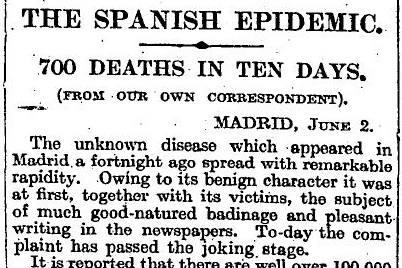 The Times 3 June 1918 p5 You can say that again. It ended up killing 40 million people. Incidentally the Wikipedia page on the subject is an appalling mess. At one point it claims that it began on the Allied side of the front, at another that it began on the Central Powers’ side. At one point it claims that it was particularly lethal to those with strong immune systems and at another to those with weak immune systems. Having said that I love the suggestion that it was called Spanish flu because that was the origin of the first reports of the disease. It was the origin of the reports not because it was the first place to get the disease but because wartime censors did not want to encourage the enemy by admitting its presence. So, it’s possible that this was not how Times readers first found out about it. November 1st, 2014 | 5 comments - (Comments are closed)
Normally it’s rather difficult to get the news media to lose their shit like a bunch of screeching schoolkids over a story like, “Defense Manufacturer Offers New Product That Makes Incremental Advances on Existing, Widely-Used Technology.” But fortunately for Israeli defense manufacturer Rafael, the maker of the Iron Dome short-range air defense system, reporters don’t always understand what it is they’re reporting on. November 1st, 2014 | 9 comments - (Comments are closed)
October 31st, 2014 | 8 comments - (Comments are closed)
Any CEO who thinks his sexuality is the greatest gift god has given him, is not keeping his eye on the balls I want him to. October 31st, 2014 | 8 comments - (Comments are closed)
I was only vaguely aware that Russia Today existed until our venerable chum Paul Marks mentioned it for the hundredth time, usually whilst he was sharpening a cavalry sabre (I may have imagined that last bit). So eventually I just bit the bullet (picked up on a battlefield in the Crimea I might add) and I actually went and found the damn thing on-line. Oh boy what fun I was missing! Russia Today is as much of a hoot as listening to Radio Tirana back in the great old days of Enver Hoxha, which is to say, it is AWESOME. These guys actually play it dead pan most of the time, as if people are going to take them seriously! I really do LOVE them! Of course I am sure the people who work there don’t really think that, but hey, as long as they keep getting a pay check for providing us with giggles, it is a win-win for all concerned! I mean they even have Steven Seagal! How cool is that? Seagal always wanted to be a good actor, a respected commentator and a friend of gay icon and all round great guy Vlad Putin… do not scoff! Do not titter! Face it, achieving one out of three of your life’s ambitions is more than most people ever do! October 30th, 2014 | 25 comments - (Comments are closed)
Apple CEO Tim Cook comes out as homosexual! Wonderful! Marvellous! Actually to be honest I truly do not give a damn. It might be because it has nothing to do with his job. People can announce what they do with their genitalia all they want, just do not expect me act as if this is something I need celebrate. He can shag goats for all I care, just please, make iTunes better than the steaming pile of poop it became in version 12. Should homosexuals be given grief? No. Now that we have settled that, please just STFU and run the company like a good little capitalist. October 30th, 2014 | 68 comments - (Comments are closed)
Dominic Frisby’s book Bitcoin: The Future of Money? is now available. The first chapter describes what Bitcoin is and how it works. The achievement of this chapter is that Dominic has described Bitcoin in plain English without missing any important details and without simplifying to the point of error. Too often when I read writing intended for the general audience about something I know about, I notice how wrong it is and how ill informed the general audience must be about all things. Not here. Technical description out of the way, the rest of the book deals with the culture of Bitcoin’s early adopters, the various scandals we may have heard about and what they mean, what Bitcoin means for the state and for you, and what the future might hold for Bitcoin and cryptocurrencies in general. The longest chapter is about the mysterious Satoshi Nakamoto, who wrote the original paper and developed the first versions of the software, and who has successfully remained anonymous. It is not particularly relevant to understanding Bitcoin, but it is very intriguing, and I think there is a good chance Dominic has reached the right conclusion about Satoshi’s identity. There is discussion of the problems of inflationary fiat currency: the author has read his Detlev Schlichter. There is discussion of how the decentralised nature of Bitcoin sidelines governments and opens up new markets with people who are otherwise difficult to trade with. And there is discussion of the problems, too: the volatility, the technical challenges, and the dangers of being defrauded in a new marketplace where we are still learning what are the best business practices and how to decide who to trust. Finally, there is some advice about where to buy Bitcoins. It is not out of date yet! The book is concise, complete, correct, entertaining, and a very good introduction to what Bitcoin is all about. October 29th, 2014 | 39 comments - (Comments are closed)
…mobile phone technology! VICE has a very interesting report, looking at at how the US military is adjusting to the astonishingly rapid proliferation and deployment of cheap drone technology. Faced with using multi million dollar weapons platforms firing munitions costing hundreds of thousands of dollars against these things, they are seeking more feasible ways to counter air threats costing thousands or even mere hundreds of dollars. And the threat is not hypothetical: even the daesh Islamic State claims fairly plausibly to be using cheap reconnaissance drones right now, and Hezbollah appears to have fairly sophisticated armed drones (fast forward to 1:25 or thereabouts to see the boom and hear the invocations to Admiral Ackbar or whatever). We really are entering a new era not just commercially but also militarily. October 29th, 2014 | 23 comments - (Comments are closed)
Back in 2001, Brian Micklethwait once said something that has since become part of my standard operating procedure. Speaking from his experience actually organising activities, rather than just talking about organising them as is the case with most people, he said if someone starts to offer you unsolicited advice about how to improve whatever it is that you are doing, immediately ask if they are prepared to get involved and implement their suggestion themselves. If the answer is yes, listen to what they have to say. If the answer if no, stop them right there and change the subject. October 28th, 2014 | 27 comments - (Comments are closed)
If mankind can fix paralysis, we will move into a whole new era of promise and possibility. The raising up of the lame that humanity now seems capable of – which springs from decades of research into cell growth and cell manipulation, the development of new technologies, and much experimentation – crashes violently, and gloriously, against the way man is understood and discussed today: basically as a pest, a planetary poison, not capable of much besides hatred and destructiveness. October 27th, 2014 | 37 comments - (Comments are closed)
|
   |
||||

All content on this website (including text, photographs, audio files, and any other original works), unless otherwise noted, is licensed under a Creative Commons License. |
|||||

Recent Comments