We are developing the social individualist meta-context for the future. From the very serious to the extremely frivolous... lets see what is on the mind of the Samizdata people.
Samizdata, derived from Samizdat /n. - a system of clandestine publication of banned literature in the USSR [Russ.,= self-publishing house]
|
For as long as I can remember I have been an enthusiastic supporter of the principle of road pricing, for much the same reasons that I favour the pricing of any other scarce and desirable product or service. Reduce queueing caused by underpricing. Encourage the construction of better roads, more suited to the desires of drivers, more creatively designed. Pricing will enable road ownership, and that will enable better environmental policies, because owners will then be responsible for environmental impact. Etc.
However, there are two different ways of doing road pricing, both of which have big advantages and big disadvantages.
One. Anonymous Charging. Charge each vehicle to go past certain barriers, physical or electrical. Either the man at the wheel chucks some coins down a shute, or the place has a machine which debits the vehicle as it goes by, by debiting a box on the vehicle which has been filled up with money, gas meter style.
Advantage: Anonymity! The vehicle user is no more spied on than he is when he buys a pair of socks in a shop. If the vehicle user consents to the transaction tracking inherent in the use of a credit card, fair enough. But money remains an option, and money is freedom, because money is anonymous. (I remember once a trader in a street market shouting at me: “You don’t ask me where I got the stuff I’m selling, and I won’t ask you where you got your money.”)
Disadvantage: Cumbersomeness. Every barrier becomes a huge Thames Flood Barrier for cars. Installing machines in cars is complicated and expensive, and what if different cities use different systems? A different box for each system? Until the same system wins a battle of the gauges, it’s a nightmare either of delay or of incompatible equipment. → Continue reading: Total Surveillance versus Anonymous Charging: the road pricing dilemma
When Hong Kong was handed over to Communist China by the British state, to much joy and acclamation by credulous Chinese and Gweilos alike, the totalitarian gerontocracy in Peking pronounced soothingly that Hong Hong would retain its relatively liberal order under a doctrine ‘One nation, two systems’.
Tens of thousands of people have marched in protest at a planned anti-subversion law aimed at an EU style ‘harmonizing’ of Hong Kong law with that of the rest of Communist China. One nation, one system it would seem.
…the government is pushing through the national-security legislation, known as the “Article 23” measures, too quickly, and without enough public debate. The proposal is in many ways an attempt to bring Hong Kong’s laws regarding subversion, treason, sedition and the theft of “state secrets” in line with China’s.
Well it comes as no surprise to me that these patent lies only took six years to be revealed. I look forward to hearing the people who rejoiced at the surrender of Hong Kong’s people to China recanting their folly. I am not holding my breath however.

The Chinese way of dealing with effective protests
(WSJ link via Combustable Boy)
Here’s some good news, in the form, for me, of an email from the newly launched Molinari Institute’s Director, Cécile Philippe:
I am delighted to announce the arrival a major new French-speaking free market think tank, the Molinari Institute, and the launch of its website www.institutmolinari.org
Named after the great nineteenth century French-speaking classical libertarian Gustave de Molinari, the institute aims to create an environment in which both individuals and businesses can thrive and be free without the ties of regulation and vested interest.
Through its website and conferences “Les soirées Molinari,” it will help the rediscovery of the work of Gustave de Molinari as well as other French and European liberal thinkers such as Frédéric Bastiat, Charles Coquelin and Bruno Leoni. It will focus on public policy issues such as competition, healthcare, retirement and education.
To launch the website today there is an interview with José Pinera, former secretary of labor and social security in Chile, who radically and successfully implemented in the market-oriented 80’s the pension reform.
The Molinari Institute is a non-profit organization. It accepts voluntary contributions from foundations, corporations, and individuals. No government funding or endowments are received.
I should say not. I know Cecile Philippe to be both a fearless and uncompromising libertarian activist, and a thoroughly charming and civilised person, two things which don’t always go together. The ideal combination of qualities for someone running an institute like this, in other words. I wish her every possible success, as will many others.
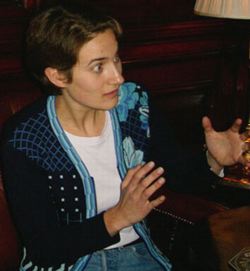
Now I know what you’re thinking. Does Cécile Philippe have a sister? Yes she does
Remember, France counts twice, at least. Whatever opinions, good or bad, sensible or stupid, those French intellectuals may happen to hold, they are, it must be admitted, totally brilliant at spreading them far and wide. Imagine the impact on mankind and its affairs if we could turn the bien pensants of France around, from statists and collectivists into the opposite. That might be a bit incroyable, but wouldn’t it be formidable?
Exactly a year ago, Melanie Phillips has written an excellent article ID cards are not the British way. Alas, her arguments are as necessary and relevant as they were then.
She addresses every point in the debate, from the increased need for security, terrorism, mass immigration, problems with ‘compulsory’ entitlement cards, personal information on ‘smart card’, causes of rising crime etc.
The most central argument, though, is difference between the British concept of liberty and the European one:
Britain is not the same as Europe. We have a very different approach to liberty. Here, everything is permitted unless it is forbidden. People can go about their business without being expected to give an account of themselves.
By contrast, in Europe freedom is something that has to be codified and granted from above. So Europeans have always been used to producing ‘papers’ to prove themselves, a practice that we have always found unacceptable.
And her last paragraph certainly belongs here, on White Rose:
Now, thrashing around in panic to show that it is getting on top of our social problems, it is not coming up with policies that actually work but is proposing instead to nail down still further the coffin of British liberty.
It has been known for some time that Britain plays a significant role as a support base for al-Qa’eda. So much so that even the government conceded the fact. Details about the activities of British-based Muslim fanatics were given during a series of appeals by suspected foreign terrorists against their detention without trial.
The Special Immigration Appeals Commission, sitting in London, heard how a dozen terrorist attacks and planned attacks around the world could be traced in part to Britain. At the centre of the network was a number of radical clerics, including Abu Hamza, the hook-handed north London imam who faces the loss of his British citizenship.
Today, a report published by Charity Commission, a statutory organisation that regulates charities in the UK, has concluded that Abu Hamza, drove away moderate Muslims from the mosque in Finsbury Park, took over and used it as a base to spread extremist views and shelter his supporters.
The Telegraph reported last week that although now removed from his post at Finsbury Park mosque, Hamza has not been detained and continues to address his followers outside the building every Friday. An attempt to strip him of his British citizenship has been stalled because Hamza has lodged an appeal that will not be heard for several months. The US authorities are delaying their extradition request until they are satisfied they have built a strong enough case to succeed in the British courts.
Why does it take so long to remove such obvious threat to the British society? Abu Hamza is a self-professed enemy of the West, with links to Taliban and Al Qa’eda. The only thing the British authorities managed so far, is to get him banned from the mosque and strip him of his many welfare benefits. I feel so much safer now!
The Dissident Frogman has returned from his trip to Normandy, where he visited, among other things, the Musée Mémorial de la Bataille de Normandie (Memorial Museum of the Battle of Normandy) in Bayeux… He is, as always full of interesting observations and has a new game for his readers. It is called “Guess what’s missing at a museum dedicated to the Battle of Normandy, 1944?”
The game consists of three incredible pictures. My first reaction was – ‘surely, they could not go that far’. But alas, it is true. What’s more, he couldn’t get any lucid and convincing explanation for this “fortuitous” accrual.
Please go here to ‘play’ and perhaps engage in shooting off a few emails to the Mayor of Bayeux…
As part of my continuing vow to be as nice as humanly conceivable towards our neighbours in France, I refer the readers of this blog to the following news item, purely for the purposes of conveying information, and not out of any desire to gloat over, denigrate or otherwise annoy the French.
Harry Potter has cast such a spell over the French that they are snapping up JK Rowling’s latest book in English, rather than waiting for the translation.
[…]
“It’s not exactly going to please the anti-globalisation movement,” noted literary magazine Livres Hebdo, which compiles and publishes the bestseller charts.
Heh. 
When Hong Kong was handed over to Communist China by the British state, to much joy and acclamation by credulous Chinese and Gweilos alike, the totalitarian gerontocracy in Peking pronounced soothingly that Hong Hong would retain its relatively liberal order under a doctrine ‘One nation, two systems’.
Tens of thousands of people have marched in protest at a planned anti-subversion law aimed at an EU style ‘harmonizing’ of Hong Kong law with that of the rest of Communist China. One nation, one system it would seem.
…the government is pushing through the national-security legislation, known as the “Article 23” measures, too quickly, and without enough public debate. The proposal is in many ways an attempt to bring Hong Kong’s laws regarding subversion, treason, sedition and the theft of “state secrets” in line with China’s.
Well it comes as no surprise to me that these patent lies only took six years to be revealed. I look forward to hearing the people who rejoiced at the surrender of Hong Kong’s people to China recanting their folly. I am not holding my breath however.
The Chinese way of dealing with effective protests
(WSJ link via Combustable Boy)
The Telegraph has an update about the vote in the House of Lords on the European Union curbs on the sale of vitamins and mineral food supplements.
Peers voted by a majority of 53 last night to call upon ministers to revoke regulations due to implement the EU’s Food Supplements Directive in August 2005. But Health Minister Lord Warner said the vote would make no difference.
The UK is obliged to implement the directive. Failure to transpose its requirements properly would be a serious breach of our obligations under the EC Treaty and would result in infraction proceedings against the UK and in the likelihood of our facing heavy fines. Ultimately, implementation would be forced upon us.
I don’t know whether the annual Glastonbury Music Festival is the world’s longest running or the world’s most famous music festival or whatever but it always attracts great heaving mobs of students and twenty-somethings.
For our enemies, this is a target-rich environment:
Bands play above a huge Greenpeace banner on the main stage, there are notices about Third World water supplies inside the toilets and organisers want every single person to sign a petition for fairer international trade laws.
On top of that, Tony Benn got a rock star’s welcome, a Palestinian group has brought an inflatable tank, Columbian trade unionists are planning to stage mock kidnappings of comedian Mark Thomas and singer Billy Bragg, and the Drop the Debt double decker bus is offering its bath to a lucky competition winner.
Depressing, isn’t it. Mind you, there’s always the risk of overkill:
“You notice it a lot but I don’t really take much interest it,” said Lisa Rush, 28, from Colchester.
Come the day we see a ‘Hayek Stall’ at a rock festival, we will truly know that we have turned a corner.
“The truth about market liberalisation and economic growth is not that it increases inequality, nor that it hurts the poor: just the opposite. Rather, the truth is that some large parts of the poor world are pulling themselves out of poverty while others are not.”
– The Economist
The quote is taken from an article in the Economist marking that publication’s 160th birthday. The Economist, even though it occasionally annoys me with its smart-ass tone, has been a fairly consistent voice of pro-free market liberal good sense since it first went to print in the Victorian age. It is worth clicking on the link and looking at the related articles in a whole series which the Economist devotes to celebrating liberal ideas.
And by “liberal”, I mean the word that would have been worn as a badge of pride by William Gladstone, Adam Smith or Milton Friedman, rather than those collectivists in drag in the U.S.
Happy Birthday, Economist!
I think that Hermann Rorschach was really onto something with that little inkblot test of his. If two different but apparently sane people can look at the same picture and see two entirely different things then perhaps that goes at least some way explaining ideology as well as psychology.
A perfect illustration of this lies in the response of British socialist bloggers to the plans for the regionalisation of England. This is the plan to divide England up into nine entirely artifical ‘sectors’ and give each its own assembly with regulatory functions. The details of this project are currently being thrashed out by the Office of Deputy Prime Minister John Prescott.
Over on the left, this is an eagerly awaited development. One of the new kids on the left-block, Farringdon Street, waxes lyrical:
The northwest is going to have a referendum on a regional assembly. This is a development that should be greeted with alacrity. While its chief protagonist in central government John Prescott hardly has a reputation as a constitutional iconoclast, devolution is vital to the reconstruction of British politics.
Power is to concentrated, the agenda to London centric. The regions especially those furthest from the capital need their own champions. We must increase the sheer amount of political muscle deployable in London and Brussels to advance the regional interest.
And he is far from alone in his enthusiasm. It is sincerely shared by the rest of British left all of whom appear to be getting moist-knickered and dewey-eyed over what they are trying to present as ‘decentralisation’.
Now, if this really was a process of decentralisation it might have some merit. At the very least it would be worthy of further discussion. But this is not a process of decentralisation. Not even to the smallest degree. → Continue reading: Top down and down and down
|
Who Are We? The Samizdata people are a bunch of sinister and heavily armed globalist illuminati who seek to infect the entire world with the values of personal liberty and several property. Amongst our many crimes is a sense of humour and the intermittent use of British spelling.
We are also a varied group made up of social individualists, classical liberals, whigs, libertarians, extropians, futurists, ‘Porcupines’, Karl Popper fetishists, recovering neo-conservatives, crazed Ayn Rand worshipers, over-caffeinated Virginia Postrel devotees, witty Frédéric Bastiat wannabes, cypherpunks, minarchists, kritarchists and wild-eyed anarcho-capitalists from Britain, North America, Australia and Europe.
|





Recent Comments