We are developing the social individualist meta-context for the future. From the very serious to the extremely frivolous... lets see what is on the mind of the Samizdata people.
Samizdata, derived from Samizdat /n. - a system of clandestine publication of banned literature in the USSR [Russ.,= self-publishing house]
|
To me it is not a new idea, but it is a good idea, the one that says that the rich splash out now for what they think of as luxuries, but that some of these luxuries are actually emerging necessities, which will in due course be available to all at a fraction of the first prices paid by the rich. Sandra Tsing Loh is reviewing a couple of books for The Atlantic on line on these kinds of themes:
To consider “luxury” always a bad thing, Twitchell argues, is simply to ignore history.
“Almost without fail, one generation’s indulgence becomes the next generation’s necessity. Think buttons, window glass, rugs, fermented juice, the color purple, door handles, lace, enamel, candles, pillows, mirrors, combs, umbrellas.”
Well said, Twitchell. Why, yesterday I even bought a comb myself. For 40p. It was a rather ugly brown colour. I would have preferred purple.
Nail clippers and shorts and socks were once a luxury, and don’t forget the least frivolous “indulgence” of all: indoor plumbing. In a way, the rich provide society with a valuable service, because they pay the “high first costs” of emerging technology. “Sure, the ‘upfronters’ get HDTV, digital cameras, laser eye surgery, Palm Pilots … They also get first crack at Edsels, the Betamax, eight-track stereo, and Corfam shoes.”
I’m not sure about Palm Pilots. Aren’t they becoming rather passé, unless you think of them as part of the ongoing attempt to perfect the portable phone? And what are Corfam shoes?
Also: into which box will history put blogging? Is blogging window glass or Betamax, nail clippers or … Corfam shoes?
Thanks to Arts & Letters Daily for the link. For me Arts & Letters Daily used to be a luxury, but it has become a necessity.
Some people have far too much time on their hands:
The County of Los Angeles actively promotes and is committed to ensure a work environment that is free from any discriminatory influence be it actual or perceived. As such, it is the County’s expectation that our manufacturers, suppliers and contractors make a concentrated effort to ensure that any equipment, supplies or services that are provided to County departments do not possess or portray an image that may be construed as offensive or defamatory in nature.
One such recent example included the manufacturer’s labeling of equipment where the words “Master/Slave” appeared to identify the primary and secondary sources. Based on the cultural diversity and sensitivity of Los Angeles County, this is not an acceptable identification label.
Okay, how about we use the term ‘Boss-man/Bitch’?
This is the subheading of Mark Steyn’s latest Spectator piece:
Mark Steyn lists the countries that must be dealt with if we are to win the war against terrorism
Okay. But the first regime listed gave me a bit of a turn:
New Hampshire
Does the axis of evil have a new member? Has the Governor of New Hampshire been stockpiling weapons of mass destruction? Is the whole article some kind of joke? Steyn is a funny man. Is this a funny piece?
Steyn goes on to list five further targets for regime change: Syria, Iran, Saudi Arabia, Sudan, and North Korea.
Profound changes in the above countries would not necessarily mean the end of the war on terror, but it would be pretty close. It would remove terrorism’s most brazen patron (Syria), its ideological inspiration (the prototype Islamic Republic of Iran), its principal paymaster (Saudi Arabia), a critical source of manpower (Sudan) and its most potentially dangerous weapons supplier (North Korea). They’re the fronts on which the battle has to be fought: it’s not just terror groups, it’s the state actors who provide them with infrastructure and extend their global reach. Right now, America – and Britain, Australia and Italy – are fighting defensively, reacting to this or that well-timed atrocity as it occurs. But the best way to judge whether we’re winning and how serious we are about winning is how fast the above regimes are gone. Blair speed won’t do.
That all sounds fairly serious, doesn’t it? So what does Steyn have against New Hampshire? Ah. Penny drops. New Hampshire is where he was writing from. The universe makes sense again.
Nevertheless, behind this little joke there is a serious point. Steyn is describing a war against terrorism that does make sense to me. But the opponents of this war say that by the time Uncle Sam has toppled the regimes of Syria, Iran, Saudi Arabia, Sudan, and North Korea – or by the time it has given up trying to – it will indeed end up governing New Hampshire, and everywhere else in the USA, somewhat differently. War is the health of the state, as somebody once said.
My answer would be that hardly anyone is suggesting that there be no vigorous war fought against Islamic terrorism – and hence that no measures be taken that might infringe the liberties of Americans, or others. The war is being fought and will go on being fought. The only serious argument is about where to fight it. Is it to be fought in places like Syria, Iran, Saudi Arabia, Sudan, North Korea, and back home in places like New Hampshire? Or should some or all of the first five be struck off the list?
Either way, New Hampshire is indeed liable to end up a rather different place.
It scarcely counts as news:
Herbert Ndlovu, 43, who retired from the Zimbabwean National Army in August after 23 years service, said he had been ordered to put a cross against Mugabe’s names on ballot papers that should have been sent to soldiers.
Instead, the papers were resealed in envelopes and driven to Harare where they were used to support claims that Mugabe won the controversial presidential poll in March last year.
There were numerous secondhand accounts of vote rigging and gerrymandering, but the statement in Johannesburg by Ndlovu, who was tortured by the regime and has fled Zimbabwe fearing for his life, is the first personal account.
Accusations of electoral fraud were so convincing that the Commonwealth expelled Zimbabwe, and the United States and the European Union imposed travel and financial sanctions on Mugabe and his cronies.
Mr Ndlovu, said: “I filled in hundreds of ballot papers, maybe thousands. There were six of us working from early in the morning.”
The real shock would have been if this kind of thing had turned out not to have been happening. If Mr Ndlovu has said: “I know everyone assumes there was cheating, but there wasn’t. I know. I was directly involved. Everything was done correctly, with no shady business.” If he’d said that, and been believed, that would have been a story. But “yes there was cheating”?
Put it this way. I don’t know where this story was in the paper version of the Telegraph, but not on page one would be my guess.
First, they came for the tobacco.
With the ‘junk food’ demonisation campaign in full swing, now is the time for our heroic public officials to do their stuff:
All foods – including fast food and snacks – should carry clear warnings about their calorie content, MPs suggested on Thursday.
Top executives from McDonalds, Cadbury Schweppes, PepsiCo UK and Kelloggs faced questions from the House of Commons Health Select Committee.
Obesity levels are soaring in the UK, but the firms said they did not believe that this was their fault.
The Food Standards Agency has described the problem as a “ticking timebomb”.
Well, they would, wouldn’t they. If food were not a problem then we would not need a ‘Food Standards Agency’ and then we would all be on our way to hell in a handcart (and we all need a handcart because we will simply be too obese to walk there).
This Court of Inquisition is merely Step 2. Step 3 is a choice of either legislative force or ‘voluntary code of conduct’. Step 4 is another public campaign (disseminated by a reliably compliant media) because Step 3 ‘is not working’.
Then on to Step 5: the levying of ‘sin taxes’ on hamburgers to ‘encourage a change of behaviour’. The money raised then pays for a lot more Food Standards Agents.
There it is. Step-by-step. Simple when you know how.
We are all in the wrong business.
Here’s a quiz. The UK government is squandering money all over the place. That’s what governments do, after all. Just look at National Rail, The Dome, Government Department IT projects… If you could choose one government project that was the most appalling of all, what would it be? Are there ones that we don’t know about?
It’s no good. Every time I think about Jonny’s sun-kissed fringe. Every time I think about Dallaglio’s try-setting run. Every time I think about that little girl at the airport, at 4:30am, holding up a homemade picture of the England rugby team framed in red tinsel, I feel like blubbing. Even now, as I write this, I’m filling up again. What a game.
I think it’s something to do with having children. You just start becoming emotionally incontinent about everything. Or at least that’s what has happened to me. But enough of this nonsense. I shall ask Mr Micklethwait to try to cure me by email.
But his post below set me thinking about something else. Having waded through various anarcho-capitalist tomes, in the last few months, there’s something I’ve found particularly unsatisfying about them all, as they babble on about private courts, private arbitration, and private police. Where’s the beef!
You hear tantalising snippets about successful anarcho-capitalist societies in fourth century Germany, in eleventh century Ireland, and in fifteenth century Iceland, but rarely, if ever, do you actually get to see the beef. What would an anarcho-capitalist society actually be like? And if it’s such a good thing, why didn’t the German, Irish, and Icelandic experiments sweep the world? Yes, those with the biggest spears, swords, and addictive philosophies, imposed their coercive natures upon the rest of us, and their useless miserable parasitical states. But even anarcho-capitalists will admit that even the worst dictator needs the support of the broad mass of his state’s population, or at least their grudging acceptance, in order to survive. Otherwise, as revolutions like the recent one in Georgia have shown, the dictator is curtains. → Continue reading: Can competitive law work?
Greg Dyke, the BBC director general, attacked American reporting of the war in Iraq and derided news organisations that were prepared to bang the drum for one side or the other. Mr Dyke, who was speaking after collecting an honorary award at the International Emmys in New York on Monday night, said the Iraq coverage illustrated the difference between the BBC and US networks:
For any news organisation to act as a cheerleader for government is to undermine your credibility. They should be balancing their coverage, not banging the drum for one side or the other. If that were true in Britain, the BBC would have failed in its duty.
He cited research showing that of 840 experts interviewed on US news outlets during the war only four opposed the conflict.
Yes, unlike the BBC that has accomplished what we would call a pervasive bias, an affliction where the reporters cannot even tell just how loudly they are banging the drum for one side. This is the news outlet that regarded the Iraqi Minister of Information a source on a par with the Command Centre. Oh, and whose reporters kept insisting that there are not US troops in Baghdad when the rest of the world were watching their tanks moving down the streets of central Baghdad.
I came across an interesting report by River Path Associates that looks at the BBC Reporters’ Log and examines evidence of bias in the BBC’s reporting during the Iraq conflict. They chose the Reporters’ Log since it is immediate and reflects assumptions of the reporters themselves. (I would argue that the more pronounced bias was at the editorial level, it was interesting that some reporters who posted to the Reporters’ Log complained that their raw reporting was given a rather different spin by editors in the UK.)
The report analyses all 1343 posts to the BBC Reporters’ Log. The majority of posts contained factual statements or accounts of reporters’ personal experiences. Others discussed strategy, Coalition and Iraqi claims, and the progress of the war. The authors focused on these latter posts, allocating them to 8 different categories:
- Praise for Coalition strategy
- Criticism of Coalition strategy
- Praise for Iraqi strategy
- Criticism of Iraqi strategy
- Coalition successes
- Coalition setbacks
- Scepticism over Coalition claims
- Scepticism over Iraqi claims
They concluded, among other things, that:
A quantitative analysis of entries in the Reporter’s Log indicates that most reports are factual in nature, and do not contain comment or speculation on the nature and progress of the war.
- Reports that do include comment and speculation, however, are likely to be critical of Coalition strategy and to report Coalition setbacks. Reporters are also more likely to be sceptical about Coalition claims than Iraqi claims. This provides some evidence of bias.
- It is notable that many of the more provocative reports are made by the BBC’s most high profile journalists, especially by those based in Baghdad. While most BBC journalists concentrate on objective factual reporting, others habitually adopt a more confrontational role. On occasion, this leads to exaggerated, speculative or incorrect stories, which seldom receive any correction.
- These findings call into question BBC attempts to try and originate more stories, in order to set the news agenda. Questions arise over whether the BBC can ‘create’ the news, while holding to the standards of impartiality and independence which its Director General sets for it.
There you have it. And for more juicy evidence there is, of course, Biased BBC, which, by the way, has also something to say about Mr. Dykes arrogant comments about the US media.
The Opinion Journal has an excellent article by Saad Eddin Ibrahim of the Ibn Khaldun Center for Development Studies in Egypt. Saad not only speaks of liberty; he has spent his time in the hell of an Egyptian prison for promoting it.
I agree with him. The Arab world is no more incapable of living in peace and liberty than anywhere else. As Saad points out, Egypt has been there before and still retains shreds of a once vibrant civil society. The world has forgotten the century of Egyptian history prior to Colonel Gamal Abdel Nasser’s 1952 coup.
We of Samizdata wish him and the many others like him success and good fortune in their efforts to bring the blessings of liberty to their homelands.
Brian just posted one of my favorite shots of the Scaled Composites spaceship and wondered how large the windmills in the background windfarm are.
The answer is: big. Here are two of my non-telephoto photos of roughly the same area as seen from within the confines of the Mojave Civilian Test Flight Facility (a couple hours travel north and east of Los Angeles, California):
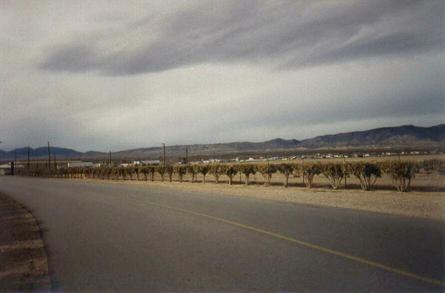
Photo: Dale Amon, all rights reserved
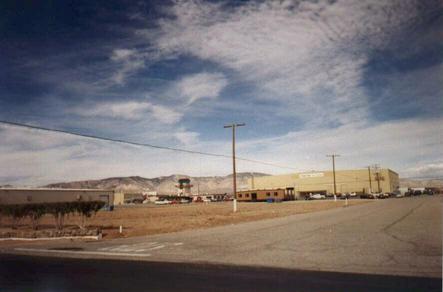
Photo: Dale Amon, all rights reserved
Yes, those are the same mountains you see in the photo on Brian’s blog. The windfarm was actually just barely visible in the top image before I cut it down to blog-size. I am far less certain of the direction of the bottom photo, but I think it shows the mountains in the opposite direction as I can see the control tower in it. (There is also an F4 Phantom. Can you find it?)
Things tend to be very big and very far away in that part of the world!
I bought the paper version of the December 2003 issue of Prospect yesterday, and was all set to quote from the two pieces I’ve already been reading with particular interest, while apologising for not supplying any links. Well, I can, but in the case of the longer article only to an introductory excerpt. How long even these links will last, I cannot say.
From Michael Lind’s review of D. B. C. Pierre’s Vernon God Little, which won the Booker Prize.
At one point Pierre’s cartoon Texas sheriff says: “How many offices does a girl have that you can get more’n one finger into?” The comic malapropisms of pompous black characters were a staple of racist minstrel-show humour of the Amos ‘n’ Andy kind. If Pierre, purporting to unveil the reality of black America, had depicted a leering, sex-obsessed African-American police officer unable to distinguish the words “office” and “orifice,” would jury members like AC Grayling – a distinguished philosopher whose work I have long admired – have voted to award such bigoted trash the Booker prize?
But I don’t want to be too hard on the Booker jury. They’ve democratised literature by proving that a book doesn’t have to be any good to win a prize, so long as it exploits socially acceptable national and ethnic stereotypes. …
Assuming Lind is right about the crassness of this book, and although I’ve not read it I have no particular reason to doubt him, the next question is: why? What gives? Why this animus against Americans, and especially against those most American of Americans, the Texans. → Continue reading: Market-dominant minorities of the world unite!
Meanwhile, Armadillo Aerospace has solved their H202 supply problems, has run a test engine at better than 1000lbf and good ISP and is working on vehicle modifications to deal with the new engine design.
You can watch them testing the modified landing shock absorbers of their VTVL spaceship.
|
Who Are We? The Samizdata people are a bunch of sinister and heavily armed globalist illuminati who seek to infect the entire world with the values of personal liberty and several property. Amongst our many crimes is a sense of humour and the intermittent use of British spelling.
We are also a varied group made up of social individualists, classical liberals, whigs, libertarians, extropians, futurists, ‘Porcupines’, Karl Popper fetishists, recovering neo-conservatives, crazed Ayn Rand worshipers, over-caffeinated Virginia Postrel devotees, witty Frédéric Bastiat wannabes, cypherpunks, minarchists, kritarchists and wild-eyed anarcho-capitalists from Britain, North America, Australia and Europe.
|





Recent Comments