We are developing the social individualist meta-context for the future. From the very serious to the extremely frivolous... lets see what is on the mind of the Samizdata people.
Samizdata, derived from Samizdat /n. - a system of clandestine publication of banned literature in the USSR [Russ.,= self-publishing house]
|
Our good friends at Slugger O’Toole were featured on the Northern Ireland TV show “Hearts and Minds” tonight. Politicians from across the spectrum heaped praise on what the blog has accomplished for local politics.
We had Mick Fealty’s smiling face in multiple cuts. The previous time I saw it was after about six pints (or so) in the local, well… locals some months ago. He didn’t look quite the same on TV as when I last saw him that night, searching for his coat under the legs at the bar…
Not too long ago, David Goodhart, the editor of the left-wing magazine Prospect, had an epiphany.
Rather less romantically, he must have had one of those “oh..umm, hang on a minute” moments when he realised that his movement was not just heading off in two different directions but that those directions are mutually exclusive:
And therein lies one of the central dilemmas of political life in developed societies: sharing and solidarity can conflict with diversity. This is an especially acute dilemma for progressives who want plenty of both solidarity (high social cohesion and generous welfare paid out of a progressive tax system) and diversity (equal respect for a wide range of peoples, values and ways of life). The tension between the two values is a reminder that serious politics is about trade-offs. It also suggests that the left’s recent love affair with diversity may come at the expense of the values and even the people that it once championed.
Mr Goodhart calls this the ‘progressives dillema’ which, in a nutshell, means that for the want of the diversity, the solidarity may be lost.
[It is worth digressing here for a moment to note how Mr. Goodhart, along with the rest of his ideological bedfellows now insist on referring to themselves as ‘progressives’, a painfully sanctimonious but revealing bit of re-branding. It is as if they no longer want to be publicly associated with the contaminated ‘S’-word. There is much satisfaction to be had here for people like me. Indeed, it is something I may have mentioned on previous occasions but I cannot be bothered to go trawling through the archives and, in any event, it is an observation that merits virtually no end of repetition.] → Continue reading: Who put that brick wall there?
There is a reason why the military is one of the few areas in which the State operates successfully. It is Darwinian. Bad soldiers die at a faster rate than good soldiers; bad generals lose battles and are replaced; nations with bad armies cease to exist.
So it is with defense programs in war time. No matter how technically sweet a weapon system may be, it must fulfill an actual current battlefield need. It must be able to survive in the battlefield that actually exists and perform the actual missions required in war as it is, rather than as it was imagined.
So it is with heavy heart we say goodbye to a truly magnificent and now still-born aircraft: the Comanche. The US Army announced it will be cancelled. The money will instead be used to buy more Longbows and Blackhawks and to upgrade survivability across the fleet and especially in the National Guard units.
The SAM’s of Iraq spoke… and the US Army listened.
Here on Samizdata we seem to make a point of remembering things that happened on today’s date but in an earlier year.
So does the New York Times. Their “ON THIS DAY” section today contains this poignant and thought provoking item:
On Feb. 26, 1993, a bomb exploded in the garage of New York’s World Trade Center, killing six people and injuring more than 1,000 others.
It’s a cruel thought, but suppose that if, instead of killing six people, this explosion had killed, say, three hundred and fifty. Given that it injured a thousand, it presumably might have killed many more. Had it done so, that actually might have saved quite a lot more lives, come a certain later date, in September 2001. Not that anyone would ever have known.
Which of course also gives rise to the even crueller thought that, when it comes to the actual body count on that later date, America might even then have got off quite lightly. Once again, we will never know.
Yesterday I finally got around to renting the DVD of the documentary (“D – O – C – U – M – E – N – T” um er “A – R – Y”) movie Spellbound, which is about a bunch of American kids selected for their variety of ethnic backgound – as well as unity of linguistic (“L – I – N – G” er “U – I – S – TIC”) foreground or course – who took part in the 1999 National Spelling Bee Championships in Washington DC. Until now I had not really appreciated what an important piece of Americana the institution of the Spelling Bee is. (And by the way, what does the “Bee” bit mean? Is that bee as in the insect, and if so, how did that come about?)
The spelling of English is notoriously perverse and difficult. Spelling Bees turn what might have been a horrible barrier to becoming an American into a patriotically shared ordeal, and this movie shows this process still to be in rude health. Spelling Bees for other languages would not make nearly so much sense, because other languages are so much easier to spell. Spanish spelling, for instance, is a doddle (doddle? – could you give me the language of origin please? – language unknown) compared to English spelling.
My favourite bit of Spellbound was watching an Indian-American boy who had sailed through hundreds of other words being struck dumb by “Darjeeling” (“DAR” – “D – A – R” pause, etc.). You could really see the American Dream and the American Melting Pot working at full power, melting the various ethnically diverse peoples who still now flood into America into Americans, in the heat of competition, gripped by a shared desire to Get Educated and to Get Ahead, and join in being Americans by competing with other Americans for the Good Life and the Glory of winning the National Spelling Bee Championship. Since competition is such a huge part of American culture, the psychological art of handling it is also central to being a successful American, and you could see them all learning about that also. (“Our daughter was a winner just by getting this far”, etc.)
The key quote probably came from the mother of the Indian-American girl who actually won it, in the form of the claim that she now felt that she “belonged”. Quite so. Americans, bound together by their shared struggle to spell the American language. Bound by spelling, that being the point of this movie’s title.
I know, I know, champion spellers are only a geeky freaky minority. But think how much trouble such intellectuals can make when they have some ethnic differences and resentments to work with. Getting the clever ones stirred really thoroughly into the Melting Pot counts for a lot more than their mere numbers would suggest. → Continue reading: Spelling Bees and Melting Pots
That’s it, I’ve had enough. I just could not believe my ears, last night, listening to some po-voiced BBC reporter agreeing with some equally pompous do-gooding UK doctor that British people simply cannot be trusted to look after their own health. They also agreed that Wanless Chinder’s HM Treasury proposal, to introduce yet more tax-funded social engineering into British health care, was a desperately needed breath of fresh air.
Jesus H. Christ. Just when will you people get it? When will you get it into your thick skulls that it is your damned social engineering policies, over the last sixty years, which have created all of your alleged problems in the first place? When you take away people’s responsibilities for their own health care, by providing them with an MRSA-infested paid-for-by-everybody-else National Health Service, the obvious response is for many of them to start abusing their own bodies, or at the very least to start taking less care of themselves. Why? Because someone else will be forced to pick up the pieces afterwards, that’s why. So what the hell, let’s eat another cream cake, let’s drink another bottle of whisky. Because the NHS will pay for any liposuction I may need, afterwards, and the NHS will always supply me with a new liver, should I need one. And if they refuse to, then I’ll sue them for a loss of human dignity. → Continue reading: Death to the chocolate smugglers
VC readers will know I am skeptical of many government interventions. But I view asteroid protection as a genuine public good. Budget deficit or not, we are not spending enough money to address this problem.
– Tyler Cohen of the Volokh Conspiracy
It seems Gordon Brown’s favourite useful idiot, Derek Wanless, has been at it again. The much-criticised former banker, who disastrously turned the giant NatWest bank into a tiddler taken over by the Royal Bank of Scotland, has taken a second lump of taxpayer cash from HM Treasury, to produce a second report telling them, once again, what they wanted to hear in the first place.
This follows his previous report, also commissioned by HM Treasury, which told them National Insurance payroll taxes should be raised to increase government spending on the NHS. Which duly happened, straight after the last General Election.
Dilbert Derek’s latest report tells us essentially that the government should do more to look after the health of its citizens. In much the same way, of course, that pig farmers should look after the health of their pigs. Welcome to the farm, citizens.
What this will undoubtedly turn into is a righteous claim, as predicted by our very own Mr David Carr, that HM Treasury should, unwillingly, and after due consideration, raise our taxes again. For our own good. Bless them.
Who cares what the actual tax will be? A fat tax, a hat tax, a stick it up your jumper tax, don’t worry, they’ll think of something. So my hot gambling tip of the day, if you’ve got any money left after this year’s January self-assessment tax deadline, is to put your loot down on ‘More Taxes Soon’, in the five o’clock at HM Treasury. This may be your last chance to ever have any spare money, so enjoy it while it lasts. Get a McDonalds with your winnings. Don’t worry. They won’t mind. They just want your money.
The following point may seem obvious, and my apologies to you in advance if it is, but it did wake me this morning, at around 5am. Which is unusual for me, because at that time in the morning, before my first cup of tea, I normally have the mental capacity and memory attention span of a small flea. A particularly unintelligent flea. A flea, perhaps, in desperate need of a government initiative.
It’s because of all these strikes we’ve been having recently, within the foaming shores of these sceptred isles. We had a paralysing Firemen’s strike, in which 17,000 soldiers, with 50-year-old equipment, unflappably replaced 55,000 strikers. We’ve just had a catastrophic government Civil Service strike, in which I was unable to claim state benefits for almost two whole days. And we’re currently enduring a calamitous state-owned University strike, where a bearded lecturer called Kevin, at the Friedrich Engels College in Newhaven, is refusing to deliver his annual keynote lecture on the philosophy of Schopenhauer. It’s been hell, it really has.
In some ways you could imagine that British industrial relations are heading down the same pan they headed down in the late 1970s. But wait! None of these strikes are actually industrial. In fact I cannot remember, for the life of me, the last serious strike which occurred, at all, in the industrious wealth producing private sector. There may have been the odd Spanish practices walkout in previously nationalised industries, such as British Telecom or British Airways, but a question formed in my mind, this morning, when by all that is great and good in the world it should have been dreaming about Penelope Cruz instead.
Have British strikes, to all serious intents and purposes, become an exclusively public sector phenomenon?
Are British strikes the last refuge of incompetent non-tax-paying public sector ‘key workers’, who wish to hold Britain’s wealth-creating taxpayers to ransom via the coercive hand of their idiot socialist friends in government? And is the public sector exclusivity of these strikes yet another testament to the enduring genius of our very own Joan of Arc, political saviour, and English heroine, Margaret Hilda, the Baroness Thatcher?
Your country is plagued by strikes and you want rid of them. Solution? Get rid of the public sector. Job done. Problem solved. Another instrumental Thatcherite lesson for politicians everywhere.
Baroness Thatcher. We truly are not worthy.
Whilst undertaking a major reorganization of my house and all the junk accumulated over many years, I have been constantly rediscovering little treasures at the bottom of boxes or at the back of seldom visited closets which have not seen the light of day for many years.
One of the most interesting items to emerge today was a pristine £1 note issued by the Bank of Biafra: a poignant reminder of a truly savage war which raged between the Nigerian Federal Government and Ibo Separatists from 1967 until 1970. I acquired the banknote during a trip I took to Nigeria in the late 1970’s with my grandfather. A business associate of my grandfather was a former Biafran soldier and gave it to me after we had a very interesting chat when we visited his home in Port Harcourt.
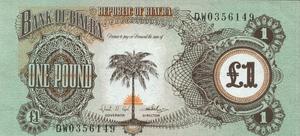
click for bigger image The daily images of starving children with beri-beri during the dying days of the Biafran Republic was one of the first things I saw on television as a child which I recall having made a real impact on me. That was also what started both my fascination with Africa and my abiding cynicism towards it. I find objects like this bank note a fascinating bit of not-so-far-off history that one can hold in one’s hand and finding such things is one of the reasons I have always so enjoyed travelling.
The Balkans: Nationalism, War and the Great Powers 1804–1999
Misha Glenny
Granta Books, 1999
Though well-written and well-organised, its length (662 pages +) and the nature of its subject make this a book to be ploughed through, as one switches from one depressing topic to another. Yet Glenny’s attitude to it all is a little difficult to fathom. On the last page he complains of the “long periods of neglect [when] the Balkan countries have badly needed the engagement of the great powers. Yet the only country to demonstrate a sustained interest … was Nazi Germany during the 1930s.” Some model!
Certainly, left to themselves, every ethnic group (Jews excepted?) behaved badly, both internally and externally. Just how badly the book is disgustingly, though not exactly surprisingly, informative. Yet this does not seem to arouse in Glenny any doubts as to the desirability of mixed-ethnic communities. Contrast this with Spain, where the essence of the reconquest there was the homogenising of the population, with the separation of Portugal, and the imperfect assimilation of the Basques exceptions tending to prove the rule that this uniformity was ultimately beneficial. Neither the Ottoman conquest, nor its liberation homogenised the Balkans. Much of it was Slav, the exceptions being Romanian, Albanian and Greek speakers, with a good deal of intermingling, a large Jewish community in Salonica, descended from Spanish expellees, the whole top-dressed with a Turkish ruling class and military. Not that being Slav in any way prevented mutual hatred between Serb, Croat, Bulgar and Macedonian.
Glenny has chosen 1804 as the date when, with the Serbian revolt, the Ottoman Empire started to disintegrate territorially. Attempts to halt this by progressive” well-meaning Sultans failed because any liberalisation encouraged it, while the economic levers were not in Turkish hands. After relatively discrete parts of the Empire had achieved independence or autonomy – Serbia, Greece, the Rumanian principalities and Bulgaria – the rest of the peninsula was land to be squabbled over. The impression is that the Turks were not major contributors to the turmoil, nor the Islamicised Bosnians and Albanians they left behind.
It is difficult to imagine how the great powers could have intervened more effectively than they did. After all, they brought about the independence of Greece (in nuclear form) in 1830, and a settlement of the Bulgarian border at the Congress of Berlin in 1878, after Russia had done most of the fighting. Not that Glenny seems very pleased with the Congress, loading it rather heavily with responsibility for future events in Afghanistan, Bosnia and the Sudan and for the scramble for Africa (p. 150). Admittedly either Austria or Russia could have tried to establish a Balkan protectorate, but why, except to keep the other out? And Britain would never allow Russia control of the Bosphorus and Dardanelles. There was nothing to be gained from a political occupation of a region where all the natives would turn hostile. Economically there were no resources to be exploited or with which to set up an industrial base. Building infrastructure, such as railways, could be, and was, seen as a strategic threat, by the Ottomans or the successor states, or both.
In each of his eight Chapter-Periods, Glenny makes a repeat visit to each separate area, discovering depression and despair in every one, with assassinations for the prominent and massacres for the common people unlucky to live on the wrong side of an ethnic line or be a minority in a particular place. The only exception seems to be Slovenia, which managed to break away from Yugoslavia without much fuss. As man on the spot, Glenny must be regarded as an authority on Yugoslav disintegration and great power intervention, yet there is something contrary-minded about his castigation of America for not intervening sooner in Bosnia and trying to do so just by bombing “without risking the lives of their service men and women” (p. 640). As with recent responses to its intervention in Iraq, the US position seems to be damned if you don’t, damned if you do. Leaving aside the idea that the Americans might consider the bombing option (as also followed in Kosovo) a reasonable preference,surely the facts are that the initial EU reaction was that this was a European dispute and as such should be left to Europeans to take care of. Yet he makes no mention of the inactivity of the Dutch UN “peacekeepers” which preceded, if it did not permit, the massacre of Muslims by Serbs in the so-called “safe haven” of Srebrenica (p. 650). As for the Serbs rallying round Milosevic when he got them bombed, it must be a sign of the times that it is NATO and the Americans that Glenny seems to blame for the irrational behaviour of the Serbs (p. 658).
This is not a very gracious review for a massive, painstaking and brilliant historical survey, but it is a tribute to the fact that its judgements provoke thought and, to some extent, dissent. Incidentally, Glenny uses the presumably Slavic spelling and lettering with the appropriate diacritical marks, but gives no indication as to their pronunciation.
What does this sound like to you?
[From UK Times]
DOZENS of speed cameras are to be replaced with electronic signs that display a frowning face when a driver is speeding but do not result in fines or penalty points.
The devices are to be placed where police can no longer justify having a speed camera because there is no recent history of crashes.
Police hope that the speed indicator devices (SIDs) will defuse some of the anger generated by the huge increase in camera fines. Last year an estimated two million drivers caught on camera were fined £60 and given three penalty points.
The new devices use radar to detect the speed of an oncoming vehicle, and flash it up on a screen. If the driver is within the limit, the screen changes to a smiling face.
At just 1mph over the limit, the face will frown.
Because it sounds to me like the Home Office are starting to back down.
At this rate it will take about another year for the ‘frowny faces’ to be replaced by an All-Weather Traffic Co-Ordination Officer whose job it will be to stand on the verge of a dual carriageway and shout “fascist, fascist” as the cars whizz by.
|
Who Are We? The Samizdata people are a bunch of sinister and heavily armed globalist illuminati who seek to infect the entire world with the values of personal liberty and several property. Amongst our many crimes is a sense of humour and the intermittent use of British spelling.
We are also a varied group made up of social individualists, classical liberals, whigs, libertarians, extropians, futurists, ‘Porcupines’, Karl Popper fetishists, recovering neo-conservatives, crazed Ayn Rand worshipers, over-caffeinated Virginia Postrel devotees, witty Frédéric Bastiat wannabes, cypherpunks, minarchists, kritarchists and wild-eyed anarcho-capitalists from Britain, North America, Australia and Europe.
|





Recent Comments