We are developing the social individualist meta-context for the future. From the very serious to the extremely frivolous... lets see what is on the mind of the Samizdata people.
Samizdata, derived from Samizdat /n. - a system of clandestine publication of banned literature in the USSR [Russ.,= self-publishing house]
|
The way to tell what is really happening by reading newspapers – which is not always very easy, is it? – is to look for what both sides in arguments agree about. And in Africa the reports which I read from time to time all seem to agree that educational standards are falling. The only argument is about whose fault that is.
Take this report, which I found on a google hit list from typing in, as is my occasional wont, “education”:
Principals in secondary schools in Ebonyi State have been identified as responsible for the falling standard of education in Post-Primary schools as they contribute significantly to examination malpractices in the state.
This was the view of members of State House of Assembly who spoke when the planning committee on the forthcoming Ebonyi State educational summit paid advocacy visit to the House in Abakaliki on Monday.
The House members frowned at the prevailing situation where many principals allegedly collect money from students and aid them during NECO and WASC examinations and even negotiate deals between the students and examination supervisors.
Sounds like Nigerian business as usual is proceeding as usual. I do not know anyone with direct experience of Nigeria who does not regard the place as the world capital of anarcho-capitalism, in a bad way. In London – which is now, like the Internet itself, infested with dishonest Nigerians – our default attitude is: crooks the lot of them, until an individual can prove himself an exception to the rule. Anyone not totally prejudiced against Nigerians, from the trust point of view, is totally ignorant.
At first the link to this report didn’t work, and my immediate inclination was to blame a Nigerian somewhere for taking a bribe instead of doing his job, but that may have been somewhat unfair. (And when I checked the link again before posting this, it was back to not working again. Bloody Nigerians!)
Not that those “House members” who “frowned” at all this are going to do anything about it. They are just higher up in the bribery chain.
My solution: make Nigeria anarcho-capitalist in a good way. Stop trying to have a government that does anything, because whatever government there is will be totally corrupt. Make the system that everything is for sale and everything negotiable official, including law and order. Then the place might work semi-reasonably.
But then again it still might not.
George Monbiot is as mad as hell and he’s not going to take it anymore. Narcolepsy-inducing speeches, plaintive whining and bogus statistics are no longer enough to bring about revolution. And George should know because he has tried all three.
The time for mere words has passed and the time for action has begun:
The formula for making things happen is simple and has never changed. If you wish to alter a policy or depose a prime minister between elections, you must take to the streets.
I think George is making yet another big mistake if he thinks that sleeping in shop doorways and begging strangers for money is going to change the world. But who am I to argue?
Iraq’s US appointed ‘governing council’ has produced a deal on a new national constitution which was described by a Kurdish delegate as one of the most liberal and progressive documents of its kind to have been produced in the Middle East
A coalition official said the charter sets a goal, not a quota, to have at least 25% of the national assembly made up of women. It also includes protections for free speech, religious expression, freedom of assembly and due process.
Free speech and religious expression? Due process? No quotas? At this rate Iraq may end up with a more (classically) liberal constitution that several quota addicted regulatory western nations I would mention. No, not really, as the whole ‘Islamic dimension’ rather precludes that.
There is a long way to go and the devil is not just in the details but the implementation. Nevertheless, this is a very big step in the right direction.
Unintended Consequences: The Impact of Factor Endowments, Culture, and Politics on Long-Run Economic Performance (Ohlin Lectures)
Deepak Lal
MIT Press, 1998
I felt I had to read this book twice to fully appreciate its message, yet it is not difficult to read, indeed to do so is easy and a pleasure. It must have been equally a pleasure to attend the lectures on which it is based. But a large accumulation of facts, each one of which can be seen to be relevant to the thrust of the book, are difficult for the reader (or anyway, by me) to hold ready to slot into a logical structure to be reproduced in a satisfying synthesis in the memory when the book is finished.
As for the “unintended consequences” of the title, these are the results of social structures, political motives and individual actions which often have quite different aims: “We have known since Adam Smith that an unplanned but coherent and seemingly planned social system can emerge from the independent actions of many individuals and in which the final outcomes can be very different from those intended. All this, I hope, is uncontroversial,” writes the author (p. 7). Well, I hope so too – but “we” needed Hayek and the collapse of Communism to convince a lot of other people.
Lal seeks to find an answer to the question why the explosive development that characterised the Industrial Revolution took place in Western Europe, though he merely mentions Great Britain as its origin, without further analysis (p. 20). Why not in the other great areas of civilization – India, China or Islam? He proceeds to examine the civilizations that arose after the development of agriculture from about 10,000 BC; pastoralism as a parallel development is mentioned but left undiscussed, presumably because it is basically predatory on and if successful, assimilated into neighbouring agricultural civilizations.
Such civilizations typically reach an optimum through what Lal labels Smithian growth, where greater efficiency is generated by division of labour and by trade, capitalism being the result (according to the precepts of Adam Smith). They are, however, limited by having only human and animal power and organic, rather than mineral sources of fuel. The breakthrough to Industrial Civilization, technologically based with mechanical power and virtually unlimited energy from mineral resources, Lal calls Promethean growth and this was evolved only in Western Europe. The question is: why? → Continue reading: How did Europe reach Promethean growth?
Political campaigns are the graveyard of real ideas and the birthplace of empty promises.
– Teresa Heinz, aka Mrs John Kerry, on why she refused to run for office after her first husband’s death. Definitely First Lady material.
I have lately been reading a book of essays and review articles by Richard Dawkins, and mostly I agree with him, about most things. However, in his Foreward to a book called Pyramids of Life, which he here entitles “Ecology of Genes”, he indulges in an aside on the subject of the free market (p. 266 of my Weidenfeld & Nicolson, 2003 paperback edition):
As Adam Smith understood long ago, an illusion of harmony and real efficiency will emerge in an economy dominated by self-interest at a lower level.
Dawkins is not here making a point about the free market. He is merely seeking to punch home a point about how ecological systems are not designed, but instead merely present the illusion of having been designed, in rather the same way that individual species also appear to be designed, but also are not. In truth, species evolve blindly, with no designing intelligence determining their shape, and ecologies are but aggregates of species. It gets a bit more complicated by the end of the piece, because actually species do somewhat resemble ecologies, in that they too are coexisting aggregates of mutually sustaining genes. I may have explained that slightly wrongly, but in any case, my point here is not what Dawkins says about what he is really writing about and really knows about.
No. I am interested in what Dawkins says in that little dig at the free market (the “economy dominated by self-interest at a lower level”). Illusion of harmony? Adam Smith said a great deal more than that. The free market does not just look harmonious and efficient, Smith said. It is harmonious and efficient. This is no mere illusion. → Continue reading: A surprising aside by Richard Dawkins about the free market
The Office of Fair Trading (the name being a splendid example of British irony in action) has ordered 60 private schools in the UK to hand over documents for an inquiry into alleged fee-fixing in violation of the 1998 Competition Act.
The OFT’s move provoked protests from the Independent Schools Council, which said it had “serious concerns about the protracted nature of this investigation and the effect it may have on schools”.
However, the ISC appeared to acknowledge that some schools may have fallen foul of a change in the law, but blamed the Government for failing to keep them informed.
Yet again we see that the scope and burden of state regulation is such that it is almost impossible for businesses to avoid breaking some laws unless they employ a ruinously huge staff of lawyers and ‘compliance officers’. Of course the very notion that the state, which imposes vast distorting pressures throughout the economy, can be an arbiter of ‘Fair Trading’ is almost beyond parody. As the Angry Economist said the other day:
Now, I would be the last person to claim that markets always produce good results. Some problems are hard for markets to solve simply because they are hard problems. Pointing to a problem which is hard for markets to solve doesn’t automatically mean that solution-by-government will be better. It may turn out to be that government interference will produce a better result (pareto optimal) than peaceful cooperation. I allow that as a possibility at the same time that I doubt it will ever happen, once all costs are accounted for.
The trouble is, as economies are complex networked systems, that it is not always obvious how this law over here buggers up that market over there. The distortions are often not a single causal step away and thus might as well be completely unrelated unless you are willing to take the time to really look at why things happen the way they do… and in most political systems, it is usually easier to just pass another law.
Reagan’s War: The Epic Story of His Forty Year Struggle and Final Triumph Over Communism
Peter Schweizer
Doubleday, 2002
“It’s surprising what you can accomplish when no one is concerned about who gets the credit.” This lettered sign stood on Reagan’s desk during his presidency and since it reflected his attitude, he cannot have worried much that his own part in the downfall of Communism has been seriously underestimated, a judgement which Peter Schweizer labours to correct in this book. For its theme, Reagan’s War, was the war against communism. By leaving out other aspects and events which did not touch on it – Israel, the Palestinians, the Lebanon, the Falklands, or the home economy – an exaggerated impression may have been given of Reagan’s singlemindedness. Even the inclusion of the assassination attempt, so nearly successful, is with an emphasis on Reagan’s belief that he had been preserved by God to conduct this war.
Reagan began political life as a Roosevelt-admiring Democrat. He had been aware of the attempt by communists to dominate and subvert the American film industry as early as 1946 and become involved in countering it, almost certainly sidetracking his career as a film star. The Korean War (1950-3) reinforced his attitude and, while still a Democrat he campaigned for Eisenhower, though disappointed later by his lukewarm anti-communism, and even less impressed by Nixon. This was also the time when anti-anti-communism became intellectually fashionable, Reagan encountering it when he was hired by General Electric to host and act in GE Theatre on television. Travelling round the country as the company’s roving ambassador to its plants and business contacts he was able to give speeches entirely based on his own views, unhampered by any kind of censorship. Schweizer distances Reagan from Senator McCarthy, who, he mentions, was initially supported by John F. Kennedy and never censured by him (p. 37). Reagan met Nancy Davis, who became his second wife (after his first wife Jane Wyman left and divorced him) through being asked to exonerate her of communist connections, apparently a case of mistaken identity. → Continue reading: “Reagan was the main author of the victory …”
I have been to a marvelous party and now I am back.
The marvelous party was the CNE Capitalist Ball, held at the Belgian Stock Exchange in central Brussels.
Now before I go any further here, I have a confession to make. Two confessions, in fact. Last Thursday, I referred to Brussels as the ‘Heart of Darkness’. Well, I was wrong about that. I also suspected that I was going to find myself in Brussels amid a room full of musty, fusty academics plus a few corporate types and policy wonks. I was wrong about that too.
In fact, my travelling companion and fellow Samizdatista Antoine Clarke and I found ourselves in sumptuous surroundings with hundreds of European, British and American glitterati and illuminati from the worlds of business, finance, politics, journalism and academia. In other words, lots of clever, interesting men and lots of clever, interesting and head-turningly lovely women. They were smart, young, chic, funny and sexy.
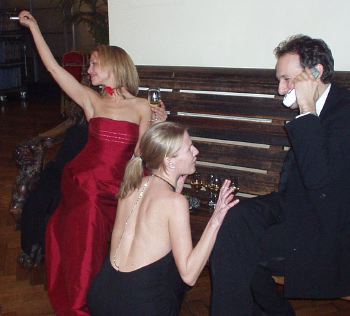
The belles are ringing for capitalism → Continue reading: I love the smell of glamour in the morning
Well, it’s Oscar night this evening. The big question seems to be whether Mel Gibson will make an appearance as a presenter, and if so what he will say and what the reaction will be. (If his aim of releasing The Passion of the Christ was simply to make a lot of money, he has succeeded. The film has grossed $118m in five days and as Gibson put up the entire budget himself, almost all of the profits will go to him). However, as I promised I might when I wrote my overlong overview of what happened in the Holiday and New Year film season a couple of weeks ago, here are my predictions as to who are going to win the Academy Awards this evening. Some people might think that the Oscars are too trivial for a Samizdata post, but if you think this, don’t read. If it is good enough for Mark Steyn, it’s good enough for me. (How do I begin my campaign to be the next Spectator film critic).
I have of course refrained from using the special hotline that we Samizdatistas have direct to the Stonecutter World Council to find out in advance who the winners are, so I am just guessing using my judgement here. I will stick to the major categories, with perhaps occasional thoughts on the other categories.
As well as merely trying to predict the winners, as an added bonus, I give you a star ranking. Four stars means I will eat my metaphorical hat if this is not the winner. Three stars means I will be quite surprised if this is not the winner. Two stars means that I think this will be the winner, but that I think that there are other possibilities that would not be an overwhelming surprise. One star means that the category looks very open and I have no idea, but that I am willing to guess. I will give other people I think who are in with some kind of chance in brackets, and if I list more than one such person I list most likely first. I may or may not follow this up with a sentence or two as to why but I will try to keep it brief. In a couple of instances I will elaborate on my reasoning at more length on the special blog I use for that purpose, and will link to those comments.
Anyway, here goes.
The full nomination list is here. → Continue reading: Yes, it’s Oscar Night.
It will come as no surprise to anyone with a 100+ IQ and a modicum of knowledge about how the world works that Robert Mugabe and his murderous kleptocrats have appropriated more that £100 million (US $190 million) in aid sent to Zimbabwe by Britain and the EU.
As that was only to be expected, I cannot say it adds significantly to my loathing of the Mugabe regime. What does fill me with utter contempt is that the people responsible for this utterly predictable outcome still allowed the money to be sent in the first place.
As I have previously argued many times before about foreign aid, to send money for ostensibly humanitarian aims to a nation governed by a tyranny is to become the logistic support arm of that tyranny: insulating the regime from the economic (and hence political) consequences of its actions and thereby indirectly, but in a very real sense, making the regime more likely to survive than would otherwise be the case. That is true even if the humanitarian aid does indeed reach the people and projects it is targeted at.
This however is even worse than that. To send aid to Zimbabwe is to underwrite the tyrannical Mugabe regime directly as according to the latest report, 89% ends up in the pockets of Zimbabwe’s rulers rather than being spent on the humanitarian objectives for which it is intended. Thus not only can the people who sent the money not bask in their delusions that they have at least done good for those who benefit from the worthy projects, they might as well be buying weapons for Mugabe’s police and paramilitaries, not to mention making the bankers and shopkeepers in Zürich rather happy. They are directly supporting the tyrants with large cash injections.
As I disinclined to believe that the people in charge of the governments and agencies in question do not know full well where the money is going to end up, that makes them knowingly supporters of the regime. Which means they are supporting this:
Hilary Andersson, of the BBC’s Panorama programme, reveals how thousands of youths are being taught to rape, maim, torture and kill in Zimbabwe’s terror training camps – and now Robert Mugabe intends to make the camps compulsory for all the country’s young men and women
[…]
A former official with the Ministry of Youth, Gender and Employment Creation that oversees the camps, explained the government’s thinking. “You are moulding somebody to listen to you, so if it means rapes have to take place in order for that person to take instructions from you, then it’s OK,” he said. He was so horrified that he left his job with the ministry in disgust. Rape is just one of the ways camp commanders are able to turn their charges into unquestioning automata. The training methods vary from camp to camp, but the pattern is consistent.
If all that was happening was that the Guardian reading classes were getting a warm fuzzy glow because they were supporting British tax money going to ‘help stamp out poverty in the third world’, then that would be bad enough, given the reality of what this distorting flow of cash really does. But as Zimbabwe slowly morphs into an inept ‘North Korea Lite’, the platitudes and wilful ignorance of some are now directly funding truly monstrous horrors and misery because they are too damn lazy to think the whole issue through.
Of course if our political masters did not know this was going to happen when they decided to send huge chunks cash to a place like Zimbabwe, then they are naive to the point of idiocy and have no business being in charge of vast amounts of other people’s money to begin with.
So which is it?
There are several things which annoy the hell out of me regarding the ongoing ruckus over whether or not the British intelligence services have been spying on Kofi Annan and the UN generally, as alleged by Claire Short.
Firstly, the UN is nothing less than a logistics agency for tyrants around the world, insulating them from the economic consequences of their policies and ostensibly giving them equal standing with liberal human rights respecting regimes. Thus the notion that this institution’s leader, Kofi Annan, is some sainted figure beyond reproach (and beyond espionage) is both bizarre and repugnant. If we are to get any value from our pilfered tax money at all, I would hope some of it is spent spying on the corrupt functionaries at the United Nations.
Secondly, whilst I will defer to our in-house lawyer David Carr as to whether Claire Short’s actions constitute treason, at the very least I can only marvel how she was not immediately charged under the Official Secrets Act and thrown in jail… but silly me, I forgot there is one rule for the political, establishment and another everyone else.
|
Who Are We? The Samizdata people are a bunch of sinister and heavily armed globalist illuminati who seek to infect the entire world with the values of personal liberty and several property. Amongst our many crimes is a sense of humour and the intermittent use of British spelling.
We are also a varied group made up of social individualists, classical liberals, whigs, libertarians, extropians, futurists, ‘Porcupines’, Karl Popper fetishists, recovering neo-conservatives, crazed Ayn Rand worshipers, over-caffeinated Virginia Postrel devotees, witty Frédéric Bastiat wannabes, cypherpunks, minarchists, kritarchists and wild-eyed anarcho-capitalists from Britain, North America, Australia and Europe.
|






Recent Comments