We are developing the social individualist meta-context for the future. From the very serious to the extremely frivolous... lets see what is on the mind of the Samizdata people.
Samizdata, derived from Samizdat /n. - a system of clandestine publication of banned literature in the USSR [Russ.,= self-publishing house]
|
In the latest (April 2004 – paper only so far as I can tell) issue of Prospect, there is an excellent letter about private investment in space exploration, from Stephen Ashworth of Oxford, in response to this article by Oliver Morton in the March issue:
Oliver Morton (March) is misleading Prospect readers with his implication that Nasa spaceflight is the only kind that matters. His statement that Nasa’s new direction “marks the end of the era in which the goal of spaceflight is to become routine” will be seen in retrospect as the exact opposite of the truth.
The government space agencies’ monopoly on manned spaceflight is about to be broken. Twenty-seven industrial teams, mostly in North America and Britain, are competing to be the first to fly private passengers to the edge of space in a commercially-operated reusable spacecraft. Their immediate goal is to win the $10m X prize (see www.xprize.org). In America, aircraft designer Burt Rutan is almost ready to claim the prize. In Britain, Steve Bennett’s Starchaser Industries has been building and test-firing large rocket engines and test-flying a reusable piloted capsule, as well as touring schools with Starchaser 4, which in 2001 became the largest rocket ever flown from mainland Britain.
If our civilisation is to make the leap from a one-planet to a multi-planet one, then, just as when it made the leap from a European to a global civilisation, the ultimate drivers will not be government programmes (of Prince Henry the Navigator, Ferdinand and Isabella, Kennedy and Khrushchev). Progress will rather depend upon commercial enterprises which serve public demand (the East India company, the Cunard line, the embryonic space tourist companies).
It would not surprise me if the first astronaut on Mars were not a government employee, but a visionary entrepreneur like Burt Rutan or Steve Bennett, a CEO of a space tourism company with a string of orbital and lunar hotels. That outcome would take much longer than a focused Apollo-style push. But, unlike any past or future Nasa programme, it would not run ahead of the market or the technology in the way that Apollo did.
This letter was worth reproducing in its entirely here not just because it is a good letter, but also because it appeared in Prospect. I like Prospect. It is often leftism, but it is not nearly so often knee-jerk leftism, and often, as here, it is not leftism at all.
I particularly like the comparison between NASA and its political paymasters, and Henry the Navigator and Ferdinand and Isabella. We are told with wearisome frequency nowadays that “technology is moving so much faster these days”, but even the time scales of space exploration have an early navigation feel about them.
It will be interesting to read what Dale Amon has to say about this.
One of the great pleasures and advantages of living in Pimlico, in central London, is its proximity to one of the world’s great art galleries, The Tate, a fine classical building looking over the Thames. Recently my girlfriend and I went around two separate exhibitions and had two contrasting experiences not far different in extremes from the North Pole and the Sahara Desert.
The first exhibition was a display of Pre-Raphaelite art, from that group of talented, romantic and at times eccentric group of artists in the middle of 19th Century England. They took their inspiration, as the word pre-Raphaelite suggests, from the Renaissance artist Raphael. Some of them were intensely religious, while others took a passionate interest in the natural world.
I must say I have mixed reactions to their art. Some of the paintings, particularly the coastal seascapes and the depictions of the Swiss Alps, were stunning. Others, while rendered with incredible attention to detail, left me rather cold. There is something almost rather mannered about this art, as if it was produced by someone trying too hard to impress. On the whole, however, I could not fail to be struck by the descriptive lust of these artists, their desire to convey the world as they saw it and as it could be.
And then, after a slurp of wine – we were at a private viewing – we set off to another part of the Tate for an altogether different experience, namely, a selection of ‘art’ (I will explain the inverted commas a bit later) by some of the world’s newest artists, including the so-called enfant terrible of the Brtitish art establishment, Damien Hirst., and Sarah Lucas, about whom I had not heard before.
Some of the exhibits featured dead animals inside tanks containing fluids, bits of sausages, live fish, a brain, bottles of wine, a bucket, and other bits and pieces I could not readily identify. Two exhibits were models of people undergoing surgery, with nothing showing apart from their genitals. Several large oval-shaped boards were covered with hundreds of dead butterflies. An empty full-size truck cab, plastered in its interior with tabloid newspapers, had a man’s arm pumping up and down in a familiar sexual act. In fact, several exhibits seemed to portray human bodily functions, as if the exhibits had been assembled by a sniggering, slightly conceited 12-year schoolboy trying to shock his elders.
I will not deny Hirst and others like him are folk with a certain talent. They are talented in much the same way that pickpockets can be said to be talented. But to what effect? So much of his art seems to shout, “I am taking the mickey out of you stupid, repressed middle class wankers”……No doubt Hirst thinks he is being ever so clever and subversive, and judging by the large audiences for his work, he probably is. What perhaps is forgotten is that the image of the artist as the mocker of bourgeois sensibilities, far from being daring and new, is in fact very dated, and bang in line with the ethos of the Modern Art establishment. They are the bores of our age.
There you have it. About 150 years from the Pre-Raphaelites, we have gone from the ability to portray nature with passionate concern for accuracy, and an essentially warm embrace of human life, to lumps of meat in tanks, and to images of human beings sitting on the toilet, smoking a cigarette. Perhaps these folk really have caught the meaning of Blair’s Britain, after all.
Addendum: if you are as disgusted as I am by the bogus nature of much modern art, but cannot always put that disgust into words, then I strongly recommend the book, What Art Is, written by Louis Torres and Michelle Marder Kamhi. It unashamedly defends representational art, questions whether certain forms, such as abstract painting, really can pass muster as art, and perhaps controversially, argues that photography does not pass the test. I do not agree with everything in the book but it is well worth the attention.
The Daily Telegraph ran an obituary yesterday for a man who seems to have been almost the archetype of the corporatist economist.
I must stress that I never met Sir Donald and I am certainly not claiming that he did not love his children, or was not kind to small animals. It is just that he seems to have fit a certain patten of economist.
When Rab Butler (British finance minister at the time) produced a plan in 1952 (“ROBOT”) to stop trying to rig the value of sterling on the exchange markets, who leaked the private plan he had been trusted with? Lord Charwell (Sir Donald’s boss) and who worked to rubbish the plan (Sir Donald himself).
I have no great affection for fiat money. But if one has such a thing one should not try and rig its value in terms of other currencies – such efforts just lead to crises after crises.
Not that Sir Donald even had any real affection for maintaining the “strong Pound” in terms of the American Dollar. Sir Donald supported devaluation in the 1960s – it was allowing the market (i.e. buyers and sellers – there being no such thing as metaphysical ‘market forces’ separate from the choices of actual buyers and sellers) to determine the value of the currency (in terms of other currencies) that he seems to have objected to.
Sir Donald got many of the honours and jobs one would expect to come to a man of his type (head of the National Economic Development Council and so on), and the change of government did not harm him.
No, Sir Donald just went to work for the Labour economics minister (George Brown) working on a “national plan” to “plan the economy”.
Later Sir Donald went to work for the Confederation of British Industry, which (like the old Federation of British Industry) can normally be expected to support ‘moderation’ (i.e. statism).
With economists like this, who can blame the public for the lack of knowledge?
It would appear that a careful study of the works of the favoured economists of their time would just leave the public more misguided in their opinions than they already are.
I would be happy to be corrected in my opinion of Sir Donald’s working life – but I suspect that I have not been misled by the obituary.
Recently a commenter here on Samizdata.net used a term that I think sums up modern regulatory statism in the Western World rather well.
Populist Authoritarianism
Whilst Google shows that the term is not exactly new, it does seem both little used and particularly apt. The banning of smoking on private commercial property seems a classic example of this in action. Let’s start calling a spade a spade and stop letting the statists of all stripes hide behind euphemisms.
Spread the word.
A new nationwide police agency, the Serious and Organised Crime Agency (SOCA) has been created in Britain.
The creation of a new “British FBI” to combat organised crime, with informants being offered reduced sentences to snitch on their gangland bosses, was given unanimous support in the Commons today – despite a controversial raft of new powers.
The home secretary, David Blunkett, told MPs he was in favour of allowing intercept material – bugged phone calls and emails – to be used as evidence, pending a review which would report back in June.
And he would also, for the first time, force professionals such as lawyers and solicitors to cooperate with police enquiries into organised crime, even if it meant betraying client confidentiality.
And thus people will simply stop asking for legal opinions just in case their shyster runs off to the police in order to cover their rear ends and thereby ensuring a steadily increasing climate of fear, distrust and uncertainty. The Blair-Blunkett government are nothing less that populist authoritarians.
Barbara Amiel is someone I frequently find disagreements with but when she is right, boy, is she right. Whilst I am usually rather prone to point the finger of blame at the state as the font of all evils when things go wrong, Amiel makes the reasonable point that even with the best intelligence in the world, the prevailing zeitgeist in the United State (and elsewhere) on and before September 10th 2001 meant that there was very little support for anything which could really have stopped Al Qaeda’s infamous arrival onto the world’s front pages.
The question is not whether Reagan-Bush-Clinton-Bush actually knew about the murderous intentions of radical Islam or whether they took what they knew seriously, but what the public mood would have let them do about it before 9/11.
Not much, I wager. What administration could, before 9/11, have sent in American boys to fight a regime in Afghanistan because it was implementing the ideas of an old man with a long white beard, sitting crossed-legged in the mountains talking about Satan America? Had I been in Congress before 9/11, knowing everything that was knowable about the Islamists, I still doubt if I would have voted to send troops to the Hindu Kush to topple the Taliban. Eardrums would have exploded all over Capital Hill from outcries of racism and imperialism if there had been serious efforts, pre-9/11, to round up suspected Muslim militants in the United States and tighten security on Muslims entering the country. As it is, the post-9/11 sensitivity to racial profiling makes travel hazardous for white grannies who dislike body-searches.
All too true. Read the whole article.
It is galling to read endless utilitarian articles for and against banning smoking on commercial (but nevertheless private) property with nary a mention of whether it is actually just to enact authoritarian proscriptions on the acts of others who are, after all, in voluntary close proximity.
At least the erratic Telegraph takes a fairly good stab at doing just that:
Other politicians throughout Europe will be watching the Irish experiment closely. You can be sure that if the Irish surrender to the new law without a strong show of resistance, it will not be long before a similar ban is introduced in Britain.
So Irish smokers have a responsibility to freedom-lovers everywhere to make their displeasure felt. They have already come up with some ingenious suggestions for exploiting loopholes in the new law. We wish them luck in finding more.
We note that prisons are among the very few workplaces exempted from the ban. So anyone incarcerated in the cause of freedom will at least be allowed the consolation of a smoke.
Light up, Ireland. Do not cooperate in your own repression.
Gerhard Schröder is calling companies who outsource ‘unpatriotic‘, after Ludwig Georg Braun, the president of the federation of chambers of industry and commerce, advised German businesses to seek opportunities elsewhere.
So, Gerhard Schröder, the man who has presided over yet another interventionist government whose policies have made Germany progressively more and more uncompetitive over the years, brazenly refuses to accept his personal responsibility for imposing the very policies which are driving businesses to seek to invest elsewhere.
But then I suppose as the prerequisite for any professional politician is to be able to look an entire nation in the eye and tell them black is white and up is down, and then ask to be applauded for saying that… and what is more, more often than not, that is exactly what happens.
Whatever. Reality always has its way with vainglorious politicians in the long run because people, and their capital, will eventually go where their interests are best served.
And that place will not be Gerhard Schröder’s Germany.
Let’s take some time off away from the gloomy issues of the day to drool over the latest creation of the Ferrari empire. This car looks fantastic.
A four-door car that does 200mph. This model looks particularly good in silver, as is the case with a lot of famous Ferraris. Is capitalism wonderful or what?
“It is our responsibilities, not ourselves, that we should take seriously.”
–Sir Peter Ustinov, who died on Sunday.
As a dedicated fan of the Australian cricket team, I have been watching them play a series of one day internationals, and Test matches, in Sri Lanka. These matches went very well for Australia and concluded last night. (I write about such things here)
Australia had played a series in Sri Lanka in 1999, and I had watched that also. In contrast to 1999, Sri Lanka looks to be a happier and more prosperous place now then it did back then. From what I could see on the television, the grounds this time were not ringed with military style police, and there was evidence of much new building, infrastructure, and normality.
For example, one of the most prominent advertisers on the grounds was a mobile phone company.
However, the peace in Sri Lanka is under pressure. Some background to the civil war can be read here, and news of latest incidents can be read here. The basic problem is that unity between the two sides in the civil war is breaking down, with dissention in the Tamil Tigers, and also within the Sri Lankan government itself. The President fired the Prime Minister and called for fresh elections. The issues can be read about here, and on first reading, I think Samizdata.net is hoping for the Prime Minister’s party to prevail.
The prime minister’s United National Party (UNP) wants to press ahead with market reforms and is pressing for free trade agreements with many countries, including the United States, Singapore, Thailand, European Union member states as well as Pakistan and Bangladesh.
President Kumaratunga’s party is for a market economy with a ‘human face’ and has ruled out privatisation of banks, transport and several other utilities. Her ally the JVP wants state control on key sectors of the economy and supports price controls on essentials, and to curb imports of what it considers non-essentials. Both want to offer a plethora of farm subsidies.
The monks’ party is for an open economy based on ‘Buddhist values’.
I am bemused by the “Buddhist values” of an open economy… and not thrilled to read about farm subsidies! Not enough Sri Lankans are reading Samizdata!
Anyway, if peace can be maintained, I might be able to visit Sri Lanka the next time the Australian cricketers go there. Many Australians went this time, and looked to be having a rousing good time. That sounds like my idea of a good time.
One of the reasons for slightly less output on this august blog is that two of the editors and the inimitable Gabriel Syme were off meeting other sinister Illuminati in Prague for a fine Czech beer or six.

No prize for guessing where the Illuminati meet in Prague Prague, like Bratislava, is known for its splendours…
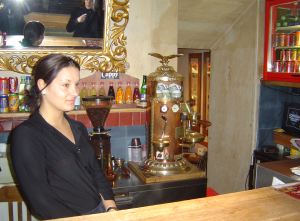
Hot… steamed in fact One of the upsides of the dire weather was that many of the usually crowded tourist attractions were almost deserted.
We meet one of the leading central European bloggers, Tomas Kohl (on the right)…
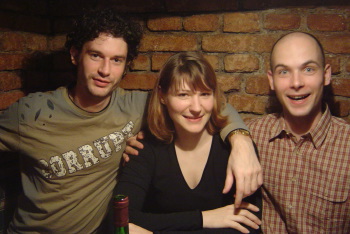
Tomas sinks some fine Czech Pilsner with Adriana and Gabriel Syme → Continue reading: Samizdata.net on the river Vltava
|
Who Are We? The Samizdata people are a bunch of sinister and heavily armed globalist illuminati who seek to infect the entire world with the values of personal liberty and several property. Amongst our many crimes is a sense of humour and the intermittent use of British spelling.
We are also a varied group made up of social individualists, classical liberals, whigs, libertarians, extropians, futurists, ‘Porcupines’, Karl Popper fetishists, recovering neo-conservatives, crazed Ayn Rand worshipers, over-caffeinated Virginia Postrel devotees, witty Frédéric Bastiat wannabes, cypherpunks, minarchists, kritarchists and wild-eyed anarcho-capitalists from Britain, North America, Australia and Europe.
|







Recent Comments