We are developing the social individualist meta-context for the future. From the very serious to the extremely frivolous... lets see what is on the mind of the Samizdata people.
Samizdata, derived from Samizdat /n. - a system of clandestine publication of banned literature in the USSR [Russ.,= self-publishing house]
|
But for the grace of God, are there any loathsome politicians out there who you sometimes feel you may have ended up like? I have one. His name is Alan Milburn, a man who I sometimes look like and sound like, which for those of you who know the difference really is quite a cross to bear.
Mr Milburn used to be the Secretary of State for Health, here in the UK, until his shock resignation in 2003. We may never know the real reason why he resigned. But when Alan visited me in a nightmare recently, in the guise of my former Marxist Dark Half, he told me he flounced out of government because Tony Blair had become incapable of protecting him from Gordon Brown’s prime ministerial ambition.
But it seems Alan is regretting his flounce and is trying to worm his way back into Tony’s ministerial cash box. This morning, on Radio4’s Today programme, he spent a lengthy chat with James Naughtie banging on about the glorious work-life balance achievements of Scandinavian-style socialism. → Continue reading: Return of the undead
Unpersons alerted us to the news that from today British police may legally and against the will of any law-abiding subject, take DNA samples and fingerprints from any arrested person without that person having even been charged with committing a criminal act.
We can but echo the good Unpersons concerns:
The law now leaves British police officers free to help Blunkett establish one of the most ambitious and truly disturbing elements of the British police state that he has slowly but surely been working to create over the last few years. In a country where the state can take over half of your income, charge you expenses when it wrongly imprisons you – yet fail to defend you after it has crushed the right to self-defence, send parents to jail for not sending their children to state day-care centres schools, steal your property because ‘you couldn’t possibly have earned that much money without selling illegal drugs’ whilst slowly handing over control to a foreign power, attempt to dictate what you eat ‘for your own good’ and generally treat its citizens as its troublesome children one has to wonder to what extent we already live in a police state.
This has not been a good week.
H-A-P-P-Y.
I am H-A-P-P-Y.
I know I am.
I am sure I am.
I am H-A-P-P-Y.
I’ve been dipping into a book called Churchill’s Generals, which was published in 1991, having been edited by the redoubtable John Keegan. I’m now reading the piece by Duncan Anderson about Field Marshall Slim. During the retreat from Burma in 1942, Slim did very well, no thanks to his superior, the nice but dim, and rattled and incoherent, Alexander.
Alexander’s responsibility as army commander now lay in maintaining the efficient functioning of the rear areas for as long as possible, supervising an orderly withdrawal, and ensuring the successful demolition of access routes. It was Slim’s task to keep the frontline forces intact and conduct rearguard operations. The conduct of these two aspects of the retreat is instructive. The rear areas rapidly fell apart, the administrative troops degenerating into bands of pillaging brigands. Confusion reigned supreme. Major Michael Calvert waited for days for Alexander’s order to demolish a vital railway bridge – an order which never came. Conversely, Major Tony Mains, acting under Alexander’s explicit orders, destroyed a stockpile of fuel outside Mandalay which was almost essential for the successful withdrawal of Slim’s 7 Armoured Brigade. Years later Slim had still not forgiven the unfortunate Mains.
The retreat of the frontline forces, however, proceeded with almost clockwork precision. A brilliant rearguard action at Kyaukse delayed the Japanese, and at Monywa and Shwegyin, Slim extricated his forces from near disaster with considerable skill. Once contact was broken with the Japanese at Shwegyin, the retreat became as much a race against the monsoon as against the advancing Japanese. Slim marched back with his exhausted and now disease-ridden columns up the Kebaw Valley to the relative safety of Tamu on the India – Burma border. Thin and ragged as they were, they still carried their weapons like soldiers.
By rights, Slim’s conduct of the two-month retreat should have earned him recognition in the highest quarters as a general of first-rate ability. Yet in the event it was Alexander as army commander whom the waiting press men interviewed, Alexander who was the hero of A Million Died [the first book written about the Burma campaign, published in 1943], Alexander whom the BBC extolled as ‘a bold and resourceful commander, [who] has fought one of the great defensive battles of the war’. Stilwell knew better. He had seen both generals under stress and knew that ‘good old Slim’ rather than ‘Alex [who] has the wind up’ was the real hero of the piece. ‘Vinegar Joe’ lived up to his name in his acerbic dismissal of Alexander’s BBC publicity as ‘crap’.
What? Biased BBC, in 1942? Yes. In those days the BBC was biased in favour of a previous, more aristocratic sort of establishment, the sort personified by Alexander, and then only being challenged by likes of the strictly meritocratic Slim, whose father was a Birmingham ironmonger.
Slim eventually got the recognition he deserved. His ‘forgotten army’ is not forgotten now, by anyone who knows much of the British military effort in World War Two.
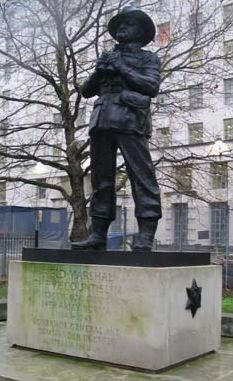
A statue of Slim stands, eccentrically but proudly, outside the Ministry of Defence in Whitehall, alongside Montgomery and Alanbrooke, no less.
Alexander is nowhere to be seen. Is there a statue of him in London, anywhere? There must be, but where?
Two news stories caught my eye today.
Firstly B.B.C. Radio 4’s Today show reported that the authorities in the People’s Republic of Scotland have noticed that sport is unfair – there are winners and losers and sometimes the winners win big.
To deal with this problem the local authority in Edinburgh has declared that if a team in a children’s football match are winning by 5 to 0 (or more) at half time the ref should be allowed and encouraged to declare the score to be 0 – 0.
In this way the losing children can have another chance – and their self esteem will be protected.
Soon the careful minds of the Scottish authorities will work out that a better way of ensuring equality would be to declare that all matches end in the score 0 – 0.
Oh well, whilst the English taxpayers continue to fund the Scottish government (latest example – a 400 milion plus Paliament building that was supposed to cost “a maximum of 40 million”) such sillyness will continue.
Also today I got to see this week’s Economist… and I spotted a report on Somalia that I think will be of interest.
As is well known most of the nation of Somalia does not have a formal government. Now opponents of anarchism (or perhaps “anarchocapitalism” as “anarchism” is a word that is sometimes used to refer to some forms of collectivism) have pointed at Somalia and said “see anarchy – it really is vile, bloodsoaked chaos” and defenders of anarchy have claimed “no – Somalia does have a government (indeed it has multiple governments), the Warlords are all statists acting as warring governments”.
The Economist report does not settle the dispute between anarchists and non-anarchists, but it does provide some information.
Firstly that paying the Warlords money to protect oneself and property does not work very well as (unlike the “protection agencies” of anarchist or anarcho-capitalist theory) the Warlords will take the money – but their men will tend to rob and murder you anyway. → Continue reading: Scotland and Somalia
Mohammed and Charlemagne
Henri Pirenne
Barnes & Noble, 1992
In view of the debates, controversies, outraged cries and tactful statements regarding the relationship between Islamic and (for want of a better word) Western civilizations, it is of interest to read this classic work (his last) by the great Belgian historian, Henri Pirenne. And when the reader comes to its end and wonders how to sum it up, prior to making a judgement, what could be more convenient than to find that the author, in his Conclusion, has done it for him in masterly fashion? So here it is, almost seventy years after the author’s death.
From the foregoing data [some 260 pages, broadly dealing with the Mediterranean economy from 300 to 800 AD], we may draw two essential conclusions:
The Germanic invasions destroyed neither the Mediterranean unity of the ancient world, nor what may be regarded as the truly essential features of the Roman culture as it still existed in the 5th century, at a time when there was no longer an Emperor in the West.
Despite the resulting turmoil and destruction, no new principles made their appearance; neither in the economic or social order, nor in the linguistic situation, nor in the existing institutions. What civilization survived was Mediterranean. It was in the regions by the sea that culture was preserved, and it was from them that the innovations of the age proceeded: monasticism, the conversion of the Anglo-Saxons, the ars Barbarica &c.
The Orient was the fertilizing factor: Constantinople the centre of the world. In 600 the physiognomy of the world was not different in quality from that which it had revealed in 400.
→ Continue reading: Henri Pirenne on the impact upon Europe of the advance of Islam
Glenn Reynolds pointed me to this story which should warm the cockles of a libertarian anarchist’s heart. It seems ‘hundreds’ of what I presume were members of the Mahdi’s ‘army’ were held off for hours by eight employees of Blackwater Security Consulting (apparently all ex-Special Forces), four MP’s and a Marine. Company helicopters flew in under fire to pick up the wounded Marine and drop off ammunition supplies.
The DOD Press briefing for the day neglected to mention the government building was privately held.
John Lettice writes for The Register on the difficulties associated with relying on biometrics.
It will all be very costly, he says, and the pseudo-certainty that it supplies may actually cause mistakes to be made, when the ID checks out but the surrounding facts look dodgy.
If you do not check for duplicates, for example, then the system is not going to tell you that Fred Bloggs of Sollihul is in fact Osama bin Laden. A silly example? Yes and no – obviously, it is not very likely that our current entry systems are going to let someone called Fred Bloggs walk through when they look strangely like Osama bin Laden. However, if he checks out as Fred Bloggs, UK citizen, with no record under our future automated systems, then general appearance is rather less likely to be challenged, or even noticed. So the assumed reliability of the systems could actually increase the security of fugitives in the event of their having successfully obtained clean, genuine ID.
There is much more.
Intelligence sources have confirmed to Sky News that a plan to launch a chemical attack in the UK has been foiled. A highly toxic chemical called osmium tetroxide was to be used in a device. The chemical compound, which can be bought on the internet, causes victims to choke to death in agony. It also attacks the cornea of the eye and can lead to blindness.
The security services are believed to have been alerted after a mention of the chemical was picked up at the GCHQ electronic listening centre near Cheltenham. The speculation is that it could have been used by terrorists to target enclosed spaces such as the London Underground, airports or a busy shopping centres. Even though arrests were made in the United Kingdom, authorities say the operation was being run out of Pakistan by a suspected al Qaeda figure.
Londoners are not novices to security alerts and actual terrorist attacks. Irish Republican terrorists made sure of that. But this is different. However despicable the acts of the Irish terrorists have been, their aim was limited, if not acceptable.
The islamofascists are fighting us because of what we are, because our existence is a daily reminder to them of the failure of their ways. Their aim is our destruction and the notion that they can be appeased is absurd.

Occasionally, one stumbles across actions of the regulatory state that masquerade as market policies. Irish health insurance falls into this category.
Health insurance is always a tricky subject as it falls into the wider issues of how private sector medicine can be established. In Europe, with its wide diversity of state driven medical practices, plus voluntary health insurance and complentary health insurance as a tolerated private sector, it is difficult to envisage how one would wean the populace off these systems, even with impending bankruptcy looming. The ‘Big Bang’ approach of deregulation would not work as the infrastructure and skillset to develop an entrepreneurial model does not exist and this is one area where the gradual replacement of state structures by the private sector and/or civil society may be more appropriate. Complex and difficult issues to grasp with few answers. → Continue reading: Irish Health Insurance
For those who missed it, this morning, there was a fascinating article in the Daily Telegraph about the increasing failure of the British state to perform its most basic activity, that of providing personal security to its tax-paying citizens. It seems more and more people are simply withdrawing any hope they may have once held in the British police and are taking their own personal security matters directly into their own hands, with impressive crime reduction results to boot, through the creation and adoption of private police forces.
It seems the Individualist Revolution really is creeping up on us, unawares, as street by street, in Britain, the enfeebled state withers away and people take an ever-increasing amount of private control over their own private lives.
This is not what the state intended. But it is what is happening. Long may this withering process continue.
The Jews are behind materialism, animal sexuality, the destruction of the family and the dissolution of society. Principal among them are Marx, Freud, Durkheim and the Jew Jean-Paul Sartre.
Sayid Qutb, former leader Muslim Brotherhood, quoted by Barbara Amiel.
Well I disagree with the conclusion, but I must admit that the pantheon of evil is pretty exhaustive.
Marx: the inspiration for all the best serial killers
Freud: the apologist for all the best serial killers
Durkheim: serial killer of brain cells
Sartre: creep
Hmm…
|
Who Are We? The Samizdata people are a bunch of sinister and heavily armed globalist illuminati who seek to infect the entire world with the values of personal liberty and several property. Amongst our many crimes is a sense of humour and the intermittent use of British spelling.
We are also a varied group made up of social individualists, classical liberals, whigs, libertarians, extropians, futurists, ‘Porcupines’, Karl Popper fetishists, recovering neo-conservatives, crazed Ayn Rand worshipers, over-caffeinated Virginia Postrel devotees, witty Frédéric Bastiat wannabes, cypherpunks, minarchists, kritarchists and wild-eyed anarcho-capitalists from Britain, North America, Australia and Europe.
|





Recent Comments