We are developing the social individualist meta-context for the future. From the very serious to the extremely frivolous... lets see what is on the mind of the Samizdata people.
Samizdata, derived from Samizdat /n. - a system of clandestine publication of banned literature in the USSR [Russ.,= self-publishing house]
|
I am glad to see I am not the only one who thinks the frequently reported ‘sharp exchanges’ between Blair and Chirac (or Shröder) are a phoney as a three pound note. Some of the commenters here on Samizdata.net seems to have taken a similar view as has the Daily Telegraph opinion leader article.
At EU summits, there is always a row and always a deal – and the European constitution negotiations did not disappoint. Tony Blair’s spin doctors did not quite say, “Gentlemen in England now abed shall think themselves accursed they were not here,” but he was, apparently, battling like Henry V against the French and also the Germans. But he signed the constitution anyway, even though last week’s election results clearly show he had no mandate to do so. There was something distinctly phoney about the row.
Indeed. The fact having ‘rows’ with the French and Germans is good for the standing of a British leader hardly needs explaining. Yet the fact is that regardless of the acrimony, the deals still seem to get signed. ‘Red line’ after red line gets laid down, acclaimed by both supporters and people who should know better: “Thus far and no further!” cries our plucky Leader of the Day. Which of course really means “only thus far this time“. Just wait a year or two and the process can be repeated yet again and a little more agreed, once the ‘red lines’ of yesteryear have vanished down the memory hole.
Forget the rhetoric, if you want to know the truth, just look for the signatures on the treaties. The rest is just so much verbal fart gas.
I wonder if the fact France is, get this, cracking down on opponents of the theocratic tyranny in Iran will produce howls of anger from the same people who complain that the US has on many occasions propped up unsavoury regimes for various reasons? I have my doubts as most are convinced that if the US is not involved in something, it does not really happen.
Why is the French state doing this? Well who knows… I am sure that fact lucrative deals have been signed in Iran by French companies over the last few months have nothing to do with it. Nope, that could not possibly be the reason.
We recently marked the 200th anniversary of the birth of the 19th century free trade reformer, classical liberal and ardent anti-interventionist politician, Richard Cobden. Cobden rose from conditions of poverty that would have crushed lesser spirits to become one of the greatest advocates of laissez faire capitalism and globalisation to have ever lived. Along with fellow liberal John Bright, Cobden created the anti-Corn Law League, one of the most successful pressure groups in British history. The Corn Law protectionist measures were eventually swept away by Tory Prime Minister Robert Peel in 1846, helping to set the stage for the mid-century industrial boom. (Peel is also one of my few historical political heroes). Cobden opposed protectionism and explained the benefits of free trade with a passion and energy that puts our timid politicians of today to shame.
So it was rather fitting to have just spent a most enjoyable evening listening to live jazz and sipping champagne in one of London’s oldest private member clubs, known as The Cobden Club. Located near the Paddington area of west London, and founded as a working man’s club in the Victorian age, it has now morphed into a comfortable bar and restaurant complete with a separate dance floor for those inclined. I like the way that the Victorian architecture has been retained, with wonderful tall ceilings and fittings, combined with plenty of modern touches and colourful prints on the walls. The atmosphere is very ‘chilled out’ and relaxing. I love its big comfy armchairs into which you can sink while sipping a coffee or brandy in the company of friends. It is also unpretentious and lacks the stuffy atmosphere one finds in some of the clubs around Mayfair, for example.
I like to think that the spirit of the great man would have smiled at the thought of a Samizdata blogger carousing in the club that bore his name, since I very much doubt whether 90 percent of its clientele have ever heard of Richard Cobden, and his standing as a magnificent advocate of classical liberalism.
An EU Constitution has been agreed, sort of, and now a powerful section of the political establishment will begin the process of spinning it as ‘a great victory for Britain’ because it will not immediately wipe out the ability of British people to have at least a little influence over the laws under which they live. And in other parts of Europe, the same constitution will be spun as ‘moving Europe closer to complete union’. It is like a vast edifice growing ever taller by the year, a great movable siege tower surrounded by a fog of graft and corruption and expense accounts.
But it is a constitution quite unlike the more famous US one. The EU constitution will incorporate, amongst other things, the essence of the Charter of Fundamental Rights, which requires not that the state refrain from making laws in many areas of life but that laws be mandated to ensure ‘rights’. This includes such wonders as the ‘right to education’ including the phrase “this right includes the possibility to receive free compulsory education” (which is of course not in fact free at all and suggests we have a ‘right to be compelled’). And wonders of double talk such as:
Equality between men and women must be ensured in all areas, including employment, work and pay. The principle of equality shall not prevent the maintenance or adoption of measures providing for specific advantages in favour of the under-represented sex.
So the much awaited document will prohibit discrimination between men and women… unless it is decided to pass laws requiring discrimination between men and woman. Clearly the Charter of Fundamental Rights which the new EU Constitution will aim to enforce is nothing less that the ‘right’ to require all European states to maintain regulatory welfare states. The much vaunted priests of democracy want to make sure that the constitution ensures that all you can vote for is who gets to regulate you rather than whether or not you will be regulated at all.
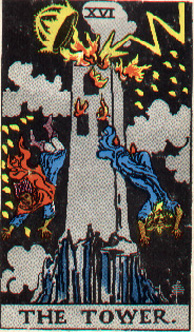
It is not too late for Britain but the last bastion is indeed the one on which the battle will be fought. Perhaps, just perhaps, when comes time for the UK referendum, that vast and growing tower will be struck by lightning and come crashing down.
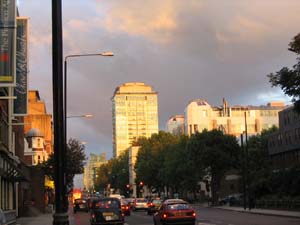
The evening sun that illuminated one of my favourite views near where I live was especially dramatic this evening. And this little photo of how things looked is surprisingly effective I think. Even the little thumbnails I got I scrolled through all the pictures in Photoshop to choose a good one looked rather impressive.
But if you would like to see this rather bigger, then click on it.
I suppose there are some readers of this blog who will say, when confronted by images like this: what has this got to do with blah-blah-blah-ism (or whatever word they choose to give to the political assumptions and axioms we tend to favour here)? But, even though many readers may be puzzled, the fact is that our standing orders here are to write about what is on our minds. And what was on my mind when I went shopping earlier this evening was not the EU or the level of taxation or the importance of consenting relationships. It was how beautiful that usually quite mundane building over towards the river can look when it catches the evening sun just so, and especially when the sky behind it is also doing dramatic things of its own.
This kind of thing does make me want to have a more expensive camera, though, plus some lessons in how to use it. Because what my cheap little camera shows you is only a pale shadow of what I myself saw.
We have a posting category called “How very odd!”. Now I want one for “How very beautiful!” Meanwhile, “Architecture” will have to do.
I recommend this article about the Organization for Economic Cooperation and Development (OECD).
It reminds us here, if any of us need reminding, that even if we do manage to shake our country loose from the EU, there is still a ghastly alphabet soup of international organisations lying in wait for us.
Representing mostly high-tax European nations, the OECD thinks it is unfair when jobs and investment move from high-tax to low-tax nations. The bureaucrats are particularly upset that so-called tax havens provide a refuge for oppressed taxpayers from welfare states like France, Germany, and Sweden. As part of its anti-tax competition project, the OECD met in Berlin for a two-day conference during the first week of this month, hoping to bully tax havens into helping high-tax nations track and tax flight capital.
Using various threats, the OECD is pushing low-tax countries into providing information about nonresident investors to foreign tax authorities, meaning that any benefit of investing elsewhere disappears once European tax collectors can impose taxes on money invested outside their borders.
Acting as the Gambino family of the tax world, the OECD has pressured places like Anguilla and Panama to sign “commitment letters” pledging to participate in something called “information exchange” – an odd term for a one-way flow of data from “tax havens” to high-tax governments.
The writer of this, Joel Mowbray, focuses on the US contribution of $50 million per annum to this evil enterprise. But what this makes me think of is the fact that, following their recent electoral success, Britain’s UKIP is now being challenged by its enemies to work out some other policies, besides merely saying a big NO to the EU. And I say to such challengers, be careful what you wish for.
The great canard of the collectivists holds that a free-market in healthcare will assuredly result in healthcare providers hungrily pursuing maximum profits while abandoning the poor, the elderly and the vulnerable to a wretched and untreated fate.
So often and so passionately has this big lie been repeated that it is now accepted by most people in this country as an incontrovertibe truth. Nationalised healthcare, they say, puts people’s needs at the top of the agenda where there is no room for ugly money-grubbing.
Only they forgot about ugly bed-grubbing:
A nurse has been jailed for five years for trying to kill two elderly patients at a Cheshire hospital.
Barbara Salisbury, 47, was found guilty of trying to kill them to free up more beds at Leighton Hospital, in Crewe.
Rationed resources require desperate measures. In fact, and given the governmental obsession with reducing waiting times for hospital treatment, I am a little surprised that the Department of Health has not pinned a medal on this woman.
When she finally emerges from her time in stir, Ms Salisbury may well find herself being offered a job back in the NHS as a senior consultant.
Yesterday Michael Jennings introduced me to Skype, a sort of instant messaging program that is very good at voice communications. This is part of an ongoing trend which is seeing computer networks challenge the traditional telephone networks for business.
Because rather then pay a large sum of money to make an international phone call, I’m now able to speak with Michael in London from my Australian home, for free, and with a better sound quality then I was able to do before.
So as you can imagine, it is a time of fast change in the telephone business. This has implications wider then the share prices of telephone companies.
To encourage take up of VoIP, legislation has been introduced in the US Senate, by Senator John Sununu. The VoIP Regulatory Freedom Act of 2004 is designed to exempt this technology from most state and federal regulations.
Needless to say there’s been plenty of opposition to this. Much of the opposition comes from self-interested telephone companies, but the US Dept of Justice is not happy either.
The VoIP Regulatory Freedom Act of 2004, sponsored by Senator John Sununu, would exempt VoIP service from a wire-tapping regulation called the Communications Assistance for Law Enforcement Act, or CALEA, commonly used to listen in on traditional telephone calls, said Laura Parsky, deputy assistant attorney general for the DOJ’s criminal division.
“I am here to underscore how very important it is that this type of telephone service not become a haven for criminals, terrorists and spies,” Parsky told the Senate Commerce, Science and Transportation Committee Wednesday. “If any particular technology is singled out for special exemption from these requirements, that technology will quickly attract criminals and create a hole in law enforcement’s ability to protect the public and national security.”
You can read Laura Parsky’s complete testimony here
What this statement is all about is that the Dept of Justice has got quite accustomed to using the wiretap to track down undesirables and is most unhappy that this legislation might prevent them from doing so in the future.
This is part of a wider trend that I suspect we will see more of, with people taking the opportunity to try out new ways of communicating with each other, and regulatory agencies scrambling to keep up. In the United States, there are US Senators who seem, like Senator Sununu, who consider privacy issues and freedom from regulation important. I fear that when the EU catches up, as it surely will, that those issues will be the least of the concerns of the people who draft the regulations.
So far, I have not been all that enthused by the Euro 2004 European Championship football tournament being held in Portugal at the moment but finally, it appears, the sporting event has sparked into life. This evening, Croatia came close to beating the former champions France, in a thrilling game. Earlier in the day, England, who lost their first game in the last minutes to France, managed after some hiccups to overwhelm Switzerland.
All to the good. I must say that watching some of the matches has reminded me of why, despite my annoyance at the antics of highly paid sportsmen, I still love watching football, and why I despise those who think it is amusing to sneer at we plebs and our love of what Brazil’s Pele called the “Beautiful Game”.
Take this piece of drivel from an anti-sports snob, for instance:
The players are even more loathesome than the fans. All professional sportsmen are more or less imbeciles, of course, but only footballers manage to be so utterly charmless with it. They are essentially overgrown spoilt children, diving and rolling around pretending to be injured, and practically wetting themselves whenever someone scores. There is a general, and sometimes quite fantastic, ugliness. If I had my way, I would have them all shot.
I wonder if the author of this piece would like to pass on his profound thoughts to one of the England team? Seriously though, for all that I despise the moronic behaviour of certain England football “fans” causing mayhem, I also despise a certain kind of anti-sport snob who imagines he or she is being terribly daring and original by sneering at the pleasures of the ordinary guy and his enthusiasm for team sports.
Oh well, come on England!
I have known for quite a while that the hierarchy of Roman Catholic Church in England has decided that it no longer wishes the Church to be a force for moral suasion but would rather simply act as a political lobby, seeking to use the force of the state to compel behaviour it approves of rather than allow moral choices to remain in hands of thier parishioners (or anyone else for that matter). It is good to see articles in the mainstream press saying much the same thing and holding them up to a spotlight.
I would hope that Roman Catholics who view the political secularisation of their church do not just meekly sit in their pews and listen to the advocacy of coercive statism without a murmur. If the Church wants to act like a political organisation, people should have no compunction treating them like nothing more than that… and there are few ways better to get an institution’s undivided attention than starving it of funds.
If the leaders of the Church in England want the state to take your money regardless of how you feel about that, rather than bending their efforts to urging you to give it to charitable works of you own free will, then might I suggest to Church-goers that they remember that when the collection plate comes around during mass… but do not just decline to part with your funds, tell your priest that you will not do so and why.
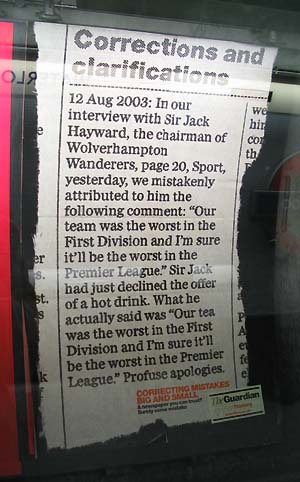
Here is a poster I snapped in the London Underground the other day, through the Jubilee Line glass screen at Waterloo. It is quite amusing, but should they really be boasting about things like this?
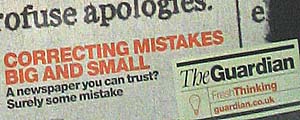
And look down at the bottom. Is this a conclusion they really ought to be proud to be drawing? Or is the implication that if they ever do make any mistakes, they are all just typos?
Detail of the bottom corner, with a bit of help from Photoshop to make it more readable:
So, may we now expect a poster with a big mistake corrected?
We have been supporting state centralised socialistic stupidity and stagnation for, you know, a long time. We were wrong. Sorry and all that. Capitalism has its problems, but it is, we now realise, much better.
DifferentNow guardian.co.uk
Such will not, I suspect, be the substance of my next posting here.
Tomorrow afternoon I am off to Los Angeles… and thence to the Mojave desert to watch SpaceShipOne head for space. I will try to post some more when I get to Rand Simberg’s place in LA.
In the meantime, you can get a copy of the Aldridge Commission Report here. You do not know what it is? Well, then, follow the link! As for me, I am off to bed… there are some rather long days ahead.
|
Who Are We? The Samizdata people are a bunch of sinister and heavily armed globalist illuminati who seek to infect the entire world with the values of personal liberty and several property. Amongst our many crimes is a sense of humour and the intermittent use of British spelling.
We are also a varied group made up of social individualists, classical liberals, whigs, libertarians, extropians, futurists, ‘Porcupines’, Karl Popper fetishists, recovering neo-conservatives, crazed Ayn Rand worshipers, over-caffeinated Virginia Postrel devotees, witty Frédéric Bastiat wannabes, cypherpunks, minarchists, kritarchists and wild-eyed anarcho-capitalists from Britain, North America, Australia and Europe.
|





Recent Comments