We are developing the social individualist meta-context for the future. From the very serious to the extremely frivolous... lets see what is on the mind of the Samizdata people.
Samizdata, derived from Samizdat /n. - a system of clandestine publication of banned literature in the USSR [Russ.,= self-publishing house]
|
Last night I had some friends and business associates around for dinner here in Chelsea. It was an agreeable evening at which some interesting conversations were had, some good food was enjoyed and some nice wine drunk.
And at around 7:00pm while all that was happening in my home, some 50 yards away my neighbour John Monckton was stabbed to death and his wife seriously injured by a pair of young vermin who broke into their house.
Of course the state forbids people like the Moncktons from owning the means to defend themselves. And the CCTV cameras on our street? I cannot tell you how much better they must make everyone around here feel. The police who have closed off my street are festooned with all manner of weapons and body armour but given that their actual role in modern Britain is little more than clearing up the mess after another disarmed householder has been butchered, perhaps waterproof coveralls and mops would be more suitable equipment for our tax funded ‘guardians’.
Bitter? You bet. The world is full of predators and we are required to face them disarmed and as much in fear of the law as the criminal who attack us.
The state is not your friend.
It was a peculiar juxtaposition of programmes. First I watched the latest episode of Spooks, on BBC1 TV, and then I watched the BBC Ten O’Clock News, without pushing any buttons on the TV because that was on BBC1 TV also.
The News was dominated by David Blunkett‘s difficulties, largely self-inflicted, it would appear. There will be an independent inquiry into whether Blunkett fast-tracked a visa application for his ex-lover’s nanny, and the Prime Minister announced that he was confident of the outcome, which was an odd combination of circumstances. If the Prime Minister is so sure, why the independent inquiry? Why can he simply not say why he is so sure of the impeccability of his Home Secretary? And as another talking head opined, it would now take a brave independent inquirer to fly so completely in the face of Blair’s clear statement of what he wants the answer to be. Which means that if the independent inquiry does endorse the Prime Minister’s view, the suspicion will remain that this was because of the Prime Minister publicly demanding that answer instead of because the answer is true. So whichever way the independent inquiry goes, the stink will either be strong, or strong.
Spooks (a programme I have had cause to mention here before) was a even more lurid soap opera than usual – of junior Ministerial wrongdoing (he murders a girl, then resigns to spend more time with his family (sound familiar?)), of a famed rock and roll couple (she has her baby kidnapped to keep them in the news, but it goes wrong, the baby dies, and he finally murders her in a rage and then shoots himself). Downing Street was presented throughout as relentlessly manipulating a deranged state of public sentimentality (not least in calling in the Spooks to sort the matter in the first place, instead of leaving it to the Police), as in the grip of electoral desperation, as total hypocritical, and generally as a huge cover-up machine. If this show is any clue as to the state of public opinion, out there in Middle England, we have our answer to that question about why the Prime Minister does not want to explain why he believes his Home Secretary to be innocent of all wrongdoing. Middle England would not trust such pronouncements further than it could spit them. The Prime Minister is not trusted. → Continue reading: Public life, private life and public trust – reflections on two consecutive TV programmes
If David Blunkett falls from office because of his shenanigans between the sheets, I do hope that civil rights activists will not see this as a sign from God (be it Cthuhlu or whoever) that the truly perilous state in which British liberty stands is about to take a turn for the better.
Nothing Blunkett has ever done was done under his authority alone. The accelerating rate at which common law is set aside and ancient liberties debased have been the product of decades of antipathy to non-collectivist rights and individual liberty, a process which was well under way when David Blunkett’s Tory predecessor was in power: would-be future Prime Minister Michael ‘a touch of the night’ Howard.
The fall of a ringwraith might be cause for some brief rejoicing (I will certainly be raising a glass or two that day!) but please remember there are plenty more where he came from. Sauron lives at Number 10 Downing Street, not in the office of the Home Secretary.
A reader forwards the following information:
On October 25th, without any consultation, the Council of European Union introduced a change to this legislation, calling for the mandatory fingerprinting of all EU citizens, residents and visitors.
This, along with the passport could form the basis of an intrusive EU wide identity card, similar to that the current British government is proposing at national level, and certainly would enable EU-wide surveillance of everyone’s movements.
The organisations Privacy International, Statewatch and European Digital Rights have written an open letter to MEPs. They are calling for endorsements of this letter, please email privacyint@privacy.org if you wish to do this. (The email address (terrrights@privacy.org) given on PI’s web page for this purpose bounced.)
They are also calling for people to contact their MEPs over this by November 30th. You can find UK MEPs’ emails here. For those EU residents not in the UK, these links should help.
One senior administration official said Treasury Secretary John W. Snow can stay as long as he wants, provided it is not very long.
The Washington Post reporter Mike Allen, reporting on a possible shake up of President Bush’s economic policy team.
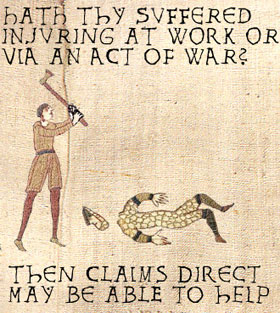
In this posting earlier today, Jonathan mentions how The Incredibles includes some “clever and sly digs at America’s litigation culture”. So here is another clever and sly dig at Britain’s fast expanding litigation culture:
With thanks to b3ta.com.
Did you join an army, and then get hurt in a battle? Sue your commanding officers for forgetting to warn you that war is sometimes violent.
Did you fall over, because of running too fast? Sue the owner of the floor you fell on, the person who employed the person who spilt some water on it and made it slippery, the maker of your shoes for not making them with more grip, the maker of the floor tiles, but: on no account blame yourself, for being careless. Your life is not your fault. It is the fault of somebody else, somebody rich. And if you were engaged in robbing the place at the time, never mind: this makes no difference!
The Ukraine faces a choice between living in Vladamir Putin’s shadow or living under the shadow of more locally sourced rascals. Yes, I wish the protestors well in their attempt to prevent Russia’s pet poodle Viktor Yanukovych from stealing an election but in truth I do not know enough about the alternatives to Yanukovych to get any real enthusiasm for what is going on.
The fact that anti-government people have a tendency to ‘disappear’ in the Ukraine is cause enough to want to see the end of Yanukovych and his supporting but the notion that ‘democracy’ is possibly being subverted is not any real cause for excitement to me per se, given that any alternative to Yanukovych (and the pretty strange Leonid Kuchma) will no doubt use democratic processes to turn the Ukraine into just another highly regulated EU-satellite ‘aid crack’ addicted state.
So sure, good luck guys, just try to make sure you are not changing Moscow’s iron handcuffs for locally made ones with a velvet lining imported from Brussels.
I have just got back from seeing The Incredibles, the computer animation movie about a family of superheroes and superheroines. I have read good things about this film and was not in the least bit disappointed. It proceeds at a crackling good pace, is often extremely funny, includes some rather clever and sly digs at America’s litigation culture, and is endowed with a wonderfully positive, life-affirming sense of life throughout. It also has great, brassy backing music.
To state the obvious, what really stunned me was just how good computer animation now is. Some of the scenes in the jungle, the big city and the sea just took my breath away. It is easy to get blase these days, given just how good film making now is, but this film goes even further than that other great animation hit of recent years, Finding Nemo.
Go and see it. You know you want to.
Despite the miserable weather, a reasonable audience turned up at Conway Hall in Holborn to listen to Aubrey de Grey, at the monthly meeting of Extrobritannia. The speaker sounded as if his life was already ebbing away, given the fast bullets assigned to each argument. Powerpoint presentations are far less interesting.
Aubrey de Grey campaigns for practical approaches to anti-aging medicine, and uses the acronym SENS (Strategies for Engineered Negligible Senescence). He is one of the few people on the planet actively attempting to help the general population live longer and healthier lives. As he argues, one without the other is pointless.
One of the strategies for promoting this goal is the Methuselah Prize, a reward designed for prestige rather than money, which will (hopefully) promote philanthropic investment in these research programmes. To those familiar with this structure, this is designed to emulate the success of the X Prize.
The talk today included the recent changes in the structure of this Prize. There are two components: an award for postponing the aging process and an award for reversal. The aim is to award those resaerchers that succeed in extending the lifespan of the laboratory mouse and, even better, reversing the aging process.
The goal of capturing the imagination of the public is best achieved by a very simple prize structure, in which money is awarded simply to the producer of the world’s oldest ever mouse. This should be restricted to the species used in virtually all laboratory work, Mus musculus , but no other restrictions should be placed on the way in which the mouse’s lifespan is extended, except for ones that fail to maintain its cognitive and/or physical well-being. This is analogous to the situation with boxing, for example: the heavyweight championship is the one that gets by far the most publicity and money.
A major shortcoming of this simple structure exists, however. Our main purpose is to find interventions which are effective when initiated at a late age; it is very likely that interventions that are applied throughout life will always be ahead of those initiated late.
Hence, we are running two prize competitions:
– a “Longevity Prize” (LP) for the oldest-ever Mus musculus ;
– a “Rejuvenation Prize” (RP) for the best-ever late-onset intervention.
Although the United States and Europe have placed cultural and regulatory obstacles in the path of longevity science, cutting edge research continues to take place in the Far East. Only yesterday did South Korean researchers claim that the injection of umbilical cord stem cells had allowed a woman paralysed from the waist down to walk again. The question on concerned minds: can this result be reproduced?
These scientific goals are no longer the dreams of writers; they are the goals of academics and the content of research programmes. This is all progress. Faster please!
In his Telegraph column, Boris Johnson comes out strongly, and in his inimitable way, against ID cards in Britain. He goes for the proposal’s jugular, which has nothing to do with anti-terrorism and security and all to do with control and commmand.
I say all this in the knowledge that so many good, gentle, kindly readers will think I have taken leave of my senses, and to all of you I can only apologise and add, in the words of Barry Goldwater, that extremism in the defence of liberty is no vice, and that I really don’t know what I dislike most about these cards.
…
Worse than the cost and the bother, however, there is the sheer dishonesty of the arguments in favour. If I understood Her Majesty correctly, her Government conceives of these cards as essential weapons in the “war” on terror.
Perhaps it’s the latest ‘release’ from Tory constraints, so to speak, that allows Boris to heave a sigh:
All these points I have made these past few years, up and down the country, and the most frustrating thing is that these objections cut absolutely no ice (unlike, as I say, the cards themselves) with good, solid, kindly, gentle Conservative audiences.
My audience were all gluttons for freedom, if by that you meant the freedom to hunt, or the freedom to eat roast beef without the fat trimmed off. But they were perfectly happy to see their own liberties curtailed, if that gave the authorities a chance to crack down on scroungers and bogus asylum-seekers.
Indeed. If you’ve got nothing to hide, you’ve got nothing to fear! Now, where have I heard this before…?
And the final exhortation:
And there, I fear, the debate has come to rest. To all those who yearn for ID cards, and who would extinguish the flame of liberty in the breath of public panic, I make this final appeal. Read this week’s Spectator, with its terrifying account by a man arrested and jailed for having a penknife and an anti-burglar baton locked in the boot of his car, and then imagine what use the cops could make of the further powers they are acquiring to inspect and control.
Yes, we have, Boris and ’tis a very scary read.
TF1, a French TV station carries this [link disabled] video report of a debate within France’s Socialist Party, concerning the ratification of the EU Constitution. Two campaigning websites each for and against are listed.
The ‘No’ camp is split with supporters of Henri Emmanuelli on the one hand, a corrupt politician who’s main claim to fame was his position as Treasurer of the Socialist Party when many of its leading figures were being caught stealing public funds to finance the Party. On the other side are supporters of Laurent Fabius, part of what was once the reformist wing of the Socialist Party (in the mid 1980s). Fabius himself of course is one of the blood contamination killers, four Socialist politicians who allowed HIV infected blood to be used in blood transfusions, leading to the contamination of as many as 2,000 French haemophilliacs or half the total French haemophilliac population. I seem to recall that there was a screening method that was delayed, on the grounds of cost. Naturally, the politicians escaped punishment, other than a token criminal conviction for “involuntary homicide”.
Details of the campaigning sites can be found here.
Sadly, with champions like this, the credibility of a “Non!” campaign would be somewhat stretched. Even in France.
Do you really think that if this were a symbol for a man’s most sensitive organ, we would cut one end and set the other end on fire?
– Ray, a character from Blowing Smoke movie, talking about cigars…
|
Who Are We? The Samizdata people are a bunch of sinister and heavily armed globalist illuminati who seek to infect the entire world with the values of personal liberty and several property. Amongst our many crimes is a sense of humour and the intermittent use of British spelling.
We are also a varied group made up of social individualists, classical liberals, whigs, libertarians, extropians, futurists, ‘Porcupines’, Karl Popper fetishists, recovering neo-conservatives, crazed Ayn Rand worshipers, over-caffeinated Virginia Postrel devotees, witty Frédéric Bastiat wannabes, cypherpunks, minarchists, kritarchists and wild-eyed anarcho-capitalists from Britain, North America, Australia and Europe.
|





Recent Comments