We are developing the social individualist meta-context for the future. From the very serious to the extremely frivolous... lets see what is on the mind of the Samizdata people.
Samizdata, derived from Samizdat /n. - a system of clandestine publication of banned literature in the USSR [Russ.,= self-publishing house]
|
I am taking the scenic route home at the moment. I know readers will think I am a wimp, but I still cannot quite summon up the courage to go down the Tube again – which is unpleasantly hot in the summer, anway – and have been getting plenty of exercise. My route takes me from Holborn, down Chancery Lane, down to the Embankment and then a long walk up to Parliament on the side of the River, then through Millbank, past the lovely Tate Gallery and then back to my home in Pimlico. (Brian of this parish also lives in the area).
The atmosphere is rather odd. There is the constant racket from helicopters hovering about, over Buckingham Palace much of the time. There are hundreds of police, some armed, outside prominent buildings including Parliament and the big Whitehall offices, of course. There are thousands of tourists, although quite a few appear unwilling to use their cameras for fears of appearing insensitive or possibly even suspicious. A lot of the tourists look even more dazed than is often the case. Most people seem pretty cheerful, though, which is good.
As I walked past Parliament Square opposite the rather scruffy anti-war posters, a young black guy in a posh shirt was shouting out loudly his evangelical Christian message. No offence to Christians but it struck a jarring note. I wish folk like this fellow, no doubt a decent person, could realise that hectoring religion is not quite what London, or anywhere else, needs right now.
A final thought for tonight: I cannot help notice how many stunning women there are walking about the moment. They may not realise it or care less, but in their ravishing way, these suntanned goddesses are sticking one in the eye to the women-hating jihadis.
Hot British crumpet – FUCK YEAH!
I have just been watching Panorama, on the subject of Islamic terrorism, and according to an investigator in Morocco, Al Qaeda has a new dress code. To start with, you must wear a beard and robes. You only switch to ordinary western clothes, to blend in, when you switch to “active service”.
This reminds me of a snatch of dialogue I recall from the movie Ice Station Zebra, which went approximately as follows. (I only saw it a long time ago, so what follows may be somewhat approximate.)
Patrick McGoohan (yes – The Prisoner himself) plays a secret service agent, and he is asked what he thinks of one of the people on the expedition, or at the base, or whatever.
“Yes” says the McGoohan character, “we’ve been watching him.”
What do you make of him?
“Oh,” says McGoohan, “he’s immaculate.”
How long have you been watching him?
Replies McGoohan: “Ever since he became immaculate.”
UPDATE: “Impeccable.” See comment 4.
Charles Moore is one of the finest essayists around, in my view, and hits the mark with one of the sanest, clearest and most honest appraisals of Islam and the United Kingdom I have read for ages.
Go and read the whole thing, like they say.
Burning in fear??!!? Ha!! Not this Brit. With my upper lip fixed stiff, I hoot and mock these jihadis. Wankers one and all. I’d like to see ’em on Celebrity Terrorist Island, the IRA’d make mincemeat of them.
– comment number 9 of these ones at Crooked Timber, spotted there by Tim Worstall yesterday
I can only assume that Michael Moore was too busy:
Nearly four years after the collapse of the World Trade Center, Oscar-winning director Oliver Stone will direct a film based on the story of two police officers who were trapped in the rubble on Sept. 11, 2001.
And in that rubble, the two stricken men will miraculously find ‘proof’ that the 9/11 attacks were carried out by a CIA-Halliburton-Zionist-BushHitler conspiracy. But the evidence will all mysteriously disappear after thay hand it in and some snarling unidentified suit with a Texan accent will warn them to “keep their big mouths shut”.
“A libertarian is a conservative with an acknowledged vice, like say, a teenage girlfriend.”
The as-ever brilliant P.J. O’Rourke (hat tip Catallarchy)
Recovering as we still are from Thursday’s mass murders in central London, a few questions start to arise. For starters, it seems to me that if, as we are, at war, then the members of Parliament need to be on the same page as far as the defence of this realm is concerned. It does not mean, of course, that MPs should not criticise the conduct of the government’s military operations or anything else, but it does mean that MPs should not actively support groups determined to do us harm.
Which brings us to George Galloway. His support for the Iraqi “resistance” (ie, the mixture of Baathist dead-enders and assorted jihadists) is a matter of shameful public record. While not – yet – conclusively proven – there remain serious allegations relating to his financial connections to Saddam Hussein and the Oil For Food Programme. And within hours of the bombings in London, this thug sought to deflect blame from the killings from the monsters who carried them out to the UK government for its overthrow of the Taliban and Hussein.
I am an ardent believer in free speech and I would be the first to defend Galloway’s right to say what he wants, no matter how thick or unpleasant. That is a non-negotiable issue for me. It is pretty clear, however, that in the current heightened threat to our national security, that Galloway should be removed from Parliament immediately.
Next time London mayor Ken Livingston professes to speak for London’s outrage at the 7/7 attack, perhaps his long standing support for Islamic extremists (not to mention Irish terrorists) needs to be thrown back at him. Moreover those who continue to support him must not be allowed to avoid these issues either and if the Labour party wants Red Ken ‘back in the fold’, they must be made to pay a suitable political price.
The last pub covered in this series is one I have known for the longest time: Paddy Reilly’s. I first came to it whilst traveling with Irish bass guitarist Dee Moore a decade ago. There has been some remodeling since then, but Tony DeMarco’s Thursday session goes on. I have no idea how long he has been at it but he has become a New York institution. He is also a very fine fiddle player, known and welcome in any session in Ireland.

The session in full flight. Tony DeMarco on fiddle at left.
Photo: D.Amon, all rights reserved
I arrived a bit early tonight and while sipping my first pint of the evening overheard a fellow I had never seen before. He told a couple at the bar how tightly knit the global traditional music scene is: how you can go to a session anywhere and in a few minutes chat with a new found trad player find people you know in common.
I put it to the test and I hit it in one. In fact, of the first six people I named there was only one who was not well known to us both. Later in the evening the fellow’s name, Jon Hicks, finally clicked in my mind. The aforementioned old friend, Dee, produced his first CD.
Jon is from Northern England; he lived in the West of Ireland for a number of years and is now on the road to becoming a permanent New York resident. From the quality of picking I heard, I believe he will be a welcomed addition to the local music scene.
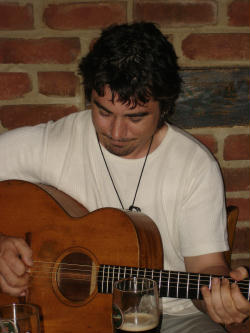
Singer-Songwriter Jon Hicks.
Photo: D.Amon, all rights reserved
It was a lovely session, typical of the decades long run of Tony’s session. Whether due to the events in London or just vageries of the summer holidays, the crowd was thin tonight. Not too thin though. We had a lively young woman who had her first introduction to Irish traditional music and was totally enthralled by the skilled musicianship involved. I think she will be back.
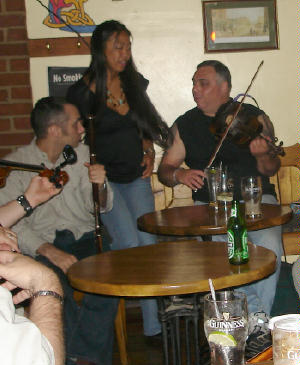
Trad music seems to attracts beautiful women.
Photo: D.Amon, all rights reserved
I was on my way to hear a talk by Tim Evans in Putney about his work as the boss of CNE. Presumably it was going to be similar to the talk flagged up here.
Anyway, I walked to St James’s Park tube station, which was open and functioning but with not many people using it. A train was standing at the platform and I ran down the steps in the hope of getting into it before the doors closed. I need not have bothered. It waited, and waited.
Until eventually, an announcement materialised saying: security alert at Victoria (the next station along the line). Damn. There I was, eager to do my bit to face down those moronofascist terrorists by going about my business as usual, as per the Spirit of the Blitz etc., which in my case meant a sweaty tube journey out to Putney to an evening meeting, but unable to make my journey. Very annoying. I would really have liked to have heard that talk of Tim’s, but there was now no way I was going to get to Putney in time.
All those Londoners who would have had to share my inconvenience had they got caught by the same delay, but who had instead decided to give their work a miss today, turned out to have made a wise decision.
I asked the bloke at the ticket barrier I went back through if I could get my money back. He pointed at the ticket window where I had bought my ticket, but said he did not fancy my chances, on account of my ticket being usable to get to my destination by other means, namely two interminable bus journeys or one bus journey and an annoyingly long walk. (Which, by the way, I was not sure about and would have to find out about. Ugh!) So when I nevertheless asked for my refund I emphasised that there was no other way I could get where I wanted to in time. And guess what, he gave me my money back. However, I got the definite impression from all of this that under normal circumstances – no bombs yesterday, the usual crazy rush hour crowds – I would not have been so lucky. They are not usually this reasonable. Has the word gone out to these guys to be nice to the passengers, until we return in sufficient numbers to clog everything up again, and they can resume their normal level of small-print-based nastiness, in circumstances like these?
I can find no reference on the internet to this particular little flap, as of 10pm, which is when I am writing this. The only relevant thing I could find was a reference to “Minor delays are occurring on the rest of the line”, i.e. the District Line, which is what it says around now at this Transport for London page.
My guess: jumpy people, chasing shadows, preferring the soft cushion of being safe to the faintest possibility of being sorry. Which is understandable. I am afraid London will be like this for quite a few more days yet.
So London was attacked and hundreds were killed or wounded by Islamic fanatics (showing incidently why we are utterly right to be fighting these vermin wherever they are to be found)… and having ID cards would have made not one damn bit of difference.
Next time some pontificating dissembling jackass holds up ‘terrorism’ as why Britain need these odious things, I am likely to spit in their face.
Despite the byline, this is being posted from London
The train and tube that I caught in to work this morning were significantly less crowded today than is usual – carrying maybe two thirds to three quarters the normal number of passengers. The atmosphere on the trains was pretty serious. People were sitting pretty still on the train with pretty serious faces and eyes even more than normally fixed on newspapers. The British air of “We are going about our business, damn it” stoicism came through pretty strongly. There were more police in London Bridge station than is usual. Advertising placards for the Evening Standard were rather incongrously still proclaiming “London’s Victory: How We Did It” or some such. These had been advertising the Wednesday edition of the paper (or perhaps the earliest Thursday edition) and rather unsurprisingly nobody had been selling the Thursday edition inside the station. They have probably been replaced by now with placards advertising the first Friday edition of the paper.
While standing on the Jubilee Line platform, the announcements were fairly normal, except that the standard, very mechanical sounding “Please make sure that you keep all packages and other personal possessions with you at all times” was replaced by a slightly more human announcement of “Obviously I don’t need to tell you that you should keep all packages and other personal possessions with you at all times”.
The large international bank I work for instituted very tight and very visible security for getting into the building after September 11. It was only two or three months ago that this was relaxed, but I found that the tight and visible security regime had returned this morning. I was required to show my company ID card several times before being able to reach my desk. Upon getting there, I found that about half of the people in the team I work for had come to work – several of the rest have logged into their work computers from home and are working remotely.
However, I hadn’t been at my desk long when an important piece of information flashed around – there was free food in the cafeteria. Management were making a friendly gesture to the employees who had made it in today, or something. I went down to the cafeteria and discovered that the number of people queueing for food and eating in the cafeteria was at least twice as long as it would be on a normal day, despite the number of people at work being much smaller than normal. Many of the people in the queue were no doubt millionaire investment bankers, but the opportunity to have free bacon and eggs was clearly not one to be sneezed at. The queue was long, but people remained in it patiently and good-humouredly. And I didn’t sneeze at it, having a helping of free bacon and eggs myself.
So, the British people have survived this terrorist attack in good shape. They are still stoic, very angry about the people who attacked their city (although it would be bad manners to show it directly), determined to go on with their lives, are still the great queueing culture they always were, and are still also profoundly cheap. I’m not British, but it makes me proud to be a Londoner.
|
Who Are We? The Samizdata people are a bunch of sinister and heavily armed globalist illuminati who seek to infect the entire world with the values of personal liberty and several property. Amongst our many crimes is a sense of humour and the intermittent use of British spelling.
We are also a varied group made up of social individualists, classical liberals, whigs, libertarians, extropians, futurists, ‘Porcupines’, Karl Popper fetishists, recovering neo-conservatives, crazed Ayn Rand worshipers, over-caffeinated Virginia Postrel devotees, witty Frédéric Bastiat wannabes, cypherpunks, minarchists, kritarchists and wild-eyed anarcho-capitalists from Britain, North America, Australia and Europe.
|





Recent Comments