We are developing the social individualist meta-context for the future. From the very serious to the extremely frivolous... lets see what is on the mind of the Samizdata people.
Samizdata, derived from Samizdat /n. - a system of clandestine publication of banned literature in the USSR [Russ.,= self-publishing house]
|
“It is a irresistible to note that nearly everyone, including the wealth creator, is inclined to see the world of inner being, of the heart and soul, as being at odds with the commercial. Wealth creators seem shy of their success. It is often said that the Englishman has always preferred to be seen as a gentleman than as a creative, industrious or commercial person.”
Richard D. North, Rich is Beautiful, (page 199).
On a train from Manchester to Nottingham I was sitting at a table when I was joined (in Sheffield) by two academics from the University of Nottingham.
The two gentlemen talked (rather loudly) about the internal affairs of their department (which seemed to be a ‘social policy’ department, at least the term ‘social policy’ was used) and their nice trips to various European nations and to Australia, New Zealand and Japan.
What struck me was the total lack of interest in ideas that the academics showed – they both boasted of using the same talk again and again, and neither cared whether their talks represented the truth or made any contribution to knowledge.
I only spoke once. One of the academics was boasting of his trip to the “biggest city in New Zealand”, but could not remember the name of the place – so I told him it was called Auckland. But later he seemed to be under the impression that he was talking about the capital of New Zealand – so he may have meant Wellington.
For the rest of the time I just sat there in the hope that some sign of interest in ideas would be shown by either man, but it was not.
I remembered Professor R. of the Politics Department of the University of Nottingham. Professor R. had always been interested in ideas – although I can not say that I had always agreed with him.
Once at a conference in London I had expressed the fear that local councils would use the introduction of the Community Charge (the “Poll Tax”) as an opportunity to increase spending – and blame the bill on the new system (my own position was that a local sales tax would be the least bad option – as people could at least vote with their feet and shop in the cheapest areas thus, perhaps, forcing down the level of the tax).
Professor R. had replied that I was too cynical and that most politicians met well, they were just guided by mistake ideas. As my own view was that most politicians (and many other groups of people) were scum, our difference of opinion became quite sharp. Perhaps my anger was due to Professor R. reminding me of my father – a man who was betrayed so many times and yet maintained a strange (at least strange to me) faith in human beings.
Some years later (after some “modernization” of academic life) Professor R. killed himself.
As I have said he was man who was interested in ideas and valued them, but perhaps he had too much faith in human beings (just as, perhaps, I have too little faith in people).
I miss people like Professor R., they thought that other people were like themselves (and they are not), but the world would be a better place if they were correct and people (especially academics) were really honest and dedicated seekers after truth.
Still what would have I had heard had the two academics had been interested in ideas? The latest plan to reform the Welfare State – yet another pattern for the deckchairs on the Titanic?
Or (if the academics had been economists) the claim that the best way to promote prosperity was to “reduce interest rates and stimulate demand”.
I have even heard libertarians talking as if investment did not have to based on real savings ( fiat money and credit bubbles performing this function instead), and as if prosperity was based on consumption (rather than on work to produce goods and services of value to human beings). The madness of the boom bust cycle being presented as what “all serious economists” believe (as a columnist in the “Times” newspaper put it – referring to his idea that Germany’s economic situation could be improved by issuing more money “stimulating demand”).
What is worse? People who are not interested in ideas, or works of political philosophy, economics (and other subjects) that are filled with absurd nonsense and seeing this nonsense repeated in so many places, from leading universities to television and the newspapers?
In the last couple days I have written, and then deleted unpublished, several articles about the IRA’s much ballyhooed decommissioning (or ‘decommissioning’, depending on what you believe to be the truth) of its weapons. In short, I am not sure what I think.
To try and make head or tail of what is going on, I have been hanging out at Slugger O’Toole.
And I still cannot figure out if it is cause to celebrate or just another ploy.
I went out this afternoon to partake of coffee with a friend, and on my way to the coffee house, I stumbled upon a news story, and took some photos of it.
Who is that?, I asked. A Father 4 Justice. Oh, one of them.
Cheap, modern, democratised communications pervade this story, and may also influence the reporting of it. Note that the guy has a portable telephone, which would probably not have been the case a decade ago, and which must surely have influenced how the authorities set about dealing with him. I mean, if you were a copper, it might make a difference if the guy you were trying to arrest was supplying a running commentary of your every move to his pals. Who were recording everything he said, as they surely were.
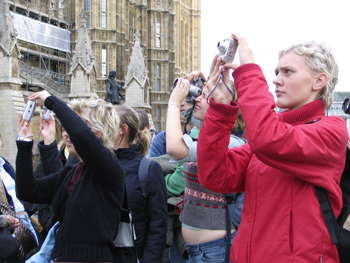
Other photographers were already out in force by the time I got there.
The professionals were there in strength.
But, so were the amateurs, …
… me included, with my 10x zoom lens and automatic anti-shake focussing, in a camera that cost less than three hundred quid.
One of the features of modern government, or maybe that should be recent government, is that modern/recent government often likes simply to blot stories off the airwaves. I am not saying that they wanted to squash this one. But I am saying that if they had entertained any such censorious thoughts, although they might have got away with this ten years ago, now, they would have far less chance.
They would merely have handed the blogosphere a nice little scoop.
Tony Blair gave his annual Labour Party conference speech to the party faithful (and not-so-faithful) in Brighton this afternoon. He touched on a variety of issues but this series of quotes stands out and reminds us, as if we needed reminding, that this is one of the most illiberal governments since the Second World War:
We are trying to fight 21st century crime – ASB (anti-social behaviour) drug-dealing, binge-drinking, organised crime – with 19th century methods, as if we still lived in the time of Dickens. The whole of our system starts from the proposition that its duty is to protect the innocent from being wrongly convicted. Don’t misunderstand me. That must be the duty of any criminal justice system. But surely our primary duty should be to allow law-abiding people to live in safety.
It means a complete change of thinking. It doesn’t mean abandoning human rights. It means deciding whose come first.
The emphasis is unmistakeable, however much Blair tries to soften the authortarian message with assurances about defending the rights of accused persons. Under this government, the traditional checks and balances of the Common Law, already eroded by the previous Tory government, have decayed at an accelerating pace. The right to trial by jury, habeas corpus, double-jepoardy, admissability of previous conviction details… the list of protections that have been wiped out or been eroded gets longer and longer.
Blair, being the crafty sonafabitch he is, understands how easy it is to portray we defenders of civil liberties as “soft on crime”, and so the point to stress must be to challenge the false choice he offers: be liberal or be safe.
Far from making us safer, playing fast and loose with the Common Law protections of the individual are having the opposite effect in the medium and long run. Weakening the right to self defence emboldens burglars. And dismantling traditional legal safeguards will undermine respect for the rule of law among the otherwise law-abiding, to no good effect. And yet when people are convicted of serious crimes like rape and burglary, the offenders often regain their liberty after a relatively brief period in jail, making no restitution to their victims.
Blair, and for that matter the Tories, have still not grasped the fact that it can and should be possible to crack down hard on crime while protecting our ancient liberties. Or is that too subtle for for our political classes to grasp? Is there some great nugget of wisdom in the Blair speech that I missed?
Those so inclined to read Blair’s speech in full can go here.
The convincing win by the anti-leftist coalition in Poland’s elections would seem to be one in the eye for the statist left.
However the perils of the left/right labels are on prominent display here: Civic Platform Party is clearly on the side of the angels in most ways, being pro-market, pro-privatisation and generally in favour of liberty and a smaller state (though sadly they seem to think the €uro is actually a good idea).
Yet the senior partner in the winning team, the Law and Justice Party are really old style paleo-conservative statists, comparable to various European Christian Democrat parties. Although the Law and Justice Party are perhaps a bit more reactionary and stasis oriented than most Christian Democrats (and as a result no great fans of free-markets), at least that right-stasis orientation gives them a healthy euro-scepticism.
It will be interesting to see how this coalition manages to square its various circles or even holds together at all.
I have long defended an American corporation, much hated by anti-globalisation types, greens, leftists, even many conservatives. While many seem to think that the mission of said corporation is to destroy all that is good in the world and to act as a back door through which America can destroy local colour and local traditions, I have found it hard to fault a company that sells hamburgers to people who voluntarily choose to consume them, that has introduced the concept of the public toilet to many parts of the world where the idea was lacking, and generally provides excellent customer service to go with its slightly questionable food. I have found it hard to see anything sinister in that.
But alas, in the Praça da Liberdade in Porto on Saturday, I discovered that those brave battlers against corporate domination of the world were right. For the era of concealment is over. McDonald’s restaurants are now established in most of the world, and they can finally allow their true ambitions and the true scope of their mission to become clear. The time for hiding is now, clearly, over.

I will confess that despite their obvious sinister ambitions, I quite like the new logo.
Rumour has it that Brian Micklethwait is aging nicely…
Many happy returns.
I was only a toddler when Neil Armstrong and Buzz Aldrin went on that historic walk on the Moon (well, assuming you don’t buy the tedious conspiracy theories that it was all staged in Madison Avenue or whatever), and have been interested in this period of post-war history for a long time. So, for all you space junkies out there, there is a 3-D IMAX documentary on the way, portraying how the whole Moon landings went. Excellent. Book the popcorn and the soda drinks.
The Science Museum in London – one of the greatest – is showing the film.
Via Daniel W. Drezner, I read this story about the new rules that China has established to regulate news reporting on the Internet.
“The state bans the spreading of any news with content that is against national security and public interest,” the official Xinhua news agency said in announcing the new rules, which took effect immediately.
The news agency did not detail the rules, but said Internet news sites must “be directed toward serving the people and socialism and insist on correct guidance of public opinion for maintaining national and public interests.”
That is a nice touch in the way they do not define what is against ‘national security and public interest’. In effect, it is whatever the Chinese Communist Party says it is.
The Chinese government is also getting quite adept at regulating Internet content in its own country, not least through help from US Internet and software companies. Dave Kopel writes that these companies might well have broken the law in selling this technology to the Chinese government, but the current administration refuses to apply it, and thinks that only pressure from consumers and shareholders will cause these companies to mend their ways.
Foreign companies that invest or do a lot of business with China are going to have more and more ethical headaches of this nature in the years ahead.
I do not usually bring my professional activities to the pages of Samizdata, but I have a very interesting little story to tell.
There are things going on out in Cyberspace of which most are little aware. Some will have heard reports saying Cyberwar backed by nation states will soon be able to bring down economies. Other reports equally vehemently say the idea is an over-hyped load of bollocks.
I can tell you from personal experience ‘on the front lines’ there are indeed goings on which I find difficult to explain without recourse to State backed Cyberwar activities as fact. I cannot give specific details: that would be violating customer trust. What I can tell is the broad brush tale of a rather interesting discovery I stumbled upon late one night.
I was trying to assist a ‘Road Warrior’ CEO in getting at his email. This was not my reason for being at the ISP working – I was there on a consulting job – but I was the only one available at that hour. Their customer was in Moscow on a business trip and was becoming more and more strident over his inability to read his office mail.
I began tracing the ISP’s systems and trying to pull needles out of haystacks of system and mail logs. At first I thought he was appearing through a different address than he claimed to be using in his hotel. Proving this was made more difficult by the Moscow hotel not having its systems properly set up.
Someone was reading his mail and it was not him. Further more, that someone was in Beijing. Most disturbingly, it was from a Beijing network through which several years ago I had a near penetration of a firewall of mine. A friend who was a reformed ‘black-hat’ could not even explain what had happened. They were that good. So seeing someone on the same network repeatedly picking up this CEO’s email was a nasty surprise. My investigation suddenly shifted from ‘help the idjit customer’ mode to defense and forensics.
I will not bore you with details. After conferring with some other network and security people I had a story that fit the facts. I cannot absolutely swear the following is what was going on, but I can make a fair case for it.
It seems old hardline KGB have a presence in China and they use Beijing as a cutout for some of their activities. Since the password had to get there somehow, I infer either in the Moscow hotel or somewhere in a nearby Russian backbone node there is a data mining operation going on.
Imagine you are a businessman arriving in Russia for a trade show or other event. You check into the hotel and immediately use the internet connection to pick up your home office email. As you are not a network security expert, you do not realize your normal ‘pop3’ mail pickup is sending a clear-text user name and password when your laptop connects to your office (or gmail) server.
Your poor, unprotected little password gets scarfed up before it reaches the border. Along with other captives it gets passed on to the cutout operation in Beijing. Someone then connects and reads your mail. Presumably all the mail then gets dumped into a huge database where it can be cross-indexed and mined for proprietary data, internal data security info, blackmail possibilities and other attack vectors into yours or other corporate networks.
I could be wrong. There are other scenarios… but not many. One must explain how a password journeyed to Beijing within no more than a day or two of the CEO’s Moscow arrival. This does not happen accidentally.
I find this all quite disturbing.
What does this, have in common with this,
and this?
What’s different is also interesting. The police being used as as an instrument to suppress peaceful political dissent is one thing, but their doing it on their own initiative is if anything more worrying.
|
Who Are We? The Samizdata people are a bunch of sinister and heavily armed globalist illuminati who seek to infect the entire world with the values of personal liberty and several property. Amongst our many crimes is a sense of humour and the intermittent use of British spelling.
We are also a varied group made up of social individualists, classical liberals, whigs, libertarians, extropians, futurists, ‘Porcupines’, Karl Popper fetishists, recovering neo-conservatives, crazed Ayn Rand worshipers, over-caffeinated Virginia Postrel devotees, witty Frédéric Bastiat wannabes, cypherpunks, minarchists, kritarchists and wild-eyed anarcho-capitalists from Britain, North America, Australia and Europe.
|








Recent Comments