We are developing the social individualist meta-context for the future. From the very serious to the extremely frivolous... lets see what is on the mind of the Samizdata people.
Samizdata, derived from Samizdat /n. - a system of clandestine publication of banned literature in the USSR [Russ.,= self-publishing house]
|
Men of Honour: Trafalgar and the Making of the English Hero
Adam Nicolson
HarperCollins, 2005
The Campaign of Trafalgar
Julian S. Corbett
Trafalgar Square Publishing, 2005
Admiral Collingwood, Nelson’s own hero
Max Adams
Weidenfeld & Nicolson, 2005
Wellington’s Navy: Sea Power and the Peninsular War, 1807-1814
Christopher D. Hall
Chatham Publishing, 2004
Start with a howler
It must be rare for a reader on opening a book to encounter a howler in line one, page one (to be pedantic, of the first Preface page, p. xiii), of a historical work, but Adam Nicolson has managed it: “More Catholics were burned at the stake in 16th century England than in any other country in Europe.” After wondering where on earth such data could have come from, I realised, as every schoolboy used to know, that it was Protestants that got burned at the stake in England, whereas this never happened to Catholics anywhere in Europe at any time. Foxe, in his Book of Martyrs, gives 300 Protestants as suffering this fate mostly under Mary Tudor, while J.A. Froude in his classic work The Reign of Mary Tudor , estimates the numbers as between 270 and 290.
Continue with some errors…
But worse is to come. To continue this criticism: Nicolson gives this as an instance of the unusual “scale of aggression” manifested by the English from that time to the Napoleonic Wars, aggression which Nelson could call upon to win at Trafalgar. But here the facts contradict this claim. Mary Tudor was entirely responsible for this persecution, though she found enough fanatics to carry it out. Her advisers – even her husband, who became Philip II of Spain, and the ambassador of his father, the Holy Roman Emperor Charles V – were against it. In many cases, sympathetic crowds came to witness the steadfastness of the victims. To complete the picture, Mary steadily ran down England’s defences, spending her income on refurbishing churches and restoring monasteries, a policy culminating in the loss of Calais, England’s last foothold on the European continent.
This particular error is all the more deplorable in a historian who has written a very competent account of the genesis of the Authorised Version of the Bible, Power and Glory, Jacobean England and the Making of the King James Bible which was completed in 1611, hardly far from the period of Mary’s reign, 1553-1558.
The same misinterpretation of events occurs in the author’s throwaway and sourceless line, “A higher percentage of the population died in the English Civil War than in the French Revolution.” Though the English Civil War can be dated as 1642-1649, no termination date is given for the French Revolution, which after 1792 continued seamlessly for nearly the next quarter century in a series of European wars which cost France itself, according to La Fayette, in his impassioned address to the French Assembly, convened after Waterloo, three million lives and many more in the rest of Europe. Nor does Nicolson take into account the reluctance with which the English Civil War was inaugurated, with the parliamentarians, all from the same class, formerly united in their resistance to the King, now forced to pick sides when he decided to enforce his will to become an absolute monarch, like others across the Channel. Nor was the general population in any way inflamed – far from it.
Even after the war was well under way, a parliamentary general could write to his opposite number:
Certainly my affections are so unchangeable, that hostility itself cannot violate my friendship to your person… The God of peace in his own good time send us peace, and in the mean time fit us to receive it. We are both upon the stage, and must act those parts that are assigned to us in this tragedy. Let us do it in a way of honour and without personal animosities.
The start and finish of a letter from Sir William Waller (Parliamentarian) to Sir Ralph Hopton (Royalist), quoted by Richard Ollard in This War Without an Enemy, a phrase he takes from the same letter.
Nicolson’s citing of the subjugation of the Highlands after the Fortyfive is also inappropriate. By this time England had not experienced any military activity on its soil for nearly a century, its citizenry were effectively disarmed and its reaction to the incursion of Charles Edward Stuart was essentially passive and very few English Jacobites joined him.
Thus the case for some sort of latent English aggressiveness falls apart on examination. Even the tactic of “breaking the enemy’s line” and provoking a melee with close ship to ship encounters became a Royal Navy tactic only in the second half of the eighteenth century. It was not invented by Nelson, but, as Nicolson states, initiated by Rodney and developed by Howe.
This policy can hardly be attributed to aggressiveness but rather to the fact that Royal Navy ships had become superior to the French in manoeuvrability and gunnery. Once engaged, a higher rate of broadside firing inevitably told and by Trafalgar they could deliver between two to three broadsides for every one of the French or Spanish. Aware of this, the British seamen sailed confidently to the attack. → Continue reading: Trafalgar – and after
In Jonathan Pierce’s recent article about the British Crime Survey, many were questioning the validity of the data but the BCS has always struck me as one of the more reasonable surveys of this kind. I think one has to be very careful about drawing too many ‘obvious’ conclusions from the data (such as one commenter’s bizarre remark that declines are down to CCTV), but the data itself seems as good as one can reasonably expect.
For what it is worth, some years ago a fairly senior policeman with whom I was acquainted put it to me that the significant decline in burglary had nothing to do with CCTV or detection rates (which were actually declining) or convictions per crime (ditto) but rather that as items like computers, DVD players, CD players, CDs, microwaves, wristwatches and the like had now become so inexpensive compared to steadily rising national incomes that even in quite ‘deprived’ areas, the ‘economics of crime’ simply made that sort of offence hardly worth the effort and risk. Why buy a stolen DVD player from some thief when you can get a new one that is more likely to actually work for the relatively trivial sum of £100?
Make of that what you will.
I received a web launch reception invite via email a couple days ago and had no particular idea why I was on the list. However, as is the case in the music world and a capital offense in that of journalism, one never, ever, passes up free food and drink.
Much to my surprise, this launch of the Britain and Ireland web site for contemporary conversations is the brain child of the British Council and our good friend Mick Fealty (Slugger O’Toole).
The new site will encourage discussion on historical and current entwinement (or entanglement) of Irish and British affairs with monthly articles as talking points. The site was introduced by Trevor Ringland and keynoted by footballer Niall Quinn. I am sure the ‘discussion as a contact sport’ I expect on this site will make even a rugby game look tame, let alone league football.
If you are interested in this part of the world, I am sure this will become a ‘must read’.
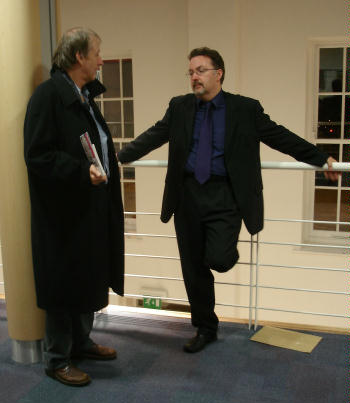 Mick Fealty practices being an amputee and nailed to a cross in preparation for discussions on Britain and Ireland Photo: Dale Amon, all rights reserved.
After returning from a few free drinks at an opening, care of a new venture of Slugger O’Toole (News and photos at 11… er tomorrow) I have returned and done some random reading. I highly suggest these two lampoons, another alternate history report set in 1944 from Rand Simberg and the Attack of the Blog by Iowahawk.
Enjoy!
The last of the Lockheed-Martin Titan rockets, after months of slow preparation, is finally up and away from Vandenberg. The blacksat on board was considered quite important and Lockheed used their clout as the launch contractor to kick fledgling rocket company SpaceX out of Vandenberg and away from the pad in which owner Elon Musk had invested millions of his own dollars.
Now that LockMart’s big launch is away they will not have the power to continue their underhanded operations against potentially cheaper competition. A number of folk have told me that Elon’s burn rate has been such that he is no longer quite a billionaire. As the adage goes, the way to make a small fortune in aerospace is to start out with a large one. Nonetheless, Elon is not letting the bastards (at Lockmart) get him down. I believe he has his next test coming up in November on Kwajalein, and the USAF is reportedly quite positive about working with him.
Except when LockMart throws a hissy fit…
 Elon Musk speaking at the National Space Society’s 2005 International Space Development Conference in Washington, DC. Photo: Dale Amon, all rights reserved
Here are the latest statistics on crime in Britain. Police statistics, according to this BBC report, show that violent crimes have gone up, while another survey shows that violent crimes are broadly stable. (The usual health warnings about statistics obviously apply). However you look at it, crime is high.
Regardless of what one thinks about the potentially civil libertarian worries about millions of CCTV cameras now scattered around the country, it hardly appears that they are very useful in deterring crime, which as far as I know, was the stated purpose for the things.
Heather “Momma Bear”, who has been an important figure in the early stages of the blog world, has died after a long battle against cancer. She has been a friend to a number of bloggers I know well, including fellow Pimlicoan Andrew Ian Dodge. She was quite a character. RIP.
Yesterday I got into conversation with two sibling members of my family, both of whom are opposed to the US invasion/liberation of Iraq. One is (approximately) an environmentalist, the other is (precisely speaking) a UKIPper, but both are agreed in opposing the war and Britain’s involvement in it. I am cautiously and pessimistically supportive, but am not sure. I hope Mark Steyn is right about it, but fear that he may not be.
Anyway, an hypothesis about the state of US public opinion surfaced, as interesting hypotheses will when people who disagree, and who hence bring varied ideas and attitudes to the table, but who wish to remain civil with one another, as I and my siblings do.
For the last few years, the Left in the USA has been saying: It’s all about oil, it’s all about oil. Now for many Americans, and for most people outside America, fighting a war for mere oil is evil. But what if lots of Americans hear that this war is all about oil, and are pleased? But what if the dime has now finally dropped that actually this war is NOT all about oil?
Could that be what Middle America is getting nervous about? For as long as they were convinced that it was all about oil, they were content. That is our kind of war. Simple, limited, clear, selfish. All the things you want, and not like Vietnam at all. But now that it is dawning on them that this really is about “democracy” and such like, for that exact reason they are getting fidgety. Will it be worth it? When will it end? Where will it end? etc.
It would be entertaining to think that the American Left have been the most energetic de facto supporters of President Bush because of what they regarded as their fiercest criticism of him, but that now that the Left is being defeated in the argument about the true nature and true purpose of the war by the war’s most energetic supporters, support for that war is, as a direct result, eroding.
One should probably not be looking for entertainment in such serious things, but, entertainment aside, is this not a rather interesting way of looking at it? I am sure that this theory does not apply to all American supporters or ex-supporters of the war. But to some, maybe?
No links in this I am afraid. I do not recall hearing anyone else saying anything quite like this, although some surely have.
We may be wandering through a vast desert of stupidity, monstrosity and petty tyranny but never forget that there are some oases of sanity still to be found.
One of them will blossom into life next month when the Libertarian Alliance Conference opens in London. True to tradition, the Conference features an impressive array of brilliant speakers who will deliver their pearls of wisdom to an audience of the enlightened. It is bound to be a uplifting experience.
Book now and book with gusto. Your salvation may depend on it.
It seems a Japanese company has invented a human steering device. It is external, harmless and affects the sense of balance.
The article suggests uses in gaming where tweaking the balance system helps make immersive gaming more realistic. One must wonder: how much time will pass before the porn industry picks up on this?
There are darker uses I am sure you can easily imagine. A company is already studying the use of the ideas for crowd control by affecting their sense of balance. One can imagine implants to control gulag prisoners of future Stalin’s.
My dark crystal gets darker still from there.
It turns out that Daniel Craig, the latest man to play 007, might not be cut out of the sort of material that Ian Fleming might have imagined. The guy doesn’t even like the Bond-style martinis!
Never mind. Whatever happens to the series, we will always have the early Sean Connery films to treasure.
Bob Bidinotto is unimpressed.
The great irony is that the most fundamental right to individual sovereignty—private property—is the one most highly questioned. Property rights are usually construed narrowly to cover only things that can be exchanged, given away, or abandoned. But since a property right is the right to use and dispose of something, it actually has a far broader meaning. One begins with a right to one’s own person, including one’s body and energies. Indeed, this is that basic right that gives rise to the right to appropriate unowned objects from nature and to exchange peacefully acquired property with willing traders. In fact, without property rights there are no no rights at all.
From the Independent Institute.
|
Who Are We? The Samizdata people are a bunch of sinister and heavily armed globalist illuminati who seek to infect the entire world with the values of personal liberty and several property. Amongst our many crimes is a sense of humour and the intermittent use of British spelling.
We are also a varied group made up of social individualists, classical liberals, whigs, libertarians, extropians, futurists, ‘Porcupines’, Karl Popper fetishists, recovering neo-conservatives, crazed Ayn Rand worshipers, over-caffeinated Virginia Postrel devotees, witty Frédéric Bastiat wannabes, cypherpunks, minarchists, kritarchists and wild-eyed anarcho-capitalists from Britain, North America, Australia and Europe.
|





Recent Comments