We are developing the social individualist meta-context for the future. From the very serious to the extremely frivolous... lets see what is on the mind of the Samizdata people.
Samizdata, derived from Samizdat /n. - a system of clandestine publication of banned literature in the USSR [Russ.,= self-publishing house]
|
Our home grown authoritarians plan to inflict yet more absurd measures which have nothing to do with defending ourselves against terrorism. ID cards would not have stopped a single terrorist attack in the UK: they are a control measure designed to make taxing and regulating people’s economic activities easier, nothing more. Yet because there is a genuine threat from Islamic terrorists, the government keeps trying to conflate ID cards with ‘doing something about terrorism’. As it is so obviously untrue, this issue makes a rather good quick and easy litmus test to detect people who are either complete idiots or barefaced liars (or both).
Moreover the intend to make ‘glorifying terrorism’ illegal is not just bound to backfire, it is a terrible idea on every level. You would think people in the dismal halls of Westminster would have learned to leave well enough alone given the comical absurdity of past attempts to ban terrorists saying things in the UK, which lead to such farcical situations as having Sinn Fein/IRA’s Gerry Adams’ voice being dubbed by other people’s voices to get around attempts to stop him airing his views. We need people to actually say what they think and the more vile they are, the more important it is to hear what motivates them.
Moreover does anyone seriously think people are attracted to actively support terrorism because of what they read in a mainstream newspaper rather than opinions closer to their every day life? It is a bit more complex than that and again you would think the experience of Ulster would have shown that when terrorists gain the support of a section of a society, all stoping their spokesmen from talking in the media does is prevent everyone else from understanding what they really think.
The BBC and mainstream media generally has followed the government line that there is a large pool of moderate Muslim opinion which does not support or sympathise with radical and intolerant Islamic views. I too have assumed this to be the case, at least in some measure, and yet as time goes by the theory is starting to look rather threadbare as if there really is a majority of moderates out there, they are more than just silent, they are almost invisible. The organisers of the demonstration yesterday in Trafalgar Square carefully choreographed the event to show the world a moderate face of muslim opinion standing hand in hand with a few dhimmis like Ken Livingston and select useful idiots such as Pax Christi and former KGB front man Bruce Kent. Yet it took less than 24 hours for one of the people behind the demo to reveal his true colours.
But any attempt to shut these people up with the law will not stop them saying whatever they want amongst their own community, unless the government plans to have multi-lingual spies reporting on what gets said in every single mosque and Arabic/Turkish/Kurdish/Pakistani social club in Britain. The only people who will no longer know what these guys really think will be the rest of us. And given that anyone who trusts the what the state says to decide who is and is not ‘the bad guys’ is a credulous fool, that is not a good idea to say the least. Yet again we see why freedom of expression is not just important, it is essential if we are to know our enemies as well as our friends.
Thanks to modern safety improvements, motor racing is not quite as dangerous as it used to be – although it probably still takes nerves of steel to hurtle around a circuit in a modern F1 car – but if there is a sport that for me demonstrates sporting bravery at its most extreme, it has to be the downhill skiing and bob-sleigh events I am currently watching at the Winter Olympics near Turin.
Being only a moderately competent skier myself, I bow in awe when I see the pros hurtle down icy slopes at speeds touching 100 mph. Wow.
“As an old Sci-Fi fan, I firmly believe that we will encounter alien races someday. These conversations are good practice. I would imagine there will really be some different worldviews when that happens, esp. if they’re hydrogen breathers.”
Comment by regular Samizdata contributor calling himself VeryRetired, who describes what it feels like to debate with apologists for radical Islam: ie, the sheer inability to bridge a gulf of understanding between those who support the open society, free speech and enquiry, and those for whom the statements contained in a book written over a thousand years ago contain the sum total of wisdom, the criticism of which should be dealt with violently.
I certainly do tend to think that understanding of how to cope with radical Islam can be usefully supplemented by reading Robert A. Heinlein, say, or Vernor Vinge rather than the editorial pages of the Guardian or the Daily Telegraph.
The demonstration in Trafalgar square, supported by dhimmi-in-chief for London Ken Livingston, was clearly orchestrated to show a homogenised face of ‘moderate Islam’ for the world to see. An interesting feature of the demo was that no ‘home made placards’ were tolerated by the organisers. A small group of Kurds turned up with their own signs and were fairly quickly handed the printed blue-white official signs. I was not quick enough to get a picture of the Kurdish ones before they vanished as I did not expect them to be taken down, but the ones in English were fairly anodyne.
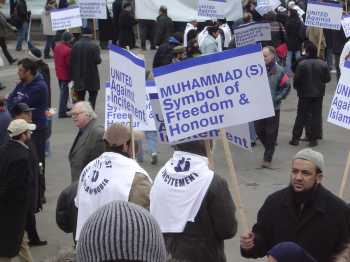
Not even in Islamic green! I would guess maybe 7,000 people showed up, perhaps 10,000 tops, at least by the time I lost interest around 3:00 and wandered off to a nearby computer faire. Many of the usual suspects were there, such as the inevitable socialist workers and CND set…
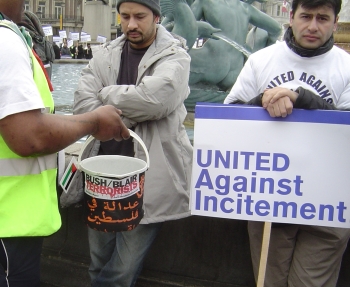
Quite what wicked old Blair and BushMcHitler have to do with protesting against cartoons of Mohammed in Denmark was not clear
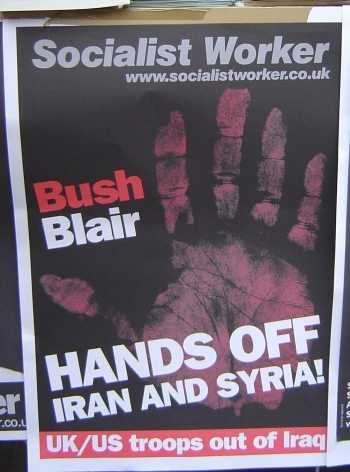
Hands off secular fascist police states and theocratic police states!
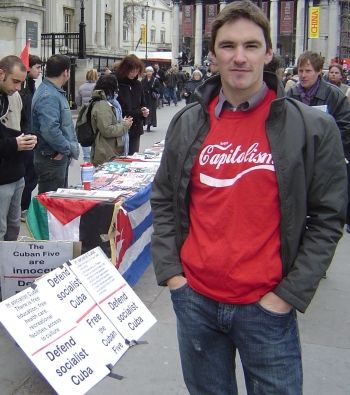
You can be sure those naughty cartoons (or that tee-shirt) would not have been allowed in Cuba! The large official signs were clearly expensive high quality creations and contained all manner of utterly irrelevant slogans designed to appeal to the ‘hard of thinking’.
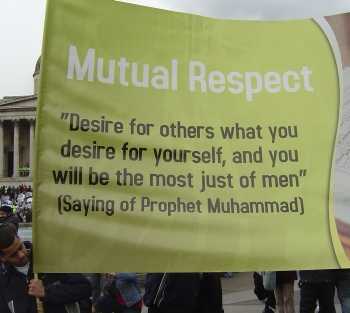
So if some Muslim desires sharia law for themselves, presumably this is what he also wishes for me… Oh I feel much better now!
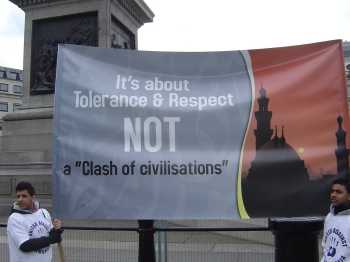
Tolerance? Sure, it is yours by right. Respect? You must be joking, that you have to earn
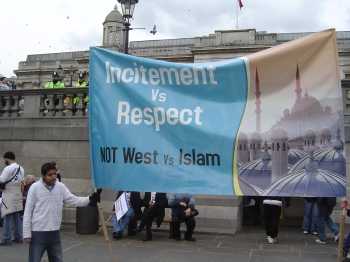
Jyllands-Posten did not ‘incite’ to violence, they just defended free expression, unlike some others we know of. Respect however has nothing to do with it
And just to remind people what this is really about…
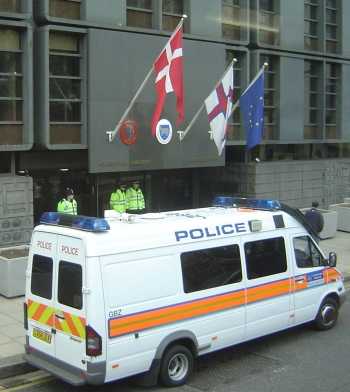
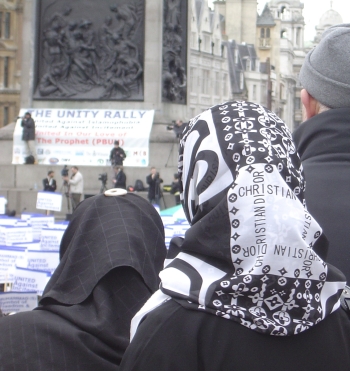
The Danish embassy in London under police guard And one final picture which tickled my sense of irony… a pleasant looking young woman watching the demonstration in her stylish Christian Dior scarf.
Seeing as Perry is dabbling in the kingdom of Animalia, I feel I should wade in with my own weighty observations. As it is summer in Australia, cockroaches are making their presence felt in even the most salubrious of households. This must be so – I live in a shared-house dump and they are everywhere.
Tonight, as I was in the shower, I noticed three large brown cockroaches (not the more numerous but less offensive small types) scurrying about the bathroom. This convinced me to abandon my do-not-kill-if-not-necessary morals and I thus plunged the three big brown blighters into the tiles with a – erm – plunger. You know – that rubber implement you use to unblock the drains. Well, it was the first thing that fell to hand. Anyway, this did the trick and happily broke the cockroaches perfectly in half. Fine – let them dry out a bit, sweep them up in a few days and be done with it. I am a student living in a shared house; cut me some slack.
I leave the bathroom after performing my twice-daily cleansing rituals – it is summer in Australia, after all – to attend to this and that. I return two and a half hours later to find the upper part of each cockroach still wiggling its (remaining) legs lamely; unsurprisingly, for it’s stuck on its back and missing half a body. The lower part – sadly disconnected from the mothership – was not returning calls.
Am I the only one who thinks this an amazing natural phenomenon?
So if hippophobia is a morbid fear of horses… what would a morbid fear of hippototamii be known as?
The European Union is making soothing clucking sounds to try and calm the outraged Muslim masses with plans of a ‘media code of conduct’ designed to prevent a repeat of the Jyllands-Posten incident with the ‘Satanic Cartoons’.
EU Justice and Security Commissioner Franco Frattini said the charter would encourage the media to show “prudence” when covering religion.
“The press will give the Muslim world the message: We are aware of the consequences of exercising the right of free expression,” he told the newspaper. “We can and we are ready to self-regulate that right.”
Who is this “we”? Does Frattini think he is speaking for the British and European on-line community? If so then perhaps I can spell out the “consequences of exercising the right of free expression” that “we” are aware of… it makes us free, that is the consequence of free expression. Are “we” clear now? These non-enforcible guidelines are just a worthless sop to people who need to be confronted, not treated as though they have a legitimate argument.
And yet later he seems to take a strangely different stance…
The chairman of World Islamic Call Society, Mohamed Ahmed Sherif told a press conference in Brussels on Thursday (9 February) that the cartoons of Mohammed published first in Danish daily Jyllands-Posten, fuelled extremism.
“Nobody should blame the muslims if they are unhappy about the images of the prophet Mohammed,” Sherif said coming out from a meeting with EU justice commissioner Franco Frattini in Brussels. “It’s forbidden to create a hate programme to show that the prophet is a terrorist while he’s not,” he stated, “Don’t ask us to try to make people understand that this is not a campaign of hate.”
EU justice commissioner Franco Frattini repeatedly nodded and mumbled “yes” in front of cameras and microphones during Mr Sherif’s statement.
Mr Frattini also denied wanting to create a code of conduct for journalists reporting on religious matters, as indicated by earlier media reports.
“There have never been, nor will there be any plans by the European Commission to have some sort of EU regulation, nor is there any legal basis for doing so,” the commissioner stated.
So in the space of two days, Frattini seems to have done a U-turn and stated his commitment to freedom of expression whilst simultaneously looking like an appeaser. That takes some doing!
Let’s hear it for ‘nuanced’ European diplomacy! 
A Danish blogger and columnist, Henrik Føhns, alerted me to a post on his blog, Mondofunza about a letter to ‘Muslim citizens’…
A letter from Another Denmark
Dear Muslim citizens in Denmark and the World
I wish to state the existence of another Denmark: A Denmark that wants to live in peace with the Muslim world. There is another Denmark, which hopes for and believes in respect and tolerance between religions and different groups of people.
As a Dane I have no responsibility for what a single and privately owned Danish newspaper chooses to publish. Even so, I strongly condemn the actions of Jyllands-Posten that have offended muslims around the world, and I understand the need for an apology from the newspaper.
We all have a responsibility for treating each other, our religious faiths, and
convictions with dignity and respect. By publishing the caricatures of Muhammad, the newspaper Jyllands-Posten failed their obligation to exercise with care and consideration the right of freedom of speech.
I condemn all kinds of discrimination, prejudice and racism, whether it is directed against Muslims, Jews, Christians or other groups in a society. Therefore, I reject the hostile and prejudicial way of speaking that has marked several Danish,political parties and media within recent years.
I want to make a request to all parts involved, that opinions and protests may be conducted in a respectful and peaceful manner. Attacks on and threats against individuals and assets only make the situation worse for all of us.
I believe in a world, where religions, ethnic groups and various political and cultural opinions can coexist in an atmosphere of dialogue, tolerance and mutual respect.
I wish to state the existence of Another Denmark that conceives itself as a part of such a heterogenous world and humanity. In the sincere hope of international tolerance and respect.
Despite some agonising, Henrik’s response is unequivocal:
I have not signed the letter and do not intend to do so. I too want to live in peace with the muslim world, but I want to live by terms set by a modern democratic society. Not by rules set by autocratic, fundamentalistic, religious regimes. The outrage about the Danish cartoons have other roots than the cartoons themselves. The cartoons and Denmark have just become scapegoats for social and political disorder in the Middle East…
… I have nothing against christianity, islam or other religions. But when they start to preach and act against basic human rights – count me out.
Note: Also, Happy Birthday, Henrik!
Sir Freddie Laker, the man who took on the nationalised airlines in the 1970s with his cheap “Skytrain” airline, only to go bust, has died at the age of 83, according to this report. Laker was, despite the failure of his venture, a hugely influential figure in the airline industry by daring to suggest that flight need not be the preserve of the wealthy. He laid down the model to be copied by the likes of Southwest, Easyjet and Ryanair. His tough business battle with BA also inspired Sir Richard Branson to have a crack at the privatised national carrier’s transatlantic business.
The economics of airlines has fascinated me, not least because as a business it has attracted some of the largest egos and some of the few remaining examples of buccaneering entrepreneur. Perhaps that is why we like them or even if we don’t, find them fascinating. They stand out from the grey suits. None more so than Sir Freddie.
On the subject of cheap airlines and their globalising impact, here is an excellent piece from a year ago by Matt Welch in Reason magazine.
Governments are not know for being truthful, but it would seem sensible to tell lies that have a reasonable probability of being believed – and I do not agree that the “biggest lies are the most likely to be believed” (at least if by ‘biggest’ we mean thing that are most obviously false).
However, the British government seems to have adopted a policy of telling obvious lies. In the last few days alone we had (for example) the claim that “violent crime has fallen by 23%”. This was duly reported by the Independent newspaper (a newspaper that hates the current government, but hates truth even more – and so was glad to support the claim). This was brought out in support of the government policy of allowing “24 hour drinking”, I am not much interested in the policy (other than like so much ‘deregulation’ it has turned out to mean a lot more form filling and other such), but the claim of vast drop in violent crime was obvious nonsense.
If the government had said “contrary to people’s believe that violent crime is rising, it is actually saying much the same” that might well still have been telling lies (as violent crime is, most likely, on the up) but they would have been more likely to be believed.
But to say a “23% drop in violent crime”? They might as well have said a 123%.
Then there was the recent launch of a new navy destroyer – “The most powerful ship built since World War II”… actually it is an extremely expensive (£1 billion pound) grossly under-armed ship (part of the government’s ‘buy European’ policy – a policy exposed by Christopher Booker and Richard North). But why say “most powerful ship built since World War II” – an obvious lie even to people who nothing of Booker or North?
Lastly we had yet more claims of super educated school children “the best ever” – almost needless to say the Universities (hardly strongholds of free market people) reported today that the students they are getting are as ignorant as sin.
What is the reason for all these wild lies?
This item from America’s satirical Onion site is too funny for words. Would advocates of “intelligent design” get the joke?
The Danish media has taken note of the Buy Danish campaigns that have sprung up spontaneously over the least week or so in response to the boycott from Islamic countries. Danes seem to be quite willing to stoutly resist the pressure to limit free speech but it is important they realise that millions of people worldwide are urging them to stand firm and so although buying Danish goods or putting a supportive graphic on your site may be a token, it is by no means pointless. Below is a translation of an article in Børsen.
Buy Danish campaigns in large markets like the USA and Germany might give Danish companies enough increased turnover to cover the losses from the Arabian boycotts.
Companies like Arla, Lego, and Carlsberg believe in increased sales when they check their books next time, and Dominique Bouchet, professor in marketing and sociology at the University of Southern Denmark also expects a plus.
“It just might give a good effect. Normally there is a greater effect the other way around, when you signal disgust and irritation through a boycott. But the present situation is completely unusual, and many dislikes the Muslim boycott and the extremists reactions to the drawings. It is expressed through the buying of Danish goods”, says Dominique Bouchet.
He emphasises that there has never been comparable situations, so it is difficult to predict how large the effect will become.
Denmark is, as most people are aware, caught in the middle of a Middle Eastern sandwich, where the hateful reactions to the Prophet drawings have become so extreme that the crisis is going straight on to front pages in media around the world.
This releases a counter expression via buy Danish campaigns, where the customers are encouraged to buy Danish goods to support Denmark in the conflict. A simple search on Google gives more than 100.000 “buy Danish” pages.”
With thanks to Kristina for the translation.
|
Who Are We? The Samizdata people are a bunch of sinister and heavily armed globalist illuminati who seek to infect the entire world with the values of personal liberty and several property. Amongst our many crimes is a sense of humour and the intermittent use of British spelling.
We are also a varied group made up of social individualists, classical liberals, whigs, libertarians, extropians, futurists, ‘Porcupines’, Karl Popper fetishists, recovering neo-conservatives, crazed Ayn Rand worshipers, over-caffeinated Virginia Postrel devotees, witty Frédéric Bastiat wannabes, cypherpunks, minarchists, kritarchists and wild-eyed anarcho-capitalists from Britain, North America, Australia and Europe.
|






Recent Comments