We are developing the social individualist meta-context for the future. From the very serious to the extremely frivolous... lets see what is on the mind of the Samizdata people.
Samizdata, derived from Samizdat /n. - a system of clandestine publication of banned literature in the USSR [Russ.,= self-publishing house]
|
Writing on the CNE Competition Blog, my co-Samizdatista Brian Micklethwait responded to my post on the present anti-trust investigation of British Airways, by in response to a mention on my part of “landing fees”, bringing up the question of whether there should be a free market in airport landing slots. Brian clearly has in mind something like an airport charging a fee for aircraft to land that is driven by demand, and setting it at a point such that the supply and demand curves meet, and thus allocating airport capacity using market pricing signals.
While I agree completely that this would be the optimal way of allocating airport capacity, things are never going to work like this. In aviation industry terms, I didn’t mention the question of landing slots at all. I mentioned “landing charges”. Slots are seen as something else. Even when people talk about a free market in landing slots, they still aren’t talking about landing charges specifically. Landing rights, landing slots, and landing fees are all separate from one another, and it wouldn’t occur to many or most people in the aviation industry that they are connected. The situation is an awful mess, and if it is ever going to be untangled, it is necessary to understand it.
For this reason, I am going to attempt to explain it. This is going to be rather nerdy. If Transport Blog still existed, it would be a fine post for that blog. However, it does not, so I will do it here. → Continue reading: The situation is even less simple than you think
Want to see Tony Blair getting a political kick in the cobblers?
Sweet. Agree or disagree, it is nice to see some political hardball. UKIP thrive on such confrontations. It is hard to imagine the pointless milksops of the ‘Conservative’ Party getting stuck in like that.
Logic has made me hated by the world
– Abelard of Le Pallet
Football, whether you love it or loathe it, is now a huge global business. It stands to reason, then, that the temptations on the part of some folk to bend the rules to make themselves rich are considerable. There are currently extremely serious allegations surrounding a number of big-name Italian clubs, including AC Milan and Juventus, to the effect that officials and others collaborated to fix games. And all this while the game’s main showcase, the World Cup, is going on.
And then there is this story today:
Juventus team manager and former defender Gianluca Pessotto has been seriously injured after falling from a building at the club’s headquarters.
“Gianluca suffered multiple fractures, but his life is not in danger,” said Juventus spokesman Marco Girotto. It is unclear where exactly the 35-year-old fell from – early reports suggested he had fallen out of a second-floor window, but now it seems he may have fallen from the roof of the building. Club officials said they were unable to give details and were looking into all possibilities.
Oh I bet they are. Consider the final paragraph of the story:
Juventus are currently facing charges relating to the massive match-fixing scandal rocking Italy. The scandal began last month with the publication of intecepted telephone conversations between former Juventus general manager Luciano Moggi and Italian Football Federation officials discussing refereeing appointments.
Italian clubs are now a major part of the corporate structure of that country. Questions about the trustworthiness of Italian corporate leaders have already been stirred by the scandal of collapsed food group Parmalat, a scandal that was a European equivalent of Enron or the Fannie Mae debacles.
Football needs trust to survive. The antics of players who writhe in fake agony after being tackled in a bid to get an opposing player sent off, or who fall over in the penalty area to get a goal (Italy arguably did this in the match yesterday against Australia) are part of a cancer eating at the game. I can put up with the antics of footballers off the pitch and I do not get upset at their huge salaries – they operate in a market after all – but without trust, without a sense that the players concerned are giving their all to win, then the game is in grave danger. Similar scandals have besmirched cricket and remain a shadow over horse racing. I hope the Italian authorities prosecute any guilty folk severely. If found guilty, some of the clubs could be relegated from the top-flight league and forced to sell some of their star players, presumably at a loss (I wonder if Ipswich Town can afford any of them?).
What a mess.
When someone denies the essential historical facts about the Jewish Holocaust, here at Samizdata what that means is you get moved into the category of presumed paleo-fascists or racist Jew-haters with whom intelligent discourse is highly unlikely to be possible.
Even so, when such remarks arrive in our comment section, that alone is (usually) not enough to get you immediately banned from commenting here. Opinions offered by members of the commentariat which are very much at odds with the world view propounded here by Sazmizdata’s authors are hardly rare and even more rarely constitute a ‘hanging offence’ (i.e. banning). No, what tends to get people banned is when they make (and keep making) assertions so preposterous that they are almost certainly not made in good faith.
For an example, take when someone makes obviously fantastical assertions to explain why Iran’s President Mahmoud Ahmadinejad ‘has a case’ when he denies lavishly documented historical facts of what occurred more than half a century ago in Central Europe, claiming he is not simply a racist Jew-hater (i.e. hates Jews for being Jews) but is rather just ‘anti-Zionist’ (i.e. opposes a political movement):
Iran’s President Mahmoud Ahmadinejad has a case for querying the Holocaust. His argument is that Nazi Germany simply didn’t have the facility and technology to dispose of some six million corpses (or whatever it was) within the assumed time frame. Therefore, the authorized version, while not entirely a fiction, was a huge exaggeration.
So let me get this straight, the claim here is that Mahmoud Ahmadinejad ‘has a case’, i.e. he is not a liar and/or a complete jackass if he thinks that Nazi Germany, a nation which produced and operated tens of thousands of combat aircraft, fielded the world’s first operational jet fighters, built and deployed the world’s first effective guided missiles, glide bombs, and military supersonic ballistic missiles, installed tens of thousands of concrete fortifications and shelters, placed hundreds of thousands of concrete and metal anti-tank obstacles across Europe, surrounded its cities with great flak batteries, laid thousands of kilometres of railtracks (re-gauging much of European Russia’s rail system!), had the logistic capacity to support millions of men equipt with vast fleets of motor vehicles in operational areas from North Africa to Norway and the French coast to the Urals, DID NOT HAVE THE FACILITIES OR TECHNOLOGY TO DISPOSE OF SIX MILLION DEAD BODIES OVER SEVERAL YEARS?
The notion is so absurd that I do not for a second think it could be said in good faith. That is what often gets a person banned from Samizdata.
So I need to try hard to make this particular grammatical error far fewer often. I must write “less” on less occasions, and “fewer” fewer infrequently. It’s the fewest I can do. But realising precisely when to use “less” and when to use “fewer” remains fewer than obvious to me. Personally I blame my primary school teachers. If they’d wasted fewer time teaching me gorgeous italic handwriting (which is fewer than usefewer in this digital age) then I might have picked up more of the key rules of grammar instead. But one can’t improve one’s English unfewer one’s mistakes are identified. That’s why I’ve been much too carefewer on countfewer occasions in the past. Sorry, it’s all been mindfewer thoughtfewerness on my part. Bfewer you all for pointing out my linguistic reckfewerness. I recognise now that my writing has been fewer than perfect, and I’ve learnt my feweron. But don’t expect less mistakes overnight. Quite frankly I still couldn’t care fewer.
– diamond geezer
The American standup comedian and actor Denis Leary has a wonderfully raucous sketch in his Lock n’ Load show when he loses his temper, unable to get someone, anyone, to serve him a regular, ordinary cup of coffee. You feel for the irascible Irish-American as the fella goes on his folorn search (he fails).
Coffee. I drink the stuff every day and there is no doubt that in my brief lifetime, it has gone from being the nasty stuff brewed from ‘instant’ granules in a jar to a massive industry boasting tremendous variety and choice. Companies like Coffee Republic and of course, Starbucks, have played a huge part in this. Sometimes the sheer headspinning variety of choices and the names of some coffees bring out the Denis Leary in me, but on the whole I have to accept that this choice has done a lot for the consumer. There is a fine article here by Edward Hudgins of the The Objectivist Center defending Starbucks and other chains from the chidings of our modern-day health scolds. There is also a fine and detailed article here via Reason magazine about the Fair Trade coffee movement. While fairly friendly to the Fair Trade outfits, the article, written by Kerry Howley, also raises some uncomfortable questions about just who wins or loses from the Fair Trade business model, and whether it is really simply about feel-good consumerism, benefiting poor farmers or just raising the quality of coffee. However, it is a paradox that the Fair Trade model has become a hugely successful business phenomenon. The FT brand is ironically, pitched at precisely the sort of folk who might claim to despise brands generally, writes Howley, in a passage reminiscent of David Brook’s work, Bobos in Paradise:
“The hippie spilling buckets of ake blood may never break bread (or sip coffee with straight-laced businessmen talking quality, but the consumer has little to lose from a synthesis of strong words and strong lattes. Another Starbucks, a better coffee, a calmer conscience: What caffeine fiend can argue?”
Related thoughts here.
European steel giant Arcelor looks as if it is going to be bought by the Indian Mittal family company. If the ink is allowed to dry on this deal, it will create the world’s biggest steelmaker and do so at a time when metal prices have been rising strongly, as have pretty much most other commodities.
That India’s economy has been on the rise is pretty much a part of the received economic wisdom these days. What is clear, though, is that country is a lot more than about lots of call centres. It is becoming a breeding ground for a whole crop of entrepreneurs able and willing to take on the biggest businesses in the established industrial world and where necessary, put a few noses out of joint in the process.
You know that this will result in less safety for the child, greater tyranny from ‘experts’ interfering in family life for any number of arbitrary reasons relating to targets ‘not met’ and could present the death-knell for home-schooling:
Changes being introduced since Victoria Climbie’s death from abuse include a £224 million database tracking all 12 million children in England and Wales from birth. The Government expects the programme to be operating within two years.
But critics say the electronic files will undermine family privacy and destroy the confidentiality of medical, social work and legal records.
Doctors, schools and the police will have to alert the database to a wide range of “concerns”. Two warning flags on a child’s record could start an investigation.
There will also be a system of targets and performance indicators for children’s development. Children’s services have been told to work together to make sure that targets are met.
This is the age of the database and the state loves them. Why does it love them? Because it reverses the roles of ruler and ruled in all matters. Dr. Eileen Munro of the London school of Economics begins to understand:
“They include consuming five portions of fruit and veg a day, which I am baffled how they will measure,” she said. “The country is moving from ‘parents are free to bring children up as they think best as long as they are not abusive or neglectful’ to a more coercive ‘parents must bring children up to conform to the state’s views of what is best’.”
How long before our children wear electronic tags for security and the monitoring of best practice, attendance at a state recognised school, and ironing out the anarchy that we used to call ‘play’?
Such is the changing nature of that world and the ferocity of those forces, we need to adjust, to reclaim the system and thereby the street for the law-abiding majority.
That means not disrespecting civil liberties but re-assessing what respect for them means today and placing a far higher priority, in what is a conflict of rights, on the rights of those who keep the law rather than break it.
This is not the argument of the lynch mob or of people who are indifferent to convicting the innocent, it is simply a reasonable and rational response to a problem that is as much one of modernity as of liberty. But such a solution will not happen without a radical change in political and legal culture and that is the case I make today.
– Tony Blair MP, June 23 2006
As ever, the pretext is “modernity”… odd how that trope of Marxian theory crops up all the time. Things have changed, we are told. Rebalancing is imposed upon us by the sudden new wickedness of the world.
But read this in the context of other recent statements by Blair and his coterie and you can see that the PM is propounding a double fallacy in order to persuade us make a great leap backward. Ossa is the false dilemma between victim’s rights and suspects’ liberties; Pelion is the great mandarin standby, seeking ‘a balance’ – conceptualised as some mid-point between where we are now and the far extreme in the direction of the proposed policy. The Olympus the New Labour titans would storm is the fundamental western concept of trial. → Continue reading: Forward into the 14th century!
President Bush, a man I have never had much affection for and about whom I have very few good things to say, has just struck a blow for the good guys of the issue of eminent domain abuse (UK= compulsory purchase) by signing an executive order that the US federal government can only seize private property for public use and not in order to turn it over to private property developers.
Although the vast majority of property seized in the United State is does by state and local authorities, this is nevertheless a very welcome development indeed and a definite move in the right direction.
Last night in Chelsea, Samizdatistas from around the globe gathered at Samizdata HQ for some of Perry’s famous chilli con Chelsea, his ‘secret recipe’ cheesecake, and plenty of wine from Stormhoek and other fine producers.
 The hostess with the mostess
 Funny, I always imagined that Perry was completely oblivious to any sport which did not involve firearms
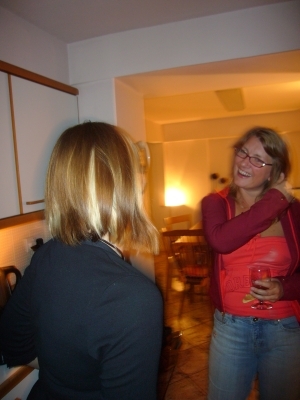 The newest Samizdatista, Hillary Johnson (visiting London from Los Angeles), was the guest of honour
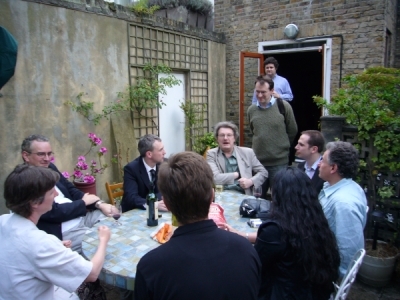 So this is what a group of bloodthirsty free marketeers looks like…
 Take me drunk, I’m home!
A fantastic time was had by all, and there are more photos from the party on Flickr.
|
Who Are We? The Samizdata people are a bunch of sinister and heavily armed globalist illuminati who seek to infect the entire world with the values of personal liberty and several property. Amongst our many crimes is a sense of humour and the intermittent use of British spelling.
We are also a varied group made up of social individualists, classical liberals, whigs, libertarians, extropians, futurists, ‘Porcupines’, Karl Popper fetishists, recovering neo-conservatives, crazed Ayn Rand worshipers, over-caffeinated Virginia Postrel devotees, witty Frédéric Bastiat wannabes, cypherpunks, minarchists, kritarchists and wild-eyed anarcho-capitalists from Britain, North America, Australia and Europe.
|







Recent Comments