We are developing the social individualist meta-context for the future. From the very serious to the extremely frivolous... lets see what is on the mind of the Samizdata people.
Samizdata, derived from Samizdat /n. - a system of clandestine publication of banned literature in the USSR [Russ.,= self-publishing house]
|
Some time ago, Michael Jennings of this parish caused a stir by suggesting a way of subverting the leftist intent of the staff who decide what sort of books they recommend to customers at Britain’s high street bookstores. While strictly against the rules of property, I totally sympathised with Michael’s intent and his annoyance that the bookstore seemed to be run this way.
It has not got any better in the bookshop world, as far as I can tell (at least not in Britain. Things may be different elsewhere). Earlier this week I spent a quick lunchbreak wandering around the nearby Books Etc. store in Holborn High Street. After browsing through a fairly sparsely-stocked crime and general fiction section, I took a peek at the current affairs and history section. The history bit was okay, if not particularly impressive. But the current affairs section was in a different class. It might have been stocked by the sort of folk who write for the Democratic Underground or who think Michael Moore is a sort of latter-day saint. Books by Chomsky, Gore Vidal, John Gray (a pet hate of mine); Michael Moore, of course; then various authors I have not heard of before but the titles give the general gist: “George W. Bush and the Arrogance of Power”; Why Do People Hate America?”, and blah, blah, blah. Apart from one slim volume by noted scholar of Islam Bernard Lewis, it was a total washout.
Now what is going on here? Clearly, the folk who decide what books to sell and what books to publish presumably want to make money. I tentatively offer a few explanations: the impact of higher education and direct bias from bookstore staff. Dealing with the latter point first, I have found, while chatting to the folk who work in the stores, that most tilt to the statist left. Maybe they directly get to decide what is put up in certain parts of the store. With popular fiction, they have to stock Harry Potter and Nick Hornby like everyone else, but when it comes to politics, they get freer rein. That is my take anyhow.
But I also believe higher education has an effect on all this. The serious, non-fiction parts of bookstores cater for a perceived ‘high-brow’ market. Given that humanities departments, such as political and history ones, tend to tilt to the left in my experience, it follows that the main market for such books will tend to shift the same way. There is not – yet – a big market for non-fiction with a clear libertarian and conservative leaning.
In the Internet Age, of course, this may not matter so much. But as a bibliophile it bugs me to see the biggest high street bookshops stocking so much crud.
We have been following the British government’s treatment of the armed forces for some time, when we got hold of some important information…
A document was found in a briefcase left outside Samizdata HQ. We would like to offer it back to the MOD (Ministry of Defence) but in the meantime we publish it for all to see…We believe it offers the key to understanding the thinking behind the government’s recent defence cuts rationalisation of the Armed forces to produce a more efficient, effective and capable military….
Download file: STAFF GUIDANCE ON DEFENCE RESTRUCTURING
We have already been alerted to a website Preparing for Emergencies that, for some strage reason, the statists want dismantled immediately.
It is remarkably similar in domain name and style to the timewasting “offishal” preparingforemergencies.org.uk. Be quick to check it out as its death sentence has alreday been pronounced on Radio 4… They are not amused.
Thanks to Tony Millard for the link.
Britain’s government has a website telling us all manner of splendid things about how we are protected by the state now that we have David Blunkett watching over us… and what we should do in the event of a spot of bother happening when Blunkett is off on a tea break.
Yet it seems a more, well, candid version of this site has also helpfully been made available to us by our political masters.
(with thanks to the eagle-eyed Guy Herbert for spotting this)
Whenever we touch on the issue of state controlled health system versus private healthcare, we get a smattering of outraged readers who cannot understand why we attack that venerable (in their eyes, not ours) dinosaur, the NHS. It’s free and for everybody they screech, you heartless capitalists… would you let your parents/grandparents/children die without treatment and care, if they couldn’t afford to go private?!.
The fact is that those I care about are more likely to be in need of treatment and care, as a result of coming into contact with the NHS. I want them to stay away from the NHS, and the government to give them back their money taken to support the giant leech known as national healthcare.
Many people are now frightened that they could pick up a dangerous infection if they go into hospital. It is hardly surprising. More and more of us know someone who has been infected with the superbug, MRSA (methicillin resistant Staphylococcus aureus). Marjorie Evans has been infected with it on eight occasions at the same hospital in Swansea. Now wheelchair-bound as a result, she says: “I’d rather go abroad and trust foreigners.”
As James Bartholomew writes in the Telegraph opinion section one is vastly safer in a private hospital and the danger of getting MRSA is a risk affecting patients of the NHS.
The NHS both is the most state-controlled hospital system in the advanced world and has the worst record in Europe. At a practical level, it is because of things like ministers driving hospitals at full capacity to reduce waiting lists, with the result that patients with MRSA cannot always be isolated.
But at a more profound level, the MRSA crisis is because the NHS is a state monopoly. Ministers are always making hospitals respond to the latest newspaper headlines rather than doing what is best in the overall interest of patients; hospital workers – like many employees of state industries – are demoralised and their pay rates are unresponsive, thus causing the local shortages. The state has also closed too many hospitals. The list of ways in which it has increased the risk is endless.
This is a result of the fundamental dynamics (or statics) of the public sector, not any lack of funding. There is no legitimate role for the state in healthcare, education and many other sectors that it appropriated for perpetration of what is so misleading called ‘public services’.
The dynamics of the private sector, meanwhile, are simpler and more effective. If you don’t treat your customers well, you go out of business.
Indeed, unless you take their money first and then help yourself to it…
If you are arrested, and the police take your DNA to run tests on it, and if the outcome of your arrest is either that no charges were brought against you or you were brought to trial and found innocent, it has been ruled that the state can retain your DNA records indefinitely regardless.
The moral of the story is, of course, that if you do not want the state to take your DNA and hold it on record forever because you simply do not trust the state or because you have the quaint notion that your body is your own property, then do whatever it takes to not get arrested, regardless of how confident you are that you can establish your innocence subsequently.
Lord Brown said the benefits of this procedure were so manifest and the objections so threadbare that the cause of human rights would be better served by expanding the police database rather than by reducing it.
Just as it has often been said that modern fascism is most likely to appear in the guise of anti-fascism, when some establishment figure like Lord Brown start taking about ‘human rights’ it is a fair bet that ‘human rights’ about to get trampled underfoot.
My guess is that it is only a matter of time before the police in some nations start taking samples of DNA from everyone, probably starting with all children under a programme with a name like ‘The Safe Children Act’ or something similar, probably with the ostensible reason of ‘protecting your child from kidnap by Paedophiles’ or some such drivel. I mean, after all, who could possibly object to that?
The state is not your friend.
As many will have read by now, the British government has made substantial cuts to parts of the country’s armed forces, such as disbanding Royal Air Force Squadrons, cutting frigates, and reducing headcount across the board. As I would have guessed, this has prompted a lot of criticism from various quarters and no doubt some, if not all of it, is justified.
However, rather than get into fine details of whether Defence Secretary Geoff Hoon is a strategic genius, sensible manager or weak fool (I report, you decide), I want to pose the question as to what sort of armed forces a libertarian-leaning government ought to have in place. (Use of mercenaries, perhaps?). Well, given that the first responsibility of any government is defence of the realm against attack, it is at least debateable whether an island nation like Britain requires, for example, a big army, an extensive airforce, or even a large navy with lots of aircraft carriers, and so on. So one could argue that the kind of armed forces envisaged by Blair’s government might be appropriate for one restricted to a self defence role. (In reality I expect commenters to point out the many flaws in these plans. Please do).
However what is obviously strange about the timing and nature of the cuts is that they come from a government not exactly shy of projecting force overseas for its liberal internationalist ends. For example, at times Blair’s position on Iraq has been more to do with overthrowing thuggish regimes that attract his scorn rather than do so on the basis of Britain’s long-term self defence needs. Such a view surely requires rather a big army, navy and air force. It also makes me wonder whether Britain any more has the ability to act as an independent military power in any meaningful sense. I doubt it. A friend of mine who has recently left the RAF says it is almost unthinkable that a Falkland Islands operation would be possible with today’s force levels. Others I know who have served in the military tell me the same thing.
There is also, one final long-term worry that I have. These cuts will further deter bright and capable young men and women from seeking a career in our forces, which require ever-higher levels of technical know-how while also drawing on the permanent need for courage and endurance. The message from these defence cuts is hardly going to get young folk to think about a career. I dreamed once of following my father into the RAF as a flyer. Now I am glad I did not. A shame. I’d have looked pretty nifty in that flying suit.
Monday night, I and Samizdata editors Perry de Havilland and Adriana Cronin-Lukas went to the House of Commons in London for the launch of the Hansard Society’s new report on blogging. Pointing out what is wrong with the report will be tackled soon enough, but the overall message of the night is what really got to me – and not in a good way.
The launch was being held in Westminster Hall, where the Hansard Society has set up an exhibition called House to Home: Bringing Parliament and people together. The first thing about this exhibition – after the huge plasma screens showing shots from parliamentary debates and self-conscious, empty elements like stacks of chairs hanging suspended from the ceiling – that caught my attention was the large banner telling us that “Politics matters”. Not only that, but that “Politics shapes us as a society”.
You can imagine how we each reacted to that supposed axiom from the Hansard Society, the “independent, non-partisan educational charity”…whose exhibition just happened to be sponsored in part by the government’s Department for Constitutional Affairs and the Electoral Commission.
The information guide that accompanies the exhibition, copies of which were handed out to everyone present at the launch, contains even more such gems. First, some good news:
If politics comes on the TV the first reaction of many of us is to switch over…'[O]fficial politics’, the formal meetings and speeches that happen in Parliament and in Downing Street, is fast becoming a minority interest: and this worries us.
Glad to hear it. But did you know that freedom of speech – along with freedom of religion and freedom to protest – is something we only have because of the government? According to the Hansard Society:
Over time, Parliament has reached out to represent more and more of the people of the country, through the extension of the right to vote, to the granting of freedoms of speech, protest, religious practice and free education.
Hmmm. Which one of these is not like the other? “Free” education is something to which each human being is entitled just by virtue of having been born, according to the “independent, non-partisan” Hansard Society’s government-sponsored exhibition. The “educational charity” also informs us that it was the benevolent Parliament that recognised this in law – and that it was the benevolent Parliament that granted us freedom of speech, to protest, and to practice religion. What is more:
[I]t is possible we could lend Parliament even more power to speak up for us.
The Hansard Society has also provided a handy guide to “How to have your say,” including tips on how to solve the vexing mystery of which constituency you live in. The guide advises us to decide which candidate and which party is most likely to speak up for what we believe in. But what if the answer is “none of the above”? Well:
If none of the parties speak for you, stand for election yourself.
Hey, that is helpful.
Finally, on page ten of this pamphlet, the Hansard Society comes clean:
This project is about changing a mindset.
Indeed. It is about telling people that it is imperative that we “get involved” in the political process – because, don’t you know, we would not have any rights if it were not for the government! And it is about freedom of expression being something that only politics can enable. As the Hansard Society puts it:
[W]e need to explore ways to allow politics to give us greater opportunities to express our views.
Because expressing one’s views can only come about through the good grace of politicians. The scary thing is, the government is taking our money to fund the “non-partisan, independent” Hansard Society’s efforts to spread this message. That is to say, British taxpayers are funding this “independent” propaganda machine.
Ah, well. It was a night for such things. Walking along Victoria Street from the House of Commons, Perry snapped a photo for me of one of my most loathed views in London – a government propaganda ticker that repeats the same message over and over: “London is getting safer…”

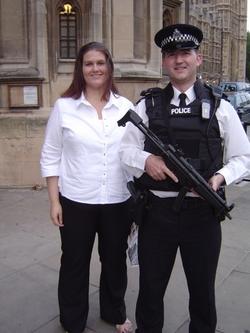
Still, the night was not all dispiriting. Leaving the House of Commons, I paused to admire a police guard’s impressive guns – two Glocks in the holster and a machine gun thingy (that is the technical name, I believe) in his hands. He was eager to show them off to me, and seemed happy to encounter someone who had respect for the weapons and his proficiency with them. It was enough to make a crunchy granola gun-control activist weep – which was more than enough to make me smile.
I swear I was not going to bash the Tories this week!
I was actually trawling the French news and looked forward to writing about some appalling corruption scandal. Well this [link in French] is close enough.
It seems that the European People’s Party (to which the British Conservatives belong) has done a deal with the European Socialist Party (to which the British Labour Party belongs) to ensure the election of a Socialist leader of the European Parliament: Josep Borrell Fontelles. In doing so they voted against the Polish former dissident Bronislav Geremek, who if this Communist denunciation is anything to go by, was obviously the right candidate to back.
So all the protestations that the Conservatives would defend British interests are a load of cobblers. These people are an insult to invertebrates.
It gets better, the French report says that the new President of the European Parliament (elected with the support of the European People’s Party) is a man who comes from the left-wing of the Spanish Socialist Party and who had to quit Spanish politics because of a series of unfortunate misunderstandings over large sums of stolen taxpayers’ money. I seem to recall that this was when the Governor of the Bank of Spain was filmed carrying suitcases of freshly printed bank notes to the Spanish Socialist Party Headquarters. The story was extensively covered at the time in El Mundo, the Spanish conservative daily newspaper. I forget if our new European Parliament President was personally involved (though the discreet shuffling of news reports suggests he may have been), but he certainly had to quit over that affair.
So the British Conservatives are fighting our corner within the European People’s Party? Nice one Michael Howard, I know exactly where we stand on the Conservative Party’s policy on Europe.
Support hard-core Socialists! Give fraudsters a second chance! Support even more European regulations and taxes! Vote Conservative!
Britain has been rocked this past week by shocking and totally unexpected revelations that have ripped apart the fabric of our national complacency and destablised our settled worldviews.
Prior to this week, it was an unquestioned given that the British National Party was an organisation that was fully committed, both in principle and practice, to multiculturalism and ethnic diversity.
But this article of faith has now been torn to shreds, thanks to the efforts of brave, crusading BBC reporter who went undercover to join the BNP and discovered (brace yourselves, please) that some BNP members are racist!!!!
The evidence he collected includes one BNP member, Steve Barkham, confessing to a violent assault on an Asian man, and a prospective election candidate admitting to a campaign of pushing dog excrement through the front door of an Asian takeaway.
I can hardly believe my own eyes and ears but I have to accept the terrible truth. We must be grateful to the BBC without whom we would all still be wallowing in ignorance and delusion. → Continue reading: You can take that to the bank
I have a confession to make.
In May 1990, I contested a local election as a Conservative candidate for Fortune Green Ward in the London Borough of Camden. Had I won, I would have been a Borough councillor representing about 4,500 electors as a Conservative politician.
It seems a Folkestone, Kent Conservative councillor also has some confessions to make.
He said his convictions included death by dangerous driving, indecent assault, drugs possession, carrying a weapon and forgery.
Richdale, an unemployed chef, confessed to using cannabis and amphetamines to control his alcoholic cravings, saying: “I am an alcoholic and I always will be but I haven’t had a drink for 11 years.”
He admitted having sex with a girl of 14 and said: “She told me she was 15 but she was 14. She stayed at mine (home) and I woke up to find her having sex with me.
“But I am not a sex case and I am not motivated by lust. I wish everyone was like me.”
Now I should point out that the lawful age of consent in England is 16, not 15 or 14. The language used by Councillor Robert Richdale in an interview to his local newspaper does not suggest the calibre of candidate that I would vote for. I also find the last two sentences of the quote completely at odds with any sense of personal responsibility. It never had occured to me before now that the closure of the Conservative Party’s youth sections over the past 15 years might be a good idea, as a way of preventing child abuse.
So next time a Conservative complains about the ‘loony’ ideas of libertarians I will not be thinking, perhaps we go a bit too far. The more I see them, the more I like my denunciation of “an unelectable shambles comprised largely of cretins, petty crooks, pompous buffoons and in-bred yahoos. I will take no lessons in morality or “coherent political philosophy” from a Tory.
And that is before I look at the deplorable results in the by-elections tonight, where the Conservatives have made no headway whatsoever against Labour in the Midlands. The Conservatives cannot get one fifth of the vote in a Birmingham constitutency and cannot remotely challenge in Leicester, a city where three out of four MPs were Conservative during the 1980s.
Over at the Social Affairs Unit, there is an interesting digital publication called Butler’s Dilemma: Lord Butler’s Inquiry and the Re-Assessment of Intelligence on Iraq’s Weapons of Mass Destruction, by Professor Anthony Glees and Dr Philip Davies.
Although the Butler Report comes out tomorrow, this interesting analysis actually explains the issues at hand. The first section is called The Whitewash Blues…
|
Who Are We? The Samizdata people are a bunch of sinister and heavily armed globalist illuminati who seek to infect the entire world with the values of personal liberty and several property. Amongst our many crimes is a sense of humour and the intermittent use of British spelling.
We are also a varied group made up of social individualists, classical liberals, whigs, libertarians, extropians, futurists, ‘Porcupines’, Karl Popper fetishists, recovering neo-conservatives, crazed Ayn Rand worshipers, over-caffeinated Virginia Postrel devotees, witty Frédéric Bastiat wannabes, cypherpunks, minarchists, kritarchists and wild-eyed anarcho-capitalists from Britain, North America, Australia and Europe.
|




