We are developing the social individualist meta-context for the future. From the very serious to the extremely frivolous... lets see what is on the mind of the Samizdata people.
Samizdata, derived from Samizdat /n. - a system of clandestine publication of banned literature in the USSR [Russ.,= self-publishing house]
|
In case anyone missed it, here is a fine article summing up what I think is the truth behind the case of the three NatWest bankers who are to be extradited to the United States on charges related to the collapse of Enron. The author, business writer Jeff Randall, fingers what he sees as the reason why the banks have been so coy about defending their employees from the U.S. legal authorities.
Unlike Stephen Pollard, who huffs and puffs about how this controversy is largely a matter of anti-Americanism, I do not like the smell of this case at all. I think Pollard’s argument – which has its merits – misses the point of how one-sided the operation of U.S. extradition powers are. These men are not regarded by the British authorities of being guilty of any offence. The U.S. authorities appear not – to the best of my knowledge – to have given even the semblance of a prima facie case justifying the extradition of this trio. And yet as the article points out, while the U.S. can use these powers – supposedly justified by the War on Terror – Britain has no corresponding right to extradite alleged U.S. wrongdoers (powers associated with terrorism have a habit of branching out).
As with the British blogger Clive Davis, I am a pro-American who also thinks the U.S. authorities sometimes do a lousy job at treating what they should regard as their close allies. Okay, I can hear the comments coming that even if they did a great job, it would make no difference. I am not so sure. While I agree with Stephen Pollard that U.S. authorities are arguably right to get nasty on financial wrongdoings and are often tougher than we Brits, this use of extradition powers looks a step too far. It does not strike me as smart diplomacy or right law, and I hope, perhaps naively, that the British government shows rather more backbone on this case than hitherto.
Here is more on the story, and more here.
UPDATE: And of course let’s not forget the continuing outrage of the EU arrest warrant. I should have mentioned this fact earlier, in case our American readers think I am picking on them.
The official in this case being the senior civil servant in charge of the project review, according to emails leaked to the Sunday Times:
From: Foord, David (OGC)
Sent: 08 June 2006 15:17
Subject: RE: Procurement Strategy
This has all the inauspicious signs of a project continuing to be driven by an arbitrary end date rather than reality. The early variant idea introduces huge risk on many levels some of which mature in these procurement options.
How can IPS plan to do anything but extend existing contracts in the absence of an approved business case? The plan on page 8 shows outline business case approval in March 2007 (which incidentally I think is a reasonable target but by no means guaranteed). OJEU is dependent on this (as page 15 plan shows correctly) so Sept 06 is not an option for anything other than supporting business as usual.
Oh there is so much more. Read the whole thing.
Now how does this square with numerous ministerial statements that all was fine and dandy? For instance, Charles Clarke,(Hansard, 18 October 2005, Col.800):
Since the debate on Second Reading, the project has been through a further Office of Government Commerce review on business justification. The review confirmed that the project is ready to proceed to the next phase. An independent assurance panel is now in place to ensure that the work is subject to rigorous, ongoing challenge by experts, as well as major period reviews by the OGC process.
Or Baroness Scotland of Asthal, to the lords (Hansard, 16 Jan 2006, col.459):
The Earl of Northesk: My Lords, perhaps the noble Baroness can satisfy my curiosity. At which traffic light, during the various stages, has the ID card been subject to review, and which traffic light has it been given for each of its stages, and which current stage has it just passed?
Baroness Scotland of Asthal: My Lords, I think it has gone through its first two stages—that is, nought and one—and it has been given a clear bill of health to continue to the next stage. So the gateway review process is well on its way and is within the ambit of where it should be. The noble Earl will know that it is not usual for the gateway process details to be expanded upon or disclosed.
Or the Prime Minister’s Official Spokesman on 17th January:
Put to the PMOS that the KPMG report on ID cards had recommended a more detailed risk based cost analysis, the PMOS said that the project had already been through a number of processes. It had already been through a further Office of Government Commerce (OGC) review on business justification. The review confirmed that the project was ready to proceed to the next phase. An independent assurance panel was now in place to ensure that the work was subject to rigorous on-going challenge by experts as well as major periodic reviews via the OGC process.
In addition there had been the KPMG independent review. So in terms of oversight and reviews it had certainly been scrutinised. It was also subject to the normal audit procedures of departmental expenditure through the National Audit Office (NAO). What would not be wise, however, would be to reveal what our baseline was in discussions with commercial contractors because that would take away the commercial flexibility needed to get the best value for money. In any other realm of business you would not expect an organisation to reveal what it’s [sic – GH] baseline cost was precisely for that reason.
Rubbish, for reasons I may go into some other time. You might however expect it to have some idea what those costs are.
In the light of the officials’ view on the facts of the matter, in what way are all these Government comments not lying to the press and to parliament?
Paul Routledge in the Mirror (not a permalink, sorry) offers a follow up to the “Bollocks to Blair” story covered here by Brian the other day:
“Getting fined worked,” he says. “I had only sold two before the police came. Once word got round, people took pity on me and everyone wanted one. I ended up selling 375.”
But more scarily…
The cops asked for the shirt seller’s eye colour, shoe size and National Insurance number to keep track of him “in case he reoffended”.
Once you know that, you know what the fuzz are up to – building a national database of people they don’t like.
Well that we knew. In fact the government is building a database of everybody just in case it might not like them – or might have some reason to ‘assist’ them personally (as a matter of ‘enabling’ a more ‘active citizenship,’ you understand) by telling them what to do – at any time in the future.
For myself I’m only surprised the cops did not take careful note of the brand of footware, and take his footprints for the national footprint database, which they have recently acquired the power to do – I kid you not. Or perhaps they did…
John Lettice in The Register calmly points out how so much ‘anti-terrorist’ activity and supposed ‘terrorist threat’ arises from the dogs of war chasing their own tails:
Real terror cases and claimed terror plots frequently include plans to attack major public buildings, tall buildings (e.g. Canary Wharf), international airports, and references to CBRN weapons use. Few if any of those that have been “frustrated” or documented so far include convincing plans (even plans, full stop) for actually mounting the attacks, sourcing the deadly poisons and constructing the weapons. Transcripts meanwhile are peppered with lurid and unfeasible attack ideas (often sounding uncannily like the sort of thing a mouthy teenager would say to impress his mates) and references to ‘terror manuals’ which often turn out to be dodgy survivalist poison recipes and/or the ubiquitous Encyclopaedia of Jihad which, as it includes references to tall buildings, is a handy fall-back if the prosecution is in want of a target list.
Read the whole thing here.
Meanwhile we have testimony from an amateur bomber that makes it pretty clear how coherent the ‘mouthy teenager’ Islamist ideology and planning is:
He says non-Muslims of Britain “deserve to be attacked” because they voted for a government which “continues to oppress our mothers, children, brothers and sisters in Palestine, Afghanistan, Iraq and Chechnya.”
Jabbing his finger emphatically, he warns: “What have you witnessed now is only the beginning of a string of attacks that will continue and become stronger until you pull your forces out of Afghanistan and Iraq and until you stop your financial and military support to America and Israel.”
(From The Guardian)
This quote no longer appears on the BBC site. Maybe they think it is somehow persuasive. But the misconceptions that Blair’s government can have any influence on the Russians in Chechnya, that it oppresses (rather than in fact succouring) the Palestinians, or that it provides financial support to either Israel or the US, ought to show how clueless these guys are about the real world. As should the idea that bombing the general population can make any difference to the policy of a state. (What touching faith in democracy!) As should the empty braggadocio of continuing, stronger, attacks. Compare that with what we’ve actually seen: outside the Middle East only wildly sporadic and variable isolated actions.
Unfortunately, if there’s anything more stupid than Mr Tanweer it is the fear-frenzy of the mainstream media. What has been continuing and strengthening is fuss and panic. A fevered but entirely vacuous piece by Gordon Correra, BBC Security Correspondent says: “Shehzad Tanweer’s videotape provides more evidence linking the London bombers to al-Qaeda.” Er, no it does not. It provides evidence for the not very shocking hypotheses that videotapes made for purposes of self-satisfaction can travel almost anywhere in a year, that post production is cheap and easy these days, and that the chief function of ‘al-Qaeda’ is as a brand-name. Mr Correra has spent too much time reading ‘security’ briefings and too little considering celebrity sex tapes. A clip in a video package of someone drawing a circle on a map has more worldwide effect than any physical activity in a real place, just as watching Paris Hilton, et al., has led to more considerably more sexual stimulation than they could ever have achieved personally.
This isn’t a clash of civilisations; it is a clash of fantasists. It is just a pity that both sides have some capacity to do real harm to the peaceful lives of non-players.
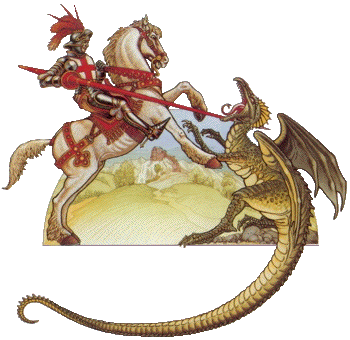
It may sound like an odd thing to claim that a ‘saint’ has nothing to do with religion but in the case of St. George, that is quite a reasonable thing to say. Thus when the politically correct functionaries of the Church of England start floating the idea of replacing St. George with St. Alban as the patron saint of England, I would have to say that the Church of England are flattering themselves if they think it is actually up to them. Dating from the reign of Edward III, a certain conception of St. George has been part of English iconography considerably longer that there has been a Church of England and I suspect the association of this mythic dragon-slayer with ‘Englishness’ will outlive England’s established church comfortably.
In a post-Christian society like England, St. George, who may or may not have been a Roman general, is really just a cultural construct that embodies certain mythic values ascribed to England. And that is, of course, why the emasculated appeasers who make up the leadership of the Church of England really want to replace the mythic warrior St. George:
But the Church of England is considering rejecting England’s patron saint St. George on the grounds that his image is too warlike and may offend Muslims.
And given that Britain is fighting two wars at the moment in Iraq and Afghanistan, against an enemy who are Muslims, I can think of nothing better to commend St. George to a nation which may feel the need to summon the fortitude of warlike archetypes more than it needs an irrelevent and collapsing Church.
This is daft:
POLICE issued two stallholders at a farming show with £80 fines for displaying T-shirts bearing the slogan “Bollocks to Blair”. Officers questioned staff on two stands at the Royal Norfolk Show after receiving a complaint, subsequently issuing two fixed-penalty notices of £80 for the offending garments.
But, it is entirely legal, given the state of the law these days. Someone says something is offensive, and if they say it is offensive it is offensive, because offensive is whatever offends anybody. Then, once the complaint is made, the police are legally obliged to inflict over-the-top and ridiculous summary justice.
Last night Norfolk police defended the action. A spokesman said: “Officers from Norfolk Constabulary issued two fixed penalty notices, each with a value of £80, at the Royal Norfolk Show in relation to two trade stands displaying T-shirts emblazoned with offensive language. The notices were issued under Section 5 of the Public Order Act as the language was deemed to cause harassment, distress or alarm at an event, where a cross section of people were present including families and young children who may have found the displays offensive. Police did receive a complaint from a member of the public.
Quite so.
I reckon that a creative application of this law could render illegal just about any damn thing anybody took against, definitely including the Police, Tony Blair, etc. Has Tony Blair never used language that was “deemed to cause harassment, distress or alarm at an event”? Selling the Koran would definitely be illegal, provided only that the Police received the complaint about it through the proper channels.
My guess is that Police morale is now so low that a lot of them are now in Good Soldier Schweik mode, i.e. doing every stupid thing that the law says they must, just to show everyone how ridiculous the law now often is.
My late father, who was a rather distinguished lawyer, used to tell us about a bloke who sat in Whitehall somewhere looking at all new laws that they were threatening to pass, pointing out inconsistencies and collisions with other laws, and unintended but possible consequences, and then deftly rewriting all the laws so that they achieved only what they were intended to achieve, and stopped only what they were supposed to stop. (He himself, apparently, had no firm opinions about what the law should do, other than what the people passing it said they wanted it to do.) Then he died, and they were never able to replace him. That must have been, if I remember it rightly, round about forty or fifty years ago. And that, my dad reckoned, was when, legally speaking, the rot set in.
Like many folk, I get my fair share of free newspapers pushed through the letterbox. These publications live on advertising and in some cases are quite useful, full of details about local plumbers, plasterers, doctors, new restaurants and the like. In my central London neighbourhood of Pimlico, there are a few of these things floating around. I normally give them a cursory glance and either jot down any handy numbers or put the rag into the trash.
The Pimlico and Belgravia Eye has this interesting ad which definitely caught my eye (not available online):
The latest craze hits Pimlico, Victoria!. Experience the ultimate sense of self expression. Not only is it an alternative form of fitness, but it is an overall empowerment source for women. Whether you want to learn new moves for personal enjoyment or for professional career development, we have just the class for you… Students are from all walks of life, ages, shapes and sizes. The school is designed for all levels of experience – total beginners, professional dancers and even aspiring pole dancing performers.
Pole dancing – now associated with ’empowerment’ and ‘professional career development’. Say what you like about we stuffy Brits – there is none of that stuffyiness in deepest Pimlico.
Here is their, ahem, website.
The Sun is not happy about the “First National Muslim Fun Day”, to be held at Alton Towers. The Sun says
BRITAIN’S biggest fun park has sparked a race row — with a MUSLIMS-ONLY day.
Up to 28,000 are expected at Alton Towers on September 17 when there will be no music, booze or gambling.
Instead there will be prayer areas, Muslim stalls and all food served will be HALAL.
Organisers Islamic Leisure have billed it the First National Muslim Fun Day and tickets can only be bought through their website.
Non-Muslims phoning the Staffordshire park have been refused tickets.
So far as I can see, Muslims who did not book via Islamic Leisure have also been refused tickets. “Sorry, the park is already booked.” What is so difficult to understand about that?
One, George Hughes, 19, who rang up for 15 tickets for a pal’s birthday, said: “I couldn’t believe it.
“It’s the only day we can go, yet I can’t because I’m not Muslim. Can you imagine all the fuss if there was a Christians-only day?”
I do not know the previous policy of Alton Towers, but a few years back I went with a church playgroup to Thorpe Park for “Prayers in the Park”. The children spent the day on the rides then finished with an open air service. Happy time had by all.
Back to the Sun:
George, of Crayford, Kent, added: “My Muslim friends think it’s outrageous.
“What’s the world coming to when people are being banned from flying the St George’s flag yet this sort of day is allowed? If it must be held, then why not on a weekday rather than a busy weekend?”
Maybe because Islamic Leisure paid the hefty premium that such places charge to book on a busy weekend?
The event is widely promoted on the internet and the Muslim Public Affairs Committee declared it “exclusively for our brothers and sisters”.
The lawyers ought to administer a slap on the wrist for the MPAC for saying that, which probably contravenes discrimination law. The lawyers ought, but libertarians and other people with respect for freedom ought not. Freedom of association necessarily involves freedom to exclude. Sometimes you want the party to be private. How would you feel if you hired a hall for the annual party of your local pro-abortion group and they demanded that the doors be open to anti-abortion activists? Feel free to swap the sides in this example. The point is the same.
(In fact the organisers seem confused as to whether they they actually want non-Muslims along. Some other statements suggest that the organisers feel that if non-Muslims see Muslims enjoying themselves just like everyone else it will would be good P.R. for them.)
The Sun says
Alton Towers said any organisation could hire the park for a day.
A spokeswoman said “We make no distinction regarding sexuality, religious, ethnic or lifestyle choices.”
I doubt either statement is entirely true. We will not be seeing a Nazi Fun Day for the excellent reason that Alton Towers would turn down the booking. That is their right. There are urban myths that theme parks are sometimes hired out for the day to childish but very rich individuals; if that is the booking a park wants to accept then that is their right too. It is tough luck on George from Crayford, but theme parks are not public utilities. Unless you want them to be nationalised (imagine a theme park run by civil servants and tremble) can I suggest that George try Drayton Manor?
My home town of Perth recently bore witness to perhaps the most shocking crime in recent memory around these parts – earlier this week, an eight year old girl was raped and murdered, her body dumped in the disabled toilet of a popular Perth shopping centre just minutes after she was separated from her parents. Now a strange twist has created even more public interest in the case. The individual apprehended and charged with the offence, twenty one year old Dante Arthurs, is rumoured to be one of the two boys who killed James Bulger back in 1993.
There are a number of coincidences that have given rise to the aforementioned rumour. Perth’s local rag, The West Australian, notes that
a Sue and Ron Arthurs lived in Surrey, south of London and left to return to Australia in 2002. Around the same time, the Bulger killers were believed to be entering a secret relocation program
More chillingly, The West – in its typical muckraking fashion – actually made the link between Dante Arthurs and the Bulger case last year. It put the question regarding Dante’s identity to the family then; long before he committed the offence he is currently being held for. It is quite remarkable that Dante, quizzed about his identity vis-Á -vis the Bulger case, would later go on to commit such a similar crime.
When the rumour surfaced, the Western Australian police force and justice system immediately rushed to scotch it. British authorities declared it untrue; the Bulger killers were not relocated to Australia. The Arthurs family vehemently denied that Dante Arthurs is an assumed identity, masking one of the Bulger killers. They produced a birth notice, published in The West Australian in 1984, declaring Dante’s birth. This would appear to conclusively bury the rumour, however some have pondered whether the birth notice simply illustrates the depth of Dante’s cover. Personally, I suspect it is more than likely that Dante is not a re-identified John Venables or Robert Thompson, and the startling coincidences linking the two cases are no more than startling coincidences. However, it must be noted that all the parties who have denied the rumour also have a strong interest in ensuring the confidentiality of such an arrangement, if it indeed exists. If child-killers like Venables or Thompson were released, given new identities and shipped off to foreign lands – only to re-offend there in similar circumstances – the political consequences would be enormous. It would at least spell the end of such expedient methods of dealing with society’s most notorious (but presumably rehabilitated) malefactors; a scenario authorities in Britain and Australia would rather not suffer. If Arthurs is one of the Bulger killers, I have no doubt that authorities would sooner lie about it if they think such evasiveness could head off the ensuing major international scandal that would inevitably follow the breaking of such news.
Unfortunately for any government agency attempting a cover-up, if the rumours are correct about Dante Arthurs, I think it likely that the truth will be explosively revealed here and in Britain sooner rather than later. There is so much public interest in the Dante Arthurs case that every angle of this tragic affair will be exhaustively probed by investigative journalists. No doubt they are at it now – wading through birth and death records, electoral rolls and the like, hunting for inconsistencies – whilst hounding their snouts within the public service for information. A devastating public service leak is a strong possibility; if there is anything to leak, that is. I still maintain that all the journalistic investigations will probably come to naught, as Dante Arthurs is most likely not Jon Venables nor Robert Thompson. However, I may be wrong and we could be seeing the early stages of a scandal that will shake the justice systems of Great Britain and Australia to their foundations.
Andrew O’Hagan in the Telegraph takes up the fashionable topic of ‘anti-social behaviour’:
I grew up on a housing estate myself, and I watched it go, in the course of 20 years, from being a zone of optimism and clean living to a sink estate and an unemployment black spot.
My mother lives alone and her door was kicked in by junkies in the middle of the night, just so they could steal her telly. My mother has never been the same (she moved into sheltered housing) and I recognise that the yobs who ruined our street are very different from the respectable working class of my youth, who deserved (and still deserve) every bit of support the Government and the community can give them.
But a couple of paragraphs later we have,
Miss Rooney’s street, like so many in Britain, has been over-run by people fuelled by a mad sense of entitlement, by a vast carelessness and selfishness, and violence on their minds.
Overrun? I suspect Mr O’Hagan would find the yobs, like him, grew up on the estate. The difference is they (and probably their parents and grandparents) also grew up on the state. It is the support the “Government [with the same capital G as God] and community” gave them that created the “mad sense of entitlement”. If the state teaches people that they are not responsible for themselves then those without other information will believe it.
Want to see Tony Blair getting a political kick in the cobblers?
Sweet. Agree or disagree, it is nice to see some political hardball. UKIP thrive on such confrontations. It is hard to imagine the pointless milksops of the ‘Conservative’ Party getting stuck in like that.
Such is the changing nature of that world and the ferocity of those forces, we need to adjust, to reclaim the system and thereby the street for the law-abiding majority.
That means not disrespecting civil liberties but re-assessing what respect for them means today and placing a far higher priority, in what is a conflict of rights, on the rights of those who keep the law rather than break it.
This is not the argument of the lynch mob or of people who are indifferent to convicting the innocent, it is simply a reasonable and rational response to a problem that is as much one of modernity as of liberty. But such a solution will not happen without a radical change in political and legal culture and that is the case I make today.
– Tony Blair MP, June 23 2006
As ever, the pretext is “modernity”… odd how that trope of Marxian theory crops up all the time. Things have changed, we are told. Rebalancing is imposed upon us by the sudden new wickedness of the world.
But read this in the context of other recent statements by Blair and his coterie and you can see that the PM is propounding a double fallacy in order to persuade us make a great leap backward. Ossa is the false dilemma between victim’s rights and suspects’ liberties; Pelion is the great mandarin standby, seeking ‘a balance’ – conceptualised as some mid-point between where we are now and the far extreme in the direction of the proposed policy. The Olympus the New Labour titans would storm is the fundamental western concept of trial. → Continue reading: Forward into the 14th century!
|
Who Are We? The Samizdata people are a bunch of sinister and heavily armed globalist illuminati who seek to infect the entire world with the values of personal liberty and several property. Amongst our many crimes is a sense of humour and the intermittent use of British spelling.
We are also a varied group made up of social individualists, classical liberals, whigs, libertarians, extropians, futurists, ‘Porcupines’, Karl Popper fetishists, recovering neo-conservatives, crazed Ayn Rand worshipers, over-caffeinated Virginia Postrel devotees, witty Frédéric Bastiat wannabes, cypherpunks, minarchists, kritarchists and wild-eyed anarcho-capitalists from Britain, North America, Australia and Europe.
|





Recent Comments