We are developing the social individualist meta-context for the future. From the very serious to the extremely frivolous... lets see what is on the mind of the Samizdata people.
Samizdata, derived from Samizdat /n. - a system of clandestine publication of banned literature in the USSR [Russ.,= self-publishing house]
|
… to save the NHS, says Ed Miliband.
My first thought was, gosh, that’s nice, three months in which to kill it. I suspect that I am in a minority: the outpouring of love, loyalty and vows to defend the NHS unto death coming from the Guardian commenters to this report and to Miliband’s own article resemble nothing so much as the frenzied cries of “Deus vult!” that greeted Pope Urban II when he declared the First Crusade. I further suspect that when it comes to this issue the knights of the Guardian would indeed get support from the peasants of the Sun and the Daily Mail.
Heigh-ho. Just for the record, I shall repost an article that is now more than ten years old. It is by Anthony Browne, once Health Editor of the Guardian‘s Sunday sister, the Observer, and at one time a passionate supporter of the NHS:
Even as you read this, in almost every hospital in the country, there will be elderly, vulnerable people left for hours and sometimes days on trolleys. Each year, thousands of British people – the young, the old, the rich, the poor – die unnecessarily from lack of diagnosis, lack of treatment and lack of drugs. They die and suffer unnecessarily for different reasons, but there is just one root cause: the blind faith the Government has in the ideology of the National Health Service, and our unwillingness to accept not just that it doesn’t work, but that it can never work.
“If “happy” means that you have satisfied your desires, then the claim that people seek only happiness is no more than the triviality that people want what they want. On the other hand, if “happy” refers to some particular state of mind, such as the apparent contentment of the Dali Lama, then we obviously do not seek only happiness. No one believes that a Rolex watch will put him in the mental state of the Dali Lama, but many still want one. Dave may seek some special mental state for himself. That’s fine by me. Alas, he will not pay me the same courtesy. Like others in the grip of an enthusiasm, he is convinced that people who do not share his vision suffer from “false consciousness” or something else in need of correction. Dave’s adolescent moment will remain amusing so long as he doesn’t try to do something about it.”
Jamie Whyte, contemplating the desire of David Cameron, UK prime minister, to make us benighted Brits happier.
It is hard to disagree with the view of Instapundit’s Glenn Reynolds that we currently suffer from the worst political class in living memory, if not for longer. It is not so much that this generation is particularly vicious or stupid – competition for that sort of standing is strong. Rather, it is that there seems to be a massive gap between the scale of the problems now faced by some Western nations, and the calibre of the people whom are being expected to do something about it, and the fatuous preoccupations of these people. We live in an age where we, for example, think a way of dealing with the banking crisis is to strip a senior former banker of his knighthood, rather, than say, address the underlying problem of fiat money, high taxes, “too big to fail” and so on.
But silly me – it is all about how we feel about things. There is a great line in The Iron Lady – the movie about Margaret Thatcher – where the great lady berates a doctor for asking her the question “how do you feel” rather than asking her about what she is thinking. Thinking is just so 1980s, dahhhling.
Hartnett wants the citizenry to stop giving cash to their cleaners, gardeners, and to small tradesmen and other potential tax cheats and economic criminals so that they can no longer avoid paying taxes. Hartnett’s vision of Britain is a society of snoops and denunciators. “Households have a duty to ensure that other people do not evade paying their share of tax. The people who are worried about it should use our whistle-blowing line to tell us. We are getting better and better at finding people who receive cash.” Nice touch. A tinge of the former GDR’s Stasi culture for the British way of life?
– Detlev Schlichter
“Nationalising RBS was a monumental error; no bank must ever bailed out again. Resolution and bail-in procedures to properly wind-down even the largest institution must be ready for use the next time there is a crisis. The government’s takeover of part of the banking industry in 2008 – combined with a stagnant economy and a flawed narrative about the real causes of the crisis – has triggered a cultural shift that will turn out to be disastrous for Western capitalism and prosperity.”
– Allister Heath.
This is also very on point:
It is impossible to run a bank – especially one with a large investment bank unit – as part of the public sector. One can only do it for a very short period of time, as the US institutions found during the Tarp episode; they paid the money back very quickly to liberate themselves from the state’s shackles. Permanent state ownership means political considerations take over; and the pressure builds to pay bank employees like civil servants.
By the way, while I was relaxing after a nice weekend in the country last night, I watched the DVD of the Atlas Shrugged movie (it shows the first third of the story, or thereabouts). I quite liked the film, although it lacks that sparkle I like to see in a big topic like this. (The actress who played Dagny Taggart is good, as is the actor who plays Hank Rearden. The rest are so-so). But even so, one thing that grabbed me from the start was that this might have been a documentary about the financial problems of the West, rather than a piece of fiction.
From the latest Radio Times:
9.00 Wonderland: My Child the Rioter
Last August’s riots provoked a legal backlash that has seen often lengthy prison sentences handed down to those involved. This documentary enters the homes of the some of the families affected, including that of Eileen and Alan Bretherton whose son Liam recently served in Afghanistan but got caught up in the unrest while home on leave. Now he is an ex-offender with a promising military career in tatters.
“Legal backlash” is, I suppose, one way to describe a severe punishment.
But the phrase that really caught my eye in this was where it says that son Liam got “caught up in” the unrest. You hear this phrase a lot these days, to describe what someone did, in a way that suggests that what he did was really done to him, by a malign outside force. The Unrest, you see, forced him to go out looting. The Unrest called round, knocked on his door, dragged him out into the street and there compelled him to misbehave. Liam didn’t do rioting. The rioting “involved” him. There the Unrest was, catching Liam up in itself. How could Liam himself be held responsible for what Unrest did to him?
Truly, we do live in a Wonderland.
And what of that “legal backlash”? (There goes another phrase which makes a bunch of decisions appear like a mere collective emotional spasm.) Well, next time Unrest decides, for its own inscrutable reasons, to reach out and grab people, more of them will surely decide to resist being caught up in it, now that there has been this legal backlash against the last lot of those picked on by Unrest.
Some Christians I know or read about claim to be concerned about the long-term health of society and the future welfare of generations yet unborn, as well as the current one, and yet all too many of the senior figures in the Church of England, say, make asses of themselves by unthinking repetition of Big Government thinking. Case in point being the Archbishop of Canterbury, Rowan Williams.
It is, therefore, a pleasant break from the norm to read this, from Dr Williams’ predecessor, George Carey:
“The sheer scale of our public debt – which hit £1tn yesterday – is the greatest moral scandal facing Britain today. If we can’t get the deficit under control and begin paying back this debt, we will be mortgaging the future of our children and grandchildren.”
(H/T, Suboptimal Planet: a new blog that I thoroughly recommend).
On the subject of the UK’s debt problems, Martin Durkin, the documentary maker, put together a programme for Channel 4 a while ago which is well worth viewing, with comments from the likes of Allister Heath, Mark Littlewood, Kevin Dowd, James Bartholomew, Nigel Lawson, Geoffrey Howe and, for some light relief, Brendan Barber of the TUC (Trades Union Congress).
Guido:
Even if the GDP numbers are not entirely unexpected, they are still a failure, a failure to grow the economy. The deficit can only be paid down if the economy grows, we can’t borrow our way out of a debt crisis. It is time for a supply-side revolution, why is the government implementing a policy of selected regional enterprise zones, why not make the whole economy an enterprise zone? It was a mistake to hike VAT and it is a strategic error to burden industry with crushingly high green taxes, penal marginal income tax rates of over 50% discourage entrepreneurs and investors from coming to Britain.
If the government is going to miss the deficit target, and it is, miss it because the government slashed taxes to grow the economy. The international bond markets will forgive a finance minister with a growing economy who misses his deficit target, they won’t forgive a finance minister with a contracting economy in any circumstances. Chancellor Zero knows that with no growth there is no hope for the deficit.
Whether Guido is right that there is any hope for the deficit, under any circumstances, is a proposition I leave to others to ponder. I quote the above posting because it illustrates something important about Guido himself.
In among all the knockabout gossip about who is sleeping with whom and who is cheating on their expenses, Guido regularly slips in more thoughtful stuff. He regularly, that is to say, drops in explicit libertarian messages, in among all the merely implicit libertarianism about how they are all conspiring with each other to rob us blind. This is why they all hate him so much. He is absolutely not one of them. They want to believe that he is only a gossip monger, and a mere partisan Tory, with no principles other than that he wants his particular team to be in charge of all the robbing and conspiring. But those of his pro-state (I often think more fun than is might be had with that hyphen) enemies and victims with any antenna or honesty know that he is something far more dangerous to them than that. He is a principled libertarian with readership numbers and influence most of them can only dream of. He, more than anyone else in Britain, is responsible for the widespread perception in British politics that the arrival of the internet was a breakthrough for libertarian ideas. Before Guido, we were talking amongst ourselves, which was good. Now Guido regularly shoves it in front of them, which is even better.
Okay, a simplification. Others were doing this before Guido. But none so entertainingly, or to such a wide readership. One of Samizdata’s prouder boasts, I think, is that before Guido found his own blog persona and his own voice as a blogger, he was briefly part of ours.
Here is a photo I took of the great man, at a recent gathering at Samizdata HQ:
A fine if rather blurry addition to this collection. (This is my favourite one of these.)
By the way, do you remember the posting I did here a while back about how so much of what happens in the world is down to two-man teams? Well, these days, anyone who cares knows that there are now two Guidos. I asked original Guido about this at the party where I took the above snap, and the partnership between him and Harry Cole is definitely the real two-man team deal.
Mark Wallace, recently “seen elsewhere” by Guido, makes a good point, in response to a piece by Tim Leunig in the Guardian, about the nature of the mixed housing economy:
Leunig’s Guardian piece claims to calculate that the benefits cap would leave people living on 62p a day. The most crucial element of his workings is that a 4-bedroom house in Tolworth costs £400 a week. That’s true right now, but it wouldn’t be the case once a cap has been brought in.
The truth is that some of the main beneficiaries of overly high benefits are private landlords. They may not get payments from the DWP direct, but they reap the cash anyway through inflated rents, secure in the knowledge that every time they put the price up, benefits levels are raised to pay them. This is a racket, exploiting the foolishness of officials in pumping more and more money out and the absence of taxpayer power to rein in this behaviour.
Tim Leunig is right that if rents were fixed as they are now then his hypothetical family would pay £400 a week. But rents aren’t fixed, they are fluid. If you remove a large amount of cash from the system then prices will fall. By arguing for the system to remain as it currently is, rather than accept a cap, this supposed “progressive” is effectively fighting the corner of benefit-farming landlords.
Government hand-outs to “the poor” enriching the not-so-poor is a familiar story. It explains a lot about the current state of politics. In fact politics generally, down the ages.
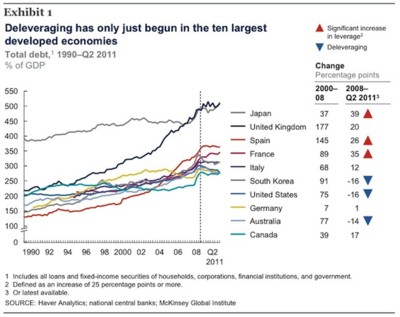
Tom Clougherty has an interesting graph up at the ASI blog, taken from this McKinsey report, of the movement in combined public and private debt for the ten biggest of the world’s developed national economies, from 1990 until now. Follow either of the above two links to get a bigger and more legible version of this graph:
Since 2007, of course, all have lurched upwards from wherever they were to quite a bit more.
To me the interesting bits are those between 1990 and 2007. The general trend was a general increase in debt, from somewhat troubling to somewhat more troubling. But three countries bucked this trend: Japan started very bad and merely stayed very bad; Canada started okay-ish and stayed okay-ish; Britain started okay-ish but became very bad. In terms of the direction things went in, Canada has the best graph of them all, and Britain has the worst. Between them, these three graphs, the grey one along the top (Japan), the green one in the pack towards the bottom (Canada), and the dark one moving most determinedly upwards (Britain), make a kind of big and elongated Z.
One other deviation from the norm worth noting is that just before 2007, Germany, unlike any other country, went (see the yellow graph) definitely downwards. It did what Keynes said, in other words, and paid down its debts when times were good, or at least when they seemed good. In Britain, the “Keynesians”, public and private, just carried on running up more debt.
I know that as a fan of Austrianism I am not supposed to get too excited about national economic aggregates. But this set of aggregates and aggregate movements looks to me quite telling. Make of it all what you will. For me, it confirms the sense that many now have that Tony Blair’s government was one of the worse ones that we’ve ever had.
Anyone looking for evidence that the current Conservative/Liberal Democrat government in the UK has the same tidy, but severely limited intelligence of its predecessor need do no more than read this story suggesting that thousands of jury trials held in the country could be axed to save what appears to be a relatively paltry sum, when measured against the dangers and cost to individuals of being wrongfully convicted.
I can understand why jury trials can be an easy target. In my distant past I had a spell covering court cases in the UK and watched several juries at work. It struck me – especially in the more complex fraud cases – that there are clear problems. And maybe – although no politician will dream of saying so – that the British are not as law abiding as they presumably were 50 years ago and therefore the average jury panel reflects this fact. But historians would point out that juries in, say, early 19th Century England could be an awkward bunch. But therein lies the strengths of trial by jury – it is one of the few elements in which ordinary members of the public can be brought into the affairs of civil society by sitting in judgement on the alleged guilt or innocence of their fellows. Juries remind the powerful and the legally sophisticated about the proper order of things.
As I remarked the other day about the dangerously misconceived move by the previous Labour government to scrap the double-jeopardy rule, the ongoing attempts by administrations of all political hues to gut the English Common Law, and the checks and balances of the system, remain one of the most foolish trends in our public life. And that such an idea is being contemplated makes a mockery of the idea that having the Lib Dems in the government coalition will increase, in any way, the supposed liberality of this administration.
Hey, “tyranny” was his word, not mine. Sid Ryan writes in the Guardian:
There have been some serious incidents at the camp in the last few months including: thefts, tents being slashed and minor assaults. These problems are not of Occupy’s making, but they’re happening on its watch. When anyone is challenged about people’s behaviour they’re quick to cry “persecution” and appeal to the founding principles of inclusion. If Occupy can’t solve the problem of behaviour on-site, a hostile media and the police will end the movement before it gets going.
Even people who aren’t aggressive or violent can derail the movement. The very nature of the general assembly (GA), whereby everyone can wield a veto, makes it inevitable. A block should be used only if the blocker feels so strongly that they would rather leave the movement than see it carried through, but it is rarely used as such and rarely with a full understanding of the issues at stake. Occupy proudly states that the GA is “real democracy”, in fact it is a tyranny that makes it possible to drown out a hundred rational voices with a single irrational one.
Schadenfreude aside, Mr Ryan’s article provides an interesting case study of an attempt at non-coercive organisation, a subject that interests many libertarians. Perhaps what stops it working for them is Original Sin. I refer to the sinful desire, shared by both the reformist and the revolutionary wings of Occupy, to coerce others.
Added later: Guardian commenter Forlornehope mentions the Seige of Münster. One hopes events will not come to such a pass that St Paul’s ends up being adorned in the manner of St Lambert’s Church:
Vigorous preparations were made, not only to hold what had been gained, but to proceed from Münster toward the conquest of the world. The city was being besieged by Franz von Waldeck, its expelled bishop. In April 1534 on Easter Sunday, Matthys, who had prophesied God’s judgment to come on the wicked on that day, made a sally with only thirty followers, believing that he was a second Gideon, and was cut off with his entire band. He was killed, his head severed and placed on a pole for all in the city to see, and his genitals nailed to the city gate. Bockelson, better known in history as John of Leiden, was subsequently installed as “king”.
Claiming to be the successor of David, he claimed royal honours and absolute power in the new “Zion”. He justified his actions by the authority of visions from heaven, as others have done in similar circumstances. He legalized polygamy, and himself took sixteen wives. (John is said to have beheaded one wife himself in the marketplace; this act might have been falsely attributed to him after his death.) Community of goods was also established. After obstinate resistance, the city was taken by the besiegers on June 24, 1535, and in January 1536 Bockelson and some of his more prominent followers, after being tortured, were executed in the marketplace. Their dead bodies were exhibited in cages, which hung from the steeple of St. Lambert’s Church; the cages still hang there, though the bones were removed later.
Exposed: Taxman’s ‘illegal’ war against Britain’s small businesses. That is the title of a most interesting report in the Independent. Not so much a war, I would have said, as a shakedown.
The Government is unlawfully using late-payment penalty fines against tens of thousands of small firms who do not file their tax returns on time as a “cash-generating scheme” for the Exchequer.
In a damning judgement, the Tax Tribunal has ruled that Her Majesty’s Revenue and Customs is operating a policy of “deliberately” waiting months before alerting businesses that have not filed their tax returns so that late- payment fines stack up.
…
“It is no function of the state to use the penalty system as a cash-generating scheme,” said the judge, Geraint Jones, QC. “We have no doubt that any right-thinking member of society would consider that to be unfair and falling very far below the standard of fair dealing expected of an organ of the state.”
While applauding his judgement in this case, I question his expectations of standards of fair dealing by an organ of the state. It’s not as if they didn’t try much the same with speed cameras.
I gather HMRC are to appeal*. Confusion to their knavish schemes.
(Via Englishman’s Castle)
*This sentence originally read “I gather HMRC are appealing.” Edited for accuracy.
|
Who Are We? The Samizdata people are a bunch of sinister and heavily armed globalist illuminati who seek to infect the entire world with the values of personal liberty and several property. Amongst our many crimes is a sense of humour and the intermittent use of British spelling.
We are also a varied group made up of social individualists, classical liberals, whigs, libertarians, extropians, futurists, ‘Porcupines’, Karl Popper fetishists, recovering neo-conservatives, crazed Ayn Rand worshipers, over-caffeinated Virginia Postrel devotees, witty Frédéric Bastiat wannabes, cypherpunks, minarchists, kritarchists and wild-eyed anarcho-capitalists from Britain, North America, Australia and Europe.
|






Recent Comments