We are developing the social individualist meta-context for the future. From the very serious to the extremely frivolous... lets see what is on the mind of the Samizdata people.
Samizdata, derived from Samizdat /n. - a system of clandestine publication of banned literature in the USSR [Russ.,= self-publishing house]
|
News can travel fast these days, but this particular bit of news took its time reaching me. It started in Covent Garden, then went to Oddity Central, then to here, in Canada, and from there to here, which is based somewhere (I think) in a southern state of the USA, where I read it, I being about two pleasant little walks away from Covent Garden. And now it is here:
Icecreamists of Covent Garden, London has created the Vice Lolly, a sacrilegious gun-shaped frozen treat made from holy water from a sacred spring in Lourdes, France, 80% alcohol absinthe and sugar.
According to this, this gun is still perfectly legal here in Britain. Nevertheless, my first thought was (hence that link): isn’t there some kind of law here against replica guns? Call it the chilling effect.
Would you prefer me to be more serious about guns in Britain? Not tonight thank you. The subject is too depressing.
If anyone ever had any hopes that Boris was any different to the dreary authoritarians who populate the system, this should lay such notions to rest. He is very much ‘one of them‘.
He purports to have ‘libertarian instincts’ and yet thinks the role of the state should extend to telling people at gun point what they can eat. To hell with taking a moral position and respecting self ownership, says Boris, what are the utilitarian arguments?
A vote for this man was sadly a vote for more of the same regulatory statism that spews out of the political class.
“By the way, George Soros also warned that the new, creditor-dominated Europe would become “a German empire with the periphery as the hinterland”. Didn’t a certain female politician warn of something along these lines nearly 25 years ago, and wasn’t she branded xenophobic for her pains? An entire generation is being made to pay for our continent’s slow learners.”
Charles Moore.
If you visit, for example, the Financial Times website, you will be presented with a pop-up box warning you about cookies. This is becoming more common and is a result of the EU Directive on Privacy and Electronic Communications, also known as the e-Privacy Directive, also known as the cookie law, which took effect on 26th May.
Since no-one understands the law and has to rely on vague guidance that gets updated without really clarifying anything, web designers who have heard of the law will likely rely on the annoying pop-up box for some time and it will become boilerplate which is instinctively dismissed by users. Luckily most web designers seemingly have not heard of the law or are otherwise ignoring it, probably because they have real work to get on with.
Dave Evans of the Information Commissioner’s Office writes:
We’ve stressed that there’s no ‘one size fits all approach’. We think that organisations themselves are best placed to develop their own solutions.
Freely co-operating organisations did solve the problem years ago, when they invented web browsers with cookie settings. This legislation solves nothing at the cost of confusing, worrying and irritating people.
“The great irony of the Diamond Jubilee celebrations is that the most overt snobbery emanated, not from the House of Windsor or its posh cheerleaders in political and media circles, but from so-called republicans. It was them, these embarrassments to Tom Paine, who looked with horror and derision upon the great hordes of modern Britain. They pronounced themselves “aghast” at all the little people “happily buying Union Jack cups and bunting”. They mocked the masses for obediently heeding the “message from on high” telling them “not to worry about increasing inequality and its accompanying social problems, but to clap your hands, smile and applaud”, like good little children.”
– Brendan O’Neill.
He’s hit the nail on the head. I think – as a libertarian and minarchist, that we if we are going to have a state at all, then I see little that is objectionable from a freedom point of view in having a constitutional monarchy instead of an elected president, although I suppose the glitz factor would be reduced. Republicans who are serious should ask this question: would a single piece of Nanny State legislation, the Database State, our membership of the EU, our massive taxes and regulatory burdens, be improved in any way if we said goodbye to the monarchy? Really?
Britain’s energy reforms are billed as a key part of the Cameron government’s growth strategy. To understand why the U.K. economy is flat-lining, look to a government that believes a policy to raise energy prices and squeeze living standards is good for growth. Unless Mr. Cameron wants to share Jimmy Carter’s electoral fate, he’d better push the reset button on his energy policy – fast
– Rupert Derwal
“Eurosceptics aren’t supposed to like Ken Clarke. But I can’t help it. Apart from being completely wrong about one of the biggest questions of our age, the disastrous EU project, “Ken” is the absolute business. The unfazed Justice Secretary stands (or often sits) as a wonderful reprimand to the prissy, on-message posturing of the dominant political class. He likes jazz, smokes cigars and after more than 40 years in Parliament is one of the government’s few true big beasts.”
– Iain Martin
I think if Ken Clarke did not have a track record of being so spectacularly wrong on the EU, he’d easily be the best man for the top job as Tory leader. Out with the windmills and the AGW nonsense, in with the Louis Armstrong and the Cuban cigars. I have met him several times and always been impressed by his blunt honesty and friendliness. The suede-shoes-and-pint-of-bitter thing is not a sort of act, either. That’s him.
But the EU-wrongness is a problem.
Being on the Cobden Centre email list is a constant source of interesting news items and opinions, in addition to all the stuff that is none of your business and not really any of mine.
Today, for instance, someone provided a link to this blog posting, which is entitled “CRASH 2: Why has the Treasury revoked debt-trading sections of a 1939 Act – without telling Parliament?” and is subtitled “How a hidden order could be used to bankrupt the UK”. Quote:
A few diligent MPs (David Davis is one, Frank Field another) often scan the SI lists looking for things like the reintroduction of chimney sweeps, incarceration of Tom Watson, invasion of the Planet Mars and so forth. Most of the other 618 (or so … I can’t remember these days) never bother. Everybody seems to have missed – or is happy to keep quiet about – a brand new one. A week ago today, the Coalition Government told us all very quietly indeed that it was going to revoke some parts of an ageing schedule from The Trading with the Enemy Act of September 5th 1939. The latter was passed two days after the Germans last went visiting their neighbours.
The gist of this particular quiet little alteration being that it just got easier for Britain to bale out the banks of various other countries which are now part of the EU. It’s all to do with “negotiable instruments”.
In response, someone else on the Cobden Centre list sent the text of a Reuters story, which I found in a linkable form here. Quote:
BRUSSELS/LONDON: European Union countries could be obliged to bail out one another’s struggling banks, according to a draft EU law that marks a big step towards greater EU financial integration likely to upset some members, particularly Germany.
And not only Germany, it would seem.
As to whether the story behind link number one really is link number two, I don’t know. But I have long believed that the European Union, when it finally collapses, will do so all at once. All the power and all the money that these fanatics have under their control will all be used up, all of it, to sustain the illusion that they are all now so determined to sustain. And then all the power and all the money will be gone, and everything will very suddenly disintegrate. At which point it will emerge that everyone was only obeying orders.
Instead of the Government directing energy policy from the centre, let the people choose.
This would involve the scrapping of ALL subsidies for power generation, direct or indirect. So all ROCs, FiTs, payments for nuclear decommissioning, tax breaks for gas extraction, and so on, would go. The real whole-life cost of each technology would be apparent. Each consumer could then choose the source, or mix of sources, for their electricity, in much the same was as at present one can choose energy supplier, or even a ‘green’ tariff, and pay accordingly.
– Murdo Fraser, deputy leader of the Conservative Party in Scotland, “breaks ranks”, as Bishop Hill puts it.
Fat chance, but good to hear such a highly ranked Conservative saying such a thing.
Samizdata’s favourite Member of Parliament, Steve Baker, has been elected an Executive Member of the 1922 Committee. What this shows is that he is the kind of Member of Parliament whom other Members of Parliament rate highly, and pay respectful attention to. It means that Baker has a Parliamentary following. He is not a loan (!!!) lone voice in the wilderness. Good.
In other words, ideas like this (written by Baker in response to some recent remarks by William Hague to the effect that we should all work harder) are now getting around:
Senior politicians must realise that hard work cannot produce prosperity without the right institutions. In addition to Adam Smith’s “peace, easy taxes and a tolerable administration of justice”, hard work must be rewarded with honest money which holds its value, not money which the commercial banks and the Bank of England can produce at the touch of a button.
Money loaned into existence in ever greater quantities caused the present crisis. It has given us a society based on crushing burdens of work in exchange for rewards which quickly disintegrate. That is the problem which must be solved if hard work is to have proper meaning and if we are to have a moral and just society which delivers prosperity for all.
Imagine a world in which the most powerful people in it started seriously to understand and to act upon notions like that. Thanks to people like Steve Baker we may eventually find our way towards such a world, and maybe (although one should never assume such a thing) quite soon.
I have admired Steve Baker MP ever since I first heard about him from my friend Tim Evans, and have liked him ever since I met him, at a Cobden Centre dinner a while back.
If you also admire Baker and what he is trying to accomplish, then please take the small amount of time needed to add a comment here saying so, even if you are not normally inclined to comment, here or anywhere else. Baker has several times told me, and I have no reason to doubt him, that encouragement of this sort makes a definite difference to his happiness, and to his willingness and ability to keep on keeping on.
A short while ago, I defended the freedom of people to say nasty, or stupid, things on sensitive subjects, so long as they don’t do so on my private property or against the rules set by owners of said. (The property point is one of the distinctive libertarian ways of framing the issue. You don’t have a right to paint slogans on my house or demand I pay for your blog fees). It is, I suppose, a sign of the times in which we live that toleration for speech that you don’t happen to agree with is now seen, in some quarters at any rate, as a “right-wing” issue. It should not be. Anyway, I was reminded of this point when I read this article about a stand taken by David Davis, the senior UK Conservative MP.
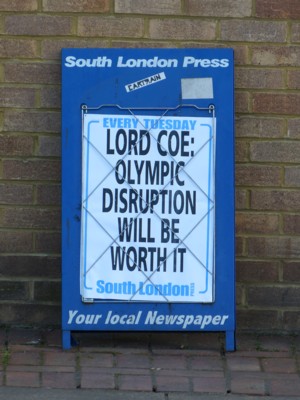
Here is a photo I took in March of this year, which I have been meaning to feature here for ages:
We shall see.
One of the many annoying things about the Olympic Games is how little clutches of contractors and workers, doing vital things, know that they can, during the frantic run-up to the Olympics, demand a hugely exorbitant price for merely doing their job, even if they had earlier sworn blind that they would not behave like this. I imagine that’s a very widespread Olympic phenomenon generally, which adds hugely to the final bill, and is just one more reason why I wish the damn things had gone to Paris and never come back, ever.
I surmise – no speculation of this sort could easily be proved – that if any such demand becomes just too demanding, the means used by the State to settle such demands are not confined to bribery. If I was the State, I’d also now be issuing threats. I’d send people round to knock on doors to explain, ever so politely (perhaps over a friendly cup of tea), to such persons as trade unionists and building contractors, just how nasty the State is now capable of being, to individual people whom it has taken against. The State knows where you live. The State decides how much tax you owe it. And so on. And it could get even nastier. So, don’t push your luck too far, there’s a good fellow.
This is all pure speculation on my part. I have zero inside knowledge of any such negotiations. It’s just that if that were now happening, I would not be surprised, whereas if it wasn’t, I would be very surprised indeed.
Another way of responding to such last minute demands is to say: Okay, if you don’t finish it in time, you don’t finish it in time and it doesn’t get finished in time. Pity, but there you go. And once the Olympic Games are over, we can then sack the damn lot of you and take our time. While keeping all your names on a Black List, for you to be suitably punished at our leisure.
This seems to be the approach being adopted in the matter of the Greenwich Cable Car. I am particularly interested in this New London Thing because, when finally finished and open for business, it will be another fine photo-op for me, to add to my London list of places like this.
Yes, says Mayor Boris, we do indeed hope that the Emirates Airline will be ready in time for the Olympics, as another way to get people back and forth across the river, to and from all that Olympicism. But if it isn’t ready by then, so be it. This is not an “Olympic Project”, or it only will be if it is ready for the Olympics.
Very wise.
I recall that the London Eye was supposed to be ready for the Millennium, but that, perhaps for the kind of reasons speculated about above, it wasn’t. Who now cares?
Pity you can’t take that line with such things as velodromes and swimming pools. Which is why I suspect that other means of persuasion are also now being deployed.
|
Who Are We? The Samizdata people are a bunch of sinister and heavily armed globalist illuminati who seek to infect the entire world with the values of personal liberty and several property. Amongst our many crimes is a sense of humour and the intermittent use of British spelling.
We are also a varied group made up of social individualists, classical liberals, whigs, libertarians, extropians, futurists, ‘Porcupines’, Karl Popper fetishists, recovering neo-conservatives, crazed Ayn Rand worshipers, over-caffeinated Virginia Postrel devotees, witty Frédéric Bastiat wannabes, cypherpunks, minarchists, kritarchists and wild-eyed anarcho-capitalists from Britain, North America, Australia and Europe.
|