What’s the difference between Fleet Street and Hacked Off?
One is a consortium of the rich and powerful with little respect for the law that has been given unwarranted access to our government, and the other… waaait a minute.
– Solent Minor
|
|||||
|
What’s the difference between Fleet Street and Hacked Off? One is a consortium of the rich and powerful with little respect for the law that has been given unwarranted access to our government, and the other… waaait a minute. – Solent Minor June 23rd, 2013 | 2 comments - (Comments are closed)
 How to tell when a politician is lying about freedom of expression: the key is the use of the word ‘but‘…
… the first fifteen words are negated by everything after the ‘but’, which is to say Newport city councillor Majid Rahman very explicitly does not believe in T-shirt printer Matthew Taylor’s freedom of speech and rights to say what he wants. No, he believes in state regulated speech enforced by the police and that he is only ‘free’ to say things that do not offend certain categories of people. And that is not freedom of speech. Personally I would like to see Newport city councillor Majid Rahman arrested and thrown in jail, not because he offends me (although such view do indeed offend me) but because a politician threatening people with the police because of a T-shirt should be regarded as a crime. Do you think if I called up the Plod in Newport and complained that might happen? 😉 If I was Matthew Taylor I would say “Get stuffed you nasty little thug, it stays in the window and if you don’t like that, I suggest you arrest me and charge me so we can run this past a jury of my peers.” I know quite a few people who would be able to find a pro bono lawyer who would delighted to take such a case. June 5th, 2013 | 50 comments - (Comments are closed)
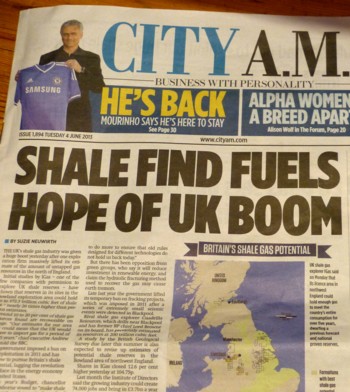
At around midday today I caught Ed Davey MP babbling away on the telly about how 97 percent of climate scientists agree with him about the need to wreck the British economy and treble our fuel bills by making carbon illegal, or whatever. The BBC person present complained that Davey wasn’t doing nearly as much to wreck the British economy and treble our fuel bills as he should have been doing, and that what he was saying was merely bluster to comfort greeny true believers. It would certainly be nice to think so. Peter Lilley MP, also present, had plenty to say about these absurd claims, but the word – just the one word – that he used that I remember most fondly was: Tosh. Later in the day, on a tube train, I learned of better British economy and energy bill news, in the form of this City A.M. front page:
Here is the front page story. Quote:
My favourite paragraph of this story is this one:
Anything that reduces invetment in “renewable” energy, which is the stupid kind, is all to the good. As for those earth tremors, bring them on. City A.M. Editor Allister Heath starts what he has to say about Britain’s shale bonanza with this question:
Waiting, presumably, for the likes of Ed Davey MP to be dumped into the dustbin of history where they belong. June 4th, 2013 | 11 comments - (Comments are closed)
The British government wants to “eradicate undernutrition globally”. It has a department for it. This can not be good. There is also a committee of MPs who have released a report. There is an argument in the report that since the population is expected, by Benny Dembitzer as far as I can tell, to increase to 9.3 billion people by 2050, and since consumption of meat is increasing, that there is going to be a general food shortage. Meat is singled out for being an inefficient use of resources. From the report:
Note that the Food Ethics Council is funded mostly by the Joseph Rowntree and Esmee Fairbairn charitable trusts. Even private organisations can be wrong. So why is pasture livestock “less problematic” than grain-fed? Note 69 points to question 62, part of a series of testimonials which seem to make up most of the evidence used to make the report. I’ll highlight the most fun bits.
It is mostly incoherent ranting. Are they arguing for less intensive farming of animals to solve the problem of too much meat consumption, or something else? I’ll see how far I can get by assuming that this is about using resources in the most efficient way. It seems to me that if people are hungry they will start to bid up the price of grain and stop buying meat anyway and that the problem will solve itself. I am not sure why pasture livestock is preferable. I suspect it is even less efficient than grain livestock, assuming all land is equal. It may be that grain for humans is always more efficient than grain for animals, however since there is land that is not suitable for grain that might as well, in that case, be used for livestock. There is also a hint here that grain production needs more water. But all this is a non-problem in a free market. In a free market the land is always used in the most efficient way and whatever shortages of grain or water come about will move the prices and hence the demand automatically. This seems to be a big problem with the concept of “sustainability”. If you think that current levels of meat production are unsustainable, then if you are right they will not be sustained. If you are right, it doesn’t matter what anyone does. Coming up with innovative policies to reduce the consumption of meat seems to be a bit pointless unless what you really want is to reduce the consumption of meat even if you are wrong about its sustainability, or you are concerned about being blamed by the voters for its un-sustainability. I rather think that it is sustainable and we will end up eating less meat anyway to please these sustainability “experts”. If some fundamental resource shortage does increase the price of food, an interesting question is at what point does food become so expensive that it takes more than one person’s labour to produce enough food for one person? I expect with 9 billion people (some of them rather more clever than the assembled committee members and witnesses at making food production more efficient) we are still a way off mass malnutrition caused by resource shortages. At some point hydroponics and 3D farming become cost effective. Still, the rest of the conversation is a fascinating insight into the minds of the elite:
Do these people listen to themselves? Meat is cheap and ubiquitous therefore we need to eat less of it. Climate change!
Do not underestimate the power of these people. They may seem like idiots and professors talking nonsense among themselves but look what they have done with smoking. In 1999 I had to change seats on an aeroplane because there was too much smoke. Now people are cast out of society for lighting up at the far end of the empty railway platform. And it started like this. Lots of conversations like that, then the report, now the news articles. Say the headlines: “Families should only eat meat as an occasional treat because the surge in global demand is unsustainable, according to a committee of MPs.” They are making the idea seem normal.
The thing about food waste is that there is no such thing. There is a rational economic decision to choose excess food production to optimise for something else instead. In my house I sometimes buy or cook more food than I need because the computing resources needed to calculate exactly the correct amount are more expensive than the food that is thrown away. Everyone else is making similar choices. If the government invents innovative new policies to reduce “waste” X they necessarily make Y more expensive and thereby allocate resources less efficiently than before. If existing policies are found to cause market distortions that cause food to be thrown away that would not be absent the policy, then these should of course be abandoned. But this should be applied generally to all policies that distort markets.
Don’t we have market solutions to this already? Speculators?
Good thinking. Don’t stop there. Let me help you along. What do biofuel targets have in common with food waste targets and meat production targets? The above is a lesson in how the ideas of certain classes of people – academics; politicians; journalists; social scientists – become law. These are the early stages, but something is afoot. June 4th, 2013 | 30 comments - (Comments are closed)
The pub chain Wetherspoons, whose chairman Tim Martin seems to be of sound mind, is opening a pub at a motorway service station. Cue whining and moaning from assorted fake charities and do-gooders of the kind who complain about the “message” that allowing such a business to exist “sends out” and advise drivers against even one drink with lunch because, though it does not follow, people who drink to excess cause traffic accidents. Say Wetherspoons:
This is individual responsibility that alcohol lobbyists do not acknowledge. June 4th, 2013 | 13 comments - (Comments are closed)
I read an article describing confrontations between the fascist EDL and ‘anti-fascist’ protesters in the aftermath of the recent Woolwich atrocity. Ok, Marxist collectivists confronting non-Marxist collectivists, very much a row-within-the-family it seems… “Yah Boo Sucks! Our identity politics are better than your identity politics!” But I have a question… were these fine anti-fascists also out in force when Islamic fascists were marching in London calling for the imposition of Sharia law? Just curious, does anyone actually know? May 27th, 2013 | 68 comments - (Comments are closed)
The events witnessed this week in Woolwich, London, were a devastating reminder of the problem Britain faces regarding the threat of terrorist activity. However, much of the ensuing reaction has been one of confusion and has done little to aid the in the slow and painstaking process of combating such delusional ideology. On the one hand there are those who are determined to tar the events by forwarding their equally absurd beliefs. Demonstrations organised by the EDL and “Operation Fightback” were organised but quickly shut down by police, while mosques were attacked in places such as Gillingham and Braintree. On the other hand, I have to say that there appears to be an apologetic element within the public domain that is just as guilty of blemishing debate, although this has been done by shooting down anyone who is willing to speak openly about the nature of the attacks as “islamophobic”, “bigoted” or “racist”. Some of these attacks are justified – the support for Stephen Lennon’s EDL movement is undoubtedly host to anti-Asian racists and those who are prepared to beat up anyone they meet wearing a veil. However, many of their gripes come as a result of the confusion that surrounds the criticism of Islam. The perennial problem for those who wish to speak frankly about organised religion is that in asserting their view they can sound similar to the bigot they would run a mile to get away from. However there is one fundamental difference; while the intolerant will tar a religion’s supporters with the same brush, the critic of religion will be averse to doing so. This can easily be put in a better light; suppose I am opposed to Conservative politics (which for the most part I am). This should say nothing about the way I treat Conservatives when I meet them in my day-to-day activities and should not prevent me from greeting them with the same friendliness I would give anyone else. However I should still have the fundamental right to speak my mind with regards their ideology or beliefs as long as my conduct towards them is not affected. One objection to this may come from those who deem it “offensive” to voice anti-Islamic views. The problem is that it assumes that this gives the offended some sort of “rights” and in doing so seems to pay little regard or thought to the fact that the person of no religion may be equally offended by religious views. For all it’s worth I may be offended at the Bible’s description of a lady turning into a pillar of salt or offended at the Quran’s views on polygamy. However, I would not for one moment suggest that my offence should impede their right to voice those beliefs. As long as we do not discriminate against Muslims, we should be allowed to voice our views and people should have the right to be offended. → Continue reading: The Woolwich attack: criticism of Islam and the issue of free speech May 27th, 2013 | 32 comments - (Comments are closed)
Yet another assault of freedom of expression by the forces of repression. Sometimes it comes from priggish intolerant ‘Daily Mail Right’ and sometimes from the thuggish and profoundly intolerant ‘Thought Police Left.
Well I regard any attempt to threaten people from selling magazines as “real harm. So perhaps it is time to pass some laws that threaten people who do that with the violence backed hammer of law. Sauce for the goose is also sauce for the gander and tolerance for people who wish to use force to impose their intolerance is both cowardice and ultimately suicidal. And lets get rid of the Equality Act 2010 while we are at it. Journalist Piers Hernu retorted:
Whilst I like his accurate characterisation of these thugs, he makes one very serious error. So what if the magazines are ‘pornographic’? Once you accept that as a legitimate reason to pass laws against a magazine, the enemies of liberty just start redefining what ‘pornography’ means until they get what they want. May 27th, 2013 | 60 comments - (Comments are closed)
Never people to let a nice atrocity go to waste, the recent murder of a British solider in London is being used by the ruling classes to renew the push for more state surveillance. Never mind that the two perpetrators were already known to the security services, somehow the non sequitur that a more panoptic state could have stopped a pair of low tech islamic psychopaths carrying out an outrage that required perhaps ten minutes of prior planning (drive to an area with a lot of soldiers, grab one, murder him in broad daylight in front of witnesses) is being run up the flagpole to see how many people salute it. Pure and utter bullshit. Just remember this when some idiot holds up Boris Johnson as someone preferable to the ghastly David Cameron when (rather than if) Cameron gets the heave ho from the Tory party leadership as they start to feel Nigel Farage’s breath on the back of their necks. May 24th, 2013 | 36 comments - (Comments are closed)
…Because a backbiting and disingenuous woman has got her comeuppance. High Court: Sally Bercow’s Lord McAlpine tweet was libel
Her claim that this blatant innuendo was merely a factual enquiry was always an insult to the intelligence of anyone who heard it. But should there be an offence of libel at all? May 24th, 2013 | 58 comments - (Comments are closed)
“I feel I am one of them” Cameron bleats, regarding the hilariously named “Loongate” incident that has set the UK media atwitter. How many people actually buy this crap I wonder? Precious few I suspect. Cameron is so remote from the Tory grass roots, who are ever more rapidly becoming the UKIP grass roots, that I very much doubt he has more than the vaguest idea who “they” actually are. May 22nd, 2013 | 25 comments - (Comments are closed)
Rape, enslavement, child prostitution go unpunished for years. The victims’ complaints are dismissed by social services. The accusations are not seriously investigated by the police. With a few honourable exceptions the politicians and the media won’t even discuss the issue. No one disputes that the crimes themselves are the responsibility of the criminals, but who is to blame for the conspiracy of silence? Why, the first man to break it, of course! In the comments to my earlier post, Jaded Voluntaryist pointed out an article by Sean Thomas in the Telegraph “…which blamed Nick Griffin for the events in Oxford, since by talking about this issue no-one wants to talk about way back in 2004, he made it impossible for anyone else to talk about it seriously. Yes, I’m sure if he had kept schtum it would have all been sorted out years ago…” Here is said article: Oxford gang rape: did people ignore this sort of scandal because racist Nick Griffin was the first to mention them? Mr Thomas has wisely opted not to allow comments. They would be radioactive. He wrote,
[UPDATE 17 MAY 09.45: As those viewing Samizdata on the morning of 17 May will have seen, I tried to edit a minor error in the post and somehow deleted the text from this point onwards. A kind person has emailed me the lost text, which now follows. I will gradually reinsert the links. Apologies for this interruption – NS] Some background on “the events in Oxford” here.
“Asian” generally means Pakistani background, although two of the perpetrators here were Eritrean. All the abusers were Muslim. None of their victims were. This was not coincidence. The men generally targeted girls from children’s homes and disrupted family backgrounds. The abusers saw their victims as promiscuous white trash, in an utterly different category from their own wives and daughters. This is the latest of a string of such cases, all following the same pattern, such that a report produced by the police-staffed Child Exploitation and Online Protection Centre “found that more than a quarter (26 per cent) of suspects reported to Ceop were of Asian origin, and the majority of groups identified were Asian”. There have been other trials of similar “Asian” (specifically British Pakistani) grooming gangs in Rochdale, Rotherham, Derby, Telford and Keighley. Keighley, as it happened, was where Nick Griffin made one of the speeches that got him prosecuted. In that speech, Griffin said,
It will be a cold day in hell before I vote for the Holocaust denier Nick Griffin’s literally fascist party, but I rather think that if Griffin feels vindicated that is because he has been vindicated. Thug he may be, but his “thuggish intervention” in this case consisted of stating the truth when almost nobody else would – and being prosecuted for it. The charges covered many things said by Griffin, but the opening speech by the prosecuting counsel specifically featured his claims of “paedophile drug rape” in Keighley. (The prosecution was unsuccessful. Two juries acquitted Griffin and another defendant in two separate trials.) Society did not just “feel able to ignore the scandal”, society – in the form of police chiefs, social workers, and the media – actively, cravenly dodged saying anything about it. Why? Because they were all afraid of being branded racist. As one of the few exceptions to the media silence, the documentary-maker Anna Hall, wrote, “…a senior children’s services manager said: “The men are Asian, Anna, but you’ll never get anyone on the record to say that.”” Or as Tim Loughton, the former Children’s Minister admitted, “There are clear cultural sensitivities around these cases that too often meant the relevant agencies were reluctant to intervene properly”. Or as retired police Superintendent Mick Gradwell said, “There is a problem with some members of the Pakistani community targeting young women in this way […] In the past there have been major fears of being seen as racist, especially after the Stephen Lawrence inquiry at the Met police said the force was institutionally racist.” (H/T: Laban Tall at UK Commentators, who has followed this story for years.) Note how Gradwell described the former Home Secretary Jack Straw as “brave” for speaking out as late as 2011. He was, too, even though his fellow Labour MP Ann Cryer had been much braver in speaking out back in 2004 when she was MP for Keighley. Bravery was required to speak out because bad things were likely to happen to the careers of those who did, particularly if they did not have Cryer’s or Straw’s Parliamentary privilege. And thus the abuse continued, Mr Thomas. Incidentally, the police “requested” that Anna Hall’s documentary “Edge of the City” be postponed until the 2004 local elections were over, for fear it would send votes to the BNP. I thought the police were meant to be politically impartial. There is a grain of truth in what Sean Thomas has written. When I first saw reports that the BNP claimed that Asian gangs were grooming white girls, my eyes skated over them because claims that “their” men are seducing, corrupting and raping “our” girls have been a staple of racist propaganda through the ages. Thus far, Mr Thomas was right. But to attempt to shift the blame for even a fraction of years of sustained, repeated evasion of their duties on the part of every organ of the establishment onto Nick Griffin is… inventive. Were the social services departments of multiple British towns really listening that hard to Nick Griffin? Did the chief constables of several different police authorities check that the chairman of the British National Party hadn’t spoilt the atmosphere before giving the go-ahead to investigate? Should we assume that the fact that in the last couple of years the Crown Prosecution Service has finally started to actively prosecute these gangs (following the initiative taken by Chief Crown Prosecutor for North West England Nazir Afzal, himself of Pakistani heritage, please note) is because the CPS lawyers have finally got over their sulk at Griffin making them look bad? A question for the mainstream media: aren’t you ashamed that the British National Party reported what you dared not? A question for the politicians, the police and the Crown Prosecution Service: do you now regret the prosecution of Nick Griffin and Mark Collett on charges of using words or behaviour likely to stir up racial hatred, specifically including his claims about Keighley? Do you acknowledge that your action in attempting to curtail and punish his free speech, in part for saying this type of crime was happening at a time and a place when it was, will certainly have deterred others from speaking out? May 16th, 2013 | 40 comments - (Comments are closed)
|
   |
||||

All content on this website (including text, photographs, audio files, and any other original works), unless otherwise noted, is licensed under a Creative Commons License. |
|||||
Recent Comments