We are developing the social individualist meta-context for the future. From the very serious to the extremely frivolous... lets see what is on the mind of the Samizdata people.
Samizdata, derived from Samizdat /n. - a system of clandestine publication of banned literature in the USSR [Russ.,= self-publishing house]
|
Yesterday, I took this photograph in Holborn, London, advertising the (Australian influenced?) cuisine of this pub:
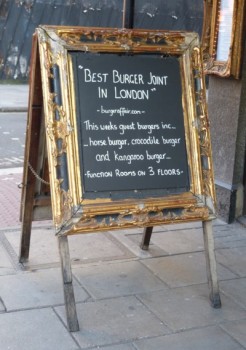
Click to enlarge, and then note the horse burger. It’s starting to look as if the main long-term effect of the Great Horse Meat Scandal upon Britain is that the British diet will be expanded. The politicians huff and puff. We get to discover how good horse can taste (that being a piece that was linked to by Instapundit yesterday).
Healthy life expectancy is shorter in the UK than abroad
People in the UK enjoy fewer years of good health before they die than the citizens of most comparable European countries as well as Australia and Canada, a major report shows.
The health secretary, Jeremy Hunt, said Britain’s performance was “shocking” compared with that of other countries, and called for action to turn it around by local health commissioners, who are about to take up their new responsibilities.
The UK ranked 12th out of 19 countries of similar affluence in 2010 in terms of healthy life expectancy at birth, according to a detailed analysis from the Global Burden of Disease data collected by the Institute for Health Metrics and Evaluation (IHME) in Seattle.
Despite big increases in funding for the NHS in recent years and many reform initiatives, the UK was in exactly the same place as in the league table for 1990, according to the IHME report, published in the Lancet medical journal.
Emphasis added. The report’s authors, and the Guardian article from which I quote, are at pains to say that
the problem is only in part to do with hospital care – much of it is about the way we live. Our diet, our drinking and continuing smoking habits all play a part
In other words, Britain’s relatively poor average life expectancy partly is to do with NHS hospital care, but they would rather not say so. As for the remainder of the problem that is not caused directly by the failings of the NHS, I wonder if the report’s authors have considered the possibility that the “despite” might be a “because”? Why do the British do worse than other nationalities of similar wealth when it comes to living an unhealthy lifestyle? It is no answer to just say “culture”; why is our culture as it is? Have we always been thus? We have a long tradition of getting drunk, I grant you, but my impression is that the British were not considered any fatter or any more drug-addled than comparable nations a few decades ago… before 1947, let us say for the purposes of discussion.
It is often said that one of the great blessings of the NHS is that it has lessened the fear of illness. The fact that they do not have additional worries about costs or insurance does come to those already worried about illness as a huge relief, and NHS-sceptics like me have to engage with that, sometimes in our own lives. So let us do so. I submit the hypothesis that a certain amount of fear of getting ill is salutary – both in the general sense of producing a beneficial effect and in the more specific, and original, sense of promoting health.
Naturally, I speak here of averages over a large population. Many illnesses cannot be avoided by human action; that is what insurance is for. When considering any one individual, I doubt that when making the many small bad decisions that have the cumulative effect of making him or her unhealthy, “hey, I don’t have to worry about paying for healthcare” often comes consciously to mind. But, like the proverbial mills of God, the mills of incentives grind slow but they grind exceeding small. In some countries those many small decisions take place under the shadow of “I might end up with a bill for this”. In Britain they do not. My hypothesis might go some way to explaining Britain’s anomalously poor average health. Something must explain it.
By the way, I shall take it as read that every human being has a perfect right to eat, drink, smoke and inject as he or she pleases. I shall also take it as read that the authors of the report and 95% of its readers wish to deny others that right. If the hypothesis above is correct, Britain has set up a system that, besides the inherent wrong of being based on coercion, removes one of the incentives for people to take care of their own health. How to solve that? More coercion, of course.
“If you want to revisit the 1970s, you no longer need a history book or a time machine. All that’s required is a collection of today’s newspapers – Right- or Left-leaning, it matters little – together with a regular infusion of BBC agitprop. With a few notable exceptions, all seem to gravitate around a tediously predictable banker-bashing, anti-profit, bonus-hating, anti-big-business agenda which spins us 40 years back in time to one of the lowest points in British history. What goes around comes around, I suppose, so with inflation perking up again, it can surely only be a matter of time before the Government brings back a fully blown Prices Commission. I exaggerate, of course, but only to make the point.”
– Jeremy Warner
He is broadly right, of course. Some of the “banker bashing”, though, has even come from the free market side of the fence, such as from the likes of Professor Kevin Dowd – who is known around these parts – making the point that banks operating with the implicit guarantee from the state and cheap money have been able to let their normally healthy instincts run amok. Alas, most of the attacks have focused on their allegedly big bonuses, which while it does not miss the mark entirely, is not really central to why we got into our current mess.
And Warner is interesting on how an energy sector, which has its problems, will not be in good shape if we keep hitting bank finance. There is another issue, meanwhile. What we might be seeing is a mixture of “junk science” (the notions that are leading us to turn our backs on cheap or at least reliable energy) and “junk money” (Quantitative Easing, etc).
It is interesting that he argues that there is a 1970s feel about the UK at the moment. He is right, although the private sector does not have the union militancy of back then, and the Cold War is over, and globalisation, for all its ups and downs, has taken more hold to the immense benefit of countries such as India and China. I see little sign of a move back to the 1970s in Asia.
The typical member of the British ruling class of yesteryear was complacent, arrogant, and a hypocrite. However his public school had at least imbued him with one particular virtue, or, failing that, had imbued him with the desire to appear to have that one virtue, which does well enough for most purposes. He wanted to be seen as a good sport. A chap who played the game. A chap who would not shoot a sitting duck or a grouse out of season, and who would never hit anyone who by reason of sex, age, or any other cause, could not hit back.
We have dispensed with all that foolishness now.
It is contempt of court for a juror ever to describe the deliberations of the jury of which he or she was a member. Thus the members of the jury held up to public scorn (“…a fundamental deficit in understanding … in 30 years of criminal trials I have never come across this at this stage, never”) by Mr Justice Sweeney for asking stupid questions cannot defend themselves.
Not playing the game, sir, not playing the game at all.
Related: Sexual and financial privacy and the bully pulpit.
If they figure at all, it is as a group to be derided, reduced to a caricature framed by Boden, Waitrose tempered by Lidl, holidays in France, and a fondness for television box sets. Their dinner-party concerns about finding a good school, a decent house or a good hospital qualify for jokes, little else. The tributes paid to Richard Briers remind us that, at best, the middle classes are an object of gentle ribbing, but seldom to be admired as the shock troops of economic recovery. Instead, politics has been reduced to an argument over how best to clobber the wealthy in order to help the poor, two small groups who attract a disproportionate amount of attention from politicians.
– Ben Brogan
Of course, it would be refreshing if we could just talk about people as individuals rather than as members of classes at all.
“More regulation” is the cry in every gagging throat, following the revelation that numerous cheap meat dishes in several supermarkets that were labelled as beef or lamb actually contained horsemeat.
Regulation caused the problem in the first place.
From today’s Times (subscriber only):
The Government knew last summer that a sudden ban on cheap British beef and lamb meant it was “inevitable” that unlawful meat would be imported from Europe.
Unintended consequences, again. It would make a horse laugh.
Jim Paice, the former Agriculture Minister, warned the committee last summer that unlawful meat would be imported from Europe as manufacturers sought cheap sources to make up for banned British supplies.
The warning came after the FSA [Food Standards Agency] suddenly told meat processors to halt the production of “desinewed” beef and lamb, which was used in tens of millions of ready meals, burgers and kebabs each year, after orders from European Commission inspectors.
The committee demanded in July last year that the Government set out its plans to prevent illegal imports, stating: “The Agriculture Minister’s evidence suggested that it was inevitable that wrongly labelled or unlawful meat products would be importing into the UK to replace UK produced desinewed meat.”
Emphasis added. Do not, however, expect this aspect to be emphasised in the Radio 4 Food Programme. I could be proved wrong; there is a podcast here which I am not in the mood to listen to, but so far the BBC’s coverage has been a relentless flow of, if you will forgive yet another revolting processed meat metaphor, pink slime.
I am not much impressed with Roger Bootle’s drearily conventional arguments for what the UK economy needs.
“I have banged on before about decisions on key projects which have large public sector involvement but which may also hold the key to major private sector spending, e.g. over London’s airport capacity.”
Preposterous Keynesian fallacy at work. It presupposes that money allocated to some project via the political process is more likely to create a ‘multiplier’ than market driven uses of that money… and it assumes that the money taken by the state by force would not have been invested in something more worthwhile in aggregate if the decisions were left to its original owners before it was confiscated by the state.
But of course as it is easier to see something like an airport rather than the myriad of other uses the money would have gone to had it not been forced into that project, so somehow the big flashy ‘infrastructure’ protect is claimed to have driven knock-on investment and is therefore an obvious Good Thing. As Bastiat put it “That which is seen versus that which is not seen”.
Ain’t necessarily so and given the record of government decision making versus the more diffused decision making of markets, usually ain’t so.
It is officially calculated that, between 2005 and 2009, up to 1,200 patients at Stafford Hospital died needlessly. Let us imagine that a comparable disaster occurred in any other institution or enterprise in this country. Suppose that hundreds of customers of the cold food counter at Sainsbury’s or Tesco died of food poisoning. Suppose that, at an army barracks, large comprehensive, steelworks, bank, hotel, university campus or holiday theme park, people died, and went on dying for years, at rates that hugely exceeded anything that could be attributed to the normal course of nature.
What would happen? In all cases – though more quickly in the private sector than in the public – the relevant management would be sacked. Indeed, the very idea of unnecessary deaths taking years to notice is almost inconceivable. Criminal charges would be brought. In many cases, the offending institution would close down.
But this is the National Health Service, and so we approach it with superstitious reverence, as if the fact that Stafford Hospital performed so many human sacrifices is so awe-inspiring that little can be done about it. For all its rhetoric of condemnation, this week’s report of the Mid Staffs inquiry by Robert Francis QC argues, in effect, that those in charge should stay in charge.
– Charles Moore
The claim that muslim thugs have been harassing people walking through ‘muslim areas’ of Britain has received much coverage in the UK media. I am always leery of taking such stories at face value… how prevalent is this? I do not live in an area with much in the way of a muslim population but I do regularly visit parts of London that do… and I have never seen anything like what is shown in the linked article/video happening.
That is not to say I do not think this sort of thing is at all implausible… not at all and heaven knows I am never slow to think poorly of a religion that explicitly espouses a totalitarian political order in its holy writings. But I wonder just how much of a problem it is? I am not in a position to judge for myself, but that it happens at all is intolerable.
Nevertheless, I wonder if the appearance of ‘Muslim Brownshirts’ in Britain is the sort of problem that is particularly amenable to government suppression. In truth, it seems to me it would be best dealt with at a more local and social level… no, I do not mean via some officially sanctioned ‘community outreach’ but rather by people taking a more ‘civil society oriented’ approach, which is to say confronting the fuckers on the streets, getting in their faces and if needed, replying to any violence by kicking them in the bollocks repeatedly.
Ideally, this sort of thing should be done by non-lunatic members of Britain’s muslim community, but that should by no means be seen as a prerequisite for pushing back. Indeed as they seem to enjoy picking on perceived homosexuals, perhaps some members of the typically vocal gay community might like to forcibly stick their oar in the water on this… but who pushes back matters less than someone should.
I suspect a more ‘grass roots’ approach would be vastly more effective than anything our worthless political class is likely to come up with.
In the UK, most of the price you pay to fuel your car is not paid to the Evil Oil Companies (boo hiss), it is in fact paid to… go on… take a guess…
… The State.
Nice, eh?
So it takes a bit of front for some vile toad from the government to moan about oil companies screwing the customer by not reducing prices fast enough when the global prices fall.
So how fast does the government reduce their tax burden when the economy is tanking? Oh yes, I forget, they generally increase taxes when that happens.
A lot of British people have done a “John Galt” in recent years, it seems, according to UK member of Parliament Nick de Bois:
Mr de Bois said tax does play a part in emigration, but suggested that culture is a more important factor, warning that Britain should encourage people to succeed and get rich, not criticise them. “Government must help lead a culture change in this country that competes with the new economies, one where competitiveness and success are valued and personal achievement and personal wealth are respected, not pilloried,” he said.
If you are mystified by the “Galt” reference (most Samizdata regulars will know it), it refers to the plot of Ayn Rand’s Atlas Shrugged, in which a character called John Galt leads a “strike” of the top businessmen, scientists, artists and others to abandon their work at a time when such people are increasingly hampered by the State. In the US, the expression “Going Galt” has caught on to describe the sort of thing written about here.
Of course, emigration needn’t be a bad sign for a country and indeed, in some countries, emigration can relieve domestic pressures. In the 19th Century, large numbers of Britons left for the New World, seeking a better life. Of course, many from the around the world did so for reasons of persecution and poverty. The ability to exit a country is also one of the few things that might persuade an otherwise foolish government to pursue policies that encourage wealth creation rather than hurt it. As I have noted before, the ability of the super-rich – or indeed far less wealthy people – to get their money abroad, or move overseas, can be a healthy constraint on government. That is why I think “tax competition” between jurisdictions, far from being an evil, as leftist campaigners claim, is a good force in the world. And so it is important to bear in mind that when governments impose capital controls and exit visas, be very afraid.
In the meantime, although I don’t agree with all of its views, this book, Exceptional People: How Migrants Shaped Our World and Will Define Our Future, by Ian Goldin, Geoffrey Cameron and Meer Balarajan, is worth a read. (I am not so keen on some of its Transnational Progressivist leanings, though).
Here is a classic piece of nonsense to start this week in chilly Britain:
The UK tax authority said the amount of tax that big companies may have underpaid by using artificial intercompany transactions to inappropriately reduce taxable profits has risen 48 percent last year. The figure comes as public anger grows over tax avoidance by big businesses and British MPs investigate possible remedies.
– (From a report from Reuters.)
I read this report carefully and nowhere does it say that the firms concerned have broken laws, engaged in fraud, or used violence or engaged in criminal acts. They are taking full advantage of the laws of the jurisdictions with which they have contact, as their shareholders would expect them to do in maximising shareholder returns. If politicians really wanted to reduce what they see as such dodgy tax avoidance, perhaps they should enact taxes that are simple, low, and flat. This is not rocket science, as the 2020 Tax Commission report issued last year showed.
The recent naming and shaming of Starbucks, for example, of simply making use of legal arrangements, was particularly odious. No wonder people are thinking that we are living in a world like something from the pages of Atlas Shrugged.
Tim Worstall writes about this sort of issue a lot, usually in the process of skewering that socialist “accountant” from Wandsworth, Richard Murphy. Tim is always entertaining and instructive at the same time.
|
Who Are We? The Samizdata people are a bunch of sinister and heavily armed globalist illuminati who seek to infect the entire world with the values of personal liberty and several property. Amongst our many crimes is a sense of humour and the intermittent use of British spelling.
We are also a varied group made up of social individualists, classical liberals, whigs, libertarians, extropians, futurists, ‘Porcupines’, Karl Popper fetishists, recovering neo-conservatives, crazed Ayn Rand worshipers, over-caffeinated Virginia Postrel devotees, witty Frédéric Bastiat wannabes, cypherpunks, minarchists, kritarchists and wild-eyed anarcho-capitalists from Britain, North America, Australia and Europe.
|