We are developing the social individualist meta-context for the future. From the very serious to the extremely frivolous... lets see what is on the mind of the Samizdata people.
Samizdata, derived from Samizdat /n. - a system of clandestine publication of banned literature in the USSR [Russ.,= self-publishing house]
|
One of the little pleasures of my life is looking back through old photo-archives and finding pictures that particularly amuse, in ways that I did register when taking them (otherwise I would not have taken them), but then forgot about.
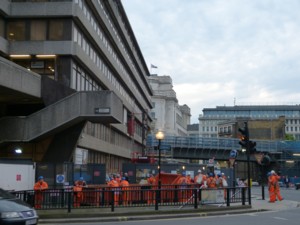
So this morning, for instance, while looking through some pictures I took earlier in the month of the remarkable (because so remarkably ugly) Baynard House, I came across this picture:
Yes, it is ugly, isn’t it? But what interested me when I took that photo was also all those Men in Orange. What were they up to? What struck me at the time, and I distinctly remember this feeling now, was what an alarmingly large number of Men In Orange there were. It was like they were making an action movie and about to be slaughtered by James Bond or by a James Bond imitator, or perhaps even plotting an urban atrocity of some sort themselves, for real. None of the photos I took of these many, many Men In Orange quite captures the scary oddity of them, congregated in such an alarmingly large number. The above snap was only the least unsuccessful from this point of view.
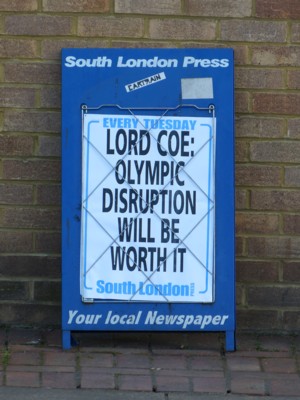
So it was that, when I encountered this sign on the side of Baynard House a few moments later, I was amused, and not wholly surprised:
Click to make that more legible.
What the Men In Orange are doing is some major rearranging of Blackfriars tube station. Blackfriars Station as a whole, including an overground railway station that straddles the Thames on Blackfriars Bridge, is being entirely reconstructed, and the underground bit with it. (I show a couple more shots of the overground aspect of all this activity here.) Merely the London Underground (LU) aspect of this is a big job, which requires the attentions of Men In Orange in large numbers.
The above snaps were taken when I was on my way to One New Change. The process of writing about One New Change caused me to forget my strange encounter with the Men In Orange, until prompted to remember the experience this morning, thanks to the magic of digital photography and the infinitely capacious hard drives that computers have in them nowadays.
Here is a photo I took in March of this year, which I have been meaning to feature here for ages:
We shall see.
One of the many annoying things about the Olympic Games is how little clutches of contractors and workers, doing vital things, know that they can, during the frantic run-up to the Olympics, demand a hugely exorbitant price for merely doing their job, even if they had earlier sworn blind that they would not behave like this. I imagine that’s a very widespread Olympic phenomenon generally, which adds hugely to the final bill, and is just one more reason why I wish the damn things had gone to Paris and never come back, ever.
I surmise – no speculation of this sort could easily be proved – that if any such demand becomes just too demanding, the means used by the State to settle such demands are not confined to bribery. If I was the State, I’d also now be issuing threats. I’d send people round to knock on doors to explain, ever so politely (perhaps over a friendly cup of tea), to such persons as trade unionists and building contractors, just how nasty the State is now capable of being, to individual people whom it has taken against. The State knows where you live. The State decides how much tax you owe it. And so on. And it could get even nastier. So, don’t push your luck too far, there’s a good fellow.
This is all pure speculation on my part. I have zero inside knowledge of any such negotiations. It’s just that if that were now happening, I would not be surprised, whereas if it wasn’t, I would be very surprised indeed.
Another way of responding to such last minute demands is to say: Okay, if you don’t finish it in time, you don’t finish it in time and it doesn’t get finished in time. Pity, but there you go. And once the Olympic Games are over, we can then sack the damn lot of you and take our time. While keeping all your names on a Black List, for you to be suitably punished at our leisure.
This seems to be the approach being adopted in the matter of the Greenwich Cable Car. I am particularly interested in this New London Thing because, when finally finished and open for business, it will be another fine photo-op for me, to add to my London list of places like this.
Yes, says Mayor Boris, we do indeed hope that the Emirates Airline will be ready in time for the Olympics, as another way to get people back and forth across the river, to and from all that Olympicism. But if it isn’t ready by then, so be it. This is not an “Olympic Project”, or it only will be if it is ready for the Olympics.
Very wise.
I recall that the London Eye was supposed to be ready for the Millennium, but that, perhaps for the kind of reasons speculated about above, it wasn’t. Who now cares?
Pity you can’t take that line with such things as velodromes and swimming pools. Which is why I suspect that other means of persuasion are also now being deployed.
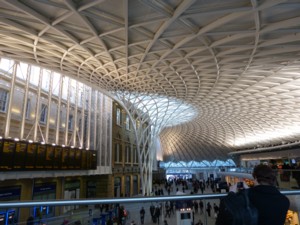
Last week, I read somewhere on the www that the new Kings Cross Station passenger concourse would be open to the general public for the first time on the following Monday, i.e. yesterday. When I got there yesterday afternoon, it was certainly functioning like a regular station concourse. It didn’t feel like it had only been open for a few hours, but then again it’s not as if an entire railway station opened, from nothing. This was a case merely of lots of people already using the approximate same place no longer having to thread their way through temporary arrangements, but instead having the pleasure of walking through this:
As you can see from my picture, I wasn’t the only photographer snapping away, and trust me, she and I were two of many. So maybe this really was the first public day of this new piece of London show-off modernity? The www confirmed it.
I knew roughly what this concourse was going to look like, having seen plenty of images of what the architects hoped it would look like, and, more recently, some photos taken by officially selected snappers before the rest of us were allowed in. But until you actually see things like this in the flesh, so to speak, you never really know what you think of them.
I was most agreeably surprised. Kings Cross, having been for the last decade put severely in the shade by the magnificently reborn St Pancras Railway Station, literally only a few dozen yards away, wasevidently making a huge effort to respond to that new Eurostar Palace. But I had feared something like one of those seemed-cool-but-actually-rather-naff, seventies, “designed” (as in: over-designed) pieces of lighting equipment. Not quite lava lamp, but in that kind of territory. I feared that the place would simply not be big enough to justify all that virtuoso metal patterning.
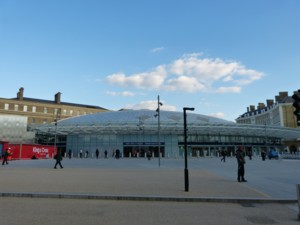
The reason I thought it would be too small for all that designer steelwork is that I had quite often walked past the outside of it, while they were building it. I photoed it again from the outside yesterday, and compared to how it looks inside, it appears from the outside to be tiny:
I say that St Pancras has upstaged Kings Cross for the last decade, but there are many who would contest this. St Pancras may have been awarded the Eurostar trains, but Kings Cross has … the Hogwart’s Express. Many of those visiting the new concourse gave no thought to its ceiling. They just wanted to have themselves photoed next to this sign:
I have a vague recollection of the real entrance to Platform 9¾ being in one of the old brick arches between Platforms 9 and 10, and an even vaguer recollection of waiting on Platform 10 for a train, and seeing some Pottermaniacs cavorting in front of this entrance. If that’s right, the sign I photoed yesterday is a fake. A fake, I tell you.
I guess they figure that the platform ticket business they might be doing is not worth all the bother.
Asks David Cameron:
Why is it that other infrastructure – for example water – is funded by private sector capital through privately owned, independently regulated, utilities… but roads in Britain call on the public finances for funding?
It might work, too, if roads really were private, with no subsidies to road owning companies and no government meddling in their operations, though I would be surprised if it works like that. The article suggests that this thinking is motivated by tight government finances. I rather like the idea of the government being forced to privatise everything because it has run out of money.
The president of the Automobile Association is not impressed:
In the water industry we saw big companies make big profits initially, at the same time as water and sewage costs went up by 42% and 36%.
Big profits are not a problem in themselves. But why would end user costs go up after privatisation if private companies are so efficient and competitive? It could be that before water privatisation the real costs were hidden inside other taxes, or it could be that water privatisation, much like rail privatisation, was anything but.
I am in Paris, staying with occasional Samizdatista Antoine Clarke.
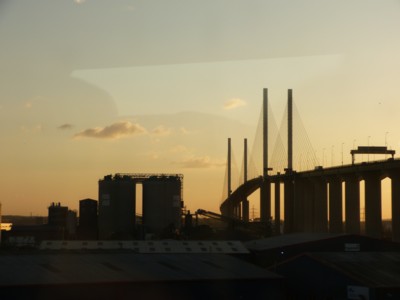
Photoed out of the Eurostar on the way, the M25 bridge over the Thames:
When I got there and after I’d settled in, we went out for supper and then went walking for a while.
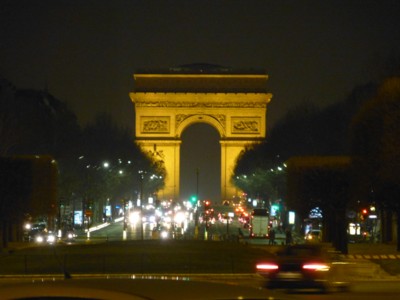
Arc de Triomphe:
Old internal customs duties office, which ceased functioning in 1943:
Antoine on Twitter this morning:
Ice cold in Paris … And those nice straight boulevards make wonderful wind tunnels.
Michael Jennings on Twitter:
Brian is having a good time then?
Antoine:
Likes this.
Bastard.
We were going to go out walking today, but instead will be indoors, either at Antoine’s home or in some museum.
It is surprisingly easy to get the sign wrong when reasoning about quantities. Consider this old riddle:
Three ladies go to a restaurant for a meal. They receive a bill for $30. They each put $10 on the table, which the waiter collects and takes to the till. The cashier informs the waiter that the bill should only have been for $25 and returns $5 to the waiter in $1 coins. On the way back to the table the waiter realizes that he cannot divide the coins equally between the ladies. As they didn’t know the total of the revised bill, he decides to put $2 in his own pocket and give each of the ladies $1.
Now that each lady has been given a dollar back, each of the ladies has paid $9. Three times 9 is 27. The waiter has $2 in his pocket. Two plus 27 is $29. The ladies originally handed over $30. Where is the missing dollar?
To get the missing $1 in the question we have done this arithmetic: 10 + 10 + 10 – 1 – 1 – 1 + 2 – 30 = -1
The correct arithmetic is: 10 + 10 + 10 – 1 – 1 – 1 – 2 – 25 = 0
Positive numbers represent payments from the ladies to the restaurant, and negative numbers represent money received by the restaurant. The result should obviously always come out to zero. That +2 should be a -2. Okay, there is a 30 where there should be a 25 as well, but only because the +2 yielded an intermediate result of 29 which is close enough to 30 to cause confusion.
This getting the sign wrong is the same mistake that means Tim Worstall has to point out that jobs are a cost. The new widget factory will create 1000 jobs, we are told. If it produces 1000 widgets per year, that means we get one widget per man-year of time. The man-year of time is a cost. If we could somehow arrange for the widget factory to create only 100 jobs for the same output, we would have just as many widgets and 900 man-years left to spend on some other useful thing. We would be richer.
This mistake crops up in trivial ways all the time. My friend recently gave up full-time work to look after the children for various financial and logistical reasons. Think how the economy is losing out, she mused. Not only am I not producing widgets, I am not paying the nursery workers or buying train tickets for my commute. Well it is true that the widgets my friend used to make are no longer made, but the nursery workers do not count: the same amount of childcare is being done as was being done before. It is not correct to add the childcare previously done by the nursery worker to the childcare now done by my friend. At worst there is now an unemployed nursery worker who will go and do something else instead, but that is just a market optimising everyone’s activities to match the level of demand. The train tickets were just part of the cost of getting the widgets made.
Ah, train tickets. We are going to get a new high speed rail link between London and Birmingham. The government is going to ‘invest’ £32.7bn in order to reap up to £46.9bn of ‘economic benefits’. I wonder how many of these benefits have the wrong sign. Counted among the benefits are “hundreds of jobs”, but these are already included in the cost figure.
Also counted are ticket sales. Which makes sense if the ‘investment’ was really an investment. But invest here really means to steal from the British public £32.7bn so that they can then pay, say, £40bn for train tickets in exchange for £40bn worth of train travel. I make that -32.7 – 40 + 40 = -32.7. Where is the missing £32.7bn?
The maths doesn’t add up; this is just sinking capital into a loss making project. If you’re going to use the power of the state to do that, then you shouldn’t be surprised that this country is getting poorer.
– Steve Baker MP denounces the plan for a new stretch of high speed rail, quoted (behind a registration wall) at the Financial Times.
I make this today’s QotD here not in spite of Guido having already featured it as his quote of today (and maybe also of the next few days) but because of this. Baker’s soundbite is getting around. Good.
Lots of Americans who read Samizdata but not Guido, and who are also confronting idiot plans to waste their money on high speed rail foolishnesses, will now also read this soundbite. Good again.
Meanwhile, as the FT’s headline proclaims, “economists insist” that this piece of Keynesian pump priming that won’t should go ahead, damn the expense. Well they would, wouldn’t they?
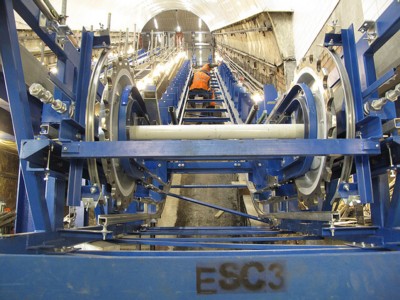
I like this picture:
I found it here. It is an escalator in the process of being replaced, at Charing Cross underground station, London. They’ve taken out the old one. They are now remaking whatever it is the new escalator will sit on top off. Then they will put in the new esacalator. It’s a routine they must have done dozens of times, with local variations to keep them on their toes. I do not doubt that when they finish their work, the escalator in question will function smoothly, no matter how many people ride on it or how heavy their luggage.
What I like about the photo is that it is, for me anyway, a reminder that there are still some things about our world that are progressing very nicely. The engineering of things like escalators continues to improve. But because the complexity that you see in this picture is, when the final object is rolled out, hidden, most people only think of such things on those rare occasions when they don’t work. At which point they grumble.
One of the big divisions in the world now, it seems to me, is between those who assume that such progress will necessarily continue, no matter how many mistakes the politicians make, and those who do not. Some people take technological progress for granted, while others notice it (often because they do it themselves for a living), want it very much to continue, but do not assume that it automatically will continue, no matter what.
Just in case you missed it, the last of these Frank Jisms is this:
This morning I started work on my next book for HarperCollins. Thanks to the sales of Obama: The Greatest President in the History of Everything, I was asked to write another book. This one will be on my solutions for all the problems facing America. Hopefully it will start a movement when it comes out with me as leader.
Earlier in the same posting Frank J quotes (admiringly) from and links to a piece (by him) about how, if cars were invented only now instead of when they were invented, we wouldn’t be allowed to drive them. Funny, and probably true.
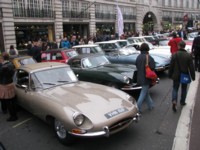
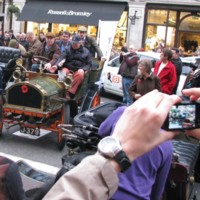
Yesterday, they closed off Regent Street, the famous central London shopping venue, to traffic, to make way for … some cars. I made my way to Regent Street, on the off chance of some photo ops, and was not disappointed.
There were E-Type Jags and Minis (i.e. real Minis – not the horribly huge German rehashes we see now), because both are celebrating their fiftieth birthdays this year:
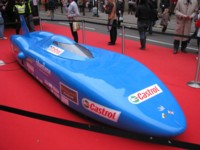
And there were even more exotic vehicles, like this one:
If there was a sign explaining that, I missed it. Anyone? It looks vaguely familiar, as having been involved in something like a land speed record.
There were also new vehicles on show, involving various drearily alternative means of propulsion, but looking exactly like regular cars.
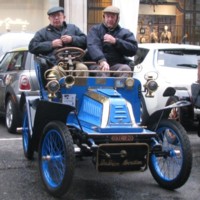
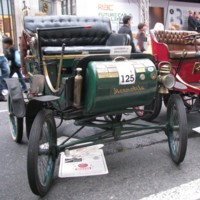
But the really old cars were something else again:
There were lots and lots of those. And it would be putting it very mildly indeed to say that I was not the only digital photographer present:
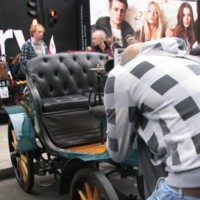
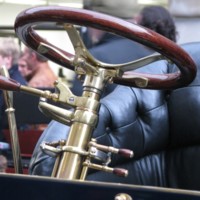
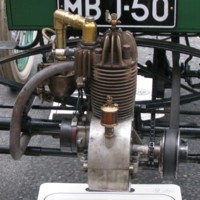
Nor was I the only digital photographer who was intrigued by many of the smaller mechanical details of these old cars:
The weather was rather grim, but the rain held off long enough for me to take all these snaps. Click on all of the above to get them bigger, and if that isn’t enough, go to my own blog, to see many, many more.
By the way, I’m not anti-German about everything they’ve done to Britain’s motor industry. I love what they’re doing with the Rolls Royce.
Time was when Ford was the model for corporatism and seen as a template for the State.
But that was before we got to a situation where Communist China’s state media castigates the US federal government for wasting money on welfare programs and over-borrowing.
I like the fact that Ford let Chris choose his own words to explain why he wouldn’t buy a government bail-out car. Very Post-Fordist.
A Brief History of the Age of Steam: The Power That Drove The Industrial Revolution
Thomas Crump
Carroll & Graff, 2007, 370pp., paperback, $15.95 (but now much less – I got my copy for £3.99 in a remainder shop)
The best thing about this book from my British point of view is that it does not focus only on British events and circumstances. It surveys the entire world, as best it can in the space it allows itself. In most other stuff I can recall reading about the history of the steam engine, Newcomen, Watt and Trevithick, the British pioneers of steam engines during the eighteenth century (Trevithick being the first to build a steam engine that propelled itself along a track – in other words the maker of the first locomotive), are followed immediately by the heroic deeds of George Stephenson and IK Brunel, the mighty British railway pioneers of the Victorian age. Foreign places get mentioned because Stephenson’s son did railways in them. Steamships are mentioned because Brunel also did them. But before you know it, you are being told about streamlined steam locos breaking speed records by hurtling from London to Scotland in the nineteen twenties and thirties, which was all good stuff but hardly central to the history of steam technology. By then, steam locomotives were a mature technology and soon to be an obsolete one.
In this book, by contrast, the steam engine arrives at its early nineteenth century state, but then the scene switches from Britain to North America. Steam engines, being still very heavy, made sense as the engines of big river boats on big American rivers well before they made sense as small locomotives on railway lines less than five feet apart. The USA, unlike Britain, has an abundance of huge rivers, in exactly the parts of the USA that were then developing most rapidly. The next chapter then concerns itself with rivers and canals (the two often being rather hard to distinguish) elsewhere in the world, most notably in central Europe, in particular in the form of the Rhine and its many reconstructions and appendages.
But already, I am getting ahead of the story. The first big job performed by steam engines was pumping water out of coal mines, the market that Newcomen catered to (1712 being the date of Newcomen’s first installation), and then the one in which James Watt and his partner Matthew Boulton also got their start. Until Newcomen made his engine, many a British coal mine would have to cease operating, not because the coal had run out but because the coal that remained, often in large quantities, was under water. Any kind of mechanically powered pump, however expensive and inefficient, could make itself useful in circumstances like that, a classic niche market of just the kind that a cumbersome but clearly important new technology needs to get started.
Thomas Crump (and yes, that is a rather Victorian sounding name, isn’t it?) does not make anything of the comparison, but the similarity between the early steam engines and the computers of our own time will strike anyone who reads this book. Steam engines started big and cumbersome. Then they got smaller and more powerful, thanks to a succession of technical innovations, and thanks to a general rise in engineering savvy and all-round craftsmanship. Not that this steam engine/computer parallel won’t have occurred to Crump. It’s merely that this book is published as one of a series called “A Brief History of …”, and you often sense, sometimes because Crump comes right out and says it, that lots of interesting stuff is being left out. → Continue reading: The age of steam powered transport
|
Who Are We? The Samizdata people are a bunch of sinister and heavily armed globalist illuminati who seek to infect the entire world with the values of personal liberty and several property. Amongst our many crimes is a sense of humour and the intermittent use of British spelling.
We are also a varied group made up of social individualists, classical liberals, whigs, libertarians, extropians, futurists, ‘Porcupines’, Karl Popper fetishists, recovering neo-conservatives, crazed Ayn Rand worshipers, over-caffeinated Virginia Postrel devotees, witty Frédéric Bastiat wannabes, cypherpunks, minarchists, kritarchists and wild-eyed anarcho-capitalists from Britain, North America, Australia and Europe.
|