We are developing the social individualist meta-context for the future. From the very serious to the extremely frivolous... lets see what is on the mind of the Samizdata people.
Samizdata, derived from Samizdat /n. - a system of clandestine publication of banned literature in the USSR [Russ.,= self-publishing house]
|
Yesterday, while I was cleaning my flat (you asking for a medal, Ed?), I had the TV on in the background and it was running a series of programmes via the Horizon team at the BBC about various natural disasters, such as earthquakes, killer giant waves and tsunamis. In the latter case, the programme speculated that if there was a volcanic eruption in one of the islands in the group known as the Canaries, off the African coast, that it would trigger a huge slide of rock into the ocean, therby causing a massive wave, which would then run left across to the Eastern seaboard of North America, probably parts of the Caribbean also, annihilating all in its path. New York, Balimore, Miami, etc would be obliterated.
This guy is not terribly convinced by the thesis. But suppose for a second that the direst predictions are accurate. Part of the theory is that the eruption will be so violent because of the enormous pressure that is building up inside the active volcano. So a question that occured to me was why doesn’t a team of geologists and engineers try to bore several large holes in the side of the volcano and let some of the pent-up magma come out, in a fairly controlled way?
I am not a scientist so feel free to mock this idea, but it occurs to me that given all the facts presented, this sort of idea might be a goer. I’d be interested to know what people think. There might be other techical “fixes” that spring to mind.
Some time ago, I asked here, non-rhetorically: What use is handwriting?, and I got a lot of very useful answers, such as that techies can communicate very well if they can hand-write, in ways that just wouldn’t work with any gadget more complicated than a pencil or felt-tip pen. By attaching labels to hastily sketched diagrams or graphs, for instance.
Now, for similarly pedagogical reasons I ask: What use is algebra? I refer to the most primitive sort of algebra, where you merely tiptoe into the swamp of abstraction and say things like: if a is 2 and b is 4, then what is a plus 2b? What is the specific value of writing out algebraic equations with small letters in them, and then either substituting particular values for those letters, or else deducing some of those values? Why go into letters, if all you then do is get out of them again, which seems to be the rule when you first start out at algebra.
I’m guessing – guessing because it is decades since I myself did any of this – that there is value to an equation, as a generalisation, quite lacking in the mere specifics of what happens in the particular case when a is 2 and b is 4. An equation specifies a general relationship, and one that is often worth understanding, and impossible to understand without this on-the-face-of-it peculiar and regressive diversion out of arithmetic and back into mere letters. But can the commentariat rephrase, correct, expand on that?
Ideally, they would do this in a way that might convince a twelve-year-old whose ambition is to get rich – perhaps by being a Something in The City (assuming there still is a City for him to be a Something in when he reaches his twenties) – and who now gets up before 6am every morning to do a paper round. By the time I get around to teaching him things like algebra, he is tired. What’s the point of this?, he asks. I would like to be able to give him some better answers than I have managed so far. I both like and admire this boy, and would really like him to do well.
We meet every Tuesday night, so my next chance to pass on such things will be tomorrow evening.
UPDATE Tuesday lunchtime: Many thanks for all the comments, most useful. Lots to pass on and to think about, and not just this evening.
I just watched this BBC Horizon programme, about cannabis.
Many who favour the legalisation of cannabis base their case on the claim that cannabis is less harmful than is widely assumed. It is less bad than you think, they say, in fact very good. For me, the case for legalisation does not depend on any claim about riskiness or lack of it, but rather on the idea that individuals should be allowed to decide for themselves about the risks they take, and about how pleasurable the pleasures are that they take these risks to enjoy. Not myself having any plans to take cannabis, I have tended to remain rather ignorant of the details of the riskiness argument, because I just do not think that this is what matters, any more than I favour denationalised washing machine businesses (which I do), because of and following long years spent studying the internal workings of washing machines.
But being a libertarian, I inevitably come across screeds about cannabis, of which this splendid rant (linked to from here yesterday by Johnathan Pearce) is a fine example. Spurred on by this rant, I watch the BBC show. I dozzed off during some of it, but still learned quite a lot. → Continue reading: Late night thoughts about cannabis
I have never felt the urge to buy an iPod as I am really not that interested in music-on-the-move, but maybe it is time for me to reconsider… I feel another overdue hunting trip to Central Europe coming on.
Life is always better when I have a book on the go which I can hardly wait to get back to. The Blind Watchmaker by Richard Dawkins is not quite going to be that for me. Too complicated. Not central enough to the things I happen now to be interested in, probably because I already agree with it far too completely for it to grab me by the throat. But, I have recently been dipping into this book, having finally got hold of a cheap second-hand copy of it, and yesterday I came across an argument in it which I found familiar, but in another context.
Dawkins criticises Bishop Hugh Montefiore (on page 38 of my 1991 Penguin paperback edition) for again and again resorting to the argument that he just cannot believe that this or that complex organ or organism could possibly have evolved. → Continue reading: Arguments from incredulity
Excellent, a new skycar prototype will be travelling from London to Timbuctoo, via ground and air. There is a nostalgic coolness about skycars as they reflect a legacy future where 1940s starlets are rescued by a world of modern skyscrapers and heroes in jetpacks. In reality, the car will be driven by the SAS and the Foreign Office provides its doleful advice that adventures are ‘dangerous’. Couldn’t they go to Cleethorpes instead and why can’t we force them to, thinks the man from the FO?
As well as natural barriers, the team has been warned about the threat of kidnap in volatile parts of Africa and the car will have to negotiate a minefield in Mauretania – “I might fly that one,” said 45-year-old expedition leader Neil Laughton.
When the need for flight arises – estimated to be for 40% of the journey – a ParaWing, a parachute of the type used by paragliders, will be dragged behind the modified off-road buggy and the propeller on the back of the vehicle will boost the Skycar down whatever happens to be serving as an improvised runway. When it reaches 45mph, enough lift should be generated to get the car airborne, its weight supported only by “a silk handkerchief, a large one at that”, said Laughton.
The adventure is referred to as an element of “mad Brits“, another phrase redolent of passing qualities. More details on the car can be found here, though one must accept that not all prototypes will be stylish Italian jobs. This one looks more like a souped up Dune buggy.
Following on from my post earlier about what sort of things might be regarded as wrong or intolerable by future generations that are widely done now, this book by David Friedman (son of Milton F), which looks at potential future legal, scientific and ethical controversies, looks interesting. For instance, Friedman asks what might happen to inheritance wrangles where the “deceased” is in fact held in cryonic suspension and hence not technically dead, as might be defined in a specific legal code. Some of this stuff might appear pure science fiction, but SF has a way of sometimes becoming reality. After all, the very fact that many people can afford to not use animal products such as leather has been made possible by synthetic fibres and materials such as plastic, something that did not exist about 100 years ago. Other developments could also make certain moral controversies either irrelevant or shift the boundaries markedly, or raise controversies that no-one has to contend with now.
On the dystopian side, the developments going on in IT might raise such worries about how the state might try to do things like implant computer chips into people’s bodies as a sort of ID system. Only the innocent have anything to fear…
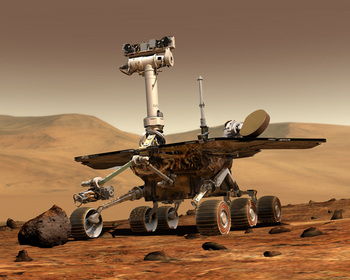
Yesterday was the fifth anniversary of the arrival on Mars of the Mars Exploration Rover Spirit. Despite a few problems to do with their age, both this rover and its identical twin Opportunity are in good working order and are still wandering around the surface of Mars and sending back interesting findings.
The obvious first thing to do is to congratulate everyone who had anything to do with these missions for a truly magnificent achievement. During my life, watching NASA’s manned space program has been intensely frustrating. Huge amounts of money have been spent on overly expensive boondogles that achieve less than was achieved in the years around the time I was born, despite there being no shortage of new and exciting things that could be achieved. At the same time, though, and on vastly smaller budgets, the unmanned probes produced by and with NASA/JPL to explore the planets and the solar system have managed magnificent achievement after magnificent achievement. Since I was a child we have learned so much about the planets and the solar system, and I have found it hugely inspiring. Seeing high resolution photographs of the moons of Saturn, or the surface of Mars, or the Great Dark Spot of Neptune – who would have imagined such things.
And yet, one thing that amazes me even more is the strange way in which NASA planetary probes stretch and warp time. For instance, the two Mars rovers were sent to Mars on missions that were supposed to last for 90 days. Both missions are now at five years, which is a little over 20 times the original length of the mission. This is an extreme example, but these missions often dramatically outlast their stated lifetimes. A four year Mars Global Surveyor mission turns into nine years. The Cassini mission to Saturn has been there for the planned four years, has had its funding extended for another two, and may manage more than that.
One reason why missions are able to be extended for long periods is of course the extraordinary ingenuity of the people who run them. That software is being upgraded and hardware used in unplanned ways to fix all manner of problems with stuck robotic arms, failed high-gain antennas, wheels getting a little sticky, rovers stuck in sand-dunes, and that these things so often seem to work is another thing that amazes me.
Yet, I wonder further. Clearly, when these missions are launched the hope is that they will keep going a lot longer than stated in the “mission objectives”. Clearly, also, in many cases the principal scientific goals will be achieved in the first few days or months after arriving at the destination, so what decides success is what happens shortly after arrival. Arguing that “everything else is a bonus” after the core objectives are achieved is probably fair.
How much of it is politics, though? I am sure it is easier to get funding for a five year old mission on the basis that “We have a rover on Mars that is still working and it would be a horrible shame to end the mission now” than asking for six years of funding at the beginning. I am sure also that when scientists are told that “You can’t have funding for A, B, C, and D, but we will give you funding for A and B”, they will find a way to include C and D while pretending that A and B is all they are doing, particularly if A and B are Jupiter and Saturn, and C and D are Uranus and Neptune.
And yet, when a 90 day mission is still going after five years, I cannot help but think that someone, somewhere, is taking the piss out of someone. All I can ask is that they please keep doing it.
Scientists are planning to ignite a tiny Man-made star, according to this Daily Telegraph article. I wonder if the scientists or the journalists writing on their activities have seen the film, Sunshine, about which reviews have been mixed?
Wired magazine has a neat item about ten species of creature that were discovered in 2008. Alas, as the comments in the article suggest, some people remain far more interested in the species varieties that have gone extinct this year. What perhaps needs to be stated is that in a constantly changing world, species are evolving and others are dying out, even without the allegedly malign influence of Man. What the deep Greens often do not seem ready to concede is that species have been wiped out before without the help of us naughty bipeds.
I have just heard on an infrastructure mail list that India has lost much international bandwidth and the problem is due to failure on the SeaMeaWea3, SeaMeaWea4 and FALCON submarine cable systems at Alexandria.
There were multiple failures in Alexandria just a few months ago if I remember correctly.
Less than an hour ago I cited Dr. Arthur Kantrowitz’s work on Science Courts in a Samizdata discussion, and in one of those strange and in this case saddening cases of synchronicity, I have just received an email notification that he passed away on November 29 at the age of 95.
Dr. Kantrowitz was a true gentleman of Science and will be much missed by all who have ever crossed his path.
I am sure others will have much more to say about his long career in the hard sciences.
|
Who Are We? The Samizdata people are a bunch of sinister and heavily armed globalist illuminati who seek to infect the entire world with the values of personal liberty and several property. Amongst our many crimes is a sense of humour and the intermittent use of British spelling.
We are also a varied group made up of social individualists, classical liberals, whigs, libertarians, extropians, futurists, ‘Porcupines’, Karl Popper fetishists, recovering neo-conservatives, crazed Ayn Rand worshipers, over-caffeinated Virginia Postrel devotees, witty Frédéric Bastiat wannabes, cypherpunks, minarchists, kritarchists and wild-eyed anarcho-capitalists from Britain, North America, Australia and Europe.
|





Recent Comments