We are developing the social individualist meta-context for the future. From the very serious to the extremely frivolous... lets see what is on the mind of the Samizdata people.
Samizdata, derived from Samizdat /n. - a system of clandestine publication of banned literature in the USSR [Russ.,= self-publishing house]
|
If you’re going to San Francisco, be sure to wear a flower in your hair:
The Green Party is expected to take control of San Francisco tomorrow and reclaim the city’s hippy heritage with a campaign that has relied on mass yoga rallies and poetry readings to overturn 40 years of Democrat rule.
Victory in the mayoral election would provide the party with its first senior official in the United States and the result would confirm San Francisco’s status as America’s most politically radical city.
Yoga? Poetry readings? So that’s how to beat the Democrats!
Among his policies are vast investment in cheap housing and the raising of the minimum wage to the highest in the country.
Assuming, of course, that any Green Party supporters actually have any intention of working for a living.
If he wins he has promised to make the city a “laboratory” for the party’s policies.
And where have we heard that one before?
At his campaign offices supporters with Mohawk haircuts mingle with those with facial piercings. Or as self-styled “free-flowing” poet Dave Whitaker, who says he once got Bob Dylan stoned, put it: the campaign’s success has been simply “karmic”.
That place sounds like a white-hot furnace of cutting-edge political and economic analysis.
“Cast a wide net. Find the common thread. Let life flourish. Then, don’t panic. Think organic. It’s a race between history and hip-story.”
Yup, works for me.
For a textbook example of rent-seeking, look no further than that pustulent petri dish of corruption, Illinois, for a dandy look at how it is done with affirmative action, casino licensing, and (of course) political connections. It has to do with the troubled Rosemont casino, which would have been located just outside of Chicago. (Sorry, this post has been rattling around in draft long enough for my links to rot. You’ll just have to take my word for it).
The State of Illinois licenses casinos, generally under terms that skim off obscene amounts of the profit to various appendages of the state. I suppose the State earns its money; since Illinois licenses very few casinos (Rosemont would be the 10th), it suppresses competition and thus enables those high profits to a significant degree. Regardless, I defy anyone to distinguish this racket from the more straightforward protection racket run by organized crime. Let the record show that the State of Illinois, through its protection racket for casinos, is perhaps the uber-rent-seeker in the whole sordid arrangement. → Continue reading: Rent seeking
I got dinked out of posting on a Mark Steyn column earlier this week. Fortunately, the prolific Mr. Steyn has lobbed another one my way, this time ruminating on the endemic corruption of Canada’s one-party state in response to a reader inquiry. His thoughts are well worth the read, as they explore the many, many byways of political corruption in what is by all accounts a relatively law-abiding liberal democracy.
It’s certainly – how shall we put this? – striking that a fellow [Prime Minister Chretien] who’s spent 40 years in the House of Commons with the exception of a brief time-out in the late Eighties is, by Canadian standards, so phenomenally wealthy.
Let’s just pause there for a moment. In the modern Canadian state, it is not necessary for M Chrétien to do anything illegal. As he has said, after years in government, he’s a well-connected guy with a fat Rolodex who knows the wheels that have to be oiled: he can tell his clients “what is necessary for them to do”. That’s something folks will pay for, as out-of-office politicians in many western democracies have discovered. But very few have the opportunities of patronage that exist in Canada: unlike M Chrétien with Senator Fitzpatrick, Mr Bush cannot install a boardroom buddy from his ball-team days in the US Senate.
Third, it’s interesting to see how M Chrétien’s business deals – like the Grand-Mère – circle back to the government, in the form of one agency or another. He was able to tell M Duhaime “what it is necessary for him to do” – ie, put him touch with the BDC – and also able to tell the bank “what it is necessary for them to do” – ie, pony up the dough to M Duhaime. In a one-party state, he is in the fortunate position of being able to tell all parties “what it is necessary for them to do”.
Canada’s “national identity” is supposedly to be found in its “social programs”; Canadians are supposedly willing to pay higher taxes in order for a more equitable society. Quite where the 50% of income the government takes winds up is hard to see: I can’t help noticing that I see far more beggars on the streets of Toronto and Montreal than in Boston, New York, Chicago, or any other American city I’ve been in recently, whether run by Republicans or Democrats. The hospitals in Canada are so overloaded they’re unable to observe even basic hygiene procedures, a basic failing which covers everything from the Ontario health system’s incubation of SARS to Labrador’s gift of Chlamydia to its gynaecological patients. M Chrétien lectured Wall Street that, while Canada had fewer millionaires than America, it also had fewer poor people. But what you can’t help noticing is that the plutocrats we do have are almost all well-connected Liberal Party types or businessmen whose businesses are either subsidized or regulated by the government. That’s why in the one-party state we wind up not just with one party but one bookstore chain, one media chain, etc. Meanwhile, the gap in income between the governing class – in its broadest sense – and the governed grows ever wider. After 40 years as a guy who knows “what’s necessary” for others to do, M Chrétien is merely the most prominent exemplar of the system.
There are words to describe the kind of society that kicks veterans’ widows out on the street while giving the former riding secretary who approves the decision a $160,000 expense tab, that lavishes billions on corporate welfare on Lib-friendly businesses but can’t wash the instruments between pap smears: “Welfare state”? “Just society”? Try “kleptocracy”.
I find myself with very little to add.
Some people have far too much time on their hands:
The County of Los Angeles actively promotes and is committed to ensure a work environment that is free from any discriminatory influence be it actual or perceived. As such, it is the County’s expectation that our manufacturers, suppliers and contractors make a concentrated effort to ensure that any equipment, supplies or services that are provided to County departments do not possess or portray an image that may be construed as offensive or defamatory in nature.
One such recent example included the manufacturer’s labeling of equipment where the words “Master/Slave” appeared to identify the primary and secondary sources. Based on the cultural diversity and sensitivity of Los Angeles County, this is not an acceptable identification label.
Okay, how about we use the term ‘Boss-man/Bitch’?
This is the subheading of Mark Steyn’s latest Spectator piece:
Mark Steyn lists the countries that must be dealt with if we are to win the war against terrorism
Okay. But the first regime listed gave me a bit of a turn:
New Hampshire
Does the axis of evil have a new member? Has the Governor of New Hampshire been stockpiling weapons of mass destruction? Is the whole article some kind of joke? Steyn is a funny man. Is this a funny piece?
Steyn goes on to list five further targets for regime change: Syria, Iran, Saudi Arabia, Sudan, and North Korea.
Profound changes in the above countries would not necessarily mean the end of the war on terror, but it would be pretty close. It would remove terrorism’s most brazen patron (Syria), its ideological inspiration (the prototype Islamic Republic of Iran), its principal paymaster (Saudi Arabia), a critical source of manpower (Sudan) and its most potentially dangerous weapons supplier (North Korea). They’re the fronts on which the battle has to be fought: it’s not just terror groups, it’s the state actors who provide them with infrastructure and extend their global reach. Right now, America – and Britain, Australia and Italy – are fighting defensively, reacting to this or that well-timed atrocity as it occurs. But the best way to judge whether we’re winning and how serious we are about winning is how fast the above regimes are gone. Blair speed won’t do.
That all sounds fairly serious, doesn’t it? So what does Steyn have against New Hampshire? Ah. Penny drops. New Hampshire is where he was writing from. The universe makes sense again.
Nevertheless, behind this little joke there is a serious point. Steyn is describing a war against terrorism that does make sense to me. But the opponents of this war say that by the time Uncle Sam has toppled the regimes of Syria, Iran, Saudi Arabia, Sudan, and North Korea – or by the time it has given up trying to – it will indeed end up governing New Hampshire, and everywhere else in the USA, somewhat differently. War is the health of the state, as somebody once said.
My answer would be that hardly anyone is suggesting that there be no vigorous war fought against Islamic terrorism – and hence that no measures be taken that might infringe the liberties of Americans, or others. The war is being fought and will go on being fought. The only serious argument is about where to fight it. Is it to be fought in places like Syria, Iran, Saudi Arabia, Sudan, North Korea, and back home in places like New Hampshire? Or should some or all of the first five be struck off the list?
Either way, New Hampshire is indeed liable to end up a rather different place.
George Will, of all people, plants a couple of barbs in the leviathan in this column.
On May 24, 1945, just 16 days after V-E Day, Britain’s socialists were sanguine. A Labour Party firebrand, Aneurin Bevan, anticipating the Labour victory that occurred five weeks later, said privation would be a thing of the past because essentials would soon be abundant: “This island is made mainly of coal and surrounded by fish. Only an organizing genius could produce a shortage of coal and fish at the same time.”
But socialism rose to the challenge. Two years later, the coal industry having been nationalized and food still rationed, coal and fish were scarce. There are indeed some things that only government can do.
The segue into campaign finance reform is well done:
The government, by its restrictions on the amounts and conduits of political giving, has turned something that exists in wild abundance in America — money — into a scarcity. As the postwar Labour government did with coal and fish.
Speaking of fish, as in barrels, shooting in, the punchline is of course the hypocrisy of candidates bleating against the exercise of free speech and free association, via campaign contributions, of their opponents, while doing exactly what they decry.
So now [Dean] says that unless he abandons public financing, his money will be gone when the primaries are over. Then Bush could spend to speak to the nation all summer, while he, Dean, would fall silent until after the Democratic convention, when he would get a fresh infusion of public money.
But notice that Dean’s argument concedes what campaign finance regulators deny — that money is tantamount to speech, and therefore limits on political money limit political speech.
The fact that political speech, the very adamantine core of the First Amendment guarantees of free speech and association, is very highly regulated, with the blessing (to date) of the Supreme Court, is perhaps the single most damning indictment of the utility of written Constitutions as a protector of individual rights.
James Lileks’ Bleat, usually devoted primarily to domestic bliss, today gets a little screedy. James has peeked inside the sausage factory that is the US Senate.
The spleen, she hurts. I think it had to do with listening to the Senate debate, if that word applies, and wondering: are they always this banal? This condescending? Are bloviating prevarications the rule rather than the exception? In short: is the world’s greatest deliberative body really filled with this many dim bulbs, card sharps and overstroked dolts who confuse a leaden pause with great rhetoric? If everyone in America had been tied to a chair and forced to watch the debate Clockwork-Orange style, we’d all realize that the Senate is just a holding tank for people whose self-regard and cretinous reasoning is matched only by their demonstrable contempt for the idiots they think will lap this crap up.
Unicameral house! Two year term! One term limit!
There’s more, on such perennial faves as the French, Michael Moore, and the angry anti-war lot. I started to excerpt, but when your cursor is hovering over “Select All” it is time to just say “read the whole thing.”
Well, well, well. The usually flaky and oft-overturned 9th Circuit Court of Appeals (the regional appellate court in the US that includes California and sits one notch below the Supreme Court) has lobbed a high hard one at the Supremes, a direct challenge to one of the linchpins of jurisprudence permitting the federal government to exercise almost unlimited “police” powers.

The 9th Circuit just ruled that the federal government has no power to outlaw homemade machine guns, because homemade guns are not in interstate commerce. The extraordinarily broad readings of the Interstate Commerce Clause, which permits the federal government to regulate interstate commerce, were adopted in a New Deal era case in which a farmer challenged federal rules dictating how much wheat he could grow. The case was beautifully positioned, with the wheat in question being fed to the farmer’s cattle and thus never leaving his farm, much less entering into commerce at all, never mind interstate commerce. The Supreme Court would have none of it, though, and ruled that this wheat was nonetheless in interstate commerce and thus subject to federal control.
Under this reading of the Interstate Commerce Clause, I don’t see how a homemade machine gun is not in interstate commerce. After all, it affects the global supply and demand for machine guns in exactly the same way that the wheat did. This case mounts a pretty direct challenge to one of the worst Supreme Court decisions ever. Its a rare day when I root for the 9th Circuit, but all things come around in time, I suppose.
The Volokhs have a little more detail. The case (or another on the same principle) will almost certainly have to be taken up by the Supremes, as there is now a conflict between appellate courts on the issue.
The Instapundit, that wag, notes that, while he hasn’t read the opinion, any position is defensible with enough homemade machine guns!

Congress shall make no law respecting an establishment of religion, or prohibiting the free exercise thereof; or abridging the freedom of speech, or of the press; or the right of the people peaceably to assemble, and to petition the government for a redress of grievances.
– 1st Amendment of the US Constitution
As I prefer to argue matters from first principles rather than on the basis of falsely self-legitimising artefacts of state such as legal documents, I rarely discuss, much less quote, the much vaunted US Constitution. Yet I think any reasonable reading of those lines above would say that the objective at hand when it was written was to safeguard the freedom to express views, particularly political views, in any manner, so long as it was done peaceably.
So I can only assume that Democratic Party Presidential wannabe Wes Clark1 takes the view that speech and press mean literally spoken word and mechanical press, and thus the Amendment does not actually refer to expression, and thus does not cover anything not literally speech or printed media produced with a honking great press, such as the Internet or anything else not literally speech or press. How else does one explain his support for prosecuting people who engage in political expression by desecrating US flags?
Of course the argument often used is that burning a US flag pisses off some people in the USA so much that it is likely to cause violence. Funny how the same people who make that argument usually also oppose the same argument when it is applied to so-called ‘hate speech’… but being a left winger, I guess Wes Clark is at least being consistent in wanting political control over unpopular forms of expression unlike the more inconsistent conservative ‘hand on heart’ supporters who want to turn the US flag into an inviolate icon whilst insisting on the right to call a fag a fag and a spick a spick.
1 = British readers will be fascinated to know this is the same clown who wanted to start a shooting war between Russia and NATO in June, 1998. This is the guy who will save us from ‘that madman and threat to world peace, George Bush’. Aiyiyi… 
Paul Staines sees the same problem as David Carr… George Soros has gone off the deep end
I have a lot of respect for George Soros, not because he’s a muliti-billionaire, but because of his huge financial support for his Open Society foundations and for his articulating the intriguing concept of ‘reflexivity’ in financial markets. I found the philosophical excursions of the former student of Karl Popper interesting, even if professional philosophers tended to find them embarrassing. But his 2002 book George Soros on Globalization confirmed what was pretty clear from his 1998 The Crisis of Global Capitalism: Open Society Endangered. He was getting messianic and becoming like a bootlegger turned temperance campaigner. Soros would deny that he is anti-capitalist, he is he says against market fundamentalism. Ironic given his phenomenal success in unregulated currency markets.
For the last decade Soros has been preaching a third way for international finance – seeking to update the international financial architecture is an intellectually respectable position. Keynes’ Bretton Woods structures have worked more or less, they may have even prevented a few disasters, but they can definitely be improved upon. Interventionist multi-lateral institutions intervening in markets to maintain the liberal market order may or may not work. After a little over half a century of experimentation it is hard to tell. The IMF, World Bank et al may have made things worse more often than they have been the cavalry coming into save the global economy. Sometimes, his argument goes, international capitalism gets so manically out of control it needs to be saved from itself. The jury is out on that. Soros is, in the tradition of Keynes, not an enemy of capitalism, but someone who wants to radically temper it.
Fair enough, it’s not crypto-Marxism, he means well, he may even have a point. But now according to the Washington Post, Soros is devoting his efforts to defeating Bush in 2004. So far he has given $15m towards anti-Bush campaigns, “It is the central focus of my life… a matter of life and death.” He goes on to say “America, under Bush, is a danger to the world, and I’m willing to put my money where my mouth is.”
I think at 74, Soros is losing his grip, his self proclaimed ‘Soros Doctrine’ is delusional, his one-man foreign policy was fine when he was promoting democracy but is overstretched trying to re-fashion geo-politics. Now he is getting down and dirty in partisan presidential politics he may come to regret it.
Speculation, philosophy and philanthropy are much more gentlemanly affairs, the Republicans are already claiming he has bought the Democratic party. Soros is in danger of jeopardising his place in posterity. Shame.
Paul Staines
This sounds exactly like the kind of thing that should have an army of conspiracy-theorists hacking away at their keyboards in a veritable orgy of rumour-mongering. Are they? Will they?
After all, it is not every day that a gazillionaire, international financier buys up a political wing of an entire country:
George Soros, one of the world’s wealthiest financiers and philanthropists, has declared that getting George Bush out of the White House has become the “central focus” of his life, and he has put more than $15m (£9m) of his own money where his mouth is.
“It is the central focus of my life,” he told the Washington Post in an interview published yesterday, after announcing a donation of $5m to a liberal activist organisation called MoveOn.org. The gift brings the total amount in donations to groups dedicated to Mr Bush’s removal to $15.5m.
Other pledges of cash have gone to America Coming Together (ACT), an anti-Bush group that proposes to mobilise voters against the president in 17 battleground states. Mr Soros and a friend, Peter Lewis, the chairman of a car insurance company, promised $10m.
Mr Soros has also helped to bankroll a new liberal think-tank, the Centre for American Progress, to be headed by Bill Clinton’s former chief of staff, John Podesta, which will aim to counter the rising influence of neo-conservative institutions in Washington.
Excuse me, but ‘liberal’? MoveOn.org are hardcore socialists who are about as ‘liberal’ as Fidel Castro.
The 74-year-old investor, who made a fortune betting against the pound in the late 80s and against the dollar this year, is to lay out the reasons for his detestation of the Bush administration in a book to be published in January, titled The Bubble of American Supremacy, a polemic which he has half-jokingly dubbed the ‘Soros Doctrine’.
Which means that he at least half-serious (and that is generally serious enough).
Of course, Mr Soros is free to do what he pleases with his own money but is this plutocratic takeover of the American left really all about George Bush? Or are there more lavish plans afoot? Mr. Soros has mind-boggling amounts of money, an army of political footsoldiers at his disposal and a ‘doctrine’. All he needs to complete the picture is a monocle and a persian cat.
I am always rather embarrassed when I find myself in the position of defending George Bush. He is a machine politician of the kind I have learned to mistrust on principle. But looking at the respective profiles of these two Georges, which one sounds more like a demagogue?
update: ‘AK’ has sent us a very… revealing image!
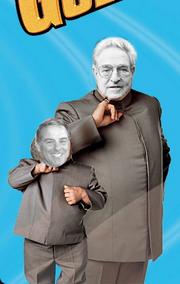
click for larger image
The Drug ‘War’ continues to dement US society in new and innovative ways that even a cynic such as myself find hard to credit. This is truly staggering:
Gun-toting police burst into a South Carolina high school, ordering students to lie down in hall ways as they searched for drugs. The commando-style raid has parents questioning the wisdom of police tactics. The raid occurred Wednesday at Stratford High School in Goose Creek, S.C. Surveillance video obtained by CBS Affiliate WCSC in Charleston shows the police waving their guns and searching lockers as students lie flat on their stomachs or sides. The school’s principal defends the dramatic sweep, caught on the school’s surveillance tape. Police came into the school with guns at the ready, ordered all students to lie on the floor and then handcuffed anyone who apparently didn’t comply quickly enough.
I am sorry, but some square headed jerks in blue shirts start waving guns around a bunch of children who are just going about their business at school, and it is reported that parents are “questioning the wisdom of police tactics”? Questioning the wisdom of police tactics? To quote that wit and sage Eddy Murphy, get the fuck outa here. I would be looking for some heads-on-spikes if a child of mine was subjected to that sort of treatment. How this incident has not resulted in angry mobs in the streets throwing rocks is beyond me. What does it take to really piss these people off?
So… attention all parents in Goose Creek: are you starting to have second thoughts about the wisdom of entrusting your children to state ‘care’ yet? Unbelievable.
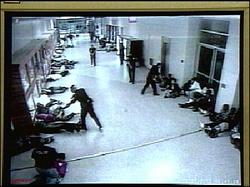
And now class, today’s important lesson:
The state is not your friend.
Any questions?
via Catallarchy.net
|
Who Are We? The Samizdata people are a bunch of sinister and heavily armed globalist illuminati who seek to infect the entire world with the values of personal liberty and several property. Amongst our many crimes is a sense of humour and the intermittent use of British spelling.
We are also a varied group made up of social individualists, classical liberals, whigs, libertarians, extropians, futurists, ‘Porcupines’, Karl Popper fetishists, recovering neo-conservatives, crazed Ayn Rand worshipers, over-caffeinated Virginia Postrel devotees, witty Frédéric Bastiat wannabes, cypherpunks, minarchists, kritarchists and wild-eyed anarcho-capitalists from Britain, North America, Australia and Europe.
|




