We are developing the social individualist meta-context for the future. From the very serious to the extremely frivolous... lets see what is on the mind of the Samizdata people.
Samizdata, derived from Samizdat /n. - a system of clandestine publication of banned literature in the USSR [Russ.,= self-publishing house]
|
I have not run across this elsewhere, but I have not been looking either. If the mad mullahs of Iran are executing officers who are war heroes, it is a worrisome sign of what they are planning for the population. If it was just a matter of tightening control over the Army, they could just ‘retire’ the offending officers. Executions mean they want to remove any possibility forthcoming orders are not followed or troops switch sides in a showdown. I am worried they are preparing for a major pogrom with an end result of yet another set of unrecorded mass graves in the deserts of Central Asia.
I have been getting conflicting information on what might happen if it comes to a confrontation ala Eastern Europe. An Arab friend feels that the majority of the country is not of the urban middle class and the country folk are absolutely loyal to their tribal leaders and very fundamentalist. A physicist friend with urban contacts tells me the balance is not so clear cut and during the previous Iranian Revolution the liberals simply got double-crossed by the fanatical mullahs with whom they had a temporary common cause.
Perhaps members of our commentariat or some Arab friends could lend insight into what might happen if push really does come to shove in Tehran.
While reading some DOD press briefing transcripts tonight I was struck by the total dehumanization inherent in a person choosing to be a suicide bomber. At the instant they strap on the explosive belt or seat themselves in a car bomb they cease being a person. They become nothing but an expendable munition, bombs in a deceptively human form.
I suggest a new name for them: SPM’s.
Self Portable Munitions.
Almost everyone has heard about the list of persons and organizations purportedly bribed with oil by Saddam Hussein. You can find the partial list here at MEMRI.
Enjoy!
This looks interesting, from today’s Independent:
Claims that dozens of politicians, including some from prominent anti-war countries such as France, had taken bribes to support Saddam Hussein are to be investigated by the Iraqi authorities. The US-backed Iraqi Governing Council decided to check after an independent Baghdad newspaper, al-Mada, published a list which it said was based on oil ministry documents.
The 46 individuals, companies and organisations inside and outside Iraq were given millions of barrels of oil, the documents show. Thousands of papers were looted from the State Oil Marketing Organisation after Baghdad fell to US forces on 9 April.
“I think the list is true,” Naseer Chaderji, a Governing Council member, said. “I will demand an investigation. These people must be prosecuted.” Rumours had circulated for months that documents implicating senior French individuals were about to surface. Such evidence would undermine the French position before the war when President Jacques Chirac staked out the moral high ground in opposing the invasion.
I don’t remember Chirac staking out any moral high ground, just that some people thought he had, perhaps including him. But I do recall learning, although I forget how, that Saddam had a bribery network that covered the whole Middle East, and I recall thinking that it probably did not stop there. Of course, it is hardly news that France is riddled with corruption. The news is that a semi-major newspaper is saying it, today, again.
British Liberal Democrat MP, Jenny Tonge, has been publicly displaying her licensed copy of ‘Root Causes Version 2.0’:
“I was just trying to say how, having seen the violence and the humiliation and the provocation that the Palestinian people live under every day and have done since their land was occupied by Israel, I could understand and was trying to understand where [suicide bombers] were coming from,” Dr Tonge told BBC Radio 4’s Today programme.
She was speaking to a pro-Palestinian lobby when she said of Palestinian suicide bombers: “If I had to live in that situation – and I say that advisedly – I might just consider becoming one myself.”
Well, if Mrs Tonge feels that she really must blow herself to smithereens, then so be it. But before she turns herself into an abstract art installation, I hope someone takes the trouble to ask her for an explanation of this:
With the identification of two suicide bombers in Israel as British subjects, Britain faced suggestions Thursday that young British Muslims, previously associated with militant Islamic groups in Afghanistan, Pakistan, Yemen and elsewhere had now shifted focus to terrorism in the Middle East.
The identification as British citizens of Asif Hanif, 21, who died in a bomb attack that killed three people in a Tel Aviv nightclub Wednesday, and an accomplice, Omar Sharif, 27, also represented the first known instance in recent years of Britons prepared to kill themselves launching a terror attack. The news seemed to leave British officials stunned. “We think that the terrorists had British passports, which is something especially sad,” said Sherard Cowper-Coles, Britain’s ambassador in Israel.
As on previous occasions when British Muslims were found to have been fighting for the Taliban in Afghanistan or planning alleged terrorism in Britain, the suspected terrorists seemed to have grown up in innocuous, middle-class or blue-collar environments far from the conflicts they came to espouse as their own. That seemed to differentiate them from the more usual image of suicide bombers molded by the hardships of Gaza or the West Bank.
Small wonder that people like Mrs Tonge have conveniently chosen to forget this particular case of ‘desperation’.
French state schools, unlike the British or American varieties, were founded explicitly to oppose clerical power. They are the most visible and enduring bastions of secularism in France. Originally, the prohibition of religious symbols in schools was aimed against Catholics. Many of the supporters of secularism in the 19th century in France were non-conformist or atheist: often Protestant or Jewish. The antisemistism of such groups as Action Française from the 1890s onwards is in turn a reaction against the French radical assault on Catholic society. In the early 20th century a deal was worked out that allowed religious schools to operate alongside the secular system.
The Islamist campaign against secularism is what the headscarf law is about. In some schools, violence has been threatened against girls who refused to wear scarves. Apologists for fundamentalists (ususally socialists hoping to play the race card) condoned the violence and have allowed a climate of terror in French schools.
As a libertarian, I oppose state schools. But also as a libertarian, I also support the prohibition of Islamic fundamentalist intimidation. If Islamic schools really allowed freedom to exit, I could back Moslem campaigns for lifting any restrictions the French government might have against their own schools.
When I visit a mosque, I take off my shoes, I do not interfere with the religious devotions of the worshippers, and I do not demonstrate my own devotions to eating pork and drinking beer. The person who chooses a turban ahead of an education has got “I’m a loser!” stamped all over him. But the people who organise the headscarf campaigns do not want freedom of choice: they want a licence to coerce.
This is not a campaign for religious freedom: Moslems are free to set up their own schools. It is a campaign to separate the public and the private sphere: in the school each pupil’s religious affiliation is a private and not a public matter.
Far be it from me to condone the criminal régime of Chirac. But, this is the same fight as the Turkish Army’s fight to defend a secular state against the fundmentalist tyranny. It is a small corner of the War on Terror, and compared with the some of the antics of the Department of “Homeland Defense” a.k.a. Minipax, one worth fighting.
It is also a campaign against obscurantism. French people often mock those parts of the USA where it is illegal to teach Darwin, or where Creationist theories have to be accorded equal credibilty in the classroom.
The cover article of the latest New Statesman is by William Dalrymple, and is called simply Islamophobia. The value of the piece for me is that it puts the case against the current trend of US (and UK) policy as strongly as I have ever read it. War is the health of the state, and it will bring ID cards and tougher searches at airports, blah blah. Maybe so, but that hardly amounts to the collapse of civilisation as we know it. This (this being the concluding paragraphs of Dalrymple’s piece), on the other hand, just might:
Meanwhile, Tony Blair’s neoconservative chums in Washington, immune to the justifiable fears of the Muslim world, talk blithely of moving on from Iraq next year to attack Iran and Syria. They have also invited Franklin Graham, the Christian evangelist who has branded Islam a “very wicked and evil” religion, to be the official speaker at the Pentagon’s annual service – and this immediately prior to his departure for Iraq to attempt to convert the people of Baghdad to Christianity.
All the while, the paranoia and bottled-up rage in the Muslim world grows more uncontrollable, and the attacks by Islamic militants gather pace, gaining ever wider global reach and sophistication. As long as British Muslims remain at the receiving end of our rampant Islamophobia, and remain excluded from the mainstream of British life, we can expect only still greater numbers of disenfranchised Muslims in the UK to turn their back on Britain and rally to the extremists.
As Jason Burke points out at the end of his excellent book Al-Qaeda, “The greatest weapon in the war on terrorism is the courage, decency, humour and integrity of the vast proportion of the world’s 1.2 billion Muslims. It is this that is restricting the spread of al-Qaeda, not the activities of counter-terrorism experts. Without it, we are lost. There is indeed a battle between the west and men like Bin Laden. But it is not a battle for global supremacy. It is a battle for hearts and minds. And it is a battle that we, and our allies in the Muslim world, are currently losing.”
This month’s upsurge of rampant Islamophobia in Britain, widely reported in Muslim countries, is the last thing we need in such a desperately volatile climate.
That “upsurge” is the Kilroy-Silk affair, and the surge of support that K-S received, in particular, from the readers of the Daily Express, together with the increasing number of attacks of British mosques there have been lately.
The point is this. More airport searches for us, or for that matter even that military ‘quagmire’ that the opponents of military action in Iraq have been earnestly predicting and for which some may even have been hoping, is as nothing – nothing – when set beside the danger that Dalrymple is describing. What he fears is a massive influx of intelligent, educated (much of it scientifically educated) talent into the ranks of the terrorists, as a result of the thrust of Western policy towards Islam in general, and in particular as a result of the inability of anti-Islamists to make any distinction between mere Muslims, and outright terrorists. Give a dog a bad name, in other words.
I don’t like Islam one little bit, because I consider its central tenets to be untrue, and I dislike untruth. (God does not exist. Muhammed is not his prophet. Etc.) I feel similarly about Christianity. (God does not exist. God did not send his son anywhere.) I further dislike Islam because so many Muslims these days, unlike most of the Christians I have much to do with, seem to take their religion really seriously and really to believe it to be true, which I find frightening. Who knows what the hell these people will deduce from their false axioms? It only takes a tiny few. (In the past it only took a tiny few Christians to set the tone of entire centuries.) So, yes, despite the fact that I am well aware of the fact – which of course it is – that the overwhelming majority of Muslims are entirely peaceable and decent and morally blameless people, and in millions upon millions of cases I dare say a lot better people than I am, I am “Islamophobic”. So, am I helping to push the world into a pit of barbarity, just by saying such things as I do earlier in this paragraph?
Setting aside entirely the moral rights and wrongs of the matter (i.e. am I entitled to put what I put in the previous paragraph?) is current US policy (and the attitudes of people like me that accompany it), as a matter of fact, having the effect on the overwhelming majority of hitherto non-terroristic Muslims that Dalrymple describes? Is George W. Bush making Al-Qaeda recruitment harder or easier than it would otherwise have been? Is GWB frightening the Muslim world into abjuring terrorism, or enraging it into taking it up big time? In short, are we winning the War on Terrorism, or losing it?
If people want to comment on that by veering off into the realms of the related but utterly distinct matter of whether we are morally or intellectually or politically entitled to be rude to Muslims, or whether they started it, or which is worse, our Islamophobia or their anti-Semitism and anti-Great-Satanism – they should obviously feel free. I can’t stop such comments. But the great strategic question is surely: whether, as a matter of fact, people like William Dalrymple are right or wrong.
My tentative opinion has always been – i.e. since 9/11 – that whereas some Muslims are no doubt being enraged into terrorism by US policy, many more are being scared away from it. But am I right?
Mark Steyn’s has something to say about the Kilroy-Silk affair in the Telegraph today. True to his ‘notorious’ style he does not mince words. Enjoy.
Let me see if I understand the BBC Rules of Engagement correctly: if you’re Robert Kilroy-Silk and you make some robust statements about the Arab penchant for suicide bombing, amputations, repression of women and a generally celebratory attitude to September 11 – none of which is factually in dispute – the BBC will yank you off the air and the Commission for Racial Equality will file a complaint to the police which could result in your serving seven years in gaol. Message: this behaviour is unacceptable in multicultural Britain.
But, if you’re Tom Paulin and you incite murder, in a part of the world where folks need little incitement to murder, as part of a non-factual emotive rant about how “Brooklyn-born” Jewish settlers on the West Bank “should be shot dead” because “they are Nazis” and “I feel nothing but hatred for them”, the BBC will keep you on the air, kibitzing (as the Zionists would say) with the crème de la crème of London’s cultural arbiters each week. Message: this behaviour is completely acceptable.
The situation starts looking serious with the concluding paragraph:
And so, when free speech, artistic expression, feminism and other totems of western pluralism clash directly with the Islamic lobby, Islam more often than not wins – and all the noisy types who run around crying “Censorship!” if a Texas radio station refuses to play the Bush-bashing Dixie Chicks suddenly fall silent. I don’t know about you, but this “multicultural Britain” business is beginning to feel like an interim phase.
I missed this article in the Telegraph yesterday. It was written by Ibrahim Nawar, an Egyptian, who is the Head of the Board of Management of Arab Press Freedom Watch, a non-profit organisation based in London that works to promote freedom of expression in the Arab world.
I fully support Robert Kilroy-Silk and salute him as an advocate of freedom of expression. I would like to voice my solidarity with him and with all those who face the censorship of such a basic human right.
I agree with much of what he says about Arab regimes. There is a very long history of oppression in the Arab world, particularly in the states he mentions: Iran, Iraq, Algeria, Egypt, Libya, Yemen, Saudi Arabia, as well as in Sudan and Tunisia. These regimes are not based on democracy and their legitimacy comes from military dicatorships or inherited systems. The basic right of an individual to voice his or her opinion is not granted in any kind of form in the Arab world.
It is worth remembering, however, that there are individual Arabs who do work hard to defend human rights and one cannot make a blanket generalisation about Arab people. We support Mr Kilroy-Silk’s comments specifically in reference to Arab regimes because we are against the oppressive policies supported by rulers in the Arab world.
As already expressed here on Samizdata.net, we do not agree with the contents of Kilroy-Silk’s article in its ‘totality’, as Tony Blair would say. But we do agree with some of the points, namely the ones about oppressive Arab regimes. These are echoed by Mr Nawar and I am particularly fond of his last paragraph though.
I condemn the decision to axe his programme and call for the BBC to reinstate him forthwith. Indeed, the treatment of Mr Kilroy-Silk is very worrying because it indicates that censorship is now taking place in liberal, Western countries like the United Kingdom. These countries should instead be setting an example to the oppressive Arab regimes that violate freedom of expression on a daily basis.
Yes, but it was the BBC, after all.
Update: Mr Nawar does have stronger words for Mr Kilroy-Silk in an article on the Arab Press Freedom watch website. And his defense of freedom of speech is pertinent as ever.
Those who are calling for a swift action against Kilroy-Silk through the administrative route will not be able in the future to defend any victim dealt with in the same way. Moreover, it is not in the interest of advocates of freedom of expression in the Arab world or in Muslim countries to resort to the state in order to punish someone they may differ with.
Glenn Reynolds blogs about a happy ending to the story of imprisoned Iranian blogger Sina Motallebi. This is very good news. The icing on the cake (the cake being release from prison) is that he credits blogs for playing key role in the events.
OJR [The Online Journalism Review]: So why do you think they let you go?
Motallebi: They didn’t expect the pressure from Webloggers and foreign media in my case. They think I’m an individual [freelance] journalist and not affiliated with any political party, I’m not an insider. So they think that when they arrested me, there wouldn’t be strong pressure to release me… I think they found the cost of arresting me more than they thought before.
There will probably be much written and made of this (quite rightly). What caught my attention was this bit from the ‘post-release’ interview with Sina Motallebi.
At newspapers, an editor can change your article. They’re [ed. Iranian authorities] afraid of Weblogs because in Iran we don’t have the experience of an [open] society. We have a [closed] society. Weblogs are a good experience, where everyone can explain their ideas. And the government is very afraid of them.
…
Socially in Iran, we haven’t experienced a [free] society where everyone can express their ideas. We don’t experience the freedom of expression that much. But Weblogs give the opportunity to Iranians to speak freely and share their ideas, their views, and even the details of their personal lives.
Freedom of expression was also important for people talking about their personal life, especially for girls and women. That’s the reason you see many Iranian females blogging now. Under Islamic rules, many things are prohibited for young people. Each week many Iranian youngsters are arrested only for going to a party or walking with a friend of the opposite sex. So normally, they can’t even talk about their personal life. But online with their fake names, or in some cases their real names, they can mention their personal lives and experience freedom of speech.
The Bloggers of the World Unite!
Aargh! Typing this almost hurt and the instinctive reaction is one of: Over my dead body…but you get the drift.
I had a small bit of free time this morning, so I have counted the December numbers for Coalition deaths. Without further ado, here is this month’s plot:
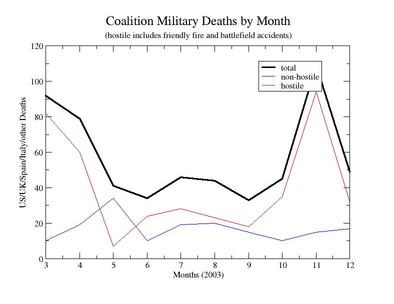
Copyright Dale Amon. All rights reserved. May be used with attribution to Samizdata
This month contains a higher number of casualties among other Coalition troops than usual. 5 Bulgarians and 2 Thai’s are included in the combat deaths (hostile) count and one Pole was involved in a fatal accident (non-hostile). American combat deaths fell to 25; no Brits were killed either by accident or in combat in December (Two died in a road accident on the New Year). It is concievable but not provable the surviving Saddamites are specifically targetting non-US/UK forces in hopes of frightening their governments out of the coaltion. Only on the ground intelligence could tell us and that sort of information is rightfully not in the public domain.
Most significant, of course, is the large drop. One could hypothesize the opposition threw everything they had into a ‘Tet Offensive’. Like the Viet-Cong before them, they lost; unlike the Viet-Cong there is no regular army from a neighboring country, armed and funded by a super-power, to take their place.
This is only a supposition; one cannot state this with any confidence of being correct until there are a few more months of data to back it up. One could alternatively hypothesize the enemy is quietly regrouping after their offensive. I do not believe this, but it is certainly possible.
There’s a curious use of a word to be found here, or there is now, as I concoct this, at about 4.40 pm on Sunday afternoon, London time. Maybe it will change soon. I refer to the little heading which leads to this story. The story itself is headed “Blair praises UK troops in Basra” and I have no problem with that. But the bit at the main website that leads to this story says, on the left, just under where it says “NEWS”:
Blair rallies UK troops in Basra.
Rallies. Yes, you read that right. Evidently some twit at the BBC thinks that Britain’s army has just suffered some sort of defeat.
Please understand that I am not in any way blaming Blair for this absurd word, merely the fool who put it up at the BBC website, and as I say it may soon vanish.
These people are starting seriously to believe their own bullshit.
|
Who Are We? The Samizdata people are a bunch of sinister and heavily armed globalist illuminati who seek to infect the entire world with the values of personal liberty and several property. Amongst our many crimes is a sense of humour and the intermittent use of British spelling.
We are also a varied group made up of social individualists, classical liberals, whigs, libertarians, extropians, futurists, ‘Porcupines’, Karl Popper fetishists, recovering neo-conservatives, crazed Ayn Rand worshipers, over-caffeinated Virginia Postrel devotees, witty Frédéric Bastiat wannabes, cypherpunks, minarchists, kritarchists and wild-eyed anarcho-capitalists from Britain, North America, Australia and Europe.
|