Here is what Sullivan says, in today’s Sunday Times:
Bin Laden offered a truce. Who offers truces? People who are losing the battle.
Just what I was thinking.
I can not find anything else along similar lines here.
|
|||||
|
Here is what Sullivan says, in today’s Sunday Times:
Just what I was thinking. I can not find anything else along similar lines here. April 18th, 2004 | 12 comments - (Comments are closed)
 We agonize a lot here about Islamic fundamentalism. But what can be done about it? There are many reasons why Islamism of the most belligerent sort now stalks the earth, but one of them is that in many parts of the world, if you want an education, your only choice now is often either an education presided over by Islamic fundamentalists, or no education at all. It is this problem which a group of businessmen in Pakistan have set out to remedy. With financial help from people of Pakistani descent who are living it Britain, they have established The Citizens’ Foundation, and there was an article about the work of TCF in the Times Magazine yesterday by Joanna Pitman. Quote:
I have been unable to locate this article either here or anywhere else (although if someone can correct that, please do), and so have taken the liberty of scanning it all into my Education Blog, where you can now read the whole thing. If you do that, you will not, I believe, regard your time as having been wasted. This project strikes me as an example of all kinds of good things, but in particular of the benefits that can come to a poor country when people from it are able to go and live in richer countries, and are then able to do something about the depressing circumstances from which they thought at first only of escaping. In general, I believe that if Islam ever does get past confrontation and accommodates itself amicably into humanity as a whole, the Islamic diaspora will be an important part of this process. April 18th, 2004 | 7 comments - (Comments are closed)
They need some stickers which say: “Warning: heading up Hamas can seriously damage your health“:
Next candidate, please. April 18th, 2004 | 32 comments - (Comments are closed)
As Antoine is fond of pointing out here, the French are not totally supine in the face of radical Islamism:
Here is the case against deporting Cherif:
I know that there is an argument that people like this just, you know, giving sermons, is just them exercising their right to free speech, but meanwhile, this man was clearly breaking French law as it actually is, and from the sound of it he certainly intended his words to give rise to actions. So my immediate reaction to this story is, in the words of the Sergeant Major with the moustache played by Windsor Davies in It Ain’t Half Hot Mum: “Oh dear. How tragic.” As was this. Not. April 17th, 2004 | 3 comments - (Comments are closed)
Much as I respect the analytical abilities of the CIA, surely I am not the only one who thinks the audio tape of ‘Osama bin Laden’ offering the hand of peace to Europe, provided Europe withdraws its troops from Muslim lands, is completely bogus. Are we to believe that the head of that nasty global franchise called Al Qaeda cannot afford to purchase a cheap camcorder in a medina somewhere in Pakistan to reproduce the distressingly effective spectacle of Osama waving his finger at the USA and going “Nah nah, you can’t get me”? The notion he is hiding what he looks like after radical plastic surgery is, I suspect, the product of watching too many Hollywood movies. Sorry, but I do not buy it. If I was a betting man, I would wager that Osama bin Laden died in Afghanistan years ago either when that group of people was attacked by US aircraft and ‘an unusually tall man was with them’ (can anyone point me at a link to that story?) or he was buried in a collapsed tunnel after one of a number of heavy US air attacks. Only time will tell for sure but although Al Qaeda lives, I very much doubt Osama bin Laden does.  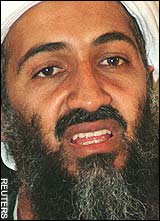
Both still dead April 16th, 2004 | 27 comments - (Comments are closed)
Arts & Letters Daily links to two articles, both protesting against the absurdities and cruelties of political correctness. David Mamet writes in the Guardian in connection with the forthcoming London production of his play Oleanna, the central character of which is a young woman who falsely accuses a man of raping her:
But as Theodore Dalrymple makes clear, there are limits to the notion that a woman can do no wrong. If the wrong is done to her by her own ethnic minority, and even in particular by a male member of it (her father), then it is all her fault. → Continue reading: She can do no wrong – but it is all her fault April 14th, 2004 | 13 comments - (Comments are closed)
It is not often I quote Nikita Khrushchev in any context, but Al Qaeda is quite correct that western civilization poses a clear and present danger to their cherished notions of a universal social life centred on submission to God. An economically successful western civilisation underpinned by severalty and free intellectual enquiry is caustic to a civilisation based on the submission to non-rational ideas which are propagated by force. To put it bluntly, we will enervate them and eventually destroy them by gradual assimilation. The best and brightest muslims are already hard pressed to not see the glaring practical and intellectual flaws in their societies and want better for themselves, and as a result there is already a small but fairly well integrated middle class of secularized American and Euro-Muslims who can be observed in the markets, cinemas, offices, pubs and bars of the west. But far more dangerous to the broader Islamist project is the example not of western thought but of western affluence and the ease and secular self-direction it yields. The sheer material wealth of the more advanced west is almost guaranteed to subvert the broad masses who come in contact with it. The current difficulties in assimilating the lower parts of the socio-economic western muslim population should not blind us to the fact that western culture’s corrosive effects on the Islamic world view really counts far more when they are felt in Peshawar, Ankara and Cairo than in Marseilles, London and Chicago. In that theatre of the war of civilisations our truly effective weapons are not the gunship helicopters, laser guided bombs and 5.56mm small arms being used in Iraq right now, but rather our cheap DVD players, Internet connections, music/porn/action videos and smorgasbord of good, accessible but inexpensive Tex-Mex, Thai, Italian and Lebanese foods that globalisation has brought us, etc. etc. I have made this point before but as we concentrate on the more local and violent issues being resolved in the streets of Iraq, it does not hurt to put it all in the broader context within which our enemies certainly see things. It is the horror of this viral characteristic of western consumer culture which really lies at the heart of the antipathy of the Islamists to the west: as secular society and severalty is the true heart of our civilisation, by our very nature we cannot and will not just ‘leave them alone’. It is not a matter of what western governments want to do, because western businesses and cultural influences will go wherever there are receptive markets and audiences. It is not a western ‘conspiracy’ to subvert Islam, merely the very nature of western civilisation at work. Short of turning the entire Islamic world into a hermit empire like North Korea writ large, the mullahs and ayatollahs cannot avoid their flocks hearing our siren songs. 
Our weapons are varied and effective April 13th, 2004 | 34 comments - (Comments are closed)
I can only hope that the Americans keep their nerve and use the wide scale of the uprising to not just decapitate the more florid Islamist leadership but also place clear ‘markers’ as to what the response will be to armed uprisings during the de facto ‘protectorate’ phase of Iraq’s post-Ba’athist reconstruction. As things are developing day by day, it is pointless for me to just reiterate the reports filling the news media as to the current state of the cut and thrust on the ground, but there may indeed be an analogue with the Vietnam war here… and it ain’t a ‘quagmire’… the Tet offensive may have been a political disaster for the USA but it was a military triumph and more or less wiped out the Vietcong as a significant military and political force. If the US can do the same to not just Muqtada al Sadr’s Islamo-fascist militia but also to any the militias of any who make the mistake of supporting him, it will have profoundly useful effects long after the fighting fades into history and the US and UK forces have gone home. 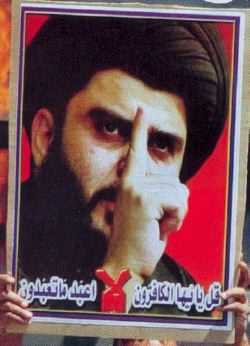 Translation: Follow my finger and shoot… here Although Ali Sistani is, in the overall scheme of things, someone that the occupying powers can probably do business with (though that remains to be seen), it can only be helpful to his education if Muqtada al Sadr, that heir to the ‘Mad Mahdi’, can be seen to come to a fairly public and messy end surrounded by as many of his supporters as possible. Notions of putting this man on trial are to say the least ‘unhelpful’. If a successful confederated Iraqi republic is going to come out of this without falling into a democratically sanctified ‘popular Islamic’ tyranny like that which so many in Iran are trying hard to throw off with their own efforts right now, it is going to take some serious stick, and not just carrot, to make things come out more or less the right way. That is, alas, the way the real world works and hopefully the US and UK have the fortitude to see it through to its conclusion without cutting and running prematurely. So far the signs are reasonably good as only the usual suspects are bleating for political defeat to be plucked from the jaws of eventual military victory. April 12th, 2004 | 75 comments - (Comments are closed)
I believe the events of the past few weeks will be seen, in time, as a major turning point for the better in Iraq. When the dust has all settled, two of the major threats to a peaceful, prosperous, and free(er) Iraq were beaten back. First, the Baathist bitter-enders invested heavily in Fallujah, where they tried to recreate Mogadishu and failed utterly. Fallujah is over for all practical purposes, and was a complete and crushing victory for the US Marines, and a humiliating and very costly defeat for the Baathists and their Sunni allies. Marine casualties were low (less than 20 killed, I believe), Baathist casualties were extraordinarily high (their body count is likely well into the mid-hundreds so far), plus the Iraqis have been treated to the sight of women and children fleeing from the Sunni/Baathist stronghold into the American-held safe zone, where they will be fed, housed, and not used as hostages or human shields. What many of the handwringers in the media and elsewhere fail to realize is that the exodus from Fallujah means that the Americans have won there. The Americans have been trying to get non-combatants out of Fallujah all along, as the noncombatants were in Fallujah primarily as hostages and human shields. The fact that they are now fleeing means either (a) their neighborhood has been taken by the Americans or (b) the Baathists have been so weakened that they can no longer stop them from leaving. → Continue reading: Turning point April 11th, 2004 | 28 comments - (Comments are closed)
Salam Pax has this to say about the al-Sadir militia.
April 9th, 2004 | 26 comments - (Comments are closed)
Sayid Qutb, former leader Muslim Brotherhood, quoted by Barbara Amiel. Well I disagree with the conclusion, but I must admit that the pantheon of evil is pretty exhaustive. Marx: the inspiration for all the best serial killers Hmm… April 5th, 2004 | 29 comments - (Comments are closed)
What seems to be developing into an open revolt in Iraq by Shi’a Islamists could be a Godsend to the coalition and secular elements of Iraqi society in the long run… in openly taking up arms against the coalition and its Iraqi supporters, radical leader Muqtadar al-Sadr has changed the equation: what could have been a long term intractable political problem has been turned onto a military problem with a fairly obvious and direct solution. April 5th, 2004 | 103 comments - (Comments are closed)
|
   |
||||

All content on this website (including text, photographs, audio files, and any other original works), unless otherwise noted, is licensed under a Creative Commons License. |
|||||