We are developing the social individualist meta-context for the future. From the very serious to the extremely frivolous... lets see what is on the mind of the Samizdata people.
Samizdata, derived from Samizdat /n. - a system of clandestine publication of banned literature in the USSR [Russ.,= self-publishing house]
|
Dale is right, in their simplistic minds, the news anchors miss the real battle.
Finally, France appears favourably disposed to new U.S. proposals for a draft resolution that now drops any immediate authorisation for a military strike against Iraq unless Baghdad balks at U.N. weapons inspections.
Facing major opposition from everybody, except the trusty Brits who supported all the U.S. drafts, the United States radically changed key parts of its earlier draft resolution which authorised any U.N. member to “use all necessary means” if it decided Iraq violated a whole series of infractions. The new text also deletes earlier proposals explicitly threatening “serious consequences.”
It does sound pretty watered down, if you ask me, but after meeting chief U.N. arms inspector Hans Blix, the U.S. Secretary of State, Colin Powell, said that a new resolution would not prevent Washington from undertaking a military strike against Iraq:
“The United States does not need any additional authority even now, if we thought it was necessary to take action to defend ourselves.”
The new U.S. compromise has been labelled as a “one-and-a-half step.” Instead of two resolutions – one that would give Iraq an opportunity to comply and a second that would authorise force – if the Security council does not do so after reports by Blix of any failure by Iraq to comply with its disarmament obligations, the United States could decide to strike Iraq anyway, and would probably get considerable support to do so.
What seems to be happening is that the French are backtracking whilst trying to preserve some diplomatic dignity. French Ambassador Jean-David Levitte said France insisted on a “two-staged” approach but did not say if this meant a second resolution. Well, given that the U.S. envoys are going around making statements about the U.S. determination to use military force anyway, and in the light of recent terrorist attacks, the opposing Europeans are starting to look like complete twits. The only reason they can get away with it, is that they look quite reasonable next to the rest of the U.N. twits.
The Russian U.N. ambassador, Sergei Lavrov, sharply criticised any unilateral action and warned the United States not to use the Security Council as an excuse for a military strike or one that would lead to a “regime change.” I am surprised that the holier-than-thou Russian even understands the meaning of “regime change”!
Bangladesh Ambassador Iftekhar Ahmed Chowdhury opined:
“Every possible effort should be made to avert war. These views are evidently shared by a preponderant majority of the membership of the United Nations. They must be heard, listened to and heeded.”
Yes, and your delusions of relevance must be exposed, dispelled and shown for what they are. An empty rhetoric with potentially dire consequences, endangering lives and safety of millions of innocent citizens whose governments, for once, are trying to have a go at protecting them. It is not often you will hear me support Tony Blair or George Bush as representatives of the state that, in case you missed it, is not your friend…

Anyone who watched news early this evening could not help but hear the joyful chortling of the anchors about the US losing in the UN and being “put back in a box”. Well, as it it turns out it ain’t so.
I had a feeling this was the case. The idea the US would sit back and wait for the mushrooms to sprout is just too ludicrous to imagine… unless you are a European news anchor.
But hey, the TV newsies are going after a UK madrassa for child abuse and doing so with both feet and cleats in the air – so they have some redeeming values. They even aired a quote that a child had been told UK law does not apply inside the Mosque!
Tim Hall says:
Some of the right-wing blogs I’ve been reading have complained that they’d heard no condemnation of the awful atrocity in Bali from the Islamic community. They should read this.
Yes we should. If we do, we find this:
Whoever has done this has committed a terrible sin and crime. The Quran says “Whoever kills a single human being unjustly is as though he had killed all of humankind” (Surah al-Ma’ida ayah 32). Deliberate murder of another person will put you in Hell forever. Imagine the punishment for those who have killed hundreds or thousands. Whoever has committed this atrocity will have God’s wrath upon him.
I fear the hatred and violence that will continue to flow from this. May Allah SWT help us all.
I also followed one of the links in this piece, to “Muslims Condemn Terrorist Attacks”, and then the links really start to pile up. I counted no less than 83.
Now I’m no expert on the nuances of Islamic theology, and I cannot possibly tell you how genuine all this condemnation really is. Do they all come from one particular part of the Islamic world, and are we only really looking at old-fashioned intra-Islamic infighting? Search me.
Are they perhaps merely pretending to condemn? Are they merely scared (“I fear the hatred and violence …”) that if the West’s plan A (“War Against Terrorism”) fails, then, united by the failure of plan A to prevent a series of Bali-type horrors around the world, the West might then switch to plan B (“nuke the damn lot of them”)?
Well if they are scared, good. They should be scared. If that message is getting through to the Islamic world, perhaps partly via its English-speaking fringes, good good good. There could hardly be better news for humanity than that.
Maybe this vast pile of links has already been Fisked into nothing in some blog now unknown to me and a commentator will supply the link with a sneerful flourish, and that will appear to be that.
But I say that even pretending is good. Someone obviously thought it worth assembling all these alleged condemnations of terrorism, even if they aren’t, to make it at least look as if terrorism is being condemned by at least some Muslims. Good. Real changes in thought often begin as a mere pretence that such change has already begun. In politics, again and again, you start by changing the window displays, and then your (at first) mere subterfuge works its way backwards into the shop itself. Such subterfuge does at least mean that some Muslims know that they have a problem.
And maybe it’s better than that. Maybe some of this is for real. Maybe those Good Muslims, whom we now curse for their insanely self-destructive silence, really are finding their voices. Maybe they found them months ago, and we’ve been missing it. True, many of the titles of these links do read more like defences of Islam against the charge of terrorism, rather than actual condemnations of terrorism, but like I say, even that is a step in the right direction, and others among them read like much bigger and more genuine steps in the right direction.
Thanks to Scrofula we know that the British MP, George Galloway is still out there, way out there.
Galloway spoke last Friday at the American University of Beirut, urging students to take to the streets in massive demonstrations if they wanted to avoid a century in which they will see their resources stolen and continued Israeli domination in the region. He talked about a Western plan aimed at carving the Arab world into smaller and even weaker states.
He claimed that British officials are deciding whether Saudi Arabia will be two or three countries and if Sudan will be two states or not. Their intention, according to Galloway, is to create a holy Saudi Arabia for the Muslims and keep the other Saudi Arabia that has oil fields for themselves.
Nothing’s missed, we have it all here – Israel, oil, British imperialism – Brendan O’Neill should leap for joy… I wonder whether Mr Galloway reads Spiked (former Living Marxism).
Galloway told the audience that people in Britain have done their bit by organising protests against a war on Iraq. But he said it is time for Arabs to demonstrate that they can threaten interests of the West in the region.
I led the biggest demonstration in the history of Britain two weeks ago, half a million people marched through the streets of London under the slogan ‘Justice for Palestine and no war in Iraq’
Apart from confusing two very different demonstrations and blatantly lying about importance and size of the anti-war one, what the hell is going on here?! How can a representative of the British public, a member of the nation’s legislature, incite violence (as in inviting ‘demonstration of a threat to insterests of the West in the region’) against his own country? This used to be called treason, fair and square, and George Galloway is guilty of it many times over. If democracy has any spine, why is he running around spewing such non-sense as an elected member of the Parliament? Do the people who voted for him agree with his treason? → Continue reading: What’s the punishment for treason nowadays?!
The media and bureaucrats are at least beginning to discuss the possibility of al Q’aeda involvement. After you’ve read the article come back and I’ll finish….
Okay. What is blatantly obvious in the comments? Do you see the same pre-September 11th thought patterns I see?
We are no longer dealing with terrorism that fits into the familiar tick box on government forms. We are not looking at terrorism intended to make a statement or to get prisoners released. We are not looking at terrorism as an isolated event with an isolated purpose.
We are looking at the face of 21st Century warfare.
The enemy is out to destroy our society by any means possible. They don’t need to give manifestos to the media about their purpose because the attacks are a warfighting tactic, not a statement.
If any of our readers happen to be in the right circles, please tell these officials to get their heads out of the box and start thinking WAR, not comfortable 1980’s statement oriented violence happenings.
Let’s stop talking about Motive. That’s police work. Start talking Strategy, Tactics and Objectives and how the Beltway events fit into the big picture of this World War.
I might be entirely wrong about the unfolding of this event…. but even if it is homegrown psychos this time… it won’t be the next.
Watching Britain’s Channel 4 news channel last night, I was treated to the amazing scene when its main newscaster, Jon Snow, announced that Iraqi leader Saddam Hussein had been reelected by more than 99 percent of the vote. No mention was made of the fact that the elections did not permit anyone else but Hussein to stand, thereby rendering the vote’s outcome a total farce. What was even more bizarre was how Snow – a man of the Left – announced the result with a totally straight face.
To be fair, the programme’s subsequent coverage of the poll highlighted its essentially coercive nature. Even so, Snow’s performance was telling.
So says Neil Morris, a Marine sniper with two decades experience in an interview done by Fox News. Neil adds:
“Anything the sniper does or fails to do that give his position away to the threat, snipers don’t do that, They don’t leave brass laying around, and they damn sure don’t leave tarot cards.”
Chuck Mawhinney, another professional with up to 300 battlefield kills to his credit told the interviewer the calibre is wrong:
The Washington killer has been using a .223 caliber projectile, which some have called a standard sniper bullet. But Mawhinney, who lives in Baker City, Ore., said a professional sniper would use a heavier load, at least a .30 caliber.
The one statement I have my doubts about comes from someone who should certainly know better than I. Eric Haney, one of the Delta Force founders, says 100 yard kills are no big deal:
“It’s the kind of thing that if you’ve never shot a rifle before in your life, you and I could spend 90 minutes together and you can do this,”
I think he’s exaggerating a little here. I’m only a casual shooter with no training beyond a basic Army Rifle Qual 30 years ago, but I’ve done a fair amount of “plinking” over the years prior to moving to GunFree Northern Ireland. I seriously doubt I could rack up 11 of 12 hits and 9 of 11 kills at 100 yards under stressful conditions… even with 90 minutes of Delta Force training.
The pros think it is two young men working together. One is a driver/spotter who stays calm; the other makes the kill. They might swap places.
A terrorist motivation still makes more sense to me than anything else. These “two” are equal opportunity killers. That scratches the homegrown Neo-Nutsies from the list – unless they are working for someone else. If not military professionals, the shooters are at least calm planners of reasonable markmanship. If they are both truly crazy, they are crazy in a calm and emotionless way.
One has to ask, “what is the point?” If they are psychotics it could be just racking up the score. Perhaps they are environuts out to cull the herd; or losers out for excitement and To Go Down in a final Bon Jovi Blaze of Glory.
My personal thoughts? Pro shooters or not, I think it is an al Qaeda attack. The tactical goal is to spread fear and create chaos in their enemy’s capitol. The logic of a low-investment high-return attack for al Qaeda is so strong that even if they had not considered it before, they must certainly see the possibilities now.
I said it over a year ago: we’re all soldiers now. If this is an attack, and if – at low cost – it is followed up by more such, there will be little choice for Americans but to go about daily business with a gun close to hand.
183 people at least are dead, probably more as 220 Australians and 20 or so British remain unaccounted for. All the victims were civilians, mostly young backpackers on holiday or the Indonesian staff serving them. Yet judging by what I seen written by John Pilger or Robert Fisk or Noam Chomsky since September 11th of last year, I thought the reason terrorists are attacking ‘us’ was something to do with injustice in Palestine? Is Bali part of Palestine? How many Palestinians have the Australian Army killed?
I recall hearing that the WTC was attacked because it was a symbol and centre of exploitive capitalism and the US military industrial complex. And what exactly was the Sari Club in Bali a symbol of? Will the people on WarbloggerWatch or at New Stateman tell us how the forces of US imperialism have been thwarted by the death of so many young Aussies and others in a holiday resort?
What was that you said? It is all about oil? Ah, silly me.
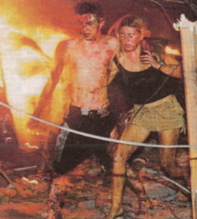
Evil-white-male and immodest un-Islamic
Australian woman flee Bali attack last night
Dogs and their owners could become the latest target of a clampdown on moral corruption in Iran after a hardline cleric called for canines of all shapes to be arrested. Gholamreza Hassani, Friday prayer leader in the northwestern city of Urumiyeh said:
“I call on the judiciary to arrest all long-legged, medium- legged and short-legged dogs along with their long-legged owners… Otherwise I’ll do it myself.”
Commentators noted that in his latest comments, Hassani appeared to be widening the net of his anti-canine campaign since last year when he thanked police for confiscating short-legged dogs in Urumiyeh. 
Iraqi deputy prime minister and minister responsible for Iraq’s weapons programmes, Abdul Tawab Mullah Hawaish, speaking at a news conference in Baghdad, has invited the United States to send officials to visit Iraqi sites suspected of producing weapons of mass destruction. He said Iraq was not producing weapons of mass destruction and declared that U.S. claims that it was producing them were false.
“As I am responsible for the Iraqi weapons programmes I confirm here that we have no weapons of mass destruction and we have no intention to produce them.”
Damn, you are just so convincing, Abdul…
And my personal favourite – he also said Iraq would teach the United States an “unforgettable lesson” if it launched a military action to oust the government of Saddam Hussein.
“If the Americans commit a new foolish action against Iraq, we will teach them an unforgettable lesson.”
But, Abdul, honey, how would you do that? This is the US army you are talking about, remember? Lots of lovely, lovely modern missiles and other amazing equipment that actually works, not like your mucked up 1950s Soviet Scud Bs (ripped off V-2s). And besides, you just convinced me that the peace-loving Iraq has no weapons to speak of!? I am sooo confused! 
Eminent blogger Alex Knapp of Heretical Ideas thinks beyond the impending war against Iraq
As you can tell by the title of this post, this discussion isn’t about whether or not it’s ‘properly libertarian’ for the U.S. to wage war against Iraq. I’m going to assume that as a given. The question that has been running around in my mind is this: what is the libertarian case for regime change? Or, to be more specific, there’s a clear libertarian case for toppling a government that proves itself to be a danger. I don’t think any libertarian thinks that, once World War II started, the only goal of the Allies was to contain Germany within its borders. Clearly, Hitler and the Nazis posed a danger, and it would have been suicide for the world to simply let them rebuild again. However, what about the aftermath? Is there a libertarian case for the Marshall Plan, rebuilding the nations of the former Axis powers, etc.? This is a particularly vital point of discussion when it comes to Iraq.
The Libertarian case for Marshall Plans
First, let’s look at a ‘Marshall Plan’ for Iraq. At first glance, it looks like the libertarian case is easy: ‘we’re against it.’ After all, libertarian theory relies heavily on the idea that neither state-supported safety nets nor foreign humanitarian aid are moral or effective. Yet a Marshall Plan would seem to combine qualities of both. However, there are several factors that differentiate the rebuilding of a country after a war from the twin devils of welfare and foreign aid. → Continue reading: Libertarians and regime change
|
Who Are We? The Samizdata people are a bunch of sinister and heavily armed globalist illuminati who seek to infect the entire world with the values of personal liberty and several property. Amongst our many crimes is a sense of humour and the intermittent use of British spelling.
We are also a varied group made up of social individualists, classical liberals, whigs, libertarians, extropians, futurists, ‘Porcupines’, Karl Popper fetishists, recovering neo-conservatives, crazed Ayn Rand worshipers, over-caffeinated Virginia Postrel devotees, witty Frédéric Bastiat wannabes, cypherpunks, minarchists, kritarchists and wild-eyed anarcho-capitalists from Britain, North America, Australia and Europe.
|





