We are developing the social individualist meta-context for the future. From the very serious to the extremely frivolous... lets see what is on the mind of the Samizdata people.
Samizdata, derived from Samizdat /n. - a system of clandestine publication of banned literature in the USSR [Russ.,= self-publishing house]
|
It will be found from the Foreign Prints, which from time to time, as Occaſion offers, will be mention’d in this Paper, that the Author has taken Care to be duly furnith’d with all that comes from Abroad in any Language. And for an Aſſurance that he will not, under Pretence of having Private Intelligence, impoſe any Additions of feign’d Circumſtances to an Action, but give his Extracts fairly and Impartially ; at the beginning of each Article he will quote the Foreign Paper from whence ’tis taken, that the Publick, ſeeing from what Country a piece of News comes with the Allowance of that Government, may be better able to Judge of the Credibility and Fairneſs of the Relation
– from the The Daily Courant of March 11, 1702. The Courant was probably the world’s first daily newspaper.
Bloggers might not like the next bit:
Nor will he take upon him to give any Comments or Conjectures of his own, but will relate only Matter of Fact ; suppoſing other People to have Senſe enough to make Reflections for themſelves.
Although Australia and the US have signed a free trade agreement, it is an imperfect document, with many exemptions on both sides. In Australia, there has been a loud campaign to have existing ‘local content’ rules for Australian television excluded, and this campaign has been successful.
The ‘local content’ rules mean that a certain proportion of television programmes that are broadcast on Australian television must be locally made. The scrapping of this rule was an American objective in the free trade negotiations, as it meant that US television companies were restricted in their access to the Australian television market by what in effect is a quota.
Australia resisted this; we should not have.
Australian television has had local content rules for a long time, they provide that at least 55% of the programming on Australian television between 6am and midnight must be locally produced. This creates a local internal market for television, which is actually quite a cut-throat industry. The economies of scale mean that Australian television products are not cost-competitive, but they do rate well. → Continue reading: Cultural protectionists win in Australia
…but not all the time. If you don’t look at the listings page and life’s busy schedule halts the urge towards the sofa, then television may take up two hours tops a week, unless Euro 2004 is on. The invasion of reality programming provides no real attractions. Big Brother, Survivor and the Sex Diaries of Ayia Napa don’t entice. (The last one is made up but the outline is on my desk, if there are any budding producers out there!)
The only time that couch potato indulgences come into play is on holiday. A recent vacation in Visby provided insights into the enthusiasm of Swedish tv for US sitcoms. Square eyes are developed after a couple of snifters before hitting the clubs (pre-season doubles of scotch are obligatory given Swedish beer prices). It was during these preparations that I came across the programme, Swag.
The series was first introduced on porn-lite, history heavy Channel Five in 2003, under the auspices of Guy Ritchie, and involves enticing the criminal element and potential lawbreakers to demonstrate their stupidity on camera. Some of the celebrity stunts are clearly staged but others demonstrate a naive verisimiltude that only chavs could provide. In the first series, one likely lad was so enraged at being trapped in the car, he stabbed a cameraman with a screwdriver.
Two examples of the programme will suffice: an open lorry with boxes of goodies, tempting for the greedy, and transforming into a cage which is driven around calling upon onlookers to look at the imprisoned thief; or the driver, who took a disabled spot, and returned to find her car encircled by a chain of wheelchairs.
Reality television has included a number of themes over the past decade: preying upon the self-indulgence of the would-be famous, manufacturing celebrities out of the public and wielding the intrinsic voyeurism of documentaries. Ritchie has demonstrated that this medium can also tap into other basic human reactions: the anger that people feel when they see a clear transgression such as theft, and a sense of justice at the comeuppance of a budding criminal.
I do not imagine that Samizdata readers spend a lot of their spare time reading Arena magazine (it does not appear to be available online). It is a chap’s monthly publication that fancies itself as being at the more intelligent end of the man’s magazine world, mixing glossy advertisements for insanely expensive wristwatches and fast cars, not to mention pictures of minor French actresses in a pleasing state of undress, with post-modernist ironic pieces on anger management, etc. I get the impression that it is the sort of publication that pitches to the sort of man who reads the Guardian or Observer but who wants to indulge his blokeish tendencies with a clean conscience – in short, to have his low-fat steak and eat it.
Occasionally the tension shows. In the August edition, for instance, we have a largely gushing and Bush-bashing film review of the latest Michael Moore propaganda effort, sorry, ‘documentary’, Fahrenheit 9/11, which contains a remarkable admission by the obviously pro-Moore reviewer that the filmaker had a “cavalier attitude to such niceties as facts” while stating what a swell film it is. Facts eh, who gives a damn about em?
But what really did it for me was an article (page 77) containing one of the nastiest attacks on a group of people in a magazine that I have read for some time: the overweight. The writer, Giles Coren, whom I have heard of before, rants against overweight people in terms of amazing verbal violence. Words such as “mountain-arsed”, “the great lumps”, “these pigs”, etc, are sprinkled around. Witty, no?
Now I accept that there is something dumb about those who are overweight trying to present themselves as victims. However, I also have nothing but contempt for the way in which the fast-food industry has been targeted for assault by an unsavoury mixture of ambulance-chasing lawyers, moral scolds and sundry bores who would legislate our pleasures out of existence rather than rely on our own self-restraint and personal responsibility. Coren’s article, in particular, seems to be steeped in a sort of fashionable puritanism and also draws on a deeply suppressed need to be able to hate a particular group. Let’s face it, hatred is out of style. There are laws against it. If our demented British Home Secretary, David Blunkett, gets his way, it will not be possible to express anything more than polite scepticism about the irrational superstitions known as official religions. But humans love to hate, or at least some of them do.
I very much fear that the overweight among us are in the cross-hairs of our fashionable haters. Of course, one should not make too much from a single article in a pretentious guy’s magazine, but Coren’s piece is all part of a trend.
To hell with him, I am sending out for pizza with extra cheese.
This post is one of my articles that explains how it is possible to screw an industry up beyond words with excessive regulation, and the consequences of doing so can occur in unexpected places. The story is in this case about how government attempted to protect the BBC and ended up giving enormous quasi-monopolistic powers to Rupert Murdoch. Next week, I shall post a similar history of the regulation or television in Australia, which explains how government attempted to give enormous quasi-monopolistic powers to Kerry Packer, and ended up giving enormous quasi-monopolistic powers to Kerry Packer.
Until a week and a half ago, British people were watching the European Championship football championship between the national teams of the best footballing countries of Europe, the English in the hope that England would win the tournament, and the Scottish in the hope that England would be eliminated early and embarassingly. Neither of these things happened: England played decently but not spectacularly and were eliminated on penalties in the quarter finals. If England had stayed in the tournament the number of cross of St George flags attached to people’s cars in this country would have steadily increased, it would have been impossible to go into a pub and had a discussion of anything else, national euphoria may have even broken out and, sady, there would have been a somewhat unpleasant yob element on the streets shortly after closing time. As an Australian, I think I would have found that (and the fact that the English would have been gloating for years if not decades) a bit much, so I am glad that it didn’t happen. Instead, I watched the rest of the tournament (which finished yesterday evening) with interest both on television at home and in pubs with much smaller crowds than would have been the case if England were still participating. The story of the tournament was that the large heavyweight countries of Europe were eliminated relatively early, and the teams from the smaller countries excelled themselves.
In yesterday’s final the host nation Portugal (regarded as a good side from before the start of the tournament, although not one of the extreme favourites to win it) took on Greece (who at the start of the tournament were absolute rank outsiders who most people would not have picked to win a match let alone the tournament). And as it happened, Greece won a perhaps a little dull and defensive (but with lots of heart) 1-0 victory, and a team that had never won a match in the finals of either the European Championship or the World Cup before are now champions of Europe. (The slightly desperate question of whether the Olympic stadium in Athens will be complete in time for the start of the Games in six weeks now has the added question of whether the Greeks will have stopped partying by then. I was in Sydney four years ago for the 2000 games, and at this point we were just coming to grips with the fact that the games were almost upon us. We didn’t really start partying until the games actually started.
It was not hard to find a place to watch yesterday’s final, because it was on two terrestrial television channels (licence fee funded BBC1 and advertising funded ITV1) simultaneously as well as satellite channel Eurosport. This followed what happened earlier in the tournament, which is that the matches have been divided evenly between the two broadcasters. Half the matches were on the BBC, and the other half on ITV, and who got to show which matches was decided more or less randomly. Neither network has been able to gain an advantage over the other by advertising itself as “The Euro 2004 channel” or anything like that.
This may seem curious. Why is what should be one of the biggest sporting events of the year on two television stations simultaneously? Given that lots and lots of people are likely to want to watch it (or would have if England were playing) would it not be of lots of value to advertisers and therefore wouldn’t the organisers of the tournament want to make huge amounts of money by auctioning the television rights to the highest bidder.
Well, actually no.
Well, actually probably yes, but this is not permitted. → Continue reading: How watching the European Championship football tells us a lot about the history of British television.
The Barclay brothers have won the fight for the Daily and Sunday Telegraph (the leading Conservative newspapers in Britain), I welcome this victory as the leading counter bidder (at least the one that made the most noise) was the company behind the Daily Mail – a fanatically anti-American newspaper.
My attitude towards the victory of the Barclay brothers (or rather the defeat of the Daily Mail) may suprise those people who think that my doubts about the policy of war and my dislike of President Bush indicate anti-Americanism. However, a good look at the Daily Mail would show such people what real anti-Americanism is like.
By the way, the Daily Mail is not a socialist newspaper (at least not in the way the word ‘socialist’ is normally understood) it is part of a different tradition of statism.
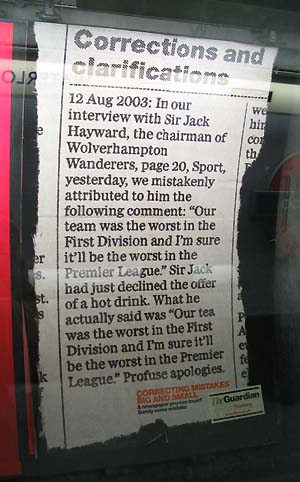
Here is a poster I snapped in the London Underground the other day, through the Jubilee Line glass screen at Waterloo. It is quite amusing, but should they really be boasting about things like this?
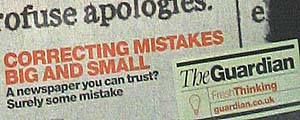
And look down at the bottom. Is this a conclusion they really ought to be proud to be drawing? Or is the implication that if they ever do make any mistakes, they are all just typos?
Detail of the bottom corner, with a bit of help from Photoshop to make it more readable:
So, may we now expect a poster with a big mistake corrected?
We have been supporting state centralised socialistic stupidity and stagnation for, you know, a long time. We were wrong. Sorry and all that. Capitalism has its problems, but it is, we now realise, much better.
DifferentNow guardian.co.uk
Such will not, I suspect, be the substance of my next posting here.
Ronald Reagan was, as we know, dubbed among other things as “The Great Communicator”. Through his speeches, radio broadcasts and writings, Reagan had a wonderful knack of communicating important truths in clear-cut ways.
What intrigues me is wondering what he would have made of this new field of blogging. I reckon he would have loved it and could easily imagine the old fella writing one. As a talk-radio host, he had a lot to say that would have fitted in perfectly with the weblog format. I have recently been reading a collection of his radio show broadcast transcripts and it blasts the idea of him being a dope. Anything but, in fact.
Reagan was eager to make full use of the modern technologies of his time in spreading his views about the role of government, capitalism, the evils of communism and the like. I don’t think it impertinent to imagine that this great man would have loved our medium and enjoyed the fact of its challenge to Big Media. I wonder what he’d have called his weblog. How about “Shining City on a Hill”?
Thoughts here have turned towards what good news might consist of, what with most of the news from Iraq lately having been so bad. Do we really want the media to be dominated by the stuff? I mean, might good news not be rather … boring?
Personally, what I dislike is not bad news as such. It is the drawing of wrong conclusions from it. Yes, there has been a terrible flood in the Dominican Republic, and I want to be able to read the details of it. But this does not mean that all the people out there live all of their lives in a state of permanent Tidal Wave of Mud Terror. You think that is an exaggeration? Well, I was living in a hotel in Krakow for the first weekend of the Iraq War, the easy bit. All I had to learn about the war was BBC 24 hour news, and this was, as I am sure you all vividly remember, the exact mistake that the BBC made. Hey, here are some soldiers who have been ambushed! Ergo, Iraq is one Great Big Ambush. No, it was just an ambush, and actually, even I could deduce that, despite all the gloomy commentary, My Team was winning big. Here was a classic piece of good news that the BBC truly did misread and misreport as bad.
But unlike the good news of how well that war was actually going, a lot of good news is genuinely dull, compared to bad news. → Continue reading: Bad news and good news
For an interesting insight into how the statist meme became so dominant, check out these comments by an Instapundit reader:
Perhaps the most pervasive way in which journalists are different from normal people is that journalists live in a world dominated by government, and they reflexively see government action as the default way to approach any problem.
. . . .
It’s no accident that for the most part, the news is dominated by people whose value is largely driven by how much publicity they receive: politicians, athletes and entertainers. The people who actually make the world work – people in private industry, rank-and-file government employees and conscientious parents – are largely invisible in the news, except when they’re unlucky enough to make one of the rare mistakes that reporters manage to find out about.
My reading of this is that the mainstream/elite media and the state sort of bootstrapped each other to the top of the pile, in classic one-hand-washes-the-other fashion.
The media propagated the statist meme because it was both easy and it elevated them to the degree that centralized media is parasitic (or perhaps symbiotic) with a centralized state.
The comments come just as yet another survey is released demonstrating that the denizens of American newsrooms are significantly more “liberal” (in the newfangled sense of the term, the one where the jackboot is made by Birkenstock) than the general public. Perhaps the best illustration of the whole dynamic is that a survey showing the media is significantly more hostile to President Bush than the general public went out under the title Press Going Too Easy on Bush.
You can’t make this stuff up. Now, I certainly have my beefs with the current President, but the self-appointed Fourth Estate has really gotten up my nose lately. They could play an important role in society, as a necessary feedback mechanism, but they have largely abrogated that role, in my view. Thank goodness that a new, distributed feedback mechanism is emerging in the form of the blogosphere.
Instapundit posts today on how two stories are playing out in the elite media and in the on-line world. (Aside: I know, I know, it looks incredibly lame to link to Glenn Reynolds’ blog. But hey, the man has already done the heavy lifting on this issue, so why shouldn’t I take advantage? I mean, he’s a public utility, isn’t he?)
To summarize:
The Nick Berg murder story holds all of the top ten slots for searches at Lycos and elsewhere. The elite media, if it ran the story at all, has “moved on” and renewing its obsessive focus on the Abu Ghraib story. This would certainly seem to point up, at a minimum, a disconnect between the elite media and web-savvy info consumers. The kind of disconnect that should have you purging your portfolio of media shares.
The real question is, as always in the blogosphere, what kind of uninformed speculation can I heap onto this occurrence?
First, it certainly seems to support the conclusion that substantial swathes of the elite media are not only opposed to the war in Iraq, they are shaping their publications to justify their opposition and to ensure the political defeat of those who support the war.
Second, it is striking how the elite media’s opposition to the war plays out in ways that undercut the American/coalition side and give aid and comfort to the Islamofascist side. The Islamofascists, of course, want the Abu Ghraib story played up in the West and the Nick Berg murder played down in the West, and this is exactly what the elite media is doing. The phrase “useful idiots” comes to mind, although for the most part “fellow travellers” seems too strong.
For the most part. There are exceptions. I can’t think of a better word for news outlets that peddle obvious fakes and frauds put forth by our enemy’s crudest propagandists. I saw the fake rape pictures a couple of weeks ago, and you would have to be total naif not to see instantly that they are porn – the posing, the production values, the uniforms, the haircuts, the whole thing practically shouts “not candid photos of US servicemen.”
Of some interest is the historical fact that many of Islamofascism’s useful idiots were also Communism’s useful idiots. Make of that what you will.
Finally, it must infuriate the media elite that, despite their most urgent efforts to make Abu Ghraib the logo of the occupation, their best and most sophisticated audience is much more interested in the Nick Berg story. This, I think, bodes well, for it demonstrates the degree to which we set our own priorities and interests, and seek information, independent of those who buy ink by the barrel.
Top down information management is defeated, yet again, by a distributed network.
UPDATE: On the fellow traveller front, we have pretty solid confirmation that the photos of alleged British abuses were faked as well.
As a rule (well, more of a ‘guideline’ really) I do not fisk the ‘readers letters’ section of media organs.
There is no objectively good reason for me to refrain from doing so except that I regard it as bad form; rather too close to bullying for comfort. After all, the whole point of ‘readers letters’ sections is for the public to let off some steam and drawing attention to the wild and woolly nature of the some of the contributions hardly makes me a clever dick.
Still, this particular missive in the ‘Feedback’ section of the Spectator is so extravagantly barking that I am going to grant myself a (temporary) exemption:
It is an indictment of the pitiful state of our ‘democracy’ that Britain’s future role in Europe should depend on the whim of one egregious Australian-born businessman (‘The man who calls the shots’, 24 April).
I did not realise that Prime Minister Blair was an Australian-born businessman.
How to stop similar circumstances arising again? Our broadcast media — i.e. the BBC — is the envy of the world.
If that is true, then all I can say is that the world must be in a piss-poor state.
The solution is obvious: we need a British Press Corporation, an equivalent of the BBC for print media. The ‘Beep’ could run a small stable of publications from tabloids to broadsheets (and even perhaps weeklies too).
Of course!! (meaty slap to the forehead). The solution is so obvious. Damn my eyes for not thinking of it sooner!
It could be part-subsidised out of general taxation, and would therefore be more independent of the business interests whose ownership deforms the content of so much of our press.
It would have to be subsidised out of taxation. Nobody is going to voluntarily hand over hard-earned money for that crap.
Drawing as it would on the existing structure of news-gathering available to the BBC, the BPC would be cost-effective as well as provide an intelligent and informative source of news. Its competition would surely have the effect of undercutting the worst at least of the present tabloid excesses and the dominance of a handful of private individuals over the British polity.
Listen, buster, if any ‘handful of private individuals’ are going to have dominance over the British polity, then it is the Samizdatistas. Got it?
|
Who Are We? The Samizdata people are a bunch of sinister and heavily armed globalist illuminati who seek to infect the entire world with the values of personal liberty and several property. Amongst our many crimes is a sense of humour and the intermittent use of British spelling.
We are also a varied group made up of social individualists, classical liberals, whigs, libertarians, extropians, futurists, ‘Porcupines’, Karl Popper fetishists, recovering neo-conservatives, crazed Ayn Rand worshipers, over-caffeinated Virginia Postrel devotees, witty Frédéric Bastiat wannabes, cypherpunks, minarchists, kritarchists and wild-eyed anarcho-capitalists from Britain, North America, Australia and Europe.
|





Recent Comments