We are developing the social individualist meta-context for the future. From the very serious to the extremely frivolous... lets see what is on the mind of the Samizdata people.
Samizdata, derived from Samizdat /n. - a system of clandestine publication of banned literature in the USSR [Russ.,= self-publishing house]
|
A letter to The Independent:
Sir: In the article “Terror suspects describe alleged torture ‘in front of MI6 agents’ ” (4 January) Elinda Labropoulou claimed “The British Government has issued a gagging order to prevent the publication of the alleged British agent’s name”. It has not.
The advice given to editors on this issue was not offered by the Government, but by me on behalf of the Defence Press and Broadcasting Advisory Committee. The five standing Defence Advisory Notices on the publication and broadcasting of national security information agreed by this independent Committee (see www.dnotice.org.uk) constitute a purely voluntary code, one without any form of legal sanction. Any suggestion that the media has been “gagged” on this issue is plain wrong.
ANDREW VALLANCE
AIR VICE-MARSHAL, SECRETARY, DEFENCE PRESS AND BROADCASTING ADVISORY COMMITTEE, LONDON SW1
Which rather begs some questions. If the D-notice DPBAC has no legal sanction, what extra-legal sanctions are available to it? Is there an implicit distinction here between “the Government” and government? I’m sure you can think of others.
Almost two years ago, David Carr posted a piece on this blog about statues in Trafalgar Square. In the comments, I made a brief observation that the person I would commemorate with a statue there was mathematician Alan Turing, who is rather inadequately commemorated given that his achievements were that he won the second world war and invented the computer. (Yes I am exaggerating, but not truthfully by all that much).
Yesterday, I received a couple of e-mails and then a phone call from the letters editor of the Evening Standard newspaper here in London. The paper had a couple of days earlier published an article on a plan to put a statue of Nelson Mandela in the square, and they wanted to publish some responses from readers. He thought that my comment (that he had presumably found by Googling) was very interesting, and would I write a short letter to the newspaper saying the same thing?
I was happy to oblige, but I asked that if they publish the letter that they credit this blog as well as me personally. And that is exactly what they did. They published my letter in this evening’s newspaper (slightly edited for space, unfortunately) and credited me as “Michael Jennings, samizdata.net” at the end.
If you are a newspaper editor who wishes to use the blogosphere as a source, this is exactly the right way to go about it. Contact the blogger first, get him to update what he wrote, and always credit the blog and publish its address. We bloggers love being linked to.
This afternoon I was in Newport in South Wales. I had half an hour or so to kill before my train back to London was to depart, so I went to a nearby pub and ordered a pint of ale. Due to the general lousy state of WiFi hotspot provision in Britain, I was not able to connect my laptop to the internet. However, I also had my PDA with me. The PDA in question is branded as an O2 XDA IIi, but the device is in fact made by a company named High Tech Computer Corporation (HTC) of Taiwan, and is known generically as the HTC Alpine, as well as being rebranded by a variety of other companies under a variety of other names. It runs Windows Mobile 2003SE, which includes stripped down versions of Internet Explorer, Microsoft Word and Excel, and a variety of other applications. The device also functions as a GSM cellphone, and in what is I think is the way of the future, the device has several different wireless technologies built into it – 802.11b (WiFi), Bliuetooth, and at that moment most importantly. GPRS, the usual packet switched data overlay of the GSM cellphone system.
What did this all mean? Well, it meant that I could connect my PDA to the internet via a GPRS cellular connection and check my e-mail and browse a few blogs. The limitations of this were that I was using a rather limited browser and I had a slow connection – in practice probably only around 20kbps. This means that I didn’t want to view too many separate pages – each takes a while to load and as one is paying by the megabyte, one also doesn’t want to download too much in the was of fancy graphics. Being asked to browse through six pages to read one article is something of an imposition. Lots of popups and flash animation is also bad. Relatively straightforward HTML is best.
After a quick trip to Samizdata, I went to Instapundit to see what was up. I scrolled down, and came to the observation that Time Magazine’s choices as “People of the Year” were lame, and a link to a Michelle Malkin piece that had more to say about it. That wasn’t terribly helpful in itself, because I didn’t know who Time Magazine had chosen, but I followed the link.
Michelle didn’t say precisely who the award had gone to either, but there was a comment about philanthopists, rock stars, and Bill and Melinda Gates. Okay, so at this point my guess (which ultimately turned out to be correct) was that the award had been given jointly to Bono of U2, as well as Bill and Melinda Gates for charitable efforts in the third world.
Actually I find the (joint) award of Man of the Year to Bill Gates is kind of interesting. I have long thought that it was an absurd oversight that Time had never given the “Man of the Year” award to Gates. I am no fan of Microsoft’s products, but even I have to concede that that the man’s career is an extraordinary one, and even that the argument that he was the most significant man of the 1990s is quite a strong one. One man came from nowhere and in 20 did a considerable job of seizing control of one of the most important industries in human history. That Time missed this and failed to give him the award at any time in the 1980s or 1990s was really lame. (Time almost got off to a good start in recognising the PC revolution with “Man of the Year announcements”. They apparently intended to give it to Steve Jobs in 1982, but ultimately lamed out by giving it nebulously to “The Computer” instead after discovering that Jobs had a difficult personality. (Laming out is something they have been doing for a while).
Malkin does make some observations on this, stating that she thinks that Time’s vaguely blah leftist politics are in play here, and that they wouldn’t have given it to Gates in the 1990s when he was doing something significant because that was filthy capitalism of which they do not approve, and that they would now rather give it to him and his wife now that she has civilized him and he is doing something “worthy”. Although Time does have a bit of a history of rewarding starry eyed “one world” stuff, and that certainly explains the Bono thing here, I am not sure it does explain the Gates award.
In truth, I think that Time is almost trying to apologise for not giving the award to Gates before. → Continue reading: Time is lame in so many ways
How the Internet did away with UFOs, alien abductions, etc.:
. . . Wild rumors and dubious pieces of evidence are quick to circulate, but quickly debunked. The Internet gives liars and rumor mongers a colossal space in which to bamboozle dolts of every stripe – but it also provides a forum for wise men from all across the world to speak the truth. Over the long run, the truth tends to win. This fact is lost on critics of the blogosphere, who can only see the exaggerated claims and gossip. These critics often fail to notice that, on the ‘net, the truth follows closely behind the lies. . . .
The blogosphere is massively better in quality than the average quality of its parts. You cannot say that telephones are pointless nonsense merely by pointing out that many and perhaps most mere individual telephone conversations are pointless nonsense, and many and perhaps most telephones woefully underexploited. And you cannot derive the crapness of the blogosphere merely from the fact that most blogs, and many blog postings even on good blogs, are crap.
Read the whole thing here. Thanks to Arts & Letters Daily for the link.
The BBC top brass are demanding a rise in the licence fee, which is levied on all people who buy a television regardless of whether they watch BBC programmes or not. The fee increase is – so we are told – designed to fund the various digital television ventures the BBC believes it needs.
As I frequently have to explain to my American friends who are left aghast at the situation, the BBC licence fee must be paid, on penalty of a heavy fine, and possibly gaol. In reality, there are people who probably have gotten away with non-payment but the threat is real enough.
In the age of the Internet, satellite and cable, how long can this monster remain in existence? And for how long can it claim that without its privileged source of income, exacted with the ultimate sanction of imprisonment, our culture would be in ruins? Who seriously believes that argument today?
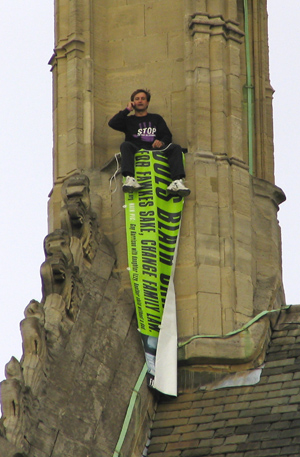
I went out this afternoon to partake of coffee with a friend, and on my way to the coffee house, I stumbled upon a news story, and took some photos of it.
Who is that?, I asked. A Father 4 Justice. Oh, one of them.
Cheap, modern, democratised communications pervade this story, and may also influence the reporting of it. Note that the guy has a portable telephone, which would probably not have been the case a decade ago, and which must surely have influenced how the authorities set about dealing with him. I mean, if you were a copper, it might make a difference if the guy you were trying to arrest was supplying a running commentary of your every move to his pals. Who were recording everything he said, as they surely were.
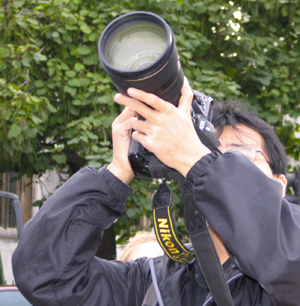
Other photographers were already out in force by the time I got there.
The professionals were there in strength.
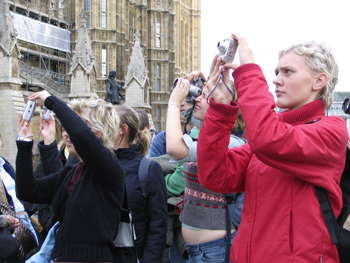
But, so were the amateurs, …
… me included, with my 10x zoom lens and automatic anti-shake focussing, in a camera that cost less than three hundred quid.
One of the features of modern government, or maybe that should be recent government, is that modern/recent government often likes simply to blot stories off the airwaves. I am not saying that they wanted to squash this one. But I am saying that if they had entertained any such censorious thoughts, although they might have got away with this ten years ago, now, they would have far less chance.
They would merely have handed the blogosphere a nice little scoop.
Some people lament the loss of the old regional television brands in the UK. In the old days, we had a choice of three channels. The privately-operated channel, ITV, was made up about 15 regional companies working together as a network – companies like Yorkshire Television, Thames, and Tyne Tees Television. Since the mid-90s, there has been a move towards a single ITV company. All the mainland English ITV regions are now simply known as “ITV1”.
What did these regional brands mean? They meant that before national programming like Coronation Street and The Bill, you got told you were in Yorkshire or wherever. Big deal. Lest anyone get the idea that ITV was once some haven for regional programming, it should be noted that ITV has always been criticized for too little regional programming. For example, in the 1960s and 1970s, ATV (later Central Television) kept on getting its knuckles wrapped from the regulator for its regional output being too poor.
The reality is that with fifteen different companies making up ITV, the channel was unfocussed and bloated. That was fine in the analogue world of a handful of channels, but ITV execs knew that ITV has always been a popular, national channel. They realized that in a multichannel world – competing with global players – it needed to be a lean machine with a single, strong channel identity.
Regional programming is still done by ITV – regulation has always required that. But it may be that national television stations are not a good environment from which to do regional programming. Arbitrarily cutting up the country into a dozen or so regions makes it difficult to do meaningful community programming. Regional programming has always been about ticking boxes, rather than about democratized bottom-up community programme-making.
But the digital age has brought with it more than just competition for ITV. It has massively cut the cost of distributing moving pictures. The ten year old who two decades ago would dream of having his own TV station can now borrow his dad’s £200 camcorder and put a programme up on the web or on a peer-to-peer network for his friends to watch. The digital world that has pulled regional ITV branding from our screens gives us the technology for real, bottom-up local television. Because such programming is not a box-ticking exercise, the programmes are likely to be far more meaningful for local communities than ITV has ever been.
And it is not just on the internet that we are seeing more local TV. In June 1999, Six TV was launched in Oxford bringing local television. In October 1999, c9tv started broadcasting in the North West of Northern Ireland. Technology – like digital editing – is making low-cost broadcasting a reality.
Will someone explain that to the BBC? As part of their news coverage, the BBC website will often construct webpages that quote from various press outlets around the world with a description of commonalities that these quotes may share. For example, on Katrina, the commentary of a piece entitled “World press berates US over Katrina” notes that:
Newspapers around the world are critical of the US government’s response to Hurricane Katrina, and its foreign and environmental policies more generally.
Links are made to regional concerns, with Asian papers recalling last December’s tsunami and African commentators highlighting the racial issue.
But some sympathy comes from Indonesia, and an Afghan newspaper takes pride in President Karzai’s offer of assistance.
However, of the thirteen newspapers quoted, the BBC does not endeavour to inform its audience that, at a conservative estimate, half function as government mouthpieces or operate under various restrictions. So, a Zimbabwean newspaper, the Daily Herald, that BBC Monitoring identifies as a government owned daily, from an unfree state, is quoted without qualification, providing free publicity for ZANU-PF.
The fact that New Orleans is a southern town predominantly populated by African-Americans explains why President George W. Bush did not see the need to cut short his holiday. All that Bush has done so far is to issue threats against the victims, and deploying trigger-happy American troops – fresh from abusing Iraqi prisoners – to go and “restore order
We should not be surprised at this. If you turn to the BBC Monitoring’s profile of the UK media, you would be surprised at the prominent role of public broadcasting versus commercial outfits, backed by a picture of Broadcasting House and a link to BBC history. The passage starts:
The UK has a strong tradition of public-service broadcasting and an international reputation for creative programme-making.
The fledgling BBC began daily radio broadcasts in 1922 and quickly came to play a pivotal role in national life. The Empire Service – the forerunner of the BBC World Service – established a reputation worldwide. The BBC is funded by a licence fee, which all households with a TV set must pay.
This bias runs throughout the entire piece. Our newspaper industry are relegated to a single sentence. Even the Hutton report acquires positive spin and two paragraphs! And look at the radio stations listed…
The variety of publications on sale reflects the full spectrum of political opinion, as well as the British public’s voracious appetite for newspapers.
The biased BBC does not have the capacity to objectively describe itself. It is unable to distinguish between free or unfree sources in its quotations. The global press is defined as a privileged and professional group because of the outlets they work for, not because of the objective and honest standards that journalists are supposed to maintain. Without this qualification, the writings of Comrade Bob’s mouthpiece, a Chinese journalist who writes only what his masters want to hear and a reporter protected by the First Amendment are presented as equally valid to the reader. The BBC news website provides the professional credentials and recognition that propaganda masquerading as journalism craves.
David Herman, writing in Prospect, does not think the Old Media are giving way to the New Media. He just reckons that some of the Old Media are crap:
The reason the Guardian’s circulation is falling is not because of the internet or because young people have gone blog-crazy but because G2 is full of uninteresting new columnists and the op-ed page has a kind of infantile ultra-leftism that no sane person would go near. Similarly, ITV is haemorrhaging viewers not because of the challenging new multi-channel environment but because it keeps making programmes like Celebrity Wrestling and Celebrity Love Island. After all, the Daily Mail and the Sunday Times do not seem to be losing too many readers and the viewing figures for BBC2, Channel Four and Channel Five are remarkably stable. Interestingly, it is the losers in the ratings wars who tend to be the hardcore technological determinists.
But hang on. If the numbers for some of the Old Media are “remarkably stable”, while other bits of the Old Media are “haemorrhaging” viewers and readers, does that not mean that the total amount of attention being paid to the Old Media is in decline?
It makes sense to me that the New Media should be better at supplying infantile ultra-leftism and uninteresting new columnists for free, than they are at replacing the Sunday Times and the Daily Mail. So, if infantile ultra-leftism is what you want, you no longer have to pay for it. However, free substitutes for the Sunday Times and the Daily Mail will be a bit longer in catching on, not least, I should guess, because their readers are more conservative in their reading habits as well as more Conservative in their opinions. The picture that Herman sketches is entirely consistent with the notion that the New Media are losing out, starting with their youngest readers and viewers.
And when the brains of all the not-so-infantile not-so-ultra-leftists cut in, as Blue Peter loses its influence over them and as Real Life impinges, will they suddenly switch back to reading newspapers, in the form of a smartened up Guardian, or the Sunday Times, or the Daily Mail? It seems improbable. They will surely carry right on with their New Media, and the New Media will expand to accommodate them, as viewers, as readers, as writers, and in whatever other ways develop.
David Herman sounds to me like he is saying that sailing ships will sail on unscathed, and that this steam stuff will never catch on. His title is: “Am I missing something?” Yes he is.
Perfect 10, an adult website, sued Google last November for infringing upon its copyrighted material, its trademarks and, to get bang for their bucks, unfair competition. The original complaint was covered by Wendy Seltzer.
Now, Perfect 10 has requested that Google is prevented from showing any of their copyrighted images. Their argument is that, through advertisements accompanying these images, Google profits from their display even though it is perceived to be a free search engine:
Perfect 10 sued Google in November of 2004. It says that Google is displaying hundreds of thousands of adult images, “from the most tame to the most exceedingly explicit, to draw massive traffic to its website, which it is converting into hundreds of millions of dollars of advertising revenue.”
Perfect 10 claims that under the guise of being a search engine, Google is displaying, free of charge, thousands of copies of the best images from Perfect 10, Playboy, nude scenes from major movies, nude images of supermodels, as well as extremely explicit images of all kinds.
Dr. Norm Zada, the founder of Perfect 10, argues that the business model of Google, whereby images can be displayed and downloaded for free without accessing the original website, reduces the profitability of pay-per-view pornographic websites. Furthermore, as the majority of searches are for pornographic images, this represents a misappropriation of intellectual property, since Google depends upon lust for its profits, at the expense of companies like Perfect 10.
Overture’s Key Selector Tool indicates that most searches on the internet are sex-related,” says Zada. “Google’s extraordinary gain in market cap from nothing a few years ago to close to eighty billion dollars, is more due to their massive misappropriation of intellectual property than anything else,” says Zada.
This court case represents an attack upon the business model of Google. It also demonstrates the unresolved tensions between the perceptions of intellectual property that pervade new and old media. Zada explains why his injunction is beneficial to other traditional media outlets:
Any website publisher can sign up for Google AdSense. It’s an easy way for publishers to display Google ads – those being paid for by its AdWords customers – on their content pages. AdWords customers pay Google and Google pays a commission to AdSense publishers. So Google can maximise its revenues by maximising the traffic that it sends to AdSense affiliates. Perfect 10 does not suggest that Google is weighting its search results in favour of AdSense-supported sites; but it does argue that Google profits directly from the popularity of porn, and its particular concern is that it profits from Perfect 10’s porn that has been stolen by others.
Zada believes that the outcome of Perfect 10’s motion for preliminary injunction should have a major impact not only on Perfect 10, but also on traditional media outlets which are losing the ad revenue war to search engines, in part because of all the nude and semi-nude images search engines offer for free.
Right now, he says, consumers who want to view a nude scene involving Halle Berry, Nicole Kidman, or other Hollywood beauties, can view that scene for free by visiting a search engine without purchasing the DVD. “If all an infringer needs to avoid liability is to provide some sort of a ‘search function,’ that will be the end of intellectual property in this country,” says Zada.
Is this a principled defence of intellectual property or an opportunistic front in the war against the new media?
Earlier this week there was an interesting moment in my personal history as a libertarian-activitist-stroke-blogger. I had a phone call from someone at The Times. “Millen” was the name, I think. He was asking me to contribute four hundred “headbanging” – his word – words on how the government is using the War on Terror to trash civil libertiess. I am not sure enough of the details of this story, and suspect that if I was, I might actually favour some of these alleged trashings, so I recommended that he give Perry de Havilland a ring, and Perry was happy to oblige.
For me what was interesting was that in his phone call to me the Times man used the word “Samizdata” – and what is more he was very nice about it – rather than the words “Libertarian Alliance”.
I switched to being a blogger, for Samizdata and elsewhere, from being a Libertarian Alliance person about three years ago. But because my home number used to be the contact number for the Libertarian Alliance, and because with my Libertarian Alliance Editorial Director hat on I used to do lots of little broadcasting performances and am still in their address books as that, I still from time to time get rung by media people who have me fixed in their databases as Libertarian Alliance, asking me to be on something or other. Never, until now, have they rung me up and talked instead about Samizdata. → Continue reading: Samizdata finally gets a mention
Fascinating entry in the daily email Political Journal (subscription only from the Wall Street Journal, no linkee):
How come the French all think alike?
Well, OK, the French don’t really all think alike: In May, 56% of them wisely voted “no” in the referendum on the European Constitution, which enjoyed the support not only of every major political party but also all of the major media outlets, from the leftist Le Monde to the right-wing Catholic paper La Croix. But if most French voters opposed the Constitution, why was their view reflected nowhere in the media? Surely there must have been a market for anti-Constitution sentiment, which any canny publisher or broadcaster could have exploited to boost circulation or ratings. But there was zippo.
This puzzle was recently solved for us by a well-placed French source. Part of the answer, he reminds us, is that much of the French broadcast media is state-owned, as is the venerable news agency Agence France-Presse.
But that’s not all: Even the “private” French press is massively subsidized. It enjoys lower tariffs for freight transport, a postal discount, a reduced value-added tax rate and a complete exemption from local taxes on investment. Government also subsidizes secondary printing facilities and helps pay for the distribution of French papers abroad. If you’re a journalist — or just a “journalist” — you also pay income taxes at a lower rate. And the best part: If a newspaper faces revenue losses because of declining advertising or circulation, the government will help make up the difference. The only catch is that, to benefit from this munificence, publications must officially register with a state agency (the French call it an organisme) run by a committee of editors and government functionaries.
The ostensible rationale for all this madness is that the government wants to avoid capitalistic media concentration and foster a plurality of viewpoints. The effect, of course, is the exact opposite: Unlike in the U.S. or Britain, in which various publications tend to represent some segment or other of market opinion or taste, French journalists are utterly indifferent to the views of their readers. Instead, they tend to write articles with a view to impressing their colleagues, a classic media echo-chamber that’s as conformist as it is insular. No wonder the French public tunes out: Le Monde, the biggest and most influential daily in a country of 60 million, has a circulation of only 400,000.
Who knew?
|
Who Are We? The Samizdata people are a bunch of sinister and heavily armed globalist illuminati who seek to infect the entire world with the values of personal liberty and several property. Amongst our many crimes is a sense of humour and the intermittent use of British spelling.
We are also a varied group made up of social individualists, classical liberals, whigs, libertarians, extropians, futurists, ‘Porcupines’, Karl Popper fetishists, recovering neo-conservatives, crazed Ayn Rand worshipers, over-caffeinated Virginia Postrel devotees, witty Frédéric Bastiat wannabes, cypherpunks, minarchists, kritarchists and wild-eyed anarcho-capitalists from Britain, North America, Australia and Europe.
|





Recent Comments