We are developing the social individualist meta-context for the future. From the very serious to the extremely frivolous... lets see what is on the mind of the Samizdata people.
Samizdata, derived from Samizdat /n. - a system of clandestine publication of banned literature in the USSR [Russ.,= self-publishing house]
|
The United Nations is seen by many, idiotarians and some otherwise quite reasonable people, as the nearest thing we have, in these modern times, to some sort of institution with ‘divine’ authority. I am sick of hearing about how the United States or UK or any other country is evil because it is acting without authorisation from the UN. It is therefore with glee that I relay any news showing that behind the edifice of self-righteousness and vast amounts of funds is all too human and corrupt an institution.
The Inter Press Service News Agency reports that the United Nations has been hit by a rash of new complaints about sexual abuse of women and children by peacekeepers, civilian staff and humanitarian organisations operating either with the blessings of the world body or under the U.N. flag. In May the news wrote about a UN probe into reports of sexual abuse by Congo staff, but things have ‘progressed’ since then.
A system-wide investigation was triggered by a report from Annan, who says that six out of 48 U.N. agencies operating in the field have received reports of new cases of sexual exploitation or abuse, mostly by blue-helmeted U.N. peacekeepers, during 2003.
The agencies that received the complaints include the Department of Peacekeeping Operations, the Office for the Coordination of Humanitarian Affairs, the Office of the U.N. High Commissioner for Refugees, the U.N. Children’s Fund, the World Food Programme and the U.N. Relief and Works Agency for Palestine Refugees. Margaret Stanley of Ireland said:
Sexual exploitation, including all forms of trafficking and related offences, particularly in the case of vulnerable persons dependent on international aid, is completely unacceptable.
Rosemary McCreery, Assistant Secretary-General for Human Resources Management, specifically singled out the sexual abuse perpetrated by civilian, police and military contingents in Kosovo and in the Bunia region in the Democratic Republic of the Congo (DRC). McCreery said preliminary internal investigations this year had revealed ”widespread abuses” in DRC.
The ‘Washington Times’ also reported that a soon-to-be-released book by current and former U.N. employees contends that Bulgarian peacekeepers in Cambodia in the mid-1990s were actually former convicts who agreed to serve six months in the Southeast country in exchange for their freedom at the end of their term. The Bulgarians were “drunk as sailors” and “rape vulnerable Cambodian women”, according to the book, Emergency Sex and Other Desperate Measures: A True Story From Hell on Earth. Bulgaria’s ambassador to the United States has denied the allegations.
The investigation into such allegations are not examplary either and several delegates are complaining that the world body is not doing enough. Karen Lock of South Africa said:
The secretary-general’s report had not elaborated extensively on measures taken to improve the conditions of refugees and vulnerable communities. It was hoped that those measures would be reported in greater detail to the appropriate inter-governmental bodies.
So we have oil for food or rather oil-for-terror and money for UN officials and assorted politicians, humanitarian aid that dare not speak its name and a sanctimonious veneer that gives tranzis and Guardianistas of all shades opportunity to draw on moral ‘authority’ for their deranged vision for the world.
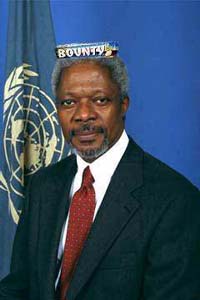
Ben Hammersley has put a bounty on Kofi Annan’s head.
Annan is an object of undeserved worship, and the way to treat objects of undeserved worship is to blow raspberries at them. This Bounty Bar makes a fine raspberry. I make that three incompatible metaphors. Salutations to Photoshop, and to Normblog for the link.
Kofi Annan has perfected the Holy Man style of public performance. He speaks very quietly, in that exquisitely enunciated African accent, and people just take if for granted that he is a Good Man and a Good Thing. But Per Ahlmark (linked to by Instapundit) shows him to be a less than perfect human being. He describes the inaction and treachery of the UN, as lead by Annan, in first promising, and then failing, to protect the Bosnian Muslims from the Serbs. But, he continues:
No one should be surprised by the UN’s inaction, because only the year before it had demonstrated utter incompetence in facing the fastest genocide in history – the slaughter of 800,000 Tutsis and moderate Hutus in Rwanda in just 100 days. UN forces in Rwanda in 1994 were Annan’s responsibility before and during the crisis.
Annan was alerted four months before Hutu activists began their mass killings by a fax message from Romeo Dallaire, the Canadian general commanding UN forces in Rwanda. Dallaire described in detail how the Hutus were planning “anti-Tutsi extermination”. He identified his source “a Hutu” and reported that arms were ready for the impending ethnic cleansing.
Dallaire requested permission to evacuate his informant and to seize the arms cache. Annan rejected both demands, proposing that Dallaire make the informant’s identity known to Rwandan president Juvenal Habyarimana, a Hutu, even though the informant had expressly named the president’s closest entourage as the authors of the genocide blueprint.
This is the man who is being seriously proposed as the next ruler of Iraq, because he would be an improvement.
Annan, Ahlmark makes clear, is an object of religious worship, a human repository of millenarian hopes, rather than a man who has earned the adoration he basks in.
A similar error of false adoration was made by the more elderly admirers of Kofi Annan, when younger, with that other African Holy Man of severe actual unholiness, Julius Nyerere. As with Nyerere, it is hard to tell what proportion of Annan’s catastrophic blunders to attribute to sheer stupidity, and how much to actual wickedness. I suspect a combination of the two in the form of a murderously stubborn stupidity, which combines intellectual mediocrity with an immoral unwillingness to admit to error, possibly all floating in the same delusions as those that engulf the minds of his worshippers, but perhaps caused by mere vanity.
Robert Mugabe is another such. Although, having a slightly more severe and steely public persona, he is more readily identified as the mass murderer that he is. He should have gone to RADA. At the very least he should lose the Hitler moustache.
The vision Kofi Annan personifies with such theatrical precision is that of a single, infinitely benign World State, which will cure all ills, correct all injustices, right all wrongs, and put down the mighty from their seats. Allelujah. Especially those horrid Americans. That this same man might be an ill, a perpetrator of injustice, a wrongdoer and far too mighty one, and that the vision he personifies might be a road to ruin of our entire species, starting with its poorest and most unfortunate, and that those ghastly Americans may in fact be energetically rescuing the human race from a great and self-sacrificial folly with no good purpose to it whatever, is a thought that is simply not bearable to the World Statists. So they caste it aside. Mere evidence has nothing to do with it. To cease from the worship of Kofi would mean changing their entire way of thinking and believing and feeling, and that they will not do, no matter how much blood soaks their altar.
David Renwick is scornful of the 52 diplomats who signed a letter denouncing Tony Blair’s Iraq policies, and is equally scornful of those who described this letter as a revolt by The Establishment:
The fact that the letter was not signed by a couple of hundred other former ambassadors, including this one, was thought scarcely worthy of mention.
So who were these signatories?
Many of the signatories were former Arabists in the Foreign Office, affectionately known as the Camel Corps. Some members of the Corps have shown a tendency over the years to develop a quite passionate attachment to the Arab world that, unfortunately, has not always been reciprocated by the Arabs. They have tended to concentrate on the crimes of the Israelis, rather than those of the Palestinians. Most of us would prefer to be more even-handed.
Stephen Pollard is even more scornful. He links to a piece by Andrew Roberts in the Times which says that whenever the Foreign Offices protests like this it tends to be wrong:
TONY BLAIR should be delighted that no fewer than 52 former diplomats have written to him to say that his Middle Eastern policy is “doomed to failure”. Whenever a collective view has developed in the Foreign and Commonwealth Office it has been only a matter of time – and usually not long, either – before it has been proved spectacularly wrong.
So the 52 are either wrong because they aren’t the majority view at the Foreign Office, or because they are. But either way, they are definitely wrong.
Pollard also links to Melanie Phillips, who is even more scornful. To her the Camel Corps is also “The Establishment”.
The main personal consequence for the 52 diplomats of having put their heads above the parapet like this has been to draw attention to all the financial interests they have which predispose them towards saying what they have said.
Personally, I am not surprised that people have financial interests in alignment with their opinions. Most of us prefer to make money doing things we believe in. And if these guys believe in making friends with Arabs … For me, the question is, not: Who paid them to say this? It is: Are they right?
Clearly a great deal of the anti-Americanism that now afflicts this world is stupid, malevolent, small-minded, cowardly, a mask behind which lurks Marxist or sub-Marxist cretinism, and generally ridiculous. But I want to suggest now that some of it may be rational, and even wise.
Consider the phenomenon of a classroom full of semi-unruly school children, who, when confronted with a new teacher, proceed to ‘test’ that teacher.
A common interpretation of such behaviour is that children “want” or “need” boundaries. That was not my experience. The fewer damn boundaries I faced when I was a child, the happier I was, and this was never more true than when I was stuck in a damn classroom, being made to attend to some stupid intellectual rigmarole that did not interest me or did confuse me or annoy me.
But what all children do want to know is simply, what kind of teacher is this? Like babies who find out how things are put together by trying to take them apart, children try to break a teacher, simply to find out what he is made of. If it turns out that he is indeed the sort of teacher who is going to put in place lots of those boundaries, well, this may be very bad news. But, whether they need such boundaries or not, most children want to know about them, so that they can then proceed with true assumptions in place in their minds about how things are going to be from now on, until this guys goes, and someone else shows up and there is another testing session.
Testing is even more necessary if a new teacher declares his desire to be nice, to allow freedom, to let children choose how they behave, what they will learn etc.. He will find himself being tested to destruction. Teachers get set upon like wounded deer being savaged by wolves.
Here the common explanation is that children behave like wolves because, basically, they are wolves.
Again, I dissent. A classroom full of children confronted by a new, liberal, nice, permissive teacher will, again, need to know where they truly stand with such a person. It is not that children do not like freedom, deciding what they will learn, how they will behave, etc. It is simply that children want very much to know, if such declarations are presented to them, whether they are in fact true, or just pious utopian drivel which will collapse in the face of the first serious challenge, or in the face of the first real decision made by a child which the permissive teacher actually does not approve of.
But there is another even more basic problem with permissive, nice teachers. The problem with a nice teacher is that there are other forces in play which threaten to destroy niceness besides nasty teachers who are only pretending to be nice. There are also the other nasties in the classroom, and a nice teacher is all too likely to be especiallyl bad at restraining these nasties. So why get your hopes up when Mr Nice Teacher makes his first nice speech? On the contrary, join the nasties and try to destroy him, again, to see what he is made of. If he then shows himself both willing and able to quell such a rebellion, good, then it looks like he might be trustworthy, a teacher whose protestations of niceness from now on might be worth betting on. If not, then best to find out now.
Here is a case where the children who are tempted to bet on the new regime do indeed need boundaries – boundaries to protect them.
There is nothing crueller for a child than having his hopes aroused, only to have them dashed by the feebleness of the very person who promised him all these wonders. Nothing is more cruel for a bottom-of-the-pecking-order child in a school to be presented with a utopian manifesto of niceness, to believe it, and then to find that actually it is not true.
Well, you can see where I am going with this, I am sure. To the point where I hardly need to spell it out. But I will anyway. → Continue reading: Anti-Americanism as teacher testing
International news agency Reuters reports that a van, containing Arabic language tapes and detonators, has been searched close to the scene of today’s mass murders in Spain. So far, the authorities have maintained that the atrocities were the handiwork of terror group ETA, but there could be a possibility that Islamo-fascists had a hand in this affair, possibly even to the point of directing the operations.
The truth is that no-one can be certain for sure, and we must be mindful about jumping to conclusions. But given Spain’s support for the U.S.-led liberation of Iraq, and Spain’s proximity to north Africa, there is a serious possibility that Islamists may have played a part in this.
There is also the worrying thought that terror groups, who have come under growing pressure from law enforcement agencies and the military since 9/11, are becoming more desperate and hence willing to co-operate with those they would have previously ignored.
If true, it makes the sneering article by Simon Jenkins in today’s Spectator, in which he mocks Blair’s concerns over global terror networks and their access to WMDs, not only wrongheaded, but frivolous in the extreme. London, Paris, Berlin or Rome could be next. Nothing to worry about eh, Simple Simon?
A black day for Spain. My heart goes out to the people of that wonderful country.
Reagan’s War: The Epic Story of His Forty Year Struggle and Final Triumph Over Communism
Peter Schweizer
Doubleday, 2002
“It’s surprising what you can accomplish when no one is concerned about who gets the credit.” This lettered sign stood on Reagan’s desk during his presidency and since it reflected his attitude, he cannot have worried much that his own part in the downfall of Communism has been seriously underestimated, a judgement which Peter Schweizer labours to correct in this book. For its theme, Reagan’s War, was the war against communism. By leaving out other aspects and events which did not touch on it – Israel, the Palestinians, the Lebanon, the Falklands, or the home economy – an exaggerated impression may have been given of Reagan’s singlemindedness. Even the inclusion of the assassination attempt, so nearly successful, is with an emphasis on Reagan’s belief that he had been preserved by God to conduct this war.
Reagan began political life as a Roosevelt-admiring Democrat. He had been aware of the attempt by communists to dominate and subvert the American film industry as early as 1946 and become involved in countering it, almost certainly sidetracking his career as a film star. The Korean War (1950-3) reinforced his attitude and, while still a Democrat he campaigned for Eisenhower, though disappointed later by his lukewarm anti-communism, and even less impressed by Nixon. This was also the time when anti-anti-communism became intellectually fashionable, Reagan encountering it when he was hired by General Electric to host and act in GE Theatre on television. Travelling round the country as the company’s roving ambassador to its plants and business contacts he was able to give speeches entirely based on his own views, unhampered by any kind of censorship. Schweizer distances Reagan from Senator McCarthy, who, he mentions, was initially supported by John F. Kennedy and never censured by him (p. 37). Reagan met Nancy Davis, who became his second wife (after his first wife Jane Wyman left and divorced him) through being asked to exonerate her of communist connections, apparently a case of mistaken identity. → Continue reading: “Reagan was the main author of the victory …”
Now that it seems Saddam Hussain may not in fact have any weapons of mass destruction, Dubya and Blair are being pilloried for having gone to war to oust that particular mass murderous fascist regime.
Sometime in the not too distant future, when it looks like war with North Korea’s mass murderous regime is inevitable, Dubya and Blair (or their successors) will be pilloried for threatening war because the North Koreans have weapons of mass destruction.
And it will be the same people doing the pillorying in both cases.
Perhaps the ‘idiotarian’ opposition to the US is over the top, a bit like suggesting that Pol Pot was better than Richard Nixon because Nixon taxed more people. But I offer three honest reasons (well, one is cowardly) for opposing British military intervention and occupation of Iraq:
- The British armed forces are not properly equipped. I did say so beforehand. Let me be clear: if the cause is just, but the equipment is not ready, kit up first, then go to war.
N.B. This is not an argument against US intervention in Iraq. I note approvingly that in the Second World War, the US federal government starting arming before launching assaults on Axis-occupied territories.
- This one will really not be popular on Samizdata.net… Suppose that it is not possible to defeat Islamic fundamentalism by force of arms – at least as far as the UK is concerned. A final ‘victory’ worldwide that follows half a dozen nuclear terrorist outrages in the UK and a racial war in most of the UK’s towns is not worth it. As far as the UK is concerned, it might be safer to appease and let others do the fighting. I think of Switzerland not declaring war with Germany over the treament of the Jews in 1941.
- To be a libertarian must include at least some reservations about using other people as ends for one’s own purpose. I do not have the right to force one person (A) to do something to another (B) that I think is moral, but that (A) did not wish to do, even though (B) may deserve it. This means among other things that I do not have the right to levy money by compulsory taxes in Yorkshire, to pay for my pet social-engineering experiments in Basra. I should add that the argument against compulsory aid for the disabled is the same.
In effect a libertarian who says it is fine to use tax-funded resources to liberate Bagdad from tyranny and economic ruin, and argue that it is not alright to use a fraction of the money to liberate a paraplegic from economic disadvantage, could be said to be inconsistent.
Failing to recognise the points I list above could lead to the following sorts of problems:
- A British soldier killed because he lent his body armour to a colleague. This sort of thing happened in the Crimean War with coats, right boots, blankets etc. In Kuwait the British troops got the nickname ‘the Borrowers’ from the US troops. I imagine that the French troops in the Crimean saw their British colleagues in much the same way.
- Consider this scenario: by the end of the ‘war on terrorism’ in 2015, France has not had a single nuclear terrorist strike, the US has had 20, the UK has had six and Spain, Italy and Poland one apiece. Who’s the idiot?
- In 2010 President of the EU Blair announces a “libertarian” programme of the Peace Corps: all 18 year olds will serve in a peace-keeping unit to promote the values of freedom around the world. The move is popular as it cuts youth unemployment in the EU from 45% to 40% and crime.
I repeat: removing Saddam Hussein is great. So why worry about all the lies or mistaken intelligence? It matters because we may be asked to believe another set of pretexts. It would be nice if the next lot were a bit more coherent and plausible. Of course it will be harder to persuade many people who swallowed the “45 minute” threat line of Tony Blair’s. Refusing to support a war just because Tony Blair says it is right does not make someone an idiot.
Instapundit links to this:
The capture by the United States of thousands of centrifuges on board a German-owned vessel, the BBC China, en route to Libya has raised suspicions in Washington and London that Col Gaddafi offered to abandon his weapons programme after threats from America, rather than the lengthy British and American diplomacy vaunted by Tony Blair.
Instapundit is pleased because this report says what he and lots of others have also said, that it was American military muscle and the threat of more of it, not merely polite requests to Col Gadaffi to be nicer from Blair or his fellow Europeans. Quite so. The idea that recent American military activity had nothing to do with Gaddafi’s change of heart is very far fetched.
But what irritates me is that Blair, the Telegraph, Instapundit, the lot of them, are all talking about “threats” and “diplomacy” as if these were two entirely different and opposite things, when in truth threats and diplomacy go hand in hand, and neither can work properly without the other.
Take this particular set of circumstances. How were those American threats communicated, if not through diplomatic channels, and how did Col Gaddafi signal his desire to comply with American wishes if not through that same diplomatic process? And did not the Americans then respond very diplomatically to the Colonel’s climbdown?
As for that non-American diplomacy which is imagined by some to have persuaded Gol Gaddafi to change his ways, well, this report illustrates that this too would have consisted of threats, diplomatically communicated and responded to, in this case the threat of not allowing such things as centrifuges to journey from China to Libya on ships controlled by those doing the threatening. An unwillingness to make any such threats would have rendered European diplomacy toothless, and hence ineffective. And that seems to be what happened.
But that is not my central point. All I here insist on is the true as opposed to sentimental and ignorant meaning of the word “diplomacy”. Diplomacy doesn’t mean being nice only. It also means being nasty, while explaining nicely – or perhaps not so nicely – what you want in exchange for being less nasty.
What does anyone think that diplomats actually say?
The cover article of the latest New Statesman is by William Dalrymple, and is called simply Islamophobia. The value of the piece for me is that it puts the case against the current trend of US (and UK) policy as strongly as I have ever read it. War is the health of the state, and it will bring ID cards and tougher searches at airports, blah blah. Maybe so, but that hardly amounts to the collapse of civilisation as we know it. This (this being the concluding paragraphs of Dalrymple’s piece), on the other hand, just might:
Meanwhile, Tony Blair’s neoconservative chums in Washington, immune to the justifiable fears of the Muslim world, talk blithely of moving on from Iraq next year to attack Iran and Syria. They have also invited Franklin Graham, the Christian evangelist who has branded Islam a “very wicked and evil” religion, to be the official speaker at the Pentagon’s annual service – and this immediately prior to his departure for Iraq to attempt to convert the people of Baghdad to Christianity.
All the while, the paranoia and bottled-up rage in the Muslim world grows more uncontrollable, and the attacks by Islamic militants gather pace, gaining ever wider global reach and sophistication. As long as British Muslims remain at the receiving end of our rampant Islamophobia, and remain excluded from the mainstream of British life, we can expect only still greater numbers of disenfranchised Muslims in the UK to turn their back on Britain and rally to the extremists.
As Jason Burke points out at the end of his excellent book Al-Qaeda, “The greatest weapon in the war on terrorism is the courage, decency, humour and integrity of the vast proportion of the world’s 1.2 billion Muslims. It is this that is restricting the spread of al-Qaeda, not the activities of counter-terrorism experts. Without it, we are lost. There is indeed a battle between the west and men like Bin Laden. But it is not a battle for global supremacy. It is a battle for hearts and minds. And it is a battle that we, and our allies in the Muslim world, are currently losing.”
This month’s upsurge of rampant Islamophobia in Britain, widely reported in Muslim countries, is the last thing we need in such a desperately volatile climate.
That “upsurge” is the Kilroy-Silk affair, and the surge of support that K-S received, in particular, from the readers of the Daily Express, together with the increasing number of attacks of British mosques there have been lately.
The point is this. More airport searches for us, or for that matter even that military ‘quagmire’ that the opponents of military action in Iraq have been earnestly predicting and for which some may even have been hoping, is as nothing – nothing – when set beside the danger that Dalrymple is describing. What he fears is a massive influx of intelligent, educated (much of it scientifically educated) talent into the ranks of the terrorists, as a result of the thrust of Western policy towards Islam in general, and in particular as a result of the inability of anti-Islamists to make any distinction between mere Muslims, and outright terrorists. Give a dog a bad name, in other words.
I don’t like Islam one little bit, because I consider its central tenets to be untrue, and I dislike untruth. (God does not exist. Muhammed is not his prophet. Etc.) I feel similarly about Christianity. (God does not exist. God did not send his son anywhere.) I further dislike Islam because so many Muslims these days, unlike most of the Christians I have much to do with, seem to take their religion really seriously and really to believe it to be true, which I find frightening. Who knows what the hell these people will deduce from their false axioms? It only takes a tiny few. (In the past it only took a tiny few Christians to set the tone of entire centuries.) So, yes, despite the fact that I am well aware of the fact – which of course it is – that the overwhelming majority of Muslims are entirely peaceable and decent and morally blameless people, and in millions upon millions of cases I dare say a lot better people than I am, I am “Islamophobic”. So, am I helping to push the world into a pit of barbarity, just by saying such things as I do earlier in this paragraph?
Setting aside entirely the moral rights and wrongs of the matter (i.e. am I entitled to put what I put in the previous paragraph?) is current US policy (and the attitudes of people like me that accompany it), as a matter of fact, having the effect on the overwhelming majority of hitherto non-terroristic Muslims that Dalrymple describes? Is George W. Bush making Al-Qaeda recruitment harder or easier than it would otherwise have been? Is GWB frightening the Muslim world into abjuring terrorism, or enraging it into taking it up big time? In short, are we winning the War on Terrorism, or losing it?
If people want to comment on that by veering off into the realms of the related but utterly distinct matter of whether we are morally or intellectually or politically entitled to be rude to Muslims, or whether they started it, or which is worse, our Islamophobia or their anti-Semitism and anti-Great-Satanism – they should obviously feel free. I can’t stop such comments. But the great strategic question is surely: whether, as a matter of fact, people like William Dalrymple are right or wrong.
My tentative opinion has always been – i.e. since 9/11 – that whereas some Muslims are no doubt being enraged into terrorism by US policy, many more are being scared away from it. But am I right?
Yesterday’s Guardian contained an article that is an interesting sign of the times.
Says the subheading:
The ‘war on terror’ is being used as cover for a sustained assault on the independence and progressive agenda of NGOs, says Abigail Fielding-Smith
It may seem like a cheap joke to go on about what a perfect name that is for the piece: Abigail Fielding-Smith. Abigail. The hyphen. But I think this name is more than just a joke, because what is happening here is that an entire Ruling Class that was, which was quietly but firmly taking over the world, with no muss and no fuss, is being rudely challenged by a new Ruling Class that is: America!!!
The horror.
The so-called “war on terror” is radically reformulating many aspects of world politics, not least the international nongovernmental organisation (NGO) sector.
“War on terror”. So uncouth, unnuanced and confrontational.
Broadly defined as not-for-profit, autonomous organisations working in the global public interest, NGOs play a pivotal role in international society. They have a strong advocacy voice in intergovernmental politics and are viewed by some as the “third sector” (after intergovernmental bodies and corporations) of international society. Kofi Annan calls them “the conscience of the world”.
Northern governments respected the NGOs’ flexibility, commitment and capacity to respond to (and prevent) international crises in a way that the interstate system could not. Consequently, the proportion of aid budgets given to intergovernmental organisations such as the UN decreased during this period, while funding for NGOs rose steadily. International NGOs now receive one-quarter of the average northern government’s total aid budget; the French government gives them nearly half.
Abigail Hyphen Stroke Money was quietly taking over the world, in other words.
But now those infuriatingly heroic Arabs with their hijacked airplanes have really upset the apple cart, haven’t they? They’ve only gone and got the Americans seriously interested in the big wide world out there. And instead of just paying for them in the old style, the Americans have started trampling all over the shins of the NGOs. With the result that those ghastly Arab resistance heroes, never inclined to make very many fine distinctions, now make no distinction at all between the Great Satan and the Lesser Satans of Oxfam, the Red Cross, and the rest of them.
In Iraq, many NGOs have tried to distance themselves from coalition governments by refusing to accept their money. The attack on the neutral ICRC in Baghdad on October 27 demonstrated the futility of this attempt. As Alistair Dutton, emergencies officer for Cafod, explained: “If our government is the occupying power and we are distributing food, where is the distinction between those who wage war and those who distribute humanitarian goods? Politicians have chosen to coin the phrase ‘humanitarian war’ and they have therefore co-opted us, arguably.”
Distinctions are further blurred in Iraq by the unprecedented use of for-profit organisations in the reconstruction operation.
Those vulgar Americans. Not content with having a “war”, they also want to do trade everywhere.
It gets worse:
Another source of pressure on NGOs’ independence is the political environment of the “war on terror”. While the threat of terrorism is real and important, there is no international agreement on what it is. The concern in the NGO community, particularly in the US, is that the taint of terrorism may be used to discredit the work of politically dissenting international NGOs, or even to stop their funding.
The piece concludes:
Many of these trends existed before September 11. But the “war on terror” has created an acute need for NGOs’ international expertise while at the same time providing justification for glossing over or rooting out their progressive political agenda. At a time when it is needed most, “the conscience of the world” looks vulnerable.
The NGOs are still in business, but they’ve been demoted. They used to be in charge, but now they are only taking orders. It must be very galling.
This posting is about what is happening and about what Abigail Fielding-Smith thinks about it, and it may well be that the lady doth protest too much, and that actually the NGOs are not really being permanently stopped from becoming a new global Civil Service, and that they are merely having to duck and weave a little. But I must tell you that, insofar as what Fielding-Smith says is actually happening, Brian Hyphen Micklethwait (and I do have some hyphenage in my ancestry and quite a few people of the Fielding-Smith persuasion among my cousins) is cautiously optimistic about this trend.
Which is just one more irony. When it comes to her final intentions for the world, Fielding-Smith is a rabid statist, with her as the state. Yet meanwhile, she regrets the decline of “Non-Governmental” organisations. I’m leary of the state, usually, but when the US State barges in on the NGOs, I am, for the time being, delighted. My only worry is: is it really happening? Here’s hoping.
|
Who Are We? The Samizdata people are a bunch of sinister and heavily armed globalist illuminati who seek to infect the entire world with the values of personal liberty and several property. Amongst our many crimes is a sense of humour and the intermittent use of British spelling.
We are also a varied group made up of social individualists, classical liberals, whigs, libertarians, extropians, futurists, ‘Porcupines’, Karl Popper fetishists, recovering neo-conservatives, crazed Ayn Rand worshipers, over-caffeinated Virginia Postrel devotees, witty Frédéric Bastiat wannabes, cypherpunks, minarchists, kritarchists and wild-eyed anarcho-capitalists from Britain, North America, Australia and Europe.
|